What is the healthiest building material?
There is no single healthiest building material for every home. The best choice depends on the full assembly, indoor air goals, moisture control, fire exposure, and long-term durability. Earth'smart powered by tect prioritizes systems that work together, including non-combustible materials, durable wall and roof assemblies, fresh filtered air, and environmental controls that reduce risk while supporting healthier indoor living.
What makes a home non-toxic and healthy?
A healthy home is designed around indoor air quality, moisture management, material safety, ventilation, filtration, and long-term durability. Earth'smart powered by tect looks beyond individual products and coordinates the full structure, envelope, and mechanical systems so materials, air systems, and assemblies support comfort, resilience, and reduced exposure to avoidable pollutants.
How does earth'smart powered by tect help reduce wildfire risk?
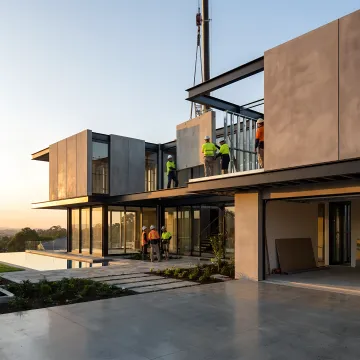
tect’s approach uses fire-resistive exterior wall systems, non-combustible materials and assemblies, long-life roofing, coordinated site planning, and optional on-site water and suppression strategies. These decisions are made early with architecture, engineering, and manufacturer input, helping the home perform more reliably in Wildland-Urban Interface and other high-risk fire areas.
Can healthy home construction also improve insurance outcomes?
tect’s services are designed to materially reduce risk through resilient assemblies, non-combustible materials, integrated suppression planning, and coordinated system performance. While insurance decisions remain with carriers and underwriters, a better-documented, better-engineered home can support risk reduction conversations by showing how fire, flood, earthquake, and lifecycle concerns were addressed.
What is included in Earth'smart™ Turnkey Delivery?
Earth'smart™ Turnkey Delivery aligns architecture, engineering, construction, permit strategy, manufacturer input, and system coordination from concept through construction. The goal is to make critical decisions early, correctly, and without friction, resulting in a home that is safer, healthier, more durable, and built to perform across structure, systems, and envelope.
Do you only work on wildfire rebuilds?
Earth'smart powered by tect is especially focused on homeowners rebuilding after wildfire, homeowners in the Wildland-Urban Interface, and families in high-risk fire areas. However, the same principles—healthier materials, resilient systems, long-life assemblies, and early expert coordination—are valuable for any homeowner seeking a safer, more durable, lower-maintenance home.
How early should earth'smart powered by tect be involved in a project?
tect should ideally be involved at the concept stage, before major design, budget, structural, material, and permitting decisions are finalized. Early involvement allows the team to coordinate architects, engineers, manufacturers, and construction strategy, preventing rework and ensuring that health, resilience, energy, and durability goals are built into the project from the start.
What budget range is typical for this service?
tect’s intake process recognizes several estimated budget ranges, including under $2M, $2M–$5M, and over $5M. Because these are complex, high-performance homes, the right budget depends on site conditions, scope, materials, systems, resilience requirements, permitting needs, and the level of turnkey coordination required.