Introduction
The homes lost in the 2025 Palisades Fire weren't simply unlucky. Many were architecturally unprepared — built with wide overhanging eaves, open soffits, wood shake roofs, and standard vents that acted as ember collectors. The fire didn't find weaknesses by chance. Those weaknesses were designed in.
Fire-resilient architecture isn't a checklist you apply at the end of a project. It's a set of integrated decisions made early — about building geometry, materials, openings, and the landscape surrounding the structure — that together determine whether a home survives or burns.
This article covers:
- How wildfires actually ignite homes
- Which building forms and materials reduce risk most effectively
- How defensible space functions as a designed fire buffer
- Why exceeding code is the real standard for homes built to last in wildfire-prone areas
Key Takeaways
- Embers start most wildfire home ignitions — building form and openings determine how vulnerable yours is
- Roof material, wall cladding, glazing, and vent covers carry the highest fire-resilience impact
- Zone 0 — a 0–5 ft noncombustible buffer around the foundation — cuts ignition risk in half, per IBHS
- WUI homes should exceed California CBC Chapter 7A — code minimum isn't enough
- The decisions that determine fire resilience are made at design — not during construction
How Wildfires Actually Ignite Homes
Understanding ignition mechanics is the foundation of fire-resilient design. There are three pathways:
- Flying embers (firebrands) — Wind carries burning debris far ahead of the fire front, landing on and around structures
- Direct flame contact — Vegetation or adjacent structures ignite and burn against the building
- Radiant heat — Intense heat from a nearby fire can fail windows and ignite combustible surfaces without direct contact
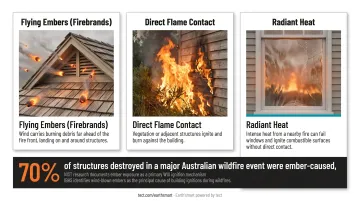
Embers are the dominant threat. NIST research documents ember exposure as a primary WUI ignition mechanism, with one study finding 70% of destroyed structures in a major Australian wildfire event were ember-caused. IBHS identifies wind-blown embers as the principal cause of building ignitions during wildfires.
Where Embers Enter
The home's most dangerous vulnerabilities are its gaps. NIST confirms that indoor ignitions commonly occur when embers enter through openings like attic vents and eaves, then ignite combustible interior contents. Other high-risk zones:
- Gutters holding dry debris (vinyl gutters can ignite and spread fire to adjacent wall framing)
- Roof valleys accumulating organic matter
- Open soffits creating sheltered ignition surfaces
- Foundation vents and any unsealed wall penetrations
The Radiant Heat Problem
Direct flame isn't required to fail a window. Single-pane glass breaks at heat flux levels between 8–20 kW/m², according to NIST. Once a window fails, the home's interior — filled with highly combustible furnishings — becomes directly accessible to the fire. UL FSRI testing found that 37 of 40 assemblies using plain glass on the back pane failed completely, compared to only 12 of 40 when the back pane was tempered glass.
Glazing decisions determine whether a home holds or opens up during a wildfire.
Fire-Resilient Building Form: Shape Matters as Much as Materials
Even the best materials fail when the building's geometry works against them. Form determines where embers land, where they accumulate, and whether they find a path inside.
Rooflines and Ember Traps
Complex rooflines — multiple intersecting planes, deep valleys, wide overhanging eaves — create physical collection points for embers and windblown debris.
UC ANR's Fire Network identifies roof-wall intersections, edges, skylights, vents, and complex roof forms as primary debris accumulation points where ignited material can expose roof coverings or siding.
Simpler rooflines with minimal horizontal surfaces and fewer intersecting planes reduce this risk. When roof complexity is unavoidable, valley and intersection detailing becomes critical — those are the zones where ember management needs to be engineered in from the start.
Vents and Openings
Attic vents and foundation vents are among the most common ember entry points. IBHS's Wildfire Prepared Home (WPH) standard requires vents tested to ASTM E2886 or covered with noncombustible, corrosion-resistant 1/8-inch mesh. Generic window screen material doesn't meet this standard.
Strategic vent placement matters too — locating vents on the leeward side (away from prevailing wildfire winds) reduces direct ember exposure.
Decks, Garage Doors, and Envelope Continuity
Decks are not landscape features — they're part of the building envelope. IBHS research documents ember ignition on deck surfaces (particularly redwood) and flame impingement from below. The correct design response:
- Non-combustible or ignition-resistant decking materials
- Closed or metal-mesh undersides to eliminate sheltered combustion zones beneath the structure
- No combustible storage under or adjacent to deck framing
Garage doors and wall-to-roof junctions deserve the same scrutiny. Gaps at the roofline, poorly sealed wall penetrations, and standard (non-fire-rated) garage doors all create entry points for heat and embers. Fire resilience requires continuity across the entire building envelope — a single weak point undermines every other component.
Building separation between the primary structure, garages, and accessory dwelling units can function as a designed firebreak. IBHS wildfire model ordinances reference minimum distances of around 30 ft for accessory structures — spacing is a structural mitigation decision, one that belongs in the design process, not just the zoning review.
Fire-Resistant Materials: Roof, Walls, Windows, and Openings
Material selection is where design decisions translate into measurable performance differences across all three ignition types.
Roofing
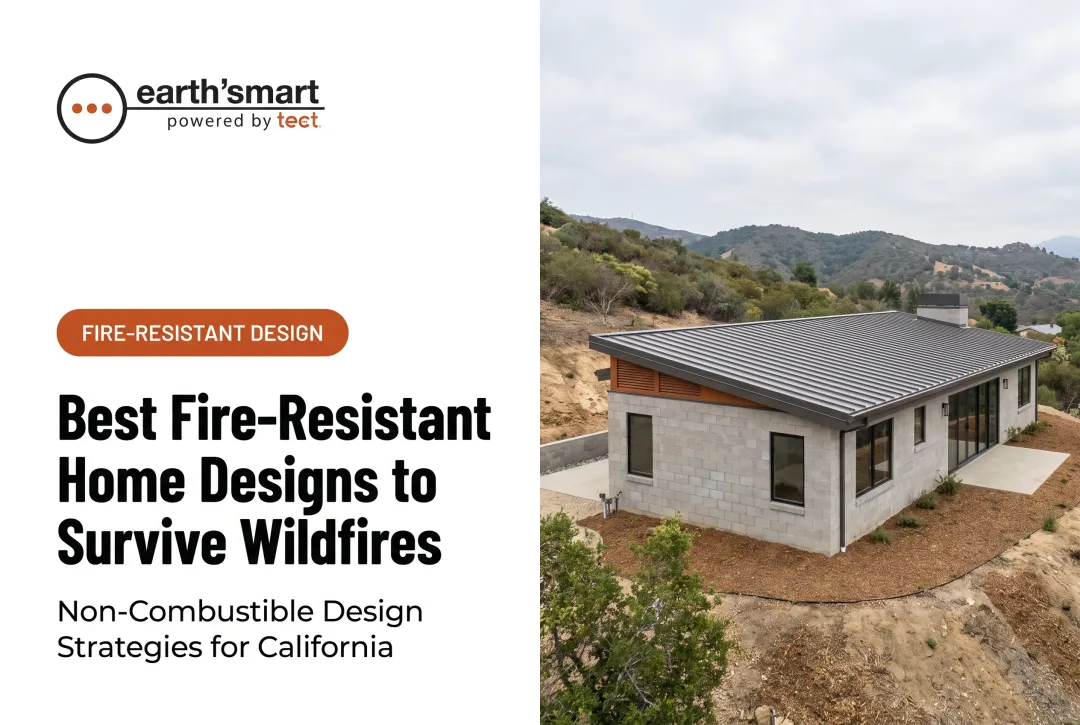
The roof is the largest horizontal surface exposed to ember fall. CBC Chapter 7A requires roof assemblies in Fire Hazard Severity Zones to meet Class A classification under ASTM E108 or UL 790, the highest fire resistance rating for roof coverings.
| Material | Class A Rating | Notes |
|---|---|---|
| Standing seam metal | Yes | Non-combustible, long-life |
| Clay or concrete tile | Yes | Non-combustible, durable |
| Slate | Yes | Non-combustible |
| Wood shake/shingle | Restricted | Prohibited by WPH; restricted in CBC 7A |
| Standard asphalt | Varies | Class A versions exist; verify for FHSZ |
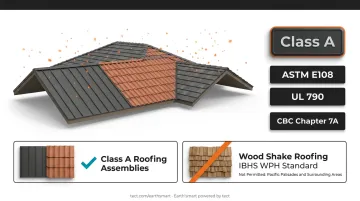
Wood shake roofing is prohibited under the IBHS WPH standard and severely restricted under CBC Chapter 7A. In the Pacific Palisades and surrounding areas, it shouldn't be on the options list.
Walls and Cladding
The roof isn't the only surface under threat. NIST research confirms that fire-resistant cladding — stucco, fiber cement, and cementitious board — resists radiant heat exposures around 15 kW/m². Combustible wood siding fails at these levels, resulting in local ignition and potential structure loss.
Earth'smart powered by tect's Earth'smart™ approach takes this further, specifying exterior wall systems built on pre-insulated concrete masonry. Unlike standard wood-frame construction, concrete masonry doesn't combust, doesn't warp under heat, and holds structural integrity at the envelope level — a key factor in supporting the firm's 100+ year performance target.
Windows and Glazing
Once the wall assembly is addressed, glazing becomes the next critical vulnerability. UL FSRI data shows the difference is significant: for fire-exposed elevations, the design standard is:
- Dual-pane or triple-pane tempered glass — tempered fire-side panes showed median failure heat flux above 45 kW/m² versus above 20 kW/m² for plain glass
- Aluminum frames over vinyl — aluminum maintains structural integrity under heat conditions; vinyl softens and deforms
- Frame-to-wall interface sealing: gaps around window frames create ember entry paths even when the glazing itself holds
Soffits, Insulation, and Interior Protection
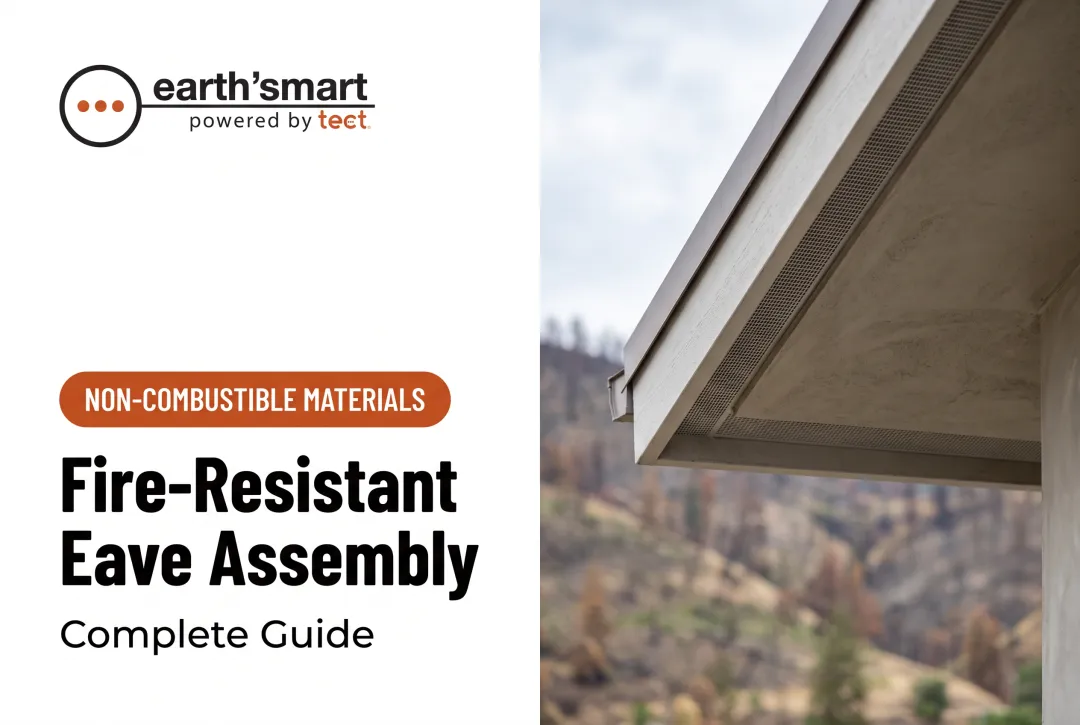
If eaves must be included for design reasons, non-combustible soffit materials with fully enclosed construction are required. Open-void soffits act as ember traps and should be eliminated where possible.
Mineral wool insulation is a fire-resistant alternative to fiberglass batts. Fiberglass melts at approximately 1,300°F; mineral wool remains stable up to around 2,150°F, slowing fire progression through wall assemblies when the exterior is breached.
Interior fire sprinkler systems provide the critical last line of defense. California Residential Code Section R313.2 requires automatic fire sprinkler systems in new one- and two-family dwellings, with exceptions for alterations to existing unsprinklered buildings. Taken together, these layered choices — from roof class to wall assembly to interior suppression — are what separate a home that survives from one that doesn't.
Defensible Space: Designing the Property Around the Home
Defensible space is a designed, layered fire buffer — not a landscaping afterthought. Treating its zones as landscape design standards from the start of a project changes what's possible during a fire event.
The Three Zones
| Zone | Distance | Primary requirement |
|---|---|---|
| Zone 0 | 0–5 ft | Fully noncombustible surface materials |
| Zone 1 | 5–30 ft | Lean, clean, fire-resistant planting with spacing |
| Zone 2 | 30–100 ft | Reduced fuels, no ladder vegetation |
Zone 0: The Most Critical Intervention
Zone 0 — the 0–5 ft perimeter immediately around the foundation — is where Cal Fire focuses first, and where the evidence is clearest. IBHS research published in 2025 found that an ember-resistant buffer in this zone cuts a home's wildfire ignition risk in half.
Zone 0 requirements under the IBHS Wildfire Prepared Home standard:
- No plants, wood mulch, or combustible groundcover within 5 ft of exterior walls and attachments
- Gravel, concrete, stone, or other noncombustible surface materials only
- No combustible stored materials (firewood, furniture, planters)
The WPH standard explicitly permits irrigation systems and automated sprinklers within Zone 0, extending the zone's protective function during dry conditions.
Zones 1 and 2: Managed Fuel Reduction
Beyond Zone 0, plant selection and spacing become the primary tools:
Zone 1 calls for fire-resistant, low-resin plant species with spacing that prevents fire laddering from ground to shrub to canopy. Hardscape features — gravel paths, stone patios, concrete driveways — do double duty as designed firebreaks.
Zone 2 shifts focus to eliminating continuous fuel pathways between vegetation and the structure. Tree limbs should be cleared from the ground up to remove the ladder effect that lets surface fires climb into the canopy.
Beyond Code: Designing for 100-Year Performance
Why Code Compliance Isn't the Target
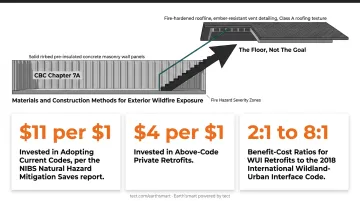
California's CBC Chapter 7A — Materials and Construction Methods for Exterior Wildfire Exposure — is among the most stringent WUI building codes in the country. It establishes the minimum. For homes in Fire Hazard Severity Zones, meeting it is the floor, not the goal.
The financial case for exceeding code is well-documented. The NIBS Natural Hazard Mitigation Saves report found returns of $11 per $1 invested in adopting current codes and $4 per $1 for above-code private retrofits. WUI retrofits to the 2018 International Wildland-Urban Interface Code showed benefit-cost ratios of 2:1 to 8:1. The avoided cost of rebuilding and the compounding savings on insurance premiums make the upfront premium for fire-resilient construction a straightforward economic decision.
The Insurance Reality
The insurance market in California is already pricing for risk at the building component level. State Farm's nonrenewal of approximately 72,000 residential policies in March 2024 following wildfire losses signals a market recalibrating around structural vulnerability. The California FAIR Plan — the insurer of last resort — now provides residential coverage limits up to $3M, but it represents a failure of conventional insurability, not a solution.
Homes built to exceed code, with verifiable fire-resistant assemblies, are better positioned for today's market. The IBHS Wildfire Prepared Home designation provides a structured framework — WPH Base and WPH Plus — that documents fire-resilient features in a format insurers can evaluate. Whether it produces direct premium reductions depends on the carrier; the documentation and risk reduction are the transferable assets.
How Integrated Design Changes Outcomes
That documentation starts at the design stage — the decisions made there determine whether a home's fire-resilient features hold up under real conditions or get stripped out before the first wall goes up.
Earth'smart powered by tect brings architecture, engineering, and construction together from concept, with direct input from building product manufacturers through the earth'smart powered by tectApp™ community of 70+ manufacturers. That alignment changes what's buildable. In a standard fragmented project, fire-resilient assemblies get cut because the people specifying them and the people building them aren't working from the same plan. Systems like pre-insulated concrete masonry walls, non-combustible material specifications, and integrated on-site fire suppression — including vapor dome technology and dedicated water supply — require every discipline coordinated from the start.
When those decisions are made early and together, the result isn't a home that meets code with fire-resistant features layered on. Fire resilience is built into the structure from the first drawing, and the home performs that way for the next hundred years.
Frequently Asked Questions
What's the difference between a fire-rated and a fire-resistant home?
A fire rating is a code-defined performance standard for a specific assembly — a wall, roof, or door tested under controlled conditions. A fire-resistant home applies integrated decisions about building form, materials, and siting to reduce the probability of ignition and structural failure during an actual wildfire.
What building forms are most dangerous in wildfire-prone areas?
Complex rooflines, wide overhanging eaves, open soffits, and recessed nooks are the highest-risk features because they trap embers and create sheltered ignition zones where firebrands can smolder undetected. Simpler geometry with fewer horizontal collection surfaces meaningfully reduces this risk.
What are the best roofing materials for high fire-risk zones?
Non-combustible Class A materials — metal standing seam, concrete tile, clay tile, and slate — are the standard for high fire-risk zones. Wood shake roofing is prohibited under the IBHS Wildfire Prepared Home standard and severely restricted under California CBC Chapter 7A.
What is Zone 0 landscaping and why is it now considered essential?
Zone 0 is the 0–5 ft noncombustible buffer immediately surrounding a structure's foundation, requiring gravel, stone, or concrete groundcover and no combustible materials. IBHS research shows it cuts wildfire ignition risk in half by eliminating the most direct ember-to-structure pathway.
Does fire-resilient design cost significantly more than standard construction?
Individual upgrades — roofing, cladding, glazing — carry modest cost premiums. The NIBS Mitigation Saves report documents returns of $4 per $1 spent on above-code design, and reduced insurance premiums compound those savings over time.
What California code applies to homes rebuilt in fire hazard severity zones?
California Building Code Chapter 7A applies to new construction and rebuilds in Fire Hazard Severity Zones and Wildland-Urban Interface areas. For properties affected by the 2025 Palisades Fire, applicability should be confirmed parcel-by-parcel through LADBS. LA's EO1 Guidelines require current Title 24 compliance but don't uniformly specify Chapter 7A for all parcels.