This is especially true for homeowners in California's Wildland-Urban Interface (WUI), where the January 2025 Palisades Fire demonstrated exactly what happens when municipal systems face demands they weren't designed to handle. LADWP reported that extreme firefighting demand caused pressure loss that hindered refilling water tanks and affected higher-elevation hydrants — even though regional water supply remained intact.
This guide is written for homeowners planning new construction, rebuilding after wildfire, or upgrading an existing home's fire protection — particularly those in WUI areas where getting water supply right from the start is non-negotiable. It covers types of water sources, flow and pressure requirements, NFPA code standards, the dedicated-vs-shared supply question, and how geography affects planning decisions.
Key Takeaways
- A compliant water supply must meet minimum flow rate, pressure, and duration requirements — not just be "connected to water"
- The four primary sources are municipal mains, onsite storage tanks, private wells with pumps, and combined/redundant systems
- NFPA 13D governs single-family homes; NFPA 13R covers low-rise residential; NFPA 13 applies to commercial occupancies
- NFPA 13D requires sustained flow for the two most demanding sprinkler heads for at least 10 minutes (or 7 minutes in qualifying one-story homes under 2,000 sq ft)
- WUI homes need water supply designed beyond code minimums; municipal pressure routinely fails during the fires it's meant to fight
What "Water Supply" Really Means for a Fire Sprinkler System
Having water available and having a code-compliant water supply are two different things. A garden hose tap has water. It cannot sustain the flow rate and pressure a sprinkler system demands. This distinction catches many homeowners off guard when they assume their existing domestic line is automatically sufficient.
A compliant water supply consists of three measurable components working together:
- Flow rate (GPM): The volume of water the system can deliver per minute under operating conditions
- Residual pressure (psi): The pressure at the system connection point while water is flowing — not the static reading when nothing is running
- Duration (minutes): How long the system must sustain that flow and pressure to control a fire
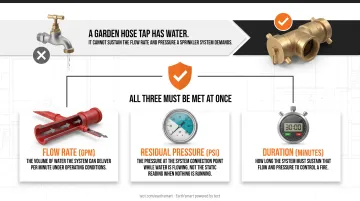
High pressure with insufficient flow rate is just as problematic as high flow with pressure that drops below minimum thresholds — all three must be met at once.
How the Supply Chain Works
Water moves from source → main control valve → backflow preventer → riser → distribution piping → sprinkler heads. A weak link anywhere in that chain compromises the whole system.
This is why hydraulic calculations — required under NFPA 13 — are performed before system design is finalized, not after. The calculation models the entire water path from source to the most hydraulically demanding sprinkler heads, accounting for pipe friction, elevation changes, fittings, and meter losses.
NFSA guidance notes that even a standard 5/8-inch domestic meter can cause an 18 psi pressure loss at 26 GPM — enough loss to disqualify a shared domestic connection in many designs.
Hydraulic calculations shape the design from the start. If the available supply is insufficient, they identify what needs to change: a larger pipe, a dedicated pump, or an alternative source.
Types of Water Supply Sources for Fire Sprinkler Systems
Municipal Water Mains
The most common source for urban and suburban residential systems. A fire flow test — conducted by the local water utility or a licensed engineer — measures available flow and residual pressure at the property connection point.
Municipal supply is generally reliable, but it has real limitations:
- Aging infrastructure in some areas limits available pressure
- Low-pressure zones (typically upper-elevation lots) may fall below design thresholds
- During large wildfire events, simultaneous firefighting demand can cause system-wide pressure drops
The Palisades Fire example is instructive here. CNRA's analysis noted the problem wasn't a lack of water in the regional system — it was that flow rate couldn't keep up with demand, and pressure collapsed as a result.
Gravity Tanks
Elevated storage tanks that use height to generate pressure. The math is straightforward: water exerts 0.433 psi per foot of elevation. A tank 50 feet above the system connection delivers roughly 21 psi before any friction losses.
Gravity tanks require no pump to operate, making them reliable during power outages. They must, however, hold sufficient volume for the required duration and be properly maintained.
Pressure Tanks
Sealed vessels pressurized with compressed air or nitrogen. They deliver immediate pressure but carry limited water volume, making them more appropriate as a supplemental or booster source than a standalone primary supply for most residential systems.
Fire Pumps Connected to a Source
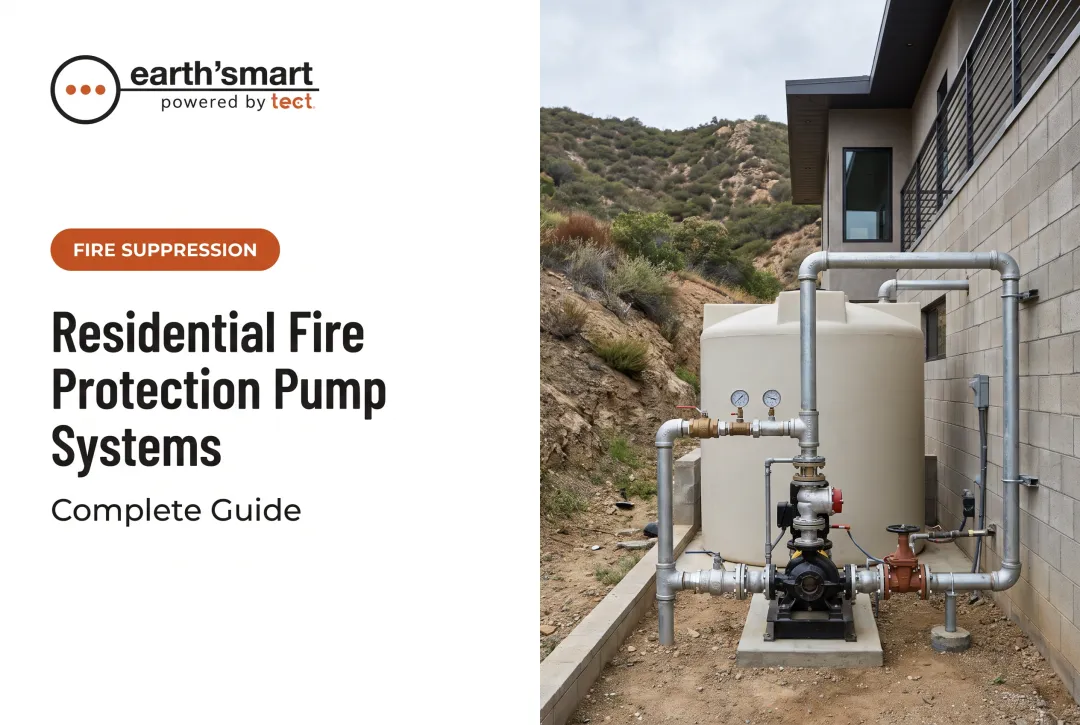
When a well, storage tank, pond, or low-pressure main can't meet pressure requirements on its own, a fire pump makes up the difference. For NFPA 13R systems, pumps must comply with NFPA 20 (the standard governing stationary fire protection pumps).
NFPA 13D systems for one- and two-family homes follow a different path — NFPA 13D includes its own pump installation requirements (including a 240V pump installed at least 1.5 inches above the floor) without requiring full NFPA 20 compliance.
Fire pumps also introduce ongoing obligations: most manufacturers require annual flow testing and inspection, and an undetected pump failure can leave the system unable to perform when it matters most.
Combined and Redundant Systems
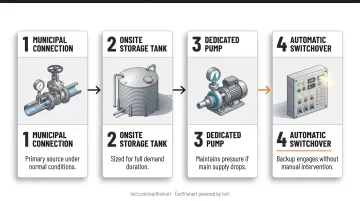
In high-risk areas, engineers specify multiple sources working together. WUI homes are particularly exposed: municipal pressure can collapse during a wildfire event precisely when the system needs to activate. A layered supply strategy addresses this directly:
- Municipal connection as the primary source under normal conditions
- Onsite storage tank sized for the full demand duration
- Dedicated pump to maintain pressure if the main supply drops
- Automatic switchover logic so the backup engages without manual intervention
Key Water Supply Requirements: Flow Rate, Pressure, and Duration
Flow Rate
Under NFPA 13D, the system is designed around the two most hydraulically demanding sprinkler heads operating simultaneously. A typical design flow runs approximately 13 GPM per sprinkler, or 26 GPM total for a standard residential system. The Home Fire Sprinkler Coalition cites up to 40 GPM for one or two operating sprinklers under NFPA 13D.
The actual flow requirement depends on the listed sprinkler's demand at design pressure — not a generic number. Designers use the manufacturer's listed performance data, not rules of thumb.
Residual Pressure
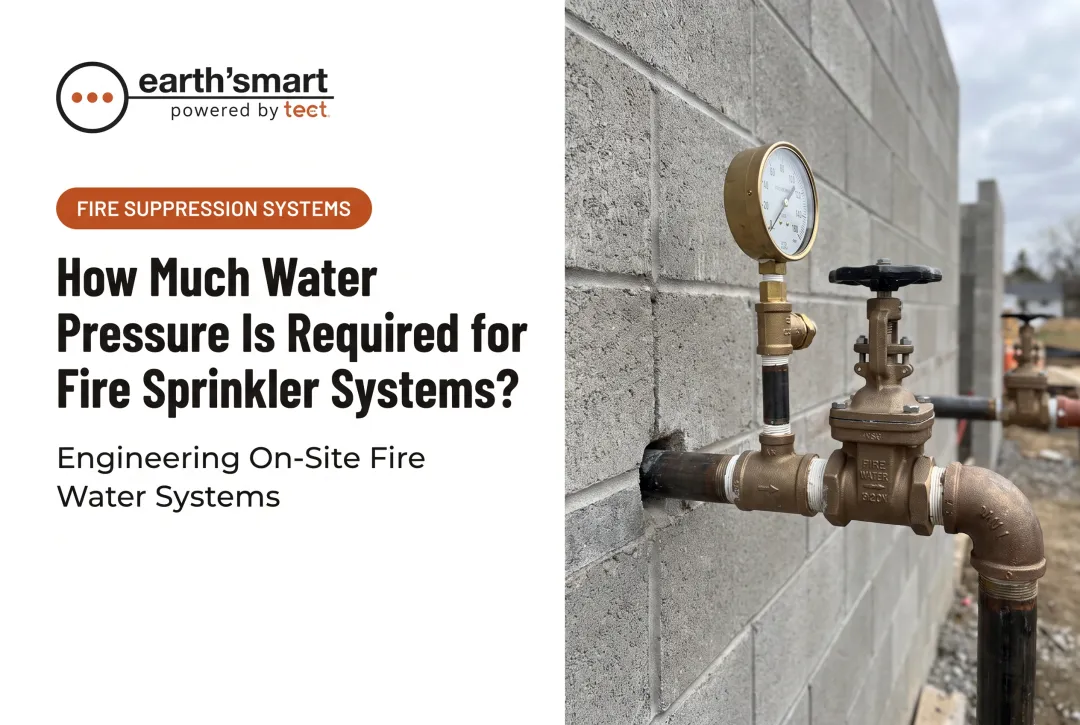
The minimum operating pressure for a residential sprinkler head is 7 psi at the sprinkler itself — or the pressure required to achieve the sprinkler's listed minimum flow, whichever is higher. This is not the same as the pressure at the meter or the service connection.
By the time you account for elevation losses, meter friction, pipe friction, and fittings, the required pressure at the point of connection is noticeably higher. Key distinctions to keep in mind:
- Static pressure (no water running) tells you almost nothing useful for design
- Residual pressure under flow is what the hydraulic calculation must satisfy
- Losses from elevation, meter, pipe, and fittings all reduce available pressure at the sprinkler
Duration
| Standard | Occupancy | Required Duration |
|---|---|---|
| NFPA 13D | One- and two-family homes | 10 minutes (7 min for one-story homes under 2,000 sq ft) |
| NFPA 13R | Low-rise residential | 30 minutes |
| NFPA 13 | Commercial/light hazard | 30 minutes minimum |
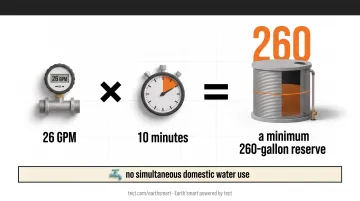
Duration directly determines minimum tank volume when onsite storage is used. A system demanding 26 GPM for 10 minutes requires a minimum 260-gallon reserve — and that assumes no simultaneous domestic water use.
Water Quality
Contaminants from private wells or untreated surface sources can clog sprinkler heads, corrode pipe interiors, and compromise valve operation — problems that may not surface until a fire event.
Before finalizing system design for any well-sourced supply, test water quality for sediment, mineral content, microbiological activity, and corrosive properties. If results fall outside acceptable ranges, filtration or chemical treatment must be part of the system design — not an afterthought.
NFPA Code Requirements for Fire Sprinkler Water Supply
Three standards govern residential fire sprinkler water supply, and which one applies depends on the building type:
- NFPA 13D (2025): One- and two-family dwellings and manufactured homes. The least demanding standard, reflecting residential occupancy risk profiles. Requires two-head simultaneous flow for a minimum of 10 minutes (with a 7-minute exception under Section 6.1.3 for qualifying one-story homes).
- NFPA 13R (2025): Low-rise residential occupancies up to four stories. More demanding than 13D — requires 30-minute duration, and pumps/tanks must comply with NFPA 20/NFPA 22.
- NFPA 13 (2025): The commercial/industrial standard for larger buildings and higher-risk occupancies — including high-rises and assembly spaces. Minimum 30-minute duration for residential/light-hazard cases under Section 19.3.1.6.
Most single-family homes fall under NFPA 13D, but local amendments can impose stricter flow rates, longer durations, or onsite storage requirements the base standard doesn't require.
The AHJ's Role
The Authority Having Jurisdiction — typically the local fire marshal, building department, or water authority — is the final decision-maker on whether a proposed water supply meets code. Two California examples illustrate how much local requirements can diverge from state minimums:
- Redlands, CA: Requires a minimum 1-inch water meter for NFPA 13D systems, plus onsite storage for at least the full 10-minute demand
- Palo Alto, CA: Under higher firefighting hazard conditions, requires a four-head sprinkler calculation — which can substantially increase flow and storage requirements compared to the standard two-head 13D design basis
Engage the AHJ before design begins — local requirements can reshape your entire water supply strategy, and discovering that after the design is complete is an expensive problem to fix.
Dedicated vs. Shared Water Supply for Residential Systems
NFPA 13D explicitly permits a combined domestic and fire sprinkler connection — one service line serving both household use and the sprinkler system. This is a commonly used, code-compliant approach in residential construction.
Whether it actually works depends on the hydraulics:
- The domestic service line must be large enough to deliver required sprinkler flow while domestic fixtures are in use
- The hydraulic calculation must account for simultaneous domestic demand
- Meter friction losses must be included — a standard 5/8-inch meter can consume 18 psi at typical 13D flow rates
A dedicated supply makes more sense when:
- Municipal pressure is marginal or inconsistent
- The home is large, with higher flow demands
- The property is in a WUI area where supply reliability is a real concern
- The local AHJ requires it regardless of what NFPA 13D permits
Some jurisdictions impose dedicated supply requirements that go beyond NFPA 13D's permissiveness. In high-hazard WUI areas, this is increasingly common — because a shared line that meets code under normal conditions may fall short during an actual fire event, when demand is highest and reliability matters most.
Water Supply Planning for Homes in High-Risk Fire Zones
The core problem with WUI fire events is timing. A wildfire that threatens your home creates the same firefighting demand across your entire neighborhood simultaneously. Municipal systems face extraordinary pressure drawdown from hydrant use, aerial drops, and structure defense at the same time.
The Palisades Fire showed this in real time. Regional water supply was intact. Local pressure still collapsed under demand. For a home depending on municipal supply for sprinkler performance, that's a critical failure scenario.
Supply Strategies for WUI Homes
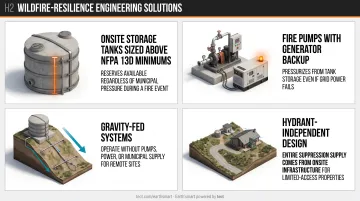
Homes in high-risk zones need to plan beyond code minimums:
- Onsite storage tanks sized above NFPA 13D duration minimums, keeping reserves available regardless of municipal pressure during a fire event
- Fire pumps with generator backup, so the system can pressurize from tank storage even if grid power fails
- Gravity-fed systems that operate without pumps, power, or municipal supply — particularly valuable for remote and rural sites
- Hydrant-independent design, where the entire sprinkler and suppression water supply comes from onsite infrastructure, critical for WUI properties at the end of long private roads with limited fire department access
The Planning Window
Water supply infrastructure decisions (pipe sizing, tank placement, pump room location) must be made during the design and permitting phase. Revisiting them during framing or after the foundation is poured turns straightforward decisions into expensive redesigns.
Tank placement affects site grading, structural loads, and landscape planning. Pump rooms need space, ventilation, and electrical service. Pipe routing must be coordinated with mechanical, structural, and architectural layouts.
Earth'smart powered by tect's Earth'smart™ Path A Turnkey Delivery model is built around exactly this problem. Fire systems engineering, architecture, structural decisions, and manufacturer input come together from concept through construction — not as separate workstreams that collide late in the process.
Earth'smart powered by tect's earth'smart powered by tectApp™ manufacturer ecosystem includes partners who specialize in dedicated onsite fire water supply infrastructure: tanks, pumps, and distribution systems sized for fire-event response. Those partners are engaged during design, not during construction administration.
The on-site water supply is also coordinated with site-scale suppression systems (vapor dome perimeter protection, FIREBOZZ® water cannons) so the entire fire response strategy is engineered as an integrated system, not assembled from disconnected components. SMARTVALVE® technology is incorporated to deliver 15–25%+ day-to-day water savings while keeping fire-event reserves intact.
Homeowners rebuilding in Pacific Palisades, the North Bay, East Bay Hills, Lake Tahoe, or any California WUI zone who engage this level of coordination early avoid the costly consequences of treating water supply as a last-minute detail — including code-compliance failures that require construction rollbacks.
Frequently Asked Questions
What is the water supply for a fire sprinkler system?
The water supply is the source and delivery infrastructure — piping, valves, and a pump if needed — that delivers water at sufficient pressure, flow rate, and volume to activate and sustain the sprinkler system during a fire. Water availability alone doesn't satisfy code — delivery must meet calculated performance requirements under live fire conditions.
What is the NFPA code for fire sprinkler water supply?
Three standards apply: NFPA 13D (one- and two-family homes), NFPA 13R (low-rise residential up to four stories), and NFPA 13 (commercial/full standard). For most homeowners, NFPA 13D is the relevant standard — it specifies minimum flow duration and sprinkler head demand requirements for single-family dwellings.
Do residential fire sprinkler systems need a dedicated water supply?
Not necessarily. NFPA 13D allows a combined domestic and fire sprinkler connection under the right conditions — the service line must be properly sized and the hydraulic calculation must confirm adequacy. A dedicated supply may be required depending on pressure, pipe size, and local AHJ requirements.
What water pressure is needed for a residential fire sprinkler system?
The minimum operating pressure is 7 psi at the sprinkler head (or the listed pressure needed to achieve required flow). The required pressure at the service connection will be higher once you account for elevation, meter friction, and pipe losses. There is no single fixed number — it's determined by hydraulic calculation for each specific system.
Can a well or storage tank supply a residential fire sprinkler system?
Yes. Both are viable under NFPA 13D, provided the well or tank can deliver required flow and pressure for the minimum duration — typically 10 minutes for a standard single-family home. A fire pump is usually required to meet pressure requirements when drawing from a tank or low-yield well; water quality testing is also required before design is finalized.