Introduction
When rebuilding or constructing a home in a wildfire-prone area, the roof is not a cosmetic decision. Homes in the Wildland-Urban Interface (WUI) face ember storms, radiant heat, and direct flame exposure, and the roof is among the most vulnerable surfaces on the structure.
TPO (thermoplastic polyolefin) roofing has become one of the most widely specified single-ply membranes for low-slope and flat-roof applications in residential construction.
For homeowners in fire-risk zones, the critical question isn't just what TPO is. It's whether it qualifies for Class A fire protection, what that actually means structurally, and when that rating applies.
This guide answers all three. You'll find a breakdown of what TPO is made of, how fire ratings work under UL 790 and ASTM E108, whether TPO can earn a Class A designation, and what to verify before specifying a TPO system on a WUI structure.
Key Takeaways
- TPO is a single-ply thermoplastic membrane for flat and low-slope roofs, available in 45, 60, and 80 mil thicknesses
- Class A is an assembly rating — the full system (membrane, insulation, deck) must be UL-listed together, not the membrane alone
- TPO can achieve Class A when fire-retardant chemicals are incorporated during manufacturing and the assembly is tested and listed
- Class A roofing is required by code in WUI zones and recognized under California's Safer from Wildfires framework for insurance purposes
- In high-heat, high-UV environments like Southern California, membrane quality, thickness, and manufacturer track record are critical selection factors
What Is TPO Roofing?
TPO is a single-ply roofing membrane made from a blend of polypropylene and ethylene-propylene rubber chemically bonded, reinforced with a polyester scrim. It's designed primarily for low-slope and flat roofs, where it functions as the primary waterproofing and weather barrier layer.
Physical Form and Specifications
TPO comes in sheet rolls, 5 to 12 feet wide and 100 feet long. Standard thicknesses are 45 mil, 60 mil, and 80 mil (one mil equals 0.001 inches). White is the dominant color, a deliberate choice tied directly to its reflective performance (covered later in this guide).
Membrane quality is governed by ASTM D6878, the standard specification for thermoplastic polyolefin-based sheet roofing. It sets minimum requirements for:
- Thickness over the reinforcement scrim
- Sheet tearing and breaking strength
- Heat aging resistance
- Weather resistance
This standard gives buyers a baseline for comparing products across manufacturers — though it governs membrane properties, not fire ratings.
History and Market Context
TPO membranes became commercially available in the U.S. in the early 1990s, initially as a lower-cost alternative to PVC single-ply systems. Significant market volumes followed in the late 1990s. According to a 2019 industry report, the global TPO roofing membrane market was projected to reach $2.2 billion by 2024, with North America representing the largest regional market.
TPO vs. EPDM and PVC
That growth reflects a broader shift in the single-ply membrane market, where three materials compete for the same low-slope applications:
- EPDM: rubber-based, typically black, with a long track record in commercial roofing
- PVC: thermoplastic with excellent chemical and UV resistance, but at a higher cost
- TPO: thermoplastic and white/reflective, positioned between EPDM and PVC on both cost and durability
Manufacturers position TPO as cost-competitive with PVC, offering comparable weather resistance and membrane longevity at a lower price point. Both EPDM and TPO can achieve Class A fire ratings through tested assemblies.
Understanding Roofing Fire Ratings: Class A, B, and C
Roofing fire ratings are not assigned to membranes or shingles in isolation. They're assigned to roof assemblies — the complete system of deck, insulation, cover board, and surface material — tested under UL 790 or the equivalent ASTM E108 standard.
The Three Tests That Determine Your Rating
ICC-ES describes the ASTM E108 fire tests for roof coverings as requiring three distinct exposures, all of which must be passed to earn a classification:
- Spread-of-flame test — measures how far fire travels across the roof surface under standardized conditions
- Intermittent flame test — simulates repeated, cycling flame exposure to the roof
- Burning brand test — replicates wind-driven embers landing on the roof surface, the most relevant scenario for wildfire events
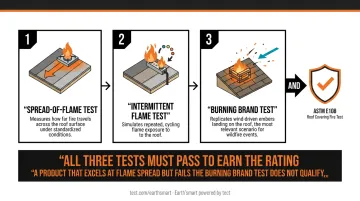
All three must be passed — a product that aces flame spread but fails the burning brand test does not earn the rating.
Class A, B, and C Defined
| Rating | Protection Level | Typical WUI Acceptability |
|---|---|---|
| Class A | Highest — severe fire exposure resistance | Required by code in most WUI jurisdictions |
| Class B | Moderate fire resistance | Not accepted in most WUI building codes |
| Class C | Light fire resistance | Not accepted in WUI zones |
According to NRCA, Class A signifies the most fire-resistant roof coverings, with Classes B and C denoting progressively less fire resistance.
Why This Matters Beyond Code
California's Department of Insurance includes a Class A fire-rated roof as a required structure-hardening action under the Safer from Wildfires framework, which ties mitigation actions to insurer recognition in rate filings and discount eligibility. In high-risk fire zones, a roof without a Class A assembly rating can disqualify a homeowner from insurer discounts or recognition programs entirely.
Is TPO Roofing Class A?
TPO can achieve a Class A fire rating — but it's not automatic. The rating depends on how the entire roof assembly is specified and installed.
How TPO Earns Class A
Fire-retardant chemicals are built into the TPO membrane during manufacturing. When paired with the right insulation, cover board, and deck configuration, the assembly can pass all three ASTM E108 tests. GAF's UL Evaluation Report confirms EverGuard TPO membranes qualify for mechanically fastened and fully adhered Class A roof assemblies in tested configurations.
The Critical Nuance: Assembly Rating, Not Membrane Rating
A TPO membrane alone does not confer Class A status on any installation. Class A is an assembly rating. The combination of:
- Membrane type and thickness
- Insulation type and thickness
- Cover board (if applicable)
- Attachment method
- Deck type
All of these components must be tested and listed together by UL before the assembly qualifies.
What to Verify Before Specifying
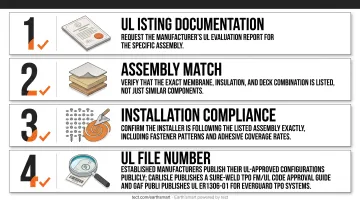
When specifying a Class A TPO system, confirm these four things:
- UL listing documentation — request the manufacturer's UL Evaluation Report for the specific assembly
- Assembly match: verify that the exact membrane, insulation, and deck combination is listed, not just similar components
- Installation compliance — confirm the installer is following the listed assembly exactly, including fastener patterns and adhesive coverage rates
- UL file number — established manufacturers publish their UL-approved configurations publicly; Carlisle publishes a Sure-Weld TPO FM/UL Code Approval Guide and GAF publishes UL ER1306-01 for EverGuard TPO systems
Types of TPO Roofing Systems
TPO is installed using three primary methods, each suited to different project conditions, wind uplift requirements, and budgets.
Mechanically Attached
The mechanically attached method fastens the membrane to the roof deck using screws and plates at sheet edges. Overlapping sheets are then heat-welded to cover the fasteners. It's the most common installation method: cost-effective and less sensitive to temperature during installation. It's also the method most associated with earlier-generation performance concerns, particularly with 45 mil membranes on older systems.
Fully Adhered
With fully adhered installation, bonding adhesive is applied to the cover board or insulation and the membrane is secured across its entire underside. This distributes wind uplift pressure across the full roof field rather than concentrating it at fastener points, enabling stronger uplift ratings. Wider sheets with fewer seams are practical under this method.
Induction Welded
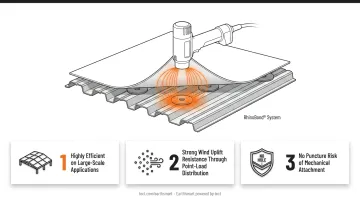
Induction welded systems — such as the RhinoBond® system — use electromagnetic induction to fuse the membrane to specially coated fastener plates below, without penetrating the membrane surface. It's highly efficient on large-scale applications and provides strong wind uplift resistance through point-load distribution, without the puncture risks of mechanical attachment.
| Installation Method | Cost | Wind Uplift Strength | Best For |
|---|---|---|---|
| Mechanically Attached | Lower | Moderate | Standard commercial/residential projects |
| Fully Adhered | Higher | High | High-wind zones, large field areas |
| Induction Welded | Moderate–High | High | Large-scale, low-penetration applications |
TPO Roofing: Key Advantages and Limitations
Advantages
White TPO membranes are listed in the EPA's ENERGY STAR roof product database, and CRRC-rated products qualify for California Title 24 cool-roof compliance. GAF's EverGuard TPO reports an initial SRI of 101 and a 3-year aged SRI of 92 — well above the LEED Heat Island Reduction threshold of 82 initial / 64 aged SRI for low-slope roofs. That "cool roof" performance reduces cooling loads in hot climates and can contribute to LEED credits.
Hot-air welded seams are also a real strength of the system. According to SPRI, a properly executed 1.5-inch weld becomes stronger than the adjacent field membrane — the seam is not where failures originate.
Warranty coverage has extended considerably. Carlisle offers fully adhered systems with 25- and 30-year warranties; GAF lists EverGuard Extreme TPO 80 mil at 35-year material warranty terms — though these are manufacturer-specific and system-dependent.
TPO's performance record is strong — but not without caveats.
Limitations
TPO entered commercial use in the early 1990s, and formulations vary considerably between manufacturers. IIBEC has cited MRCA's advisory on localized high-heat issues, noting that elevated temperatures correlate with premature aging. Some manufacturer warranties exclude in-place temperatures above 160°F. Vet manufacturer track records carefully — not just price.
Published SRI values reflect clean, new membrane surfaces. Real-world reflectivity depends on dirt accumulation, climate conditions, and maintenance frequency. A white roof that's gone grey from airborne particulates isn't performing at its rated reflectance.
TPO Roofing in Wildfire-Prone and High-Risk Areas
The Roof's Role in Wildfire Survival
IBHS research identifies ember exposure as the greatest danger to structures during wildfire events. NIST's WUI fire spread research confirms that embers, radiant heat, and direct flame contact are all active ignition pathways — with embers often the first. The roof surface, edge details, and penetrations are all potential entry points.
For flat or low-slope structures in WUI zones, a Class A-listed TPO assembly is a defensible starting point — but only when the full assembly is specified, detailed, and installed per the UL listing.
Southern California Conditions Demand More Attention to Specification
High UV intensity, sustained heat, and thermal cycling in climates like Pacific Palisades place real stress on roofing membranes over time. IIBEC's technical advisory noted that most performance issues observed by members involved mechanically attached 45 mil membranes from earlier-generation products that were six or more years old.
That's not a universal rule, but it does suggest that membrane selection, thickness, and manufacturer quality matter more in extreme environments. Thicker, higher-specification membranes may be appropriate on a project-by-project basis, guided by warranty terms and manufacturer recommendations.
The Roof Is One Component of a Resilient Building Envelope
A Class A TPO assembly is not a complete wildfire strategy on its own. For homeowners rebuilding in Pacific Palisades or other WUI zones, the roof works within a larger system that includes:
- Fire-rated wall assemblies
- Non-combustible materials throughout
- Ember-resistant vents
- Fire-rated glazing
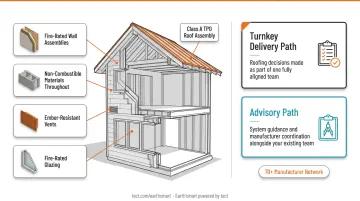
Getting that system right requires coordination from the start. Earth'smart powered by tect integrates roofing selection with every other building envelope decision at the earliest design phase, building homes engineered to perform for 100+ years. Through the earth'smart powered by tectApp™ community of 70+ building product manufacturers, the right expertise is in place before specifications are written.
Under the turnkey delivery path, roofing decisions are made as part of a fully aligned team rather than as an isolated contractor choice. Under the advisory path, earth'smart powered by tect provides system guidance and manufacturer coordination to strengthen outcomes even when working alongside an existing team.
The Class A designation delivers its full protective value as part of an integrated system. Specifying it in isolation, without coordinating the full assembly, leaves meaningful performance on the table.
Frequently Asked Questions
Is TPO roofing Class A?
Yes, TPO can be part of a Class A roof assembly when fire-retardant chemicals are incorporated during manufacturing and the full system — membrane, insulation, cover board, and deck — is tested and UL-listed together. The membrane alone doesn't carry the rating; the complete assembly does.
What is a Class A or B roof covering?
Class A and B are fire resistance ratings assigned under UL 790 or ASTM E108 testing. Class A is the highest level — indicating resistance to severe fire exposure, including burning brand penetration — while Class B offers moderate protection. Most WUI building codes and California's fire-prone jurisdictions require Class A.
What are the types of TPO roofing?
The three main installation methods are mechanically attached (fastened at sheet edges, then welded), fully adhered (bonded across the full membrane surface), and induction welded (fused to coated plates below the membrane without surface penetration). Each suits different wind uplift requirements, project scales, and budgets.
How long does TPO roofing last?
TPO typically performs for 15–20 years. When properly installed as a manufacturer-specified system and maintained, 25–30 year warranties are available from major manufacturers including Carlisle, GAF, and Johns Manville.
Is TPO roofing a good choice for fire-prone or WUI areas?
For flat or low-slope structures, TPO is viable when specified as a complete, UL-listed Class A assembly. In high-heat, high-UV environments like Southern California, the assembly listing — not just the membrane brand — is what determines whether the roof meets WUI code and insurance requirements.