In high-risk areas — particularly those prone to wildfire, earthquakes, or flooding — the stakes are higher. A home that "passes inspection" is not the same as a home built to perform for decades. The difference often comes down to whether a structural engineer was involved, and when.
This article explains what a residential structural engineer actually does, the specific situations that genuinely require one, and why bringing one in early is one of the most financially sound decisions a homeowner can make.
Key Takeaways
- A residential structural engineer designs and verifies your home's load-bearing systems — foundations, beams, walls, and roof framing — to meet safety, stability, and code requirements
- Hire one before major renovations, additions, load-bearing wall removals, new builds, or when visible warning signs appear
- Skipping structural input leads to permit failures, costly rework, and structural problems that escalate into full structural failures
- Bringing a structural engineer in early typically costs 5–10% of what mid-construction corrections run
- In WUI, seismic, and flood zones, structural engineering determines whether your home survives the next event — not just passes inspection
What Is a Residential Structural Engineer?
A residential structural engineer is a licensed professional who analyzes, designs, and verifies the structural systems of a home. Their scope covers foundations, beams, columns, load-bearing walls, and roof framing — everything that determines whether a home stands safely under the forces it will face throughout its life.
This role is distinct from other professionals homeowners typically hire:
- Home inspectors perform a visual, noninvasive examination of existing conditions. California law defines a home inspection specifically as identifying material defects through observation — not engineering analysis
- Architects design layout, function, and aesthetics, coordinating the overall building design
- Structural engineers calculate whether the physical structure can safely carry its loads — now and over time — and produce the stamped plans and calculations required for permits
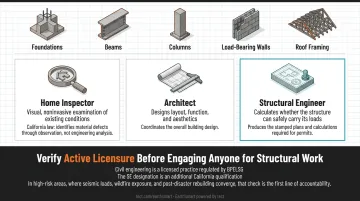
In California, civil engineering is a licensed practice regulated by BPELSG. The SE designation (Structural Engineer) is an additional California qualification granted to licensed civil engineers who meet further requirements. For homeowners, the practical takeaway is straightforward: verify active licensure before engaging anyone for structural work. In high-risk areas — where seismic loads, wildfire exposure, and post-disaster rebuilding demands converge — that licensure check isn't a formality. It's the first line of accountability.
When Do You Need a Residential Structural Engineer?
Structural engineering provides the most value before decisions are made, not after problems surface. Several situations consistently call for professional structural input.
New Builds and Wildfire Rebuilds
For new construction, the structural engineer designs the skeleton of the home: foundation system, framing, load paths, and lateral systems. They work alongside the architect to ensure the design is buildable and structurally sound, not just visually compelling.
For homeowners rebuilding after wildfire, the need is more acute. LA County's Eaton and Palisades Fire rebuild submittal requirements explicitly require architectural and structural plans, including foundation and framing information, with engineering calculations required for nonconventional construction (designs that go beyond standard prescriptive framing), covering both vertical and lateral analysis.
Structural decisions made at the design stage directly affect how a rebuilt home performs against future fire, seismic, and wind events. Earth'smart powered by tect's integrated approach — connecting architecture, engineering, and construction into one coordinated team from concept through construction — is built around this reality.
In Wildland-Urban Interface environments, where California's Chapter 7A governs exterior wildfire-exposure construction, structural engineering decisions don't happen in isolation. They interact with envelope design, material selection, and mechanical systems from the start.
Major Renovations, Additions, and Load-Bearing Wall Removals
Any project that changes how loads move through a structure requires engineering input. This includes:
- Adding a second story or expanding a home's footprint
- Building an accessory dwelling unit (ADU)
- Removing interior walls to open floor plans
- Installing large openings or span modifications
Removing a load-bearing wall without engineered plans is one of the most common and costly structural mistakes in residential renovation. Without proper beam sizing and support design, the entire floor or roof structure above can be compromised — often in ways that aren't visible until significant damage has occurred.
Visible Warning Signs
Certain conditions warrant an immediate structural assessment, regardless of project plans:
- Large or growing cracks in walls or foundation — especially horizontal cracks or stair-step patterns in masonry
- Bowing basement or retaining walls
- Sagging or noticeably uneven floors
- Gaps forming between walls and ceilings
- Doors or windows that suddenly stick or no longer latch properly
- Foundation cracking or damage (flagged specifically by the California Seismic Safety Commission as a structural risk indicator)
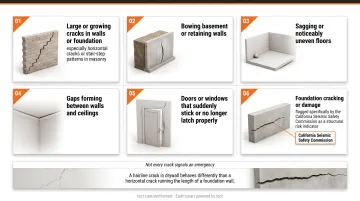
Not every crack signals an emergency. A hairline crack in drywall behaves differently than a horizontal crack running the length of a foundation wall. A structural engineer can tell the difference — and catching a symptomatic crack early typically means a targeted repair rather than a full foundation intervention.
Before Purchasing a Home
A standard home inspector will identify visible deficiencies but is not trained to diagnose structural root causes. If a property shows red flags — older construction, visible foundation movement, signs of settlement — a structural engineer assessment before purchase provides the analysis needed to make an informed decision. This matters most for homes in seismic zones or areas with expansive soils, where movement and settlement risks are elevated.
Why Hiring a Residential Structural Engineer Is Worth It
The value of a structural engineer is often underestimated because the work prevents failures that never visibly occur. Here's where that value actually shows up.
Safety and Code Compliance
A structural engineer's core function is ensuring your home safely carries the loads imposed on it — gravity, wind, snow, seismic activity, and occupant use — through calculations and documentation, not guesswork.
Building codes set minimum standards. In high-risk areas, a home that meets minimum code may still fail under extreme conditions. The 2026 CDI study on the Los Angeles wildfires found that homes with key hardening features and defensible space survived at nearly 50%, compared with 20% for homes with no mitigation — a meaningful performance gap that starts with structural and envelope design decisions.
Structural engineering that targets performance rather than mere compliance produces meaningfully different outcomes for homeowner safety and long-term habitability.
Early Error Prevention and Cost Control
Design errors caught on paper require a redline and a recalculation. The same error discovered after framing is built requires demolition, re-engineering, delay, and significant expense.
Direct rework costs range from 2.4% to 12.4% of a project's contract value, with poor data and miscommunication driving nearly half of all rework in U.S. construction. Structural coordination failures fall squarely into this category:
- Undersized beams specified without load verification
- Foundations not designed for actual on-site soil conditions
- Load paths left unconfirmed before framing begins
- Material and system decisions deferred until mid-construction
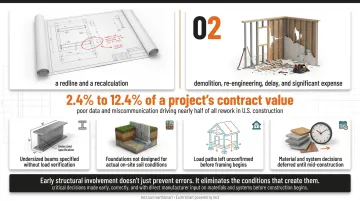
Early structural involvement doesn't just prevent errors. It eliminates the conditions that create them. Earth'smart powered by tect addresses this directly: critical decisions made early, correctly, and with direct manufacturer input on materials and systems before construction begins.
Long-Term Property Value and Resilience
A structurally engineered home carries documented proof of sound construction — engineered drawings, stamped calculations, code-compliant designs. That documentation matters:
- For buyers: Engineered homes carry transparent proof of structural adequacy
- For insurers: California's Safer from Wildfires program confirms that every listed mitigation action qualifies for an insurance discount
- For long-term costs: A 2025 IBHS/Headwaters study found that adding Wildfire Prepared Home Plus resilience to a mid-range Altadena rebuild cost only $15,000 more than traditional code construction — a modest premium for materially better performance
For homeowners in wildfire, earthquake, or flood-prone zones, structural engineering that goes beyond minimum code reduces long-term risk in ways that affect insurance coverage availability, maintenance costs, and the home's ability to perform when conditions are worst.
What Happens When You Skip Structural Engineering?
Skipping structural engineering doesn't just create problems later — it creates problems immediately, at every stage:
- Permits get rejected or require costly revisions — LA County's fire rebuild submittal requirements make clear that missing structural documentation disqualifies an application before plan check even begins
- Contractors make structural decisions outside their licensed scope — structural design falls outside what California's CSLB licenses contractors to do; when that line gets crossed, liability follows the homeowner
- Load-bearing changes without engineering create long-term structural movement — undersized beams, redistributed loads, and foundations sized for the wrong soil conditions don't stabilize over time; the damage spreads to adjacent systems
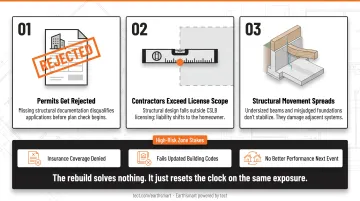
For homeowners rebuilding in high-risk zones, the stakes are higher. A home rebuilt without proper structural engineering can be denied insurance coverage, will likely fail updated building codes for the risk zone, and won't perform any better in the next fire or seismic event than the one it replaced. The rebuild solves nothing — it just resets the clock on the same exposure.
How to Choose the Right Residential Structural Engineer
Start with licensing. In California, a residential structural engineer must hold an active civil engineering (PE) or structural engineer (SE) license. Verify this directly through BPELSG's license lookup before any work begins — no exceptions.
Residential experience is not interchangeable with commercial. An engineer who specializes in large commercial structures may not be the right fit for single-family residential work. Look for a portfolio that includes renovations, additions, WUI projects, or foundation work comparable to your scope.
The right engineer asks questions, flags issues early, and works with your architect and contractor as a teammate — not a stamp-and-submit service. For homeowners in high-risk or WUI environments, this matters even more: look for engineers who understand integrated system performance, with structure, envelope, and mechanical systems working together.
Earth'smart powered by tect's coordinated model is built on this principle: architecture, engineering, and construction aligned from the start, with manufacturer input on materials and systems before decisions are locked in.
Always get a written proposal. A qualified engineer will outline deliverables, timeline, site visit expectations, and fees in writing. Compare proposals carefully — the least expensive option may not include construction-phase support or permit coordination, which is where problems get caught before they become change orders.
Frequently Asked Questions
What does a residential structural engineer do?
A residential structural engineer assesses, designs, and verifies the structural systems of a home — foundations, beams, load-bearing walls, and roof framing — to ensure the home is safe, stable, and code-compliant. They produce the stamped plans and calculations required for building permits and construction.
How much does it cost to hire a residential structural engineer?
Costs vary by scope. A basic inspection or structural assessment typically runs $350–$800, while full structural design for a renovation or new build can range from $2,000 to $8,500 or more. Request a detailed written proposal to understand what's included before committing.
When should you hire a residential structural engineer?
The best time is before structural decisions are made — ideally at the start of a project, not after problems appear. Common triggers include new builds, additions touching load-bearing elements, visible warning signs (cracks, sagging, shifting), and pre-purchase evaluations on homes with structural concerns.
Do I need a structural engineer or an architect?
Architects design layout, aesthetics, and function; structural engineers verify the physical structure can safely support those designs. Most major projects benefit from both. In many cases, a structural engineer is legally required for permit approval even when an architect is already on the team.
Can a contractor handle structural changes without an engineer?
No. Contractors are skilled at building, but only a licensed structural engineer is qualified (and legally authorized) to design structural systems and provide the stamped calculations required for permits. Relying on a contractor for structural decisions puts both the permit approval and the occupants at risk.
Is a structural engineer required when rebuilding after a wildfire?
In most California jurisdictions, yes, particularly in high-risk fire zones. LA County's Eaton and Palisades Fire rebuild requirements explicitly require structural plans, with engineering calculations required for nonconventional construction. Beyond compliance, engineering ensures the rebuilt home is designed to outperform what was lost — not simply replicate it.
Conclusion
A residential structural engineer is not a bureaucratic formality. They are the professional who determines whether your home is actually safe, whether your renovation will hold, and whether your investment is protected.
Bringing the engineer in early — before design decisions are locked — is where the real value accumulates. Waiting until a problem surfaces, or until a permit gets flagged, means costs have already grown and options have already narrowed.
For homeowners rebuilding in fire, seismic, or flood-prone environments, structural engineering isn't a cost to manage down. It's a prerequisite for a home that performs under the conditions it will actually face. Firms like tect build this coordination in from the start — connecting structural decisions to fire-resistive assemblies, system integration, and construction execution so nothing is resolved after the fact.