Introduction
Walk past a modern precast concrete home and something registers before you can explain it — the cleanness of the planes, the weight of the walls, the sense that this building isn't going anywhere. Then the assumption kicks in: concrete means cold, industrial, brutalist.
It's a fair association, and it's wrong.
Precast concrete has been rethought for residential use. Panels are formed off-site in factory conditions, transported, and assembled with a precision that site-poured work rarely matches. The result is a material that holds up structurally, manages heat effectively, and ages well — while supporting design approaches that range from warmly minimal to boldly sculptural.
This article covers what precast concrete homes actually are and why they outperform wood-frame construction in high-risk environments. It also walks through real design examples organized by approach and what homeowners should think through before pursuing one.
Key Takeaways
- Precast panels are fabricated off-site under controlled factory conditions, delivering structural consistency that on-site pours can't always match
- Modern precast homes span a wide aesthetic range — exposed concrete, mixed wood and glass, textured surfaces, and everything between
- Concrete is noncombustible and holds up against fire, wind, moisture, and seismic loading — well suited for high-risk sites
- Upfront costs exceed wood framing, though lifecycle savings in energy, maintenance, and insurance often close the gap
- Precast demands complete design and engineering resolution before fabrication; changes after that point are expensive
What Is a Precast Concrete Home?
Precast concrete construction means structural panels, wall sections, and floor systems are formed and cured at an off-site manufacturing facility, then transported to the site and erected by crane. This distinguishes precast from two other concrete approaches:
- Poured-in-place: custom formwork is built on site, concrete is cast there, and cured in place — more geometrically flexible, but dependent on field conditions
- ICF (Insulated Concrete Forms): foam forms assembled on site, then filled with concrete — strong thermal performance, more accessible labor requirements
What Factory Production Actually Delivers
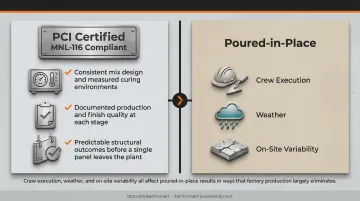
PCI plant certification requires producers to operate under audited quality-control systems, including compliance with PCI's MNL-116 manual for structural precast and architectural precast certification standards. That means:
- Consistent mix design and measured curing environments
- Documented production and finish quality at each stage
- Predictable structural outcomes before a single panel leaves the plant
Those quality controls matter most when compared to field conditions. Crew execution, weather, and on-site variability all affect poured-in-place results in ways that factory production largely eliminates.
Finish Options: Far Beyond Gray Slabs
Architectural precast panels come in a wide range of finishes. PCI's Color and Texture Selection Guide documents options including:
- Smooth as-cast surfaces
- Deeply exposed aggregate
- Acid-etched finishes
- Retarded or sandblasted textures
- Simulated brick, ashlar stone, or cedar-stake wood textures
The association between precast and bland commercial buildings comes from older, utilitarian applications. Residential precast — specified with the right finish and detailing — reads as custom masonry, not infrastructure.
Why Precast Concrete Homes Are Built for the Long Haul
Fire Resistance
Concrete is noncombustible. According to PCI and the Portland Cement Association, wood is a natural fuel source that generally requires treatment, coating, or covering to satisfy fire requirements — while concrete inherently does not contribute to fire spread.
Precast concrete wall assemblies can achieve specific fire-resistance ratings under ASTM E119 testing. For solid precast walls, PCI fire-resistance data shows 1-hour ratings begin at approximately 2.5 inches for all-lightweight concrete. Panels faced with 5/8-inch Type X gypsum can achieve 2-hour ratings at concrete thicknesses starting around 2.5 inches, depending on aggregate type.
For homeowners in California's Wildland-Urban Interface — particularly those rebuilding after the January 2025 Palisades Fire — noncombustible wall assemblies are one meaningful component of a comprehensive fire-hardened design strategy. Wildfire performance also depends on roofing, vents, glazing, decks, and defensible space.
Concrete's noncombustibility removes a significant ignition pathway. No single material choice is a guarantee, but that's a meaningful place to start.
Structural Resilience
Precast concrete walls provide resistance to multiple structural threats that wood framing handles poorly:
- High wind events and hurricane-force pressure
- Seismic forces, particularly relevant for California sites
- Flood-related hydrostatic pressure at grade
This multi-hazard performance is why concrete construction shows up repeatedly in post-disaster assessments — the material performs consistently across threat types rather than being optimized for one.
Thermal Mass and Energy Performance
Dense concrete absorbs heat during the day and releases it gradually at night, moderating interior temperature swings. NRMCA data indicates that concrete's thermal mass can save 5% or more in annual energy costs compared to softwood lumber construction — though the actual outcome depends on envelope design, glazing ratios, HVAC configuration, and climate zone. It's a design advantage, not an automatic result.
Longevity
PCI states that precast and prestressed concrete can deliver a 100-year service life, with PCI Northeast noting the material does not rot or degrade in moisture or sunlight the way organic materials do. The 100-year claim holds when design, detailing, exposure conditions, and maintenance practices support it.
Earth'smart powered by tect's Earth'smart™ standard uses the same 100+ year benchmark as a design criterion for all projects — not as marketing language but as a performance specification that governs material selection, structural system design, and envelope integration.
Insurance Implications
That durability record matters beyond construction — it directly shapes how insurers evaluate risk. California's insurance market has shifted dramatically since the January 2025 Palisades and Eaton fires. CDI Bulletin 2025-1 imposed a one-year moratorium on cancellations and nonrenewals for residential policies in affected ZIP codes, and the California Department of Insurance's Safer from Wildfires program offers discount eligibility for each qualifying mitigation action.
No verified source provides a concrete-specific premium reduction percentage. What is documented: noncombustible construction, IBHS Wildfire Prepared Home alignment, and defensible-space coordination are among the mitigation actions that affect insurer risk assessments.
For homeowners where coverage has become difficult to obtain, noncombustible materials combined with documented system performance are relevant to both coverage availability and pricing.
Modern Precast Concrete Home Design Examples and Ideas
Modern precast homes have moved well past the brutalist bunker. The material accommodates a wide range of design approaches — and several verified projects illustrate this clearly.
Minimalist and Exposed Concrete Aesthetics
The design language here is restraint: smooth or lightly textured panel surfaces, clean horizontal lines, deep overhangs, and ribbon windows that emphasize the wall plane rather than interrupt it.
Chicago Live/Work by Wheeler Kearns Architects uses precast construction on a 125-foot by 50-foot Chicago double lot to house both a residence and office for two graphic designers. The project demonstrates that exposed precast can read as considered and precise — not raw or unfinished — when panel joints and proportions are designed carefully.
Swiss Mix, near Zurich (architect Felix Oesch, reported by Dwell) uses German Syspro prefabricated concrete panels with two 2.4-inch outer concrete layers, a concrete core, and 7 inches of insulation. The home pairs concrete panels with larch timber details and a geothermal heat-pump system. The thermal envelope performance is embedded in the panel system itself — the aesthetic and the engineering are the same thing.
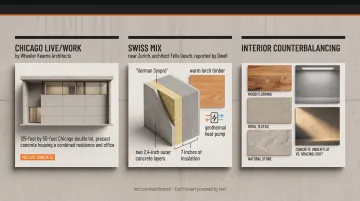
For interiors, exposed concrete walls and ceilings create a specific challenge: they can feel austere without intentional counterbalancing. The approach that works is layering warm materials — wood floors, wool textiles, natural stone — and designing lighting to graze surfaces rather than flood them. Concrete reads very differently under warm directional light than under flat overhead illumination.
Mixed Materials: Concrete + Wood, Glass, and Steel
Most successful precast homes don't use concrete exclusively. Architects pair it with other materials for a reason: concrete provides structural mass and thermal performance, while wood, glass, and steel add warmth, transparency, and visual contrast.
North Perth House (architect Nic Brunsdon, reported by Dezeen, 2020) uses eight precast concrete panels in a grid with arched openings, exposed concrete walls and floors, timber cabinetry, and insulated polycarbonate sheeting. The combination works because each material is doing different work — concrete handles structure and permanence, timber handles human scale and warmth, polycarbonate handles light diffusion.
A practical framework for mixed-material precast homes:
- Concrete carries the primary structure, retaining walls, feature walls in main living spaces, and exposed floor slabs
- Secondary volumes — garage, ADU, window surrounds, interior feature walls, exterior soffits — transition naturally to lighter materials
- Large glass panels pair well with heavy concrete walls for daylighting and view framing, but the thermal contrast benefits from careful solar analysis before finalizing placement
Precast for Challenging Sites and Resilient Environments
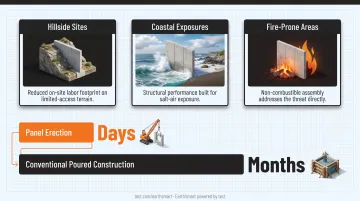
These material decisions carry even more weight on difficult sites. Precast panels are particularly well-suited for hillside sites, coastal exposures, and fire-prone areas where standard code minimums are insufficient — the structural performance of the panel system directly addresses the threats these sites present.
There's also a practical construction advantage worth noting for constrained projects:
- Panels are fabricated off-site, so less wet work happens in the field
- Hillside sites and sites with limited construction access benefit from the reduced on-site labor footprint
- Homeowners rebuilding after a fire gain meaningful time savings — panel erection typically takes days on-site, versus the months required for conventional poured construction
Precast vs. Other Concrete Home Types: Which Is Right for You?
| Precast | Poured-in-Place | ICF | |
|---|---|---|---|
| Quality consistency | Strongest — audited plant QC | Field-dependent | Site-assembled, concrete on-site |
| Geometric flexibility | Best with repetitive bays | Maximum flexibility | Form-module dependent |
| Thermal performance | Good (thermal mass) | Good (thermal mass) | Strongest (foam insulation integral) |
| Site logistics | Crane, clear delivery routes required | Pump/formwork access | Lighter materials, simpler delivery |
| Labor specialization | High | High | More accessible |
Site Constraints Are a Real Planning Issue
Precast panels require truck delivery, crane access, a staging area, and feasible road routes. PCI-MA no-permit shipping limits apply:
- Height: 13 ft 6 in maximum
- Width: 8 ft 6 in maximum
- Load weight: 48,000 lb maximum
On tight urban lots or sites with limited access roads — common in hillside California neighborhoods — screen these constraints before design begins.
When Precast Makes the Most Sense
- Larger homes with repetitive structural bays (repetition reduces cost)
- Sites in extreme-condition zones: fire, high wind, flood, seismic
- Projects where schedule certainty is a priority
- Clients who want documented, audited structural quality
The other systems have their own advantages. ICF tends to make more sense on smaller projects or where labor specialization is limited. Poured-in-place suits projects requiring maximum geometric freedom where site conditions allow extended formwork time.
Costs, Timelines, and What to Plan For
The Cost Reality
Precast concrete homes cost more per square foot upfront than wood-frame construction. Providing a reliable national cost range isn't possible here — contractor and aggregator sources vary widely and don't hold up to scrutiny. What's more useful is understanding the cost drivers, which PCI-MA documents clearly:
- Physical precast products: approximately 60% of total precast cost
- Installation: approximately 25%
- Shipping: approximately 15%
- Panel count, repetition, size, and finish complexity all affect the total
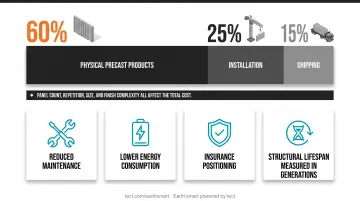
The economic case for precast isn't made on initial cost — it's made on lifecycle cost. Reduced maintenance, lower energy consumption, potential insurance positioning, and a structural lifespan measured in generations make precast the stronger financial choice for homeowners building to stay.
The Timeline Difference
Precast compresses on-site construction time by moving fabrication off-site and running it in parallel with site preparation. The trade-off: the design and engineering must be fully locked before fabrication begins.
Changes after panels are ordered are expensive. In some cases, they're impossible without scrapping fabricated components. Unlike wood-frame construction — where field adjustments are routine — precast demands decisions made earlier and held firmly.
Key implications for project planning:
- Design must be complete before fabrication begins, not refined during it
- Field changes after panel orders are costly and often impossible
- Parallel off-site fabrication and site prep can significantly shorten total build time
Assembling the Right Team
Those front-loaded decisions are also where most precast project failures originate. The breakdown typically happens in misaligned structural engineering, envelope detailing, and manufacturer specifications — not in the panels themselves.
Earth'smart powered by tect's Earth'smart™ Path A Turnkey Delivery is built around exactly this problem. The model aligns architecture, engineering, construction, and manufacturer input from concept through construction, so panel selection, joint detailing, and envelope integration are resolved before fabrication begins.
For homeowners who already have an architect and contractor but need expert coordination layered on top, Path B Advisory provides owner-side guidance through the earth'smart powered by tectApp™ community of 70+ vetted manufacturers — engaging the right specialists at the design stages where those decisions actually matter.
Frequently Asked Questions
Are steel frame houses cheaper than precast concrete?
Steel-framed homes are often comparable to or slightly less expensive upfront than concrete construction, though the comparison depends heavily on region, construction method, and project complexity. Long-term costs — energy, maintenance, and insurance in high-risk environments — frequently favor concrete.
Is it hard to sell a concrete home?
Concrete homes are generally sellable, and buyer awareness varies by market. In fire and flood-prone markets, the durability and noncombustible properties are increasingly valued, particularly where buyers have seen neighboring homes destroyed and are actively seeking resilient construction.
How long does a precast concrete home last?
PCI states that precast and prestressed concrete can deliver a 100-year service life with proper design and maintenance. That significantly exceeds conventional wood-frame construction under most conditions.
Can precast concrete homes look modern and warm, or do they always look industrial?
Precast supports smooth, textured, pigmented, and wood-grain finishes, and combines well with timber, glass, and steel. Projects like the North Perth House and Swiss Mix demonstrate that the result can be warmly minimal rather than industrial. Aesthetics are a design decision, not a limitation of the material.
Is precast concrete good for fire-prone areas?
Concrete is noncombustible and does not contribute fuel to a fire, making precast one of the strongest material choices for WUI zones and areas like Pacific Palisades with active wildfire risk. Full wildfire performance also requires attention to roofing, vents, glazing, and defensible space, but noncombustible walls remove a significant ignition pathway.