Introduction
The January 2025 Palisades and Eaton fires destroyed a combined 16,264 structures across Los Angeles County, according to CAL FIRE. That loss fits a documented pattern: the U.S. Forest Service reports the number of homes in the Wildland-Urban Interface grew 46% between 1990 and 2020, reaching 44 million — roughly one in three homes in the continental U.S.
For homeowners rebuilding or building new in fire-prone zones, material selection directly shapes whether a home survives a fire event — and how it performs over decades in terms of durability, insurance positioning, and lifecycle cost.
This guide breaks down the top fire-resistant materials used in WUI residential construction: what each is, how it's rated, where it performs best, and why evaluating them as an integrated system matters more than any single product choice.
Key Takeaways
- Fire-resistant ratings measure how long an assembly holds up under fire exposure; no material is truly "fireproof"
- Top materials for WUI construction: concrete, fiber cement, masonry, steel framing, Type X gypsum board, and mineral wool insulation
- Material selection only matters when components work together as a coordinated system across every vulnerable zone
- California's Title 24 Chapter 7A mandates specific materials in designated High and Very High Fire Hazard Severity Zones
- Verify local code compliance: Los Angeles and other jurisdictions adopt amendments that go beyond base state requirements
What Makes a Building Material "Fire-Resistant"?
Fireproof vs. Fire-Resistant
No material used in residential construction is truly fireproof. "Fire-resistant" is the correct term — it describes how long a material or assembly maintains structural integrity under fire exposure, expressed in time increments: 30, 60, or 120 minutes.
Two ASTM standards govern these ratings:
- ASTM E119 — tests complete assemblies (walls, floors, ceilings) for structural integrity, heat transmission, and resistance to hot gases
- ASTM E84 — measures surface burning characteristics of individual materials, reporting a Flame Spread Index (FSI) and Smoke Developed Index (SDI); Class A = FSI 0–25
How Fire-Resistant Materials Actually Work
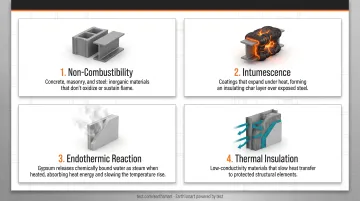
There are four distinct mechanisms:
- Non-combustibility — inorganic materials (concrete, masonry, steel) that don't oxidize or sustain flame
- Intumescence — materials that expand under heat to form an insulating char layer, used in coatings for exposed steel
- Endothermic reaction — materials like gypsum release chemically bound water as steam when heated, absorbing heat energy and slowing temperature rise
- Thermal insulation — low-conductivity materials that slow heat transfer to protected structural elements
The Ember Problem
Those four mechanisms explain how materials perform once fire reaches a structure. But for WUI homeowners, the threat often arrives long before the flame front does.
According to USFA/FEMA, embers can be deposited several miles downwind from an active fire front — and CAL FIRE/OSFM notes they can ignite buildings up to one mile away. Vents, eaves, soffits, and exterior cladding are the first points of ember entry, which means material choices at these zones are often the difference between a home that survives and one that doesn't.
Top Fire-Resistant Building Materials
The materials below are evaluated based on verified fire resistance ratings, proven performance in residential construction, and direct applicability for homeowners building or rebuilding in high-risk WUI zones.
Concrete
Concrete is one of the most inherently fire-resistant structural materials available. It's non-combustible and capable of maintaining structural integrity through high-temperature fire events. Performance depends on mix design, aggregate type, and cover thickness over reinforcing steel. Concrete can spall under extreme heat, but this doesn't constitute structural failure for code compliance purposes.
| Category | Details |
|---|---|
| Fire Resistance | Non-combustible (FSI 0); reinforced concrete assemblies can achieve 2–4 hour ratings depending on design — verify specific assembly ratings per ACI 216.1 |
| Best Applications | Structural slabs, foundation walls, exterior walls, fire-rated floor assemblies |
| Key Considerations | Higher upfront cost and weight than wood framing; extremely durable with minimal long-term maintenance |
Fiber Cement Siding and Panels
Fiber cement — a composite of cement, sand, and cellulose fiber — is one of the most widely specified exterior cladding materials in WUI construction. Per ICC-ES ESR-2290, James Hardie fiber cement products carry a Class A flame spread rating with FSI 0 under ASTM E84 and are noncombustible under ASTM E136. The evaluation report includes California-specific language for Chapter 7A ignition-resistant building material compliance.
| Category | Details |
|---|---|
| Fire Resistance | Non-combustible; Class A FSI 0–25 under ASTM E84; resists sustained ember exposure and radiant heat |
| Best Applications | Exterior wall siding, eave soffits, fascia boards, and panel cladding systems |
| Key Considerations | Requires proper installation — no gaps at joints or penetrations; confirm product-specific ICC or WUI code listings before specifying |
Installed cost benchmarks from RSMeans/Gordian (2023): fiber cement runs $5.71/sf installed wall area, compared to $2.75/sf for vinyl and $6.56/sf for wood siding.
Masonry (Brick, CMU, Stone Veneer)
Masonry is among the most proven fire-resistant construction assemblies available. According to the Brick Industry Association's Technical Notes 16, solid clay or shale brick achieves a 1-hour rating at 2.7 inches equivalent thickness and a 4-hour rating at 6.0 inches. CMU fire resistance varies by aggregate type and equivalent thickness — consult NCMA TEK 7-1C for specific values.
| Category | Details |
|---|---|
| Fire Resistance | Non-combustible; single wythe brick achieves 1–4 hour ratings depending on thickness; CMU varies by aggregate and cell fill |
| Best Applications | Exterior walls, chimneys, retaining walls, foundation systems |
| Key Considerations | High thermal mass provides energy efficiency benefits; mortar joint detailing is critical; masonry can crack under rapid thermal shock (fast cooling after heat exposure) |
The RSMeans/Gordian benchmark for brick veneer is $10.84/sf installed — higher upfront than fiber cement, but with a substantially longer service life and near-zero maintenance profile.
Steel Framing
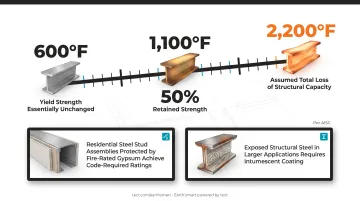
Steel is non-combustible but loses load-bearing capacity at elevated temperatures. According to AISC, structural steel yield strength remains essentially unchanged to approximately 600°F, retains roughly 50% of strength at 1,100°F, and is assumed to have lost all structural capacity by around 2,200°F for design purposes.
In residential construction, steel stud assemblies protected by fire-rated gypsum achieve code-required ratings. Exposed structural steel in larger applications requires intumescent coating.
| Category | Details |
|---|---|
| Fire Resistance | Non-combustible but requires protection; steel stud assemblies with Type X gypsum achieve 1–2 hour ratings; intumescent coatings can extend ratings up to 4 hours for exposed structural steel |
| Best Applications | Structural framing, roof trusses, floor systems — particularly in non-combustible construction types |
| Key Considerations | Lighter and faster to erect than concrete; requires thermal bridging mitigation in the wall assembly for energy code compliance |
Type X Gypsum Board
Type X gypsum board — 5/8-inch, glass fiber-reinforced — is the standard fire-rated interior finish for residential and commercial construction. Its fire resistance works through an endothermic reaction (a heat-absorbing chemical process): chemically bound water in the calcium sulfate core is released as steam when heated, delaying temperature rise on the unexposed face.
This mechanism makes it the baseline for fire-rated wall and ceiling assemblies under both the IBC and IRC. USG's Sheetrock Firecode X panels carry UL Type SCX designation and ASTM E84 surface burning values of FSI 15 and SDI 0.
| Category | Details |
|---|---|
| Fire Resistance | Achieves fire resistance ratings within tested assemblies — verify per UL assembly listing for specific hour ratings and configurations |
| Best Applications | Interior wall and ceiling assemblies, garage-to-living-space separations, shaft enclosures |
| Key Considerations | Vulnerable to moisture — not appropriate as an exterior material without rated cladding over it; USG Firecode X panels contain 100% recycled face and back papers |
Mineral Wool (Rock Wool) Insulation
Mineral wool is manufactured from volcanic rock or industrial slag. Unlike fiberglass batts, it doesn't melt or sustain combustion at temperatures typical of residential fires. According to ROCKWOOL, stone wool insulation is non-combustible and can withstand temperatures above 1,000°C — making it well-suited for fire-rated wall assemblies, particularly at exterior walls and around openings in WUI construction.
| Category | Details |
|---|---|
| Fire Resistance | Non-combustible; resists temperatures exceeding 1,000°C without melting or sustaining flame; contributes to fire-rated assembly performance in listed wall assemblies |
| Best Applications | Exterior wall cavity insulation, fire-rated floor and ceiling assemblies, continuous exterior insulation |
| Key Considerations | Higher cost per square foot than standard fiberglass; also delivers superior sound attenuation and moisture resistance compared to fiberglass batts |
Where Each Material Performs Best in Your Home
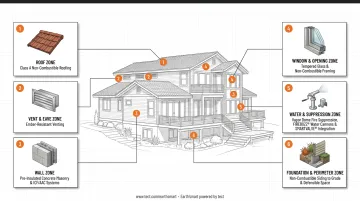
Fire resistance isn't uniform across a structure. Wildfires attack through distinct pathways — ember intrusion, radiant heat, and direct flame contact — and the right material for your roof is not the right material for your structural frame.
Zone-by-Zone Material Guide
| Home Zone | Primary Threat | Recommended Materials |
|---|---|---|
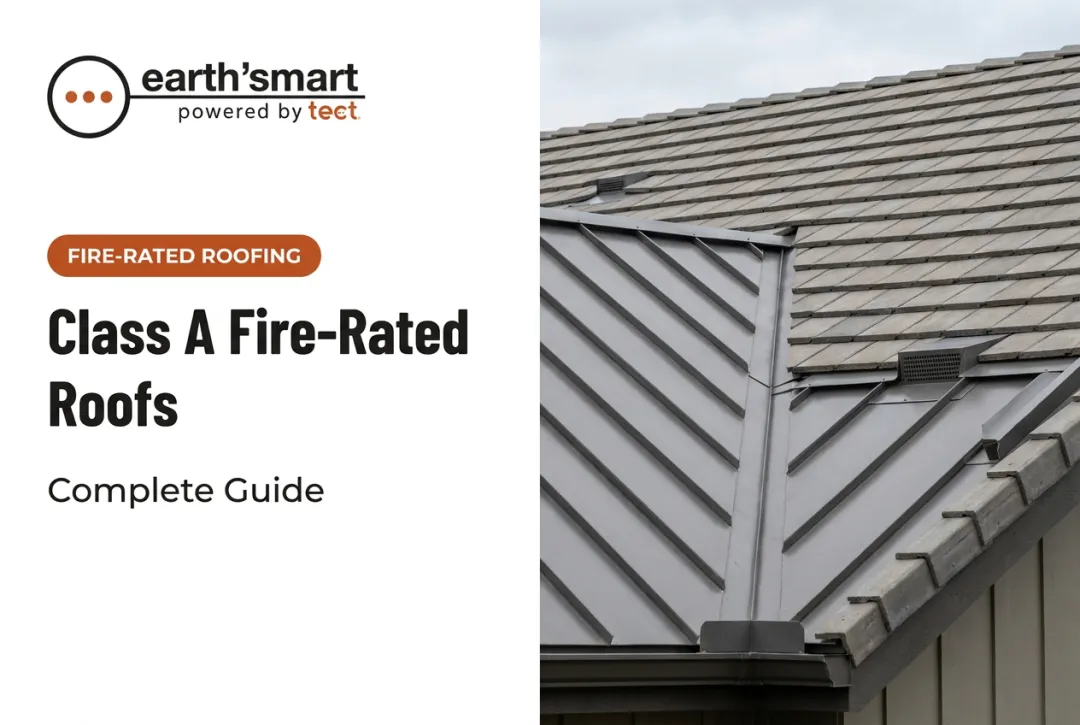
| Roof and attic | Ember accumulation and intrusion | Class A roofing — standing-seam metal, clay tile, concrete tile |
| Eaves and soffits | Ember entry and radiant heat | Fiber cement panels, metal soffit systems |
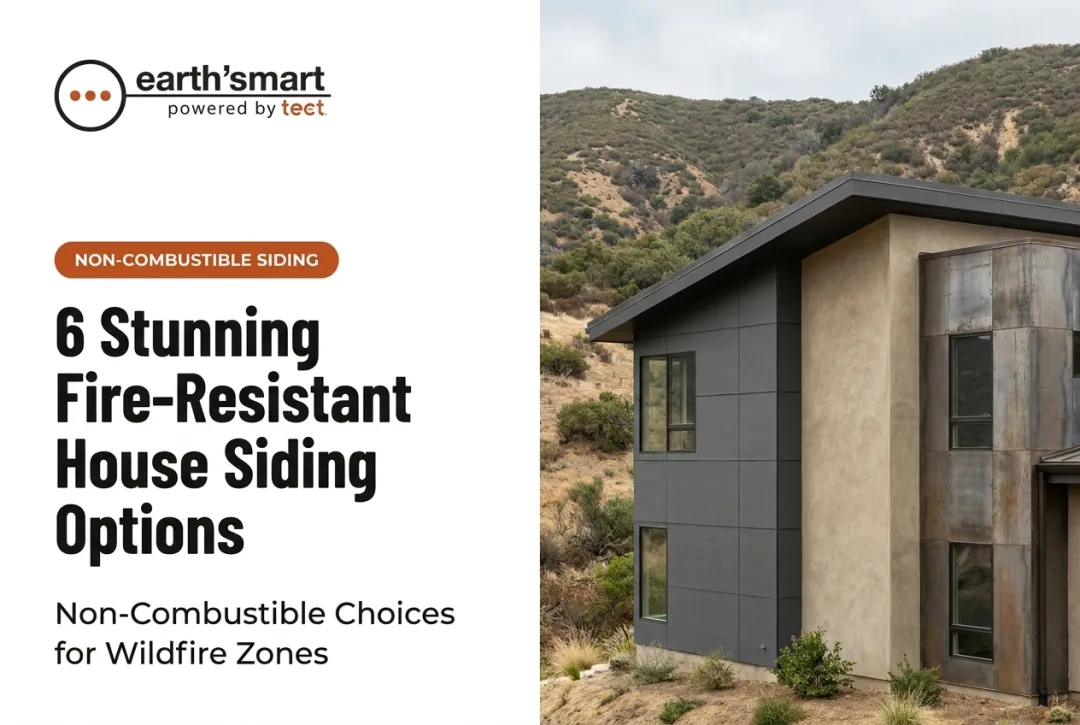
| Exterior walls | Radiant heat and direct flame | Fiber cement, masonry, stucco over non-combustible sheathing; CMU/ICF/AAC for full non-combustible assemblies |
| Structural frame | Combustion and structural failure | Concrete, steel framing, fire-retardant treated lumber |
| Interior assemblies | Fire spread from structure or adjacent ignition | Type X gypsum board — double layer for 1-hour assemblies |
| Insulation | Contributes to fire spread in wall cavities | Mineral wool throughout — exterior walls and all fire-rated assemblies |
Code Requirements by Zone
California's Title 24 Chapter 7A mandates specific material requirements for each of these zones in designated High and Very High Fire Hazard Severity Zones:
- Roofs: Class A assembly tested to ASTM E108 or UL 790
- Exterior walls: Non-combustible, ignition-resistant, fire-retardant-treated wood for exterior use, or qualifying tested assemblies
- Vents: Wildfire flame- and ember-resistant vents listed by the State Fire Marshal or tested to ASTM E2886
- Eaves/soffits: Non-combustible or ignition-resistant materials, or one layer of 5/8-inch Type X gypsum behind exterior covering
- Decks: Walking surfaces must meet Chapter 7A performance pathways including ASTM E2632 and E2726
Local jurisdictions can layer additional requirements on top of state code. The City of Los Angeles 2026 FHSZ checklist, for example, adds specific requirements including prohibition of wood shake/shingle roof coverings and a 30-foot VHFHSZ setback. Always verify local amendments, because jurisdiction requirements can exceed base Chapter 7A provisions.
How to Choose the Right Fire-Resistant Materials for Your Home
The Assembly Problem Most Homeowners Miss
The most common mistake in WUI material selection is choosing individual products based on marketing claims or price — without understanding how those materials perform together as a complete assembly.
A fiber cement panel with a Class A rating provides meaningful protection only when:
- Correctly installed with no gaps at joints or penetrations
- Listed under a code-compliant wall assembly for the specific application
- Backed by appropriate sheathing, insulation, and framing system
A product's standalone spec sheet is not an assembly rating. Assembly performance is documented through UL listings, GA-600 fire resistance design manuals, ACI 216.1 (for concrete), BIA Technical Notes (for brick), and NCMA TEK (for CMU). These are the documents that matter for code compliance.
Key Evaluation Criteria
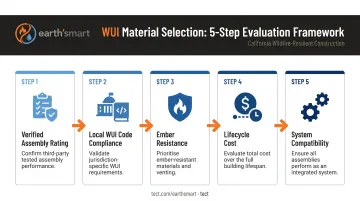
When assessing materials for a WUI build or rebuild, work through these five criteria in order:
- Verified assembly rating — confirm the UL or equivalent listing for the specific wall, floor, or roof configuration, not just the product
- Local WUI code compliance — verify Chapter 7A requirements for your specific application zone and jurisdiction
- Ember resistance — check ember intrusion performance for all exterior-facing applications, not just flame spread ratings
- Lifecycle cost — factor in maintenance, expected service life, and insurance implications alongside upfront material cost
- System compatibility — confirm materials integrate correctly with structural, mechanical, and envelope systems
Insurance and Fire-Resistant Construction
California's Department of Insurance requires carriers to offer Safer from Wildfires discounts to residential policyholders — but discount amounts vary by company. What doesn't vary: the California FAIR Plan now carries $750 billion in total exposure as of March 2026, up 242% since September 2022. In that environment, documented fire-resistant construction increasingly supports coverage access and pricing outcomes.
The IBHS released an updated 2025 Wildfire Prepared Home standard with two designation levels and a systems-based approach covering home and near-home conditions. Homes that align with this standard — and with Chapter 7A compliance documentation — give brokers, MGAs, and underwriters what they need to evaluate coverage on difficult-to-insure WUI properties.
Where Expertise Matters
For homeowners rebuilding in Pacific Palisades and other high-risk zones, specifying, coordinating, and correctly installing fire-resistant material systems across the full envelope is not a typical design-build task. Even well-funded projects fall short when product decisions are made late, teams are disconnected, or minimum-code thinking drives specifications.
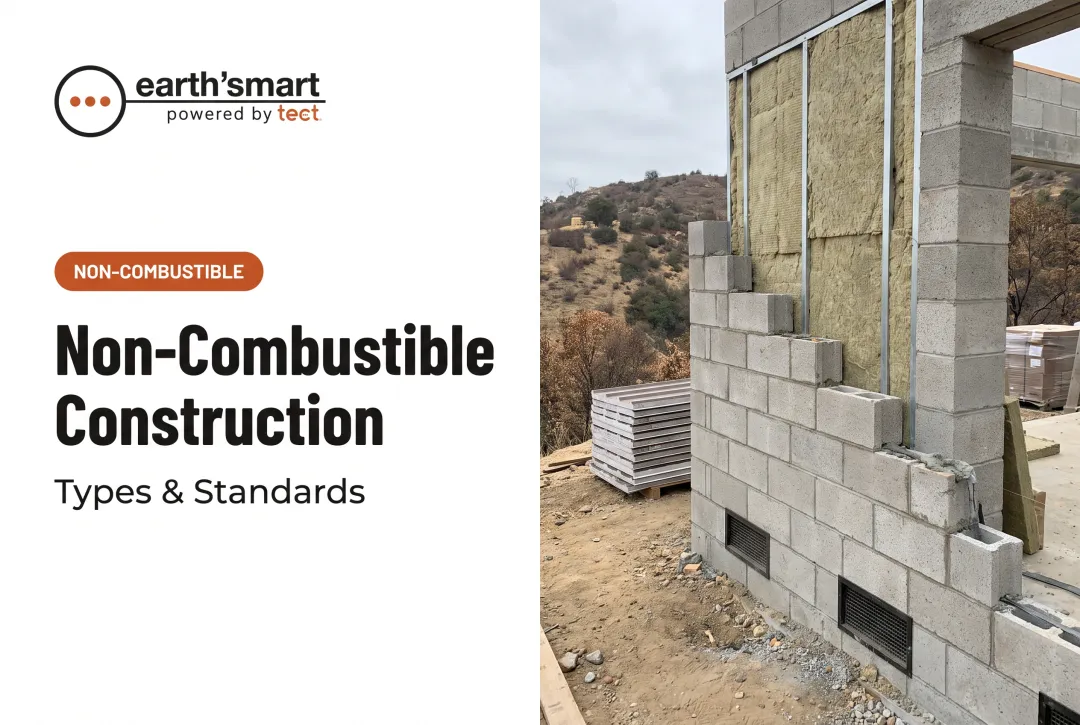
Earth'smart powered by tect's Earth'smart™ approach addresses this by connecting clients with its earth'smart powered by tectApp™ community of 70+ vetted building product manufacturers. The companies behind your home's materials are part of the design process from concept forward, not consulted after the plans are drawn. For fire-resistive wall assemblies specifically, earth'smart powered by tect most commonly specifies pre-insulated concrete masonry (CMU) as the primary exterior wall system — one coordinated assembly that delivers structural performance, continuous insulation, and fire resistance together.
When manufacturer input happens at the design stage, system conflicts get resolved before they reach the field — not discovered after framing is complete.
Conclusion
Choosing fire-resistant building materials means designing a coordinated system — where concrete, fiber cement, masonry, gypsum, mineral wool, and steel each perform their role within a tested assembly, across every vulnerable zone of the home, in compliance with local code requirements.
For homeowners in Pacific Palisades and the broader WUI, a wrong material decision — or the right material in the wrong assembly — can erase everything the rest of the design gets right. Getting those decisions right requires the right expertise from the first specification, not after the framing is already up.
Earth'smart powered by tect works with homeowners rebuilding in high-risk areas to ensure material and system decisions are made correctly — and early, before they become expensive to fix. If you're planning a rebuild or new build in a fire-prone zone, reach out to discuss how earth'smart powered by tect's coordinated approach applies to your project. Contact Bob Habian, AIA at (310) 913-5000 or bob@tect.com.
Frequently Asked Questions
What is the most fireproof building material?
Concrete, brick, stone, and glass fiber-reinforced concrete (GFRC) are among the most fire-resistant options — non-combustible and capable of maintaining structural integrity through fire events that destroy surrounding building contents. Steel is structurally strong but requires intumescent coating or gypsum protection to maintain load capacity at elevated temperatures.
What is a fire-resistant alternative to plywood?
The main alternatives are fire-retardant treated (FRT) plywood (pressure-impregnated, Class A flame spread rated), fiber cement panel sheathing, and magnesium oxide (MgO) board. Each has specific application requirements — verify code compliance for your intended use before specifying.
What is a fire resistance rating and how is it measured?
Fire resistance ratings are expressed in hours (1-hour, 2-hour, etc.) and represent how long an assembly — wall, floor, or ceiling — maintains structural integrity and limits heat transfer under standardized fire exposure. Assemblies are tested under ASTM E119; individual material surface burning characteristics are measured under ASTM E84.
Are fire-resistant materials required by code for homes in WUI areas?
Yes. Homes in designated High and Very High Fire Hazard Severity Zones in California must comply with Title 24 Chapter 7A, which mandates specific non-combustible or fire-resistant materials for roofing, exterior walls, vents, eaves, and decking. Local jurisdictions like Los Angeles may adopt more stringent amendments beyond the base state requirements.
What parts of a home are most vulnerable to wildfire ignition?
Research shows most WUI home ignitions begin from ember intrusion at vents, eaves, gaps in soffits, and on decks — not from direct flame contact. USFA/FEMA confirms embers can travel several miles downwind and smolder before igniting, making these entry points a higher priority than many homeowners expect.
Do fire-resistant building materials cost significantly more than standard materials?
Upfront costs vary: fiber cement siding runs around $5.71/sf installed versus $2.75/sf for vinyl, while brick veneer ($10.84/sf) carries a steeper premium. The cost gap typically closes when you factor in 100+ year service life, lower maintenance, and insurance positioning — especially for concrete and masonry systems.