The 2010 Haiti earthquake killed an estimated 300,000 people and damaged nearly half of all structures in the epicentral area. The 1999 Kocaeli earthquake in Turkey claimed nearly all its fatalities through building collapse. These weren't geological anomalies — they were construction failures at scale.
Here's what's worth understanding before anything else: "earthquake-proof" doesn't exist. No structure can be made completely immune to seismic damage. But "earthquake-resistant" is both real and achievable — and the gap between a home that survives and one that fails is almost always determined before the first shovel breaks ground.
Key Takeaways
- Over 75% of earthquake casualties result from building collapse, not ground shaking itself
- Standard construction handles vertical loads; seismic design handles lateral forces — two very different problems
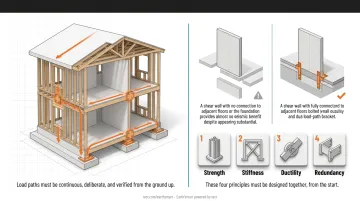
- Ductility, stiffness, strength, and redundancy are the four principles that define earthquake-resistant design
- Shear walls, base isolation, diaphragms, and moment frames are the core structural tools
- Code compliance means life safety — not that your home will be usable afterward
- Soil conditions can amplify shaking dramatically — geotechnical assessment belongs before design, not after
Why Earthquakes Bring Down Buildings That Seem Solid
Standard buildings are engineered for vertical forces — gravity, dead loads, live loads. That's what most construction codes address. Earthquakes generate something entirely different: lateral and horizontal forces that push and pull structures sideways, causing walls, columns, and beams to oscillate in ways the structure was never designed to handle.
Where Stress Concentrates
FEMA P-749 explains the mechanism clearly: when ground acceleration moves a building's foundation, the mass of the structure resists that motion, creating inertial forces that gravity-only design simply doesn't account for.
During seismic loading, stress concentrates at specific points:
- Corner connections where walls, floors, and roofs meet
- Beam-to-column joints in frames
- Material transitions between concrete, masonry, and wood
- Foundation connections where the structure meets the ground
Torsional forces — twisting — are particularly destructive. They occur when a building's center of mass and center of rigidity don't align, causing asymmetric movement that standard framing handles poorly.
The Workmanship Problem
Many building failures don't trace back to absent seismic design. They trace back to absent seismic execution. The 2010 Haiti collapse pattern is instructive: reinforced concrete frames with concrete block masonry infill performed poorly not because the design concept was wrong, but because reinforcement detailing, lap splices, and anchorage were inadequate in practice.
The seismic intent existed on paper. It wasn't built into the structure. Poor concrete mixing, under-reinforcement, and inadequate joint anchoring are well-documented failure mechanisms — which is why who builds your home matters as much as how it's designed.
The Core Principles Behind Earthquake-Resistant Design
Four principles define how a structure behaves under seismic loading. Each is necessary. None is sufficient alone.
Stiffness
A structure must resist lateral deformation without excessive sway. Too little stiffness allows uncontrolled movement that overstresses connections and damages nonstructural elements — even when the primary frame holds.
Strength
The load-bearing system must have enough capacity to absorb seismic forces without yielding at critical members. Strength sets the threshold. What matters equally is what happens when that threshold is approached.
Ductility
This is the most consequential principle in modern seismic design. A ductile structure bends, deforms, and absorbs energy without catastrophic, sudden failure. Contrast that with brittle failure: sudden, total collapse with no warning.
Plain concrete is brittle. Under tensile stress, it cracks and fails. Steel reinforcement gives concrete ductility — holding the structure together as cracks develop, allowing gradual yielding rather than instant collapse.
Ductility in concrete isn't achieved by adding steel alone. It requires:
- Correct reinforcement quantity and placement
- Transverse confinement at critical members
- Proper anchorage and lap splice detailing
Older nonductile concrete buildings — those built before modern seismic codes — remain among the highest collapse-risk structures standing today.
Redundancy
Well-designed structures have multiple pathways for transferring loads. If one element yields, the system doesn't immediately fail. This is why integrated structural systems outperform isolated solutions.
A shear wall with no connection to adjacent floors or the foundation provides almost no seismic benefit despite appearing substantial. Load paths must be continuous, deliberate, and verified from the ground up.
These four principles must be designed together, from the start. A structure optimized for strength but lacking ductility, or stiff but lacking redundancy, will underperform when actual ground motion arrives — often in ways that aren't visible until failure is already underway.
Key Structural Techniques in Earthquake-Resistant Construction
Base Isolation
Base isolators — typically lead-rubber or elastomeric bearings — physically separate a building's superstructure from its foundation. When the ground moves, the isolators absorb and redirect that motion, allowing the structure above to remain largely stationary. The Japan Society of Seismic Isolation has documented residential applications ranging from apartment buildings down to detached houses — making it one of the few techniques effective at the single-family scale, not just for large commercial structures.
Seismic Dampers
Where base isolation manages motion at the foundation, seismic dampers absorb and dissipate energy before it stresses structural members. Three types see common use:
- Viscous dampers — fluid-based, typically installed at base or floor levels; work similarly to shock absorbers
- Friction dampers — dissipate energy through controlled sliding at connection points
- Tuned mass dampers — counterweight systems, typically deployed at a building's upper levels to counteract oscillation
Shear Walls and Cross-Bracing
Dampers and isolation systems manage energy once it enters a structure — shear walls stop it from getting there. These rigid vertical elements — reinforced concrete panels or steel-braced frames — absorb lateral seismic forces and transfer them down to the foundation.
Placement and continuous anchoring are everything. A shear wall that isn't connected through to the foundation and adjacent floor systems provides negligible seismic resistance, regardless of how well it's constructed in isolation.
Diaphragms
Floors and roofs built as structural diaphragms act as horizontal load-distributing elements. They collect lateral forces from across the building's mass and channel them into shear walls and vertical frames. Shear walls only perform as well as the diaphragms feeding them. Continuity is critical — gaps, openings, and weak connections undermine the entire system by creating stress concentrations at exactly the wrong places.
Moment-Resistant Frames
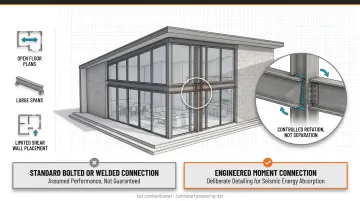
Moment frames allow beams and columns to rotate at connection joints without separating, maintaining structural integrity while absorbing seismic energy through controlled deformation. They're particularly important where open floor plans or large spans limit shear wall placement — a common condition in residential design. The connections must be engineered explicitly for this behavior. Standard bolted or welded connections don't provide moment resistance automatically — it requires deliberate detailing, not assumed performance.
Materials That Hold Up Under Seismic Stress
Material choice matters — but material ductility doesn't substitute for proper detailing.
Steel-reinforced concrete is the workhorse of seismic construction. The concrete handles compression; the steel handles tension and provides ductility. The steel-to-concrete ratio and installation quality are non-negotiable. Cutting rebar to reduce cost is a well-documented path to catastrophic failure — it's not a marginal risk, it's a known mechanism.
Structural steel and wood are inherently ductile materials that perform well under seismic loading. The performance gap between adequate and inadequate lives in the connections:
- Anchoring wood-frame walls securely to foundations
- Properly detailing steel frame joints for seismic load transfer
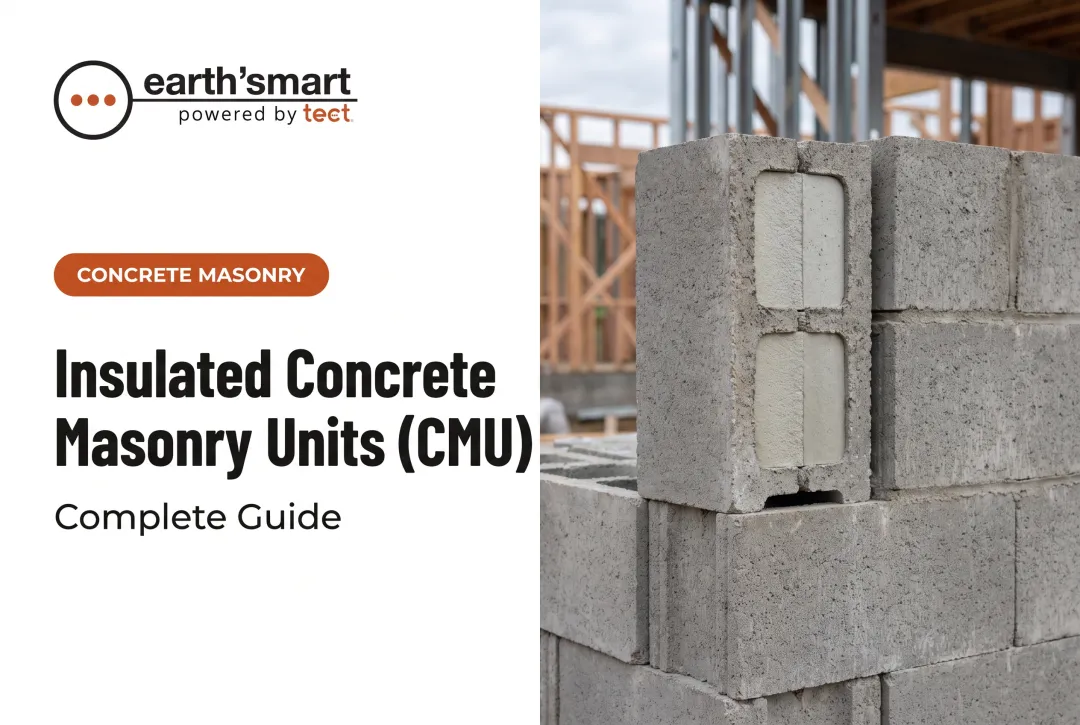
Concrete masonry (CMU) deserves specific mention in the California context. Pre-insulated CMU systems — like those earth'smart powered by tect specifies across Earth'smart™ projects — deliver shear-wall lateral resistance and fire-resistive performance within a single wall assembly. In a state where wildfire and earthquake risk overlap, that dual performance is a practical advantage, not a theoretical one.
Emerging materials — shape-memory alloys and fiber-reinforced composites — are showing strong results in seismic research and structural testing. Neither is standard practice in residential construction yet, but both are worth tracking as the field develops.
Site Selection and Foundation: Where Earthquake Resistance Begins
The best-designed building on the wrong soil can fail regardless of how well it's engineered. Site conditions can be as consequential as structural system choice.
The Soil Problem
Not all ground performs equally under seismic loading. Two conditions drive the most significant site-level risk:
- Liquefaction: Saturated soils temporarily behave like a liquid during shaking. Structures on liquefiable ground can sink, tilt, or collapse even if the building itself was designed correctly.
- Shaking amplification: Soft alluvial deposits amplify ground motion by a factor of 2–10x compared to bedrock, depending on depth and saturation.
The USGS maintains San Francisco Bay Area liquefaction hazard maps, and California's CGS publishes statewide Earthquake Zones of Required Investigation for fault rupture, liquefaction, and seismic landslide hazards.
Foundation Requirements
Foundations must be:
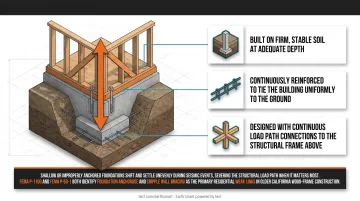
- Built on firm, stable soil at adequate depth
- Continuously reinforced to tie the building uniformly to the ground
- Designed with continuous load path connections to the structural frame above
Shallow or improperly anchored foundations shift and settle unevenly during seismic events, severing the structural load path when it matters most. FEMA P-1100 and FEMA P-50-1 both identify foundation anchorage and cripple wall bracing as the primary residential weak links in older California wood-frame construction.
When to Assess
Geotechnical site assessment — soil boring, liquefaction analysis, fault proximity evaluation — should happen before design begins. California Building Code requires geotechnical investigations for Seismic Design Categories C, D, E, and F.
Many residential projects skip or defer this step to reduce upfront cost, then discover the problem when it's expensive to correct. That sequencing error is avoidable.
What Homeowners in High-Seismic Zones Should Do Differently
Code Compliance Is Not Enough
Building code compliance means a structure is designed to prevent collapse and preserve life safety in a code-level earthquake. It does not mean the home will be functional, repairable, or insurable afterward. FEMA P-749 and the 2020 NEHRP Provisions are explicit on this: ordinary code objectives target life safety and collapse prevention for typical buildings — not immediate occupancy or functional recovery.
Homeowners who want a home that remains livable after a significant event need to ask for above-code performance objectives. That objective starts at the design stage — not during permitting.
Nonstructural Elements Are the Hidden Risk
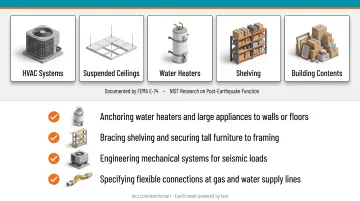
Nonstructural elements — HVAC systems, suspended ceilings, water heaters, shelving, and building contents — cause the majority of earthquake injuries and a substantial share of financial losses in residential buildings. FEMA E-74 documents this risk in detail; NIST research further examines how nonstructural damage affects building function long after structural repairs are complete.
Earthquake-resistant design must address these elements, not just the structural frame. Practical steps that most code-minimum designs don't require — but that meaningfully reduce injury and loss — include:
- Anchoring water heaters and large appliances to walls or floors
- Bracing shelving and securing tall furniture to framing
- Engineering mechanical systems for seismic loads
- Specifying flexible connections at gas and water supply lines
The Integration Advantage
For homeowners rebuilding in high-seismic zones like Pacific Palisades — where earthquake risk and wildfire risk coexist — the critical variable is whether the design team treats seismic performance as a coordinated discipline from the start or a code-compliance checkbox near the end.
Earth'smart powered by tect's Earth'smart™ approach integrates structural engineering — including concrete masonry shear-wall design and hybrid steel/concrete systems for California seismicity — from concept-design forward. Both Path A (Turnkey Delivery) and Path B (Advisory) engagements include seismic engineering as a coordinated discipline, not a late addition.
When architects, structural engineers, and manufacturers are aligned early, structural decisions, material specifications, and connection details work together — rather than creating conflicts that get resolved poorly under time pressure in the field.
That coordination also has insurance implications. The CEA documents that qualifying seismic features can affect earthquake insurance pricing in defined programs — for example, a 21% discount for mobilehomes with earthquake-resistant bracing systems. For new construction, carriers are paying closer attention to documented structural performance features. Thorough documentation of above-code seismic measures is a concrete step homeowners can take before the carrier conversation begins.
Frequently Asked Questions
What is an earthquake-resistant building?
An earthquake-resistant building is designed and constructed to withstand seismic forces through ductility, strength, and stiffness — minimizing structural damage and protecting occupants during ground shaking. Unlike conventional buildings engineered only for vertical gravity loads, earthquake-resistant structures explicitly address the lateral and horizontal forces that seismic events generate.
Is there such a thing as an earthquake-proof building?
No building is completely immune to earthquake damage. Earthquake-resistant design can dramatically reduce structural damage, prevent collapse, and protect lives. Advanced techniques like base isolation can bring high-performance buildings close to undamaged performance in moderate seismic events, but "earthquake-proof" doesn't reflect engineering reality.
What is the best design for an earthquake-resistant building?
There's no single best design. The most effective approach combines ductile construction, properly engineered shear walls and diaphragms, strong foundation connections, and a site-appropriate structural system — often augmented by base isolation or seismic dampers. The key is coordinating all these elements from early in the design process, not assembling them independently.
How are Japanese houses built to withstand earthquakes?
Japan uses mandatory seismic codes, widespread base isolation and damping systems, and lightweight flexible structural frames designed to absorb rather than rigidly resist seismic energy. The Japan Society of Seismic Isolation documents applications ranging from high-rises to detached houses.
Does earthquake-resistant construction affect home insurance costs?
Seismically designed homes generally present lower risk profiles, and resilient construction features can affect insurance pricing in defined programs. The California Earthquake Authority documents premium discounts tied to qualifying retrofit conditions. For new construction, documenting your structural systems and engineering decisions gives your insurer the specifics they need to price risk accurately.
What should homeowners look for when building in a seismic zone?
Three priorities stand out:
- Get a geotechnical site assessment before design begins
- Verify your design team has explicit seismic engineering expertise
- Confirm both structural and nonstructural elements are covered in the design
Then make sure construction is inspected — well-engineered design that's poorly executed in the field provides far less protection than it looks like on paper.