Introduction
Building codes, product specs, and insurance conversations all reference "Class A fire rating" — but ask ten homeowners what it actually measures, and most will guess wrong. Most assume it means fireproof, or confuse it with fire type classifications like "Class A fire" (ordinary combustibles), or think it equals one hour of fire resistance.
None of that is accurate — and in wildfire-prone areas, those misconceptions lead to wrong material choices, failed inspections, and coverage gaps.
This guide explains exactly how Class A ratings work, how they're measured, how they compare to Class B and Class C, and why the distinction matters if you're building or rebuilding in a high-risk fire zone.
Key Takeaways (TLDR)
- Class A = Flame Spread Index of 0–25, tested via ASTM E84
- Class A means highly resistant to surface flame spread — not fireproof
- Ratings apply to tested assemblies, not individual components
- Class A fire ratings and Class A fire types are completely separate classification systems
- California WUI zones (CRC Chapter R337) require Class A roof-covering performance
What Is a Flame Spread Rating and How Is It Measured?
Flame spread ratings answer one specific question: how quickly does fire travel across the surface of a material?
That's different from fire resistance, which measures how long a structural assembly — a wall or floor — can prevent fire from passing through it. Confusing the two is one of the most common mistakes in fire-safety conversations.
The numerical output of flame spread testing is the Flame Spread Index (FSI). A lower FSI means fire travels more slowly across the surface.
The ASTM E84 Steiner Tunnel Test
The standard test method for measuring FSI is ASTM E84, currently at version E84-26a. The process runs as follows:
- A building material sample is mounted to the ceiling of a 25-foot fire-test tunnel
- Controlled airflow passes through the tunnel while a gas flame is applied
- The test runs for 10 minutes, tracking how far and how fast the flame travels along the sample surface
- Results are indexed against calibration benchmarks to produce the FSI number
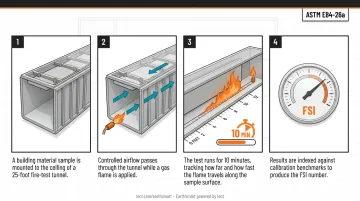
The test is comparative by design — it measures performance relative to reference materials, not absolute burn time.
The Second Measurement: Smoke Developed Index
ASTM E84 produces two outputs, not one:
- Flame Spread Index (FSI) — measures surface flame travel
- Smoke Developed Index (SDI) — measures smoke output during the test
All three rating classes (A, B, and C) share the same SDI limit of 0–450 per IBC Section 803.1.2. Smoke output doesn't distinguish the classes from each other — FSI is the differentiating metric.
What Is a Class A Fire Rating?
Under IBC Section 803.1.2, Class A (sometimes called Class 1) is defined as:
- Flame Spread Index: 0–25
- Smoke Developed Index: 0–450
It's the highest fire rating achievable for interior wall and ceiling finish materials tested under ASTM E84. An FSI between 0 and 25 means flames spread very slowly across the material's surface under test conditions.
What Class A Does NOT Mean
Class A does not mean fireproof. Under sustained or extreme heat, a Class A-rated material will still combust. The rating means the material significantly resists surface flame spread compared to lower-rated materials — not that it's immune to fire.
This distinction matters. Homeowners who assume "Class A = fireproof" often under-invest in other fire-resilience measures, which is exactly the wrong response in a wildfire-prone area.
Verified Class A Materials
Several product categories carry Class A classifications, confirmed through ICC-ES evaluation reports:
- Fiber cement siding — James Hardie products (ESR-2290) test at FSI 0, SDI less than 5
- Fire-retardant treated (FRT) wood — Dricon FS (ESR-4584) achieves FSI 25 or less under ASTM E84
- Magnesium oxide board — MAXTERRA MagRock panels (ESR-5506) achieve FSI 25 or less, SDI 450 or less
Classification is product-specific. Every product must carry its own tested evaluation report — a category name alone does not confer Class A status.
The System-Level Rule
This is where most field errors happen. A Class A rating applies to a tested assembly, not to individual components pulled out of context. Change the substrate, alter the coating thickness, or modify the installation sequence, and the tested rating no longer applies.
ICC-ES ESR-4584 states this explicitly for Dricon FRT lumber: ripping or milling the treated lumber invalidates its flame-spread classification. UL applies the same standard across all listed assemblies — the product must be built exactly as specified in the published design to keep its rated classification.
In practice, this means verifying the installed assembly configuration against the manufacturer's ICC-ES evaluation report before construction begins — not after a permit review flags a discrepancy.
Class A vs. Class B vs. Class C: Complete Comparison
All three classes are defined by IBC Section 803.1.2 and share the same SDI limit. FSI is the only metric that differentiates them.
| Class | Flame Spread Index | Smoke Developed Index | Typical Applications |
|---|---|---|---|
| Class A | 0–25 | 0–450 | Hospitals, schools, egress corridors, high-rises, WUI zones, multi-family residential |
| Class B | 26–75 | 0–450 | Offices, hotels, mid-rise structures |
| Class C | 76–200 | 0–450 | Storage buildings, warehouses, detached garages, outbuildings |
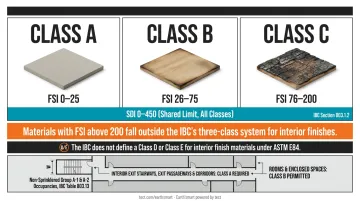
Materials with FSI above 200 fall outside the IBC's three-class system for interior finishes. The IBC does not define a Class D or Class E for interior finish materials under ASTM E84 — avoid vendor charts that suggest otherwise.
IBC application example: For non-sprinklered Group A-1 and A-2 occupancies (assembly spaces), IBC Table 803.13 requires Class A in interior exit stairways, exit passageways, and corridors, with Class B permitted in rooms and enclosed spaces.
How Class A Ratings Apply to Roof Coverings
Roof coverings operate under a different test standard — ASTM E108, not ASTM E84 — which evaluates three specific fire exposure scenarios:
- Spread of flame
- Intermittent flame
- Burning brands (simulating airborne embers)
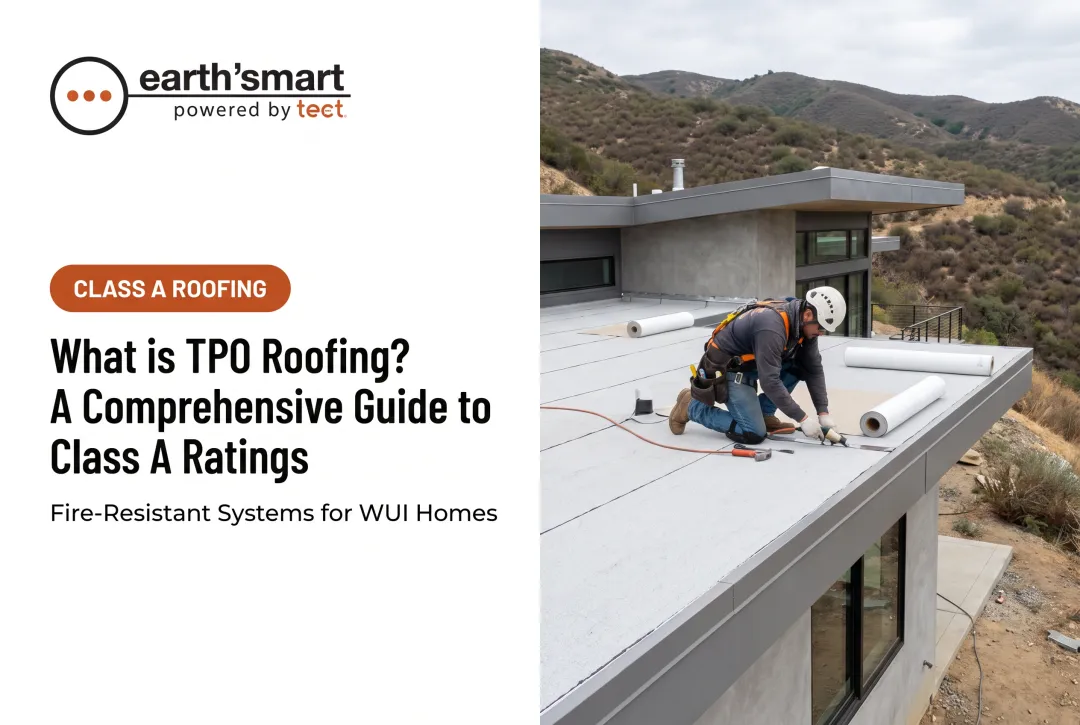
IBC Section 1505.1 requires roof assemblies to be tested under ASTM E108 or UL 790. Class A under ASTM E108 means the covering is effective against severe fire exposure.
The IBC does not require Class A roofing as the baseline for most Type I and II construction. IBC Table 1505.1 sets minimum Class B for Type IA, IB, and IIA construction, and minimum Class C for Type IIB.
Class A roofing is permitted for all construction types and required by specific jurisdictions and occupancies.
An ASTM E84 Class A result does not qualify a product as a Class A roof covering. Roof classification requires separate ASTM E108 or UL 790 testing.
"Fire Classes" vs. "Fire Ratings": Why These Are Not the Same Thing
This is the most persistent source of confusion in fire-safety discussions. When someone says "Class A fire," they're using a completely different classification system than when someone says "Class A fire rating."
Fire type classifications (used with fire extinguishers) describe fuel source:
- Class A — Ordinary combustibles: wood, paper, cloth, rubber, plastics
- Class B — Flammable liquids: gasoline, oil
- Class C — Energized electrical equipment
- Class D — Combustible metals (used mainly in industrial settings)
- Class K — Cooking oils and fats
These classifications, documented by NFPA, determine which extinguisher to use on a fire. They say nothing about how building materials perform under fire exposure.
Fire rating classifications measure something different: how quickly fire spreads across a building material's surface, tested under ASTM E84. The Flame Spread Index (FSI) ranges that define each class are:
- Class A — FSI 0–25 (best performance)
- Class B — FSI 26–75
- Class C — FSI 76–200
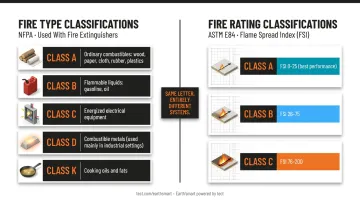
The practical takeaway: when a building code or product spec references a "Class A fire rating," it refers to the ASTM E84 surface burning classification. When a firefighter or safety manual references a "Class A fire," it refers to wood, paper, and ordinary combustibles. Same letter, entirely different systems.
Why Class A Fire Ratings Matter for Wildfire-Prone Homes
In California's Wildland-Urban Interface, Class A performance is a baseline requirement — not a premium upgrade.
California's CRC Chapter R337 (2022 California Residential Code, Title 24, Part 2.5) governs materials and construction for exterior wildfire exposure. CRC R337.5 requires WUI roof coverings to meet Class A roof-covering performance. Exterior wall coverings must comply through code pathways including noncombustible materials and ignition-resistant assemblies labeled for exterior use (CRC R337.7.3).
Los Angeles County post-fire guidance goes further, requiring applicants to provide the ICC/UL ESR number for selected roofing materials and prohibiting wood shingles and wood shakes in any Fire Hazard Severity Zone regardless of any other classification.
The Physics Behind the Requirement
Slower surface flame spread means more time — time for evacuation, time for fire suppression response. In a wildfire where embers can ignite multiple surfaces simultaneously, the cumulative impact of Class A materials across a home's envelope changes how fire spreads across the structure. IBHS research published in 2025 found that creating an ember-resistant zone around a home can cut wildfire ignition risk in half — and the IBHS Wildfire Prepared Home assessment specifically requires a Class A fire-resistant rated roof as a baseline qualifying criterion.
The Insurance Connection
Class A assemblies now carry direct financial implications. The California Department of Insurance's Safer from Wildfires framework lists a Class A fire-rated roof as a qualifying mitigation action, with CDI stating that insurers are required to offer wildfire mitigation discounts ranging 4%–40% for documented mitigation measures. In some parts of California's WUI, documented fire-resistive construction isn't just about discounts — it affects whether coverage is available at all.
Getting the Assembly Right
Material selection alone isn't enough. The substrate, product, thickness, and installation method must all match the tested configuration. This is where system-level coordination matters most. Earth'smart powered by tect addresses it through the earth'smart powered by tectApp™ community of 70+ vetted building product manufacturers, bringing manufacturer input into design rather than waiting until late in construction.
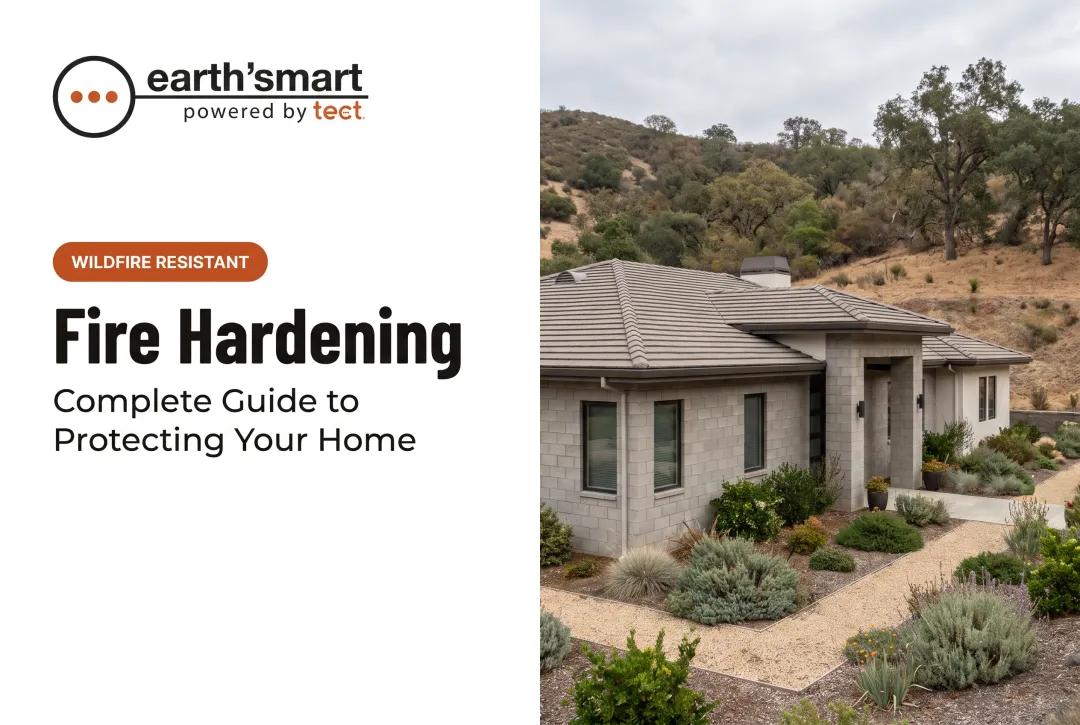
For WUI homes in Pacific Palisades and across California's high-risk fire zones, the result is a fully coordinated assembly:
- Class A roof systems (standing-seam metal, concrete tile, clay tile)
- Fire-resistive wall systems (pre-insulated CMU, ICF, AAC)
- Ember-resistant venting and non-combustible eaves
Each component is specified to work together — not assembled piecemeal by individual trades working without visibility into how the full system performs.
Common Misconceptions About Class A Fire Ratings
"Class A means the material is fireproof"
No building material tested under ASTM E84 is fireproof. Class A means the material significantly resists surface flame spread and limits smoke generation compared to lower-rated materials. Under sustained or extreme heat, it will still combust. Homeowners who treat "Class A" as a fireproofing guarantee tend to skip other fire-resilience measures that matter just as much: defensible space, ember-resistant venting, and integrated suppression.
"Flame spread rating and fire resistance rating are the same thing"
These are two distinct tests measuring different things:
| Flame Spread Rating | Fire Resistance Rating | |
|---|---|---|
| Standard | ASTM E84 | ASTM E119 |
| What it measures | How fast fire travels across a surface | How long an assembly prevents fire from passing through |
| Output | FSI (unitless index) | Hours (1-hour, 2-hour, etc.) |
| Applies to | Individual material surfaces | Structural assemblies (walls, floors, ceilings) |
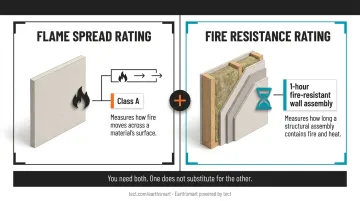
A Class A-rated drywall panel and a "1-hour fire-resistant wall assembly" are separate certifications produced by separate tests for separate purposes. One addresses surface flame spread; the other addresses structural containment. You need both — and one does not substitute for the other.
"Any Class A product achieves a Class A rating in any assembly"
A Class A-rated product installed in a different assembly than the one tested does not keep its Class A rating. Change the substrate, alter the thickness, modify the installation sequence — the certification no longer applies.
Before relying on any fire classification, verify the product documentation against the assembly as it will actually be built. A rating earned in a lab test only holds when the field installation matches that test exactly.
Frequently Asked Questions
What is a Class A fire rating?
Class A is the highest surface burning classification under ASTM E84, defined by a Flame Spread Index of 0–25 and Smoke Developed Index of 0–450. It measures how slowly flames spread across a material's surface under standardized test conditions — not whether the material is fireproof.
Does a Class A fire rating mean 1 hour of fire resistance?
No. These are separate tests for separate purposes. ASTM E84 Class A (FSI 0–25) describes surface burning behavior. A 1-hour fire resistance rating comes from ASTM E119, which measures how long a structural assembly — a wall, floor, or ceiling — prevents fire from passing through it. A product can have one, both, or neither designation.
Which is better: Class A or Class C fire rating?
Class A is the superior rating. An FSI of 0–25 means far slower flame spread than the FSI of 76–200 allowed under Class C. Class A is required in high-occupancy buildings, egress corridors, and WUI zones, while Class C is the minimum accepted standard, limited to low-occupancy structures like warehouses.
What are Class A, B, C, and D fires?
These are fire type classifications by fuel source — entirely separate from building material ratings. Class A: ordinary combustibles (wood, paper). Class B: flammable liquids. Class C: electrical equipment. Class D: combustible metals. This system governs extinguisher selection, not surface burning performance.
When is a Class A fire rating required by building code?
Main triggers include: multi-family and commercial buildings under IBC Table 803.13 (particularly egress corridors and stairwells in higher-risk occupancies), WUI zones in California under CRC Chapter R337, and specific jurisdictions with stricter requirements such as LA County's prohibition on wood shingles in Fire Hazard Severity Zones. Verify requirements with your local building department and confirm the applicable ESR number for any roofing materials.