Most homeowners rebuilding or building new face a version of the same tension: they want something beautiful and distinctive, but they also want to know it will perform. That it won't need constant repair. That it will still make sense in 30 years when design trends have cycled through twice.
This article answers the questions that sit underneath that tension: what actually defines an architect-designed home, what principles give these homes their staying power, how innovation and resilience are increasingly inseparable in high-risk regions, and what the architect-led process looks like from a homeowner's perspective.
Key Takeaways
- An architect-designed home starts from your specific site and goals — not a modified stock plan
- Timeless design comes from site responsiveness, honest materials, and functional clarity — not trend-chasing
- In wildfire-prone regions, the envelope and material decisions made in early design phases determine long-term resilience
- Integrating structural, mechanical, and envelope systems from day one is what separates high-performance homes from standard builds
- Early design decisions carry the most weight; getting them right eliminates costly problems later
What Is an Architect-Designed Home?
The term gets used loosely, but the definition is specific. An architect-designed home is one where a licensed architect (credentialed through education, the Architectural Experience Program, and the Architect Registration Examination as defined by NCARB) takes professional responsibility for synthesizing site conditions, client goals, structural requirements, and building systems into a unified design.
That's meaningfully different from a custom home built from a modified plan. A custom builder can swap finishes, adjust a floor plan, or add square footage. An architect-designed home begins from your specific context and is developed from the ground up around it.
What Architects Actually Bring
Architects combine two things most other design professionals don't: formal technical training and design thinking. They understand building codes, structural principles, envelope performance, and material behavior, and they apply those alongside spatial logic, proportion, and light. That combination is what produces homes that are both beautiful and buildable.
Why the Historic Examples Still Matter
Fallingwater — designed by Frank Lloyd Wright for the Kaufmann family, with the main house completed in 1937 — wasn't culturally significant because it looked striking in photographs. It endured because it solved real problems:
- Anchoring a building to its landscape rather than imposing on it
- Dissolving the boundary between interior and exterior
- Letting structure express itself honestly
Philip Johnson's Glass House (1949) applied the same rigor to transparency and site relationship.
These homes became touchstones through the discipline of their thinking, not stylistic novelty.
The Design Principles That Make These Homes Timeless
Site Responsiveness
Homes that feel inevitable rather than imposed are almost always deeply connected to their place. Architects orient rooms toward natural light, frame specific views, and adapt floor plans to topography. These decisions determine how a home is heated, cooled, lit, and experienced across every season.
The DOE's framework for passive solar design makes this concrete: a well-designed passive solar home uses its site, climate, windows, walls, and floors to collect, store, and distribute heat — reducing energy demand before mechanical systems are even needed. That kind of site attunement doesn't age. It compounds.
Proportion, Materials, and Functional Clarity
Three principles tend to separate homes that last from homes that date quickly:
- Proportion and spatial hierarchy: Ceiling heights, threshold transitions, and room sequencing shape how spaces feel. Well-proportioned rooms work through geometry — they don't need trends to feel complete
- Material honesty: Timeless homes use materials for what they are — exposed concrete, natural timber, stone. Veneers that mimic other materials degrade both physically and aesthetically in ways honest materials don't
- Functional clarity: Louis Sullivan's principle that form follows function isn't a constraint on beauty — it's what produces it. When every space has a clear purpose and the plan reflects how people actually live, the result holds up for decades
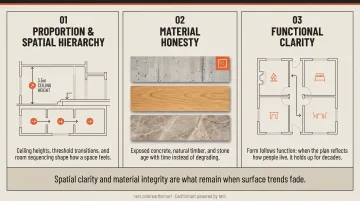
Homes built around these principles don't rely on decorative details to feel finished. That matters especially for homes designed to perform across a century — when surface trends fade, spatial clarity and material integrity are what remain.
Innovation in Architect-Designed Homes: Where Design Meets Technology
The most durable innovations in residential design aren't spectacle — they're solutions to real performance problems, integrated from the start rather than added later.
Envelope Performance
High-performance glazing is one area where measurable benchmarks now exist. ENERGY STAR Version 7.0 criteria (effective October 23, 2023) set specific targets: Northern-zone windows require a U-factor of 0.22 or less; Southern-zone windows require a U-factor of 0.32 or less with an SHGC of 0.23 or less. Specifying to these criteria isn't just about energy bills — it's about thermal comfort, condensation control, and long-term envelope integrity.
Material Innovation in High-Risk Regions
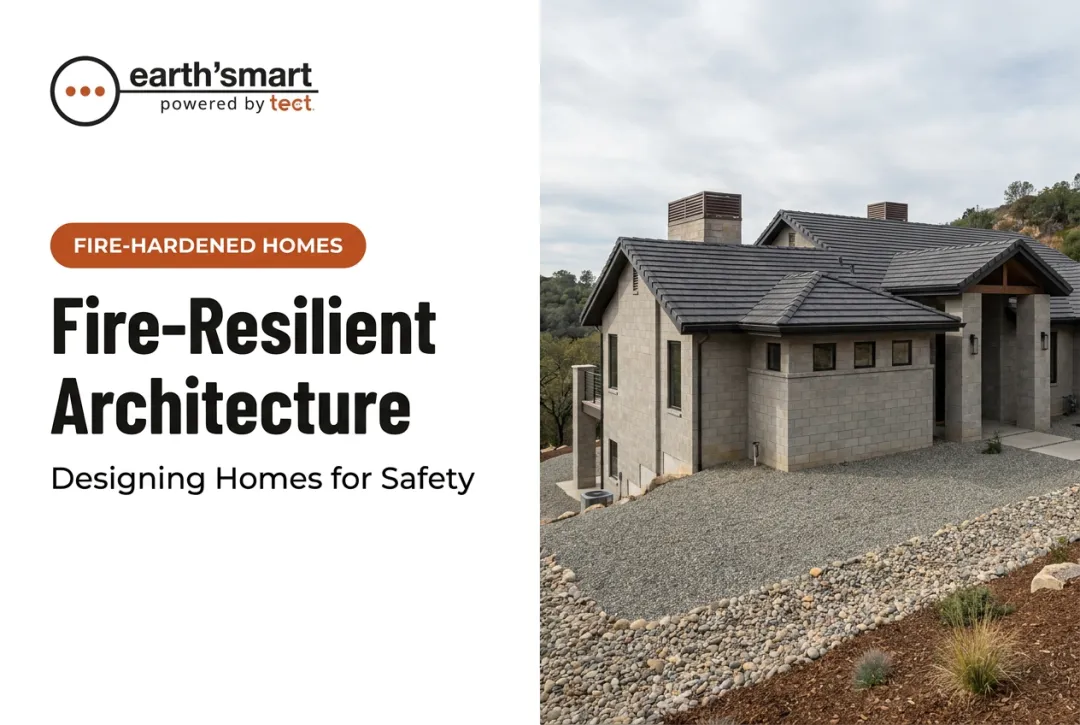
In wildfire-prone areas like Southern California's Wildland-Urban Interface (WUI), material specification is a design decision with direct life-safety implications. NFPA research identifies embers and small flames as the primary ignition pathway for most homes in wildfires. That finding shifts the focus: wildfire resilience is primarily an envelope and detail issue, not a landscaping one.
CAL FIRE's home-hardening guidance translates this into specific specifications:
- Class A fire-rated roof coverings
- Ember-resistant vents with 1/16-inch to 1/8-inch noncombustible mesh
- Multi-pane windows with tempered glass
- At least 6 vertical inches of non-combustible material at the base of exterior walls
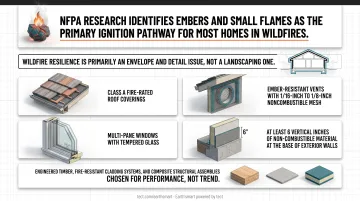
Engineered timber, fire-resistant cladding systems, and composite structural assemblies are now routinely specified in WUI projects where climate and risk conditions demand them — chosen for performance, not trend.
Systems Integration From Day One
The shift that distinguishes high-performing homes from standard construction isn't any single technology. It's the decision to integrate structural, mechanical, and envelope systems in early design phases rather than coordinating them — or failing to — during construction.
Early integration produces homes where every system reinforces the others. Late coordination — or none at all — shows up as performance failures, cost overruns, and maintenance problems that compound over time.
Early design coordination typically delivers:
- Mechanical systems sized correctly for the envelope they serve
- Structural assemblies that accommodate MEP routing without field modifications
- Envelope details resolved before they become construction conflicts
- A finished home where no system is fighting another
Built to Last: How Architect-Designed Homes Perform Over Time
A home that looks striking at completion but leaks, degrades, or fails under stress is not a well-designed home. True architectural design has always been about lifecycle performance as much as visual quality.
Designing for Risk
In WUI regions, designing for long-term performance means designing for the specific risk environment. IBHS research from 2025 found that building a 1,750-sq-ft home to California WUI Code Part 7 standards adds approximately $13,000 over traditional construction — while IBHS Wildfire Prepared Home Base certification can save more than $4,000 compared with that WUI code baseline. These are real numbers, and they reframe the cost conversation: upfront specification choices pay back in reduced exposure and, under California's Safer from Wildfires programme, can qualify homeowners for insurer discounts.
What "100-Year Home" Actually Means
ISO 15686-1, the international standard for service life planning in buildings, treats intended design life as a planning target built into every material, system, and detail decision. In practice, designing for 100+ year performance means:
- Structural assemblies chosen for durability, not minimum code compliance
- Envelope systems that resist degradation across climate cycles
- Mechanical and resilience strategies integrated from the start
- Adaptability — the ability for the home to serve different occupants and uses over generations
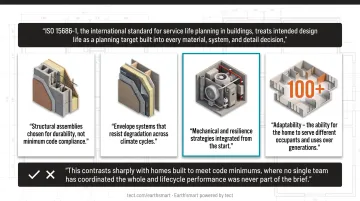
This contrasts sharply with homes built to meet code minimums, where no single team has coordinated the whole and lifecycle performance was never part of the brief.
earth'smart powered by tect's Approach to Performance
Earth'smart powered by tect's work in Pacific Palisades and surrounding WUI areas is grounded in this standard. The Earth'smart™ approach integrates architecture, engineering, and construction with direct input from the earth'smart powered by tectApp™ community of 70+ building product manufacturers from the earliest design phases.
Rather than guessing at systems or specifying them in isolation, this approach ensures structural, mechanical, and envelope decisions are made together, correctly, and early.
The material strategy reflects WUI conditions directly, with every element specified from the start:
- Fire-resistive exterior wall systems using pre-insulated concrete masonry
- Non-combustible assemblies throughout
- Long-life roofing
- Dedicated on-site water supply integrated with site-scale suppression systems
- Fresh-air environmental controls
Because these decisions are coordinated before construction begins, the systems perform as intended — not as afterthoughts retrofitted into a finished design.
In a region where insurance coverage is increasingly difficult to obtain and premiums are rising, homes designed to this level of specification are better positioned for today's insurance landscape.
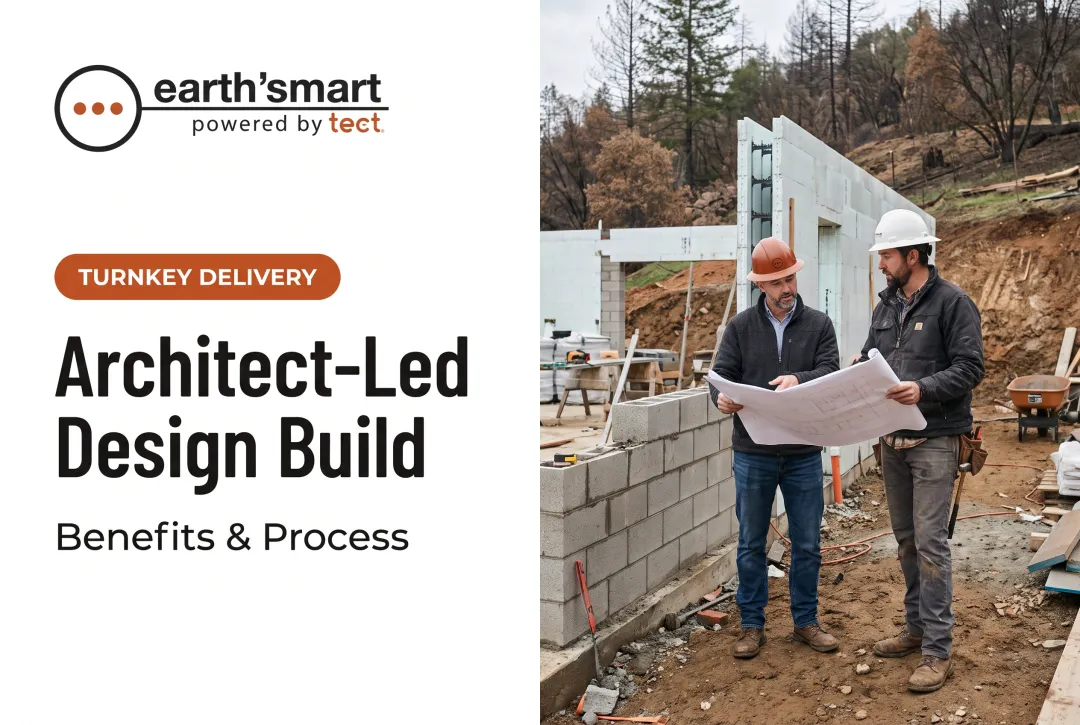
What to Expect From the Architect-Led Design Process
The Phases and Why They Matter
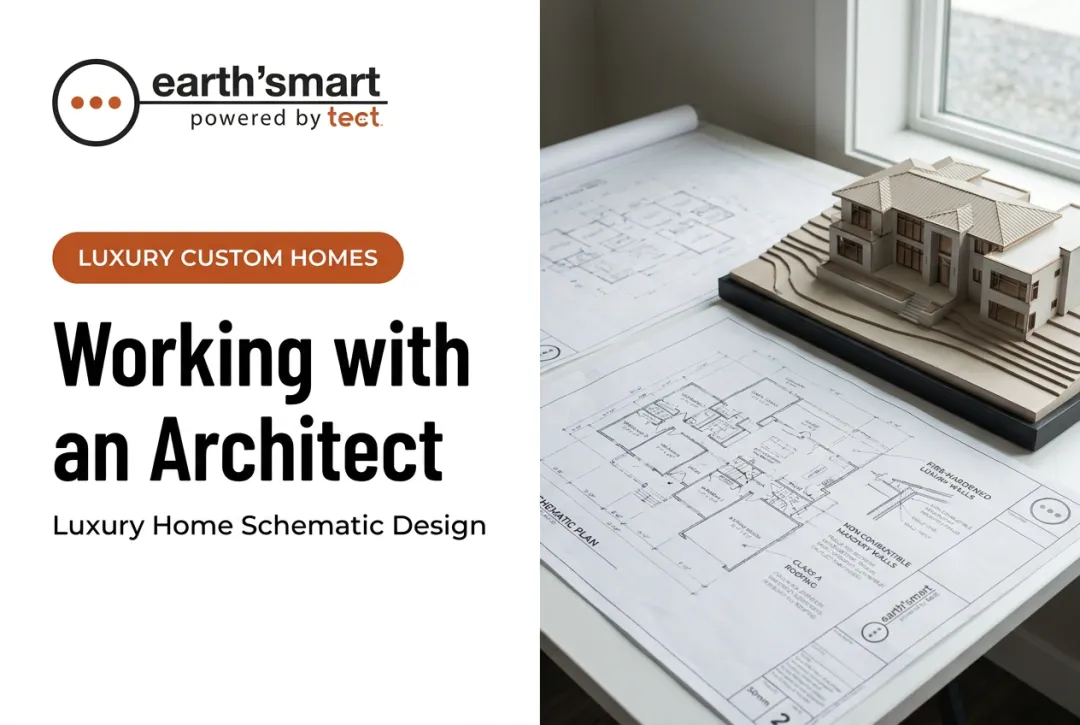
The AIA defines basic architectural services across five phases:
- Schematic design — establishes overall direction and budget alignment
- Design development — turns concept into coordinated systems and materials
- Construction documents — produces the drawings and specifications used for permitting, pricing, and building
- Bid/negotiation — aligns contractor scope and pricing against the design
- Construction administration — supports design intent through the build
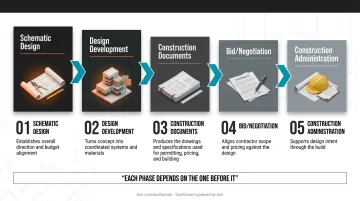
Each phase depends on the one before it. The decisions made in schematic and design development — how the building sits on its site, how systems are coordinated, which materials are specified — carry more consequence than any decision made later.
Getting these right eliminates the coordination failures, change orders, and performance shortfalls that plague projects where early thinking was rushed.
Why the Architect's Role During Construction Matters
An architect who stays engaged through construction catches installation errors before they're buried in walls and verifies that systems perform as designed. Construction administration isn't an optional add-on — it's how design intent becomes built reality.
What to Look For When Selecting an Architect
For a performance-focused home in a high-risk region, the selection criteria go beyond portfolio aesthetics:
- Licensure: NCARB-verified (not just AIA membership) — the legal credential required to offer architectural services
- Risk environment experience: WUI, seismic, and flood conditions each require specific, practiced knowledge
- Systems coordination: Look for architects who integrate structural, mechanical, and envelope scopes — not those who treat them as separate consultants' problems
- Early manufacturer engagement: Architects who involve product experts before decisions are locked in — through resources like tect's earth'smart powered by tectApp™ community of 70+ building product manufacturers — produce fewer surprises and better-performing assemblies
Frequently Asked Questions
What is an architect-designed home?
An architect-designed home is one where a licensed architect takes full responsibility for design — coordinating site conditions, structural requirements, building systems, and client goals into a unified whole. This differs from adapting a stock plan or using a design-build service without licensed architectural oversight.
How much does it cost to hire an architect to design a house?
Architectural fees for custom residential projects typically run 8–15% of construction cost, or a fixed fee scoped to the project. That investment in early coordination regularly offsets downstream costs: problems caught on paper are far cheaper to resolve than problems caught during construction.
What is the 80/20 rule in architecture?
In architecture, the 80/20 principle holds that most of a project's long-term performance is determined by decisions made in the earliest design stages. Changes made on paper cost a fraction of what the same changes cost once construction is underway, which is why early design investment pays outsized returns.
Is an architect-designed home worth the investment?
For sites with complex conditions, high-risk exposures, or performance requirements beyond minimum code, professional architectural coordination is less a luxury than a necessity. In WUI areas, the envelope and material decisions made in early design phases have direct implications for resilience, maintenance costs, and insurance eligibility.
How long does it take to design and build an architect-designed home?
Custom architect-designed homes generally spend several months in design before construction begins, with build duration varying by site complexity. For custom projects with full design coordination, that upfront time investment typically shortens the construction phase by reducing conflicts, change orders, and delays.
What is the difference between an architect-designed home and a custom builder home?
Custom builder homes typically use modified stock plans, with system coordination happening late in the process and with limited input from specialists. Architect-designed homes begin from site-specific conditions and coordinate structural, mechanical, and envelope systems through the full design process — producing homes that perform as a unified whole rather than a collection of independently specified parts.