Introduction
When the Palisades Fire tore through Los Angeles in January 2025, it destroyed 6,845 structures — and left others standing. The pattern wasn't random. Homes with non-combustible exteriors, enclosed eaves, and protected openings consistently fared better than those clad in wood, vinyl, or composite panels that became fuel.
For homeowners rebuilding in Pacific Palisades and similar WUI communities, exterior cladding is one of the first and most consequential decisions they'll make. The outer wall surface is where wildfire meets your home — through radiant heat, direct flame contact, and wind-driven embers landing at every gap and joint.
Non-combustible metal cladding — steel and aluminum specifically — is increasingly the material of choice for resilience-focused designers. But the material alone doesn't tell the whole story. Research from IBHS found that homes with a package of hardening measures — non-combustible siding, Class A roof, double-pane windows, and enclosed eaves — had a 54% likelihood of avoiding damage, compared to just 36% for a single action.
Cladding matters. The assembly matters more. This guide covers both: what makes metal cladding effective, how the surrounding assembly determines real-world performance, and the installation details that separate a resilient home from one that merely looks the part.
Key Takeaways
- Steel and aluminum cladding carry A1 (fully non-combustible) ratings — they don't ignite, spread flame, or add fuel to a fire
- Combustible cladding becomes the fire's fuel source, enabling vertical spread and re-entry through windows, vents, and gaps
- Fire ratings run A1 to F; only A1 and A2 qualify as non-combustible, with A1 meaning zero contribution to fire
- CBC Chapter 7A compliance requires documented assembly performance, not product labels alone
- Best practices require matching non-combustible insulation, subframe, and installation details throughout the full assembly
What Is Non-Combustible Metal Cladding?
Non-combustible cladding is exterior wall material that does not ignite, burn, or contribute fuel when exposed to fire. That's a different standard than "fire resistant," which describes materials rated to withstand fire for a measured period. Both terms have specific technical meanings — and confusing them leads to real specification errors.
Which Metals Qualify
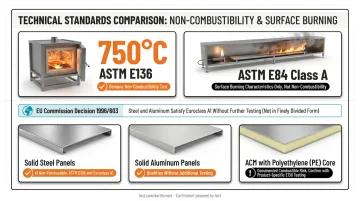
In the US, the relevant non-combustibility test is ASTM E136, which exposes materials to a 750°C furnace. The more commonly cited ASTM E84 "Class A" rating measures surface burning characteristics — not non-combustibility. For genuine non-combustibility claims, E136 test evidence is what matters.
Internationally, EU Commission Decision 1996/603 deems steel and aluminum to satisfy Euroclass A1 — the highest non-combustible classification — without further testing, provided they are not in finely divided form.
Not all metal cladding meets that standard. Here's how common materials break down:
- Solid steel panels — qualify as A1 non-combustible under both ASTM E136 and Euroclass A1
- Solid aluminum panels — same classification; qualify without additional testing
- ACM with polyethylene (PE) core — documented combustible risk; government evidence places PE-core ACM anywhere from flammable to non-combustible depending on core composition. Do not treat as non-combustible unless a product-specific E136 test confirms it.
Where Cladding Fits in the Wall System
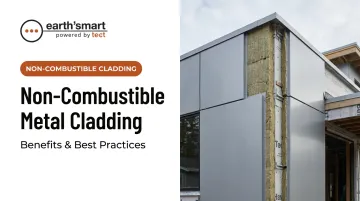
Metal cladding is the outermost layer of the exterior wall assembly. In a wildfire event, it is the first point of contact for radiant heat, direct flame, and ember accumulation. A1-rated panels don't ignite at that contact point. That protection only holds if the layers immediately behind them are equally non-combustible.
Why Combustible Cladding Is a Serious Risk in Fire-Prone Areas
In wildfire-prone areas, the exterior wall isn't just a finish layer — it's the first line of defense. When that wall is combustible, it stops defending and starts contributing to the fire.
Vertical Fire Spread
When combustible cladding ignites — from an ember landing in a joint, a burning branch against the wall, or radiant heat from a neighboring structure — the panel itself becomes a fuel source. Flames climb vertically up the wall face, moving faster than internal suppression can respond and reaching upper floors and roof junctions before occupants or firefighters can intervene.
Fire Re-Entry Through the Envelope
As flames travel across the wall surface, they exploit every gap in the building envelope: open windows, vent openings, gaps at eaves, and cladding terminations. Fire re-enters the structure at multiple levels simultaneously, bypassing compartmentalization and fire doors. What started as an exterior event becomes a full interior event within minutes.
The Hidden Toxic Smoke Risk
Combustible plastic-containing cladding — composites, vinyl, PE-core ACM — generates toxic smoke when burning — smoke that can be drawn into HVAC and ventilation systems and pose life-safety risks well after the flames are out. NFPA's research on exterior wall assemblies addresses combustible wall systems, fire-spread mechanisms, and toxicity risks as a distinct hazard category.
Combustible cladding doesn't fail passively. It accelerates the fire and increases risk to everyone inside and around the building.
Understanding Fire Ratings for Metal Cladding
The Euroclass System
EN 13501-1 classifies reaction to fire on a scale from A1 through F:
| Class | Meaning | Examples |
|---|---|---|
| A1 | No contribution to fire | Solid steel, solid aluminum |
| A2 | Negligible contribution; smoke and droplet limits apply | Some fiber cement products |
| B | Very limited contribution | — |
| C–D | Limited to medium combustibility | Treated timber (varies) |
| E–F | Combustible to easily flammable | Untreated timber, standard EPS foam |
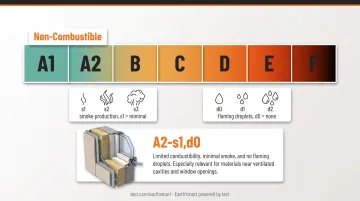
Only A1 and A2 are considered genuinely non-combustible. From B downward, cladding materials contribute fuel to a fire to varying degrees.
For A2 and below, sub-classifications add important nuance:
- s1, s2, s3 — smoke production (s1 = minimal)
- d0, d1, d2 — flaming droplets (d0 = none)
An A2-s1,d0 rating means limited combustibility, minimal smoke, and no flaming droplets — especially relevant for materials near ventilated cavities and window openings.
California WUI Compliance: Chapter 7A
California building code operates on different language than Euroclass ratings. Under CBC 2022 Chapter 7A, Section 707A, exterior wall coverings in WUI Fire Areas must comply through one of these paths:
- Non-combustible material
- Ignition-resistant material labeled for exterior use
- Fire-retardant-treated wood
- 5/8-inch Type X gypsum sheathing behind the covering
- Assembly tested to ASTM E2707 with 10-minute direct flame contact and no flame penetration
Solid steel and aluminum panels can support the non-combustible material compliance path, but California permitting requires US code-recognized evidence, not just a Euroclass certificate. Both describe the same material behavior, but the compliance documentation must reflect local code requirements.
Note that DGS's 2025 code-cycle update relocated Chapter 7A requirements. Homeowners rebuilding post-2025 should confirm the current code location with their local building official.
One more distinction worth noting: IBC Type I and Type II construction (the two highest fire-resistance classifications) require non-combustible building elements. For low-rise single-family WUI homes, however, Chapter 7A is usually the operative compliance path rather than commercial IBC type classifications.
Key Benefits of Non-Combustible Metal Cladding for Homeowners
Fire Safety
A1-rated metal cladding does not ignite from radiant heat, direct flame, or ember contact. It adds no fuel to the fire. In a wildfire event, that means the exterior wall stays intact rather than becoming the mechanism by which fire climbs and re-enters your home. Unlike combustible siding, which can carry flame vertically up a wall face, non-combustible cladding simply stops participating in the fire.
Durability and Longevity
Steel and aluminum are impervious to rot, insect damage, and moisture degradation. The Aluminum Association notes that aluminum building products can achieve 70+ year service lives — meaningful for homeowners making a long-term investment. Steel longevity depends on substrate, coating system, and coastal exposure. Properly specified steel cladding with appropriate metallic and paint coatings performs across multiple decades.
Insurance Implications
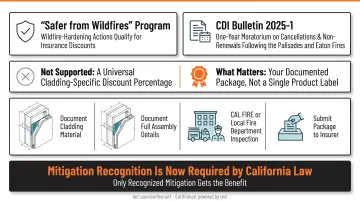
California DOI's Safer from Wildfires program confirms that wildfire-hardening actions qualify for insurance discounts, and its 2025 mitigation FAQ requires insurers to incorporate mitigation into rating plans and wildfire risk models. Following the Palisades and Eaton fires, CDI Bulletin 2025-1 also imposed a one-year moratorium on cancellations and non-renewals in affected ZIP codes.
What the evidence does not support is a universal cladding-specific discount percentage. The outcome depends on your documented package — not a single product label.
The practical guidance: document your cladding material, full assembly details, and any CAL FIRE or local fire department inspections, then submit that package to your insurer. Mitigation recognition is now required by California law — but only recognized mitigation gets the benefit.
Low Maintenance and Aesthetic Range
Metal cladding requires no periodic sealing, staining, or rot treatment. Compared to wood-based alternatives that need active maintenance every few years, the lifecycle cost advantage is real and significant over the life of the home.
Aesthetically, modern metal cladding is not the industrial corrugated sheet of 30 years ago. Current profiles span a wide range of architectural styles, including:
- Standing seam for clean contemporary facades
- Interlocking plank for a more traditional horizontal look
- Shingle profiles that replicate natural materials without the combustibility
Each is available in a broad palette of colors and factory-applied finishes.
Best Practices for Specifying Non-Combustible Metal Cladding
Verify the Rating with Certified Fire Test Documentation
Request fire test certificates directly from the manufacturer — not from product marketing materials. Confirm that the full assembly was tested together: panel, subframe, insulation, and wall backing. A panel-only certificate does not confirm how the system performs when installed over foam insulation with a timber subframe.
For California permitting, ASTM E2707 assembly testing is the relevant path when the assembly includes components that might not individually satisfy the non-combustible material path.
Specify Non-Combustible Insulation
This is one of the most commonly overlooked gaps in residential fire hardening. Placing A1-rated cladding over standard EPS or XPS foam insulation (which can be Class E or F) undermines the entire fire strategy.
The insulation layer directly behind the cladding must be A2-rated or better. The cavity, water-resistive barrier, and furring all contribute to actual fire performance.
Use Non-Combustible Subframe and Support Systems
Subframe rails, brackets, and fasteners should be steel or aluminum — not timber battens. Timber used as a cladding subframe introduces combustibility directly into the wall assembly, immediately behind your A1 panel. This detail is frequently missed when cladding is specified in isolation from the rest of the wall system.
Eliminate Ember Intrusion Points
Gaps at these locations are common fire entry points that defeat cladding performance:
- Cladding terminations at foundation and eave lines
- Window and door surrounds
- Vent openings and soffit junctions
- Wall-to-roof junctions
Proper detailing with non-combustible trims, sealed joints, and appropriate ember-resistant vent screens is essential. Ember accumulation at these junctions is a primary ignition mechanism even when the cladding itself is non-combustible.
Confirm Current Code Compliance and Document It
Code requirements for WUI exterior cladding are actively evolving. Homeowners rebuilding in California should confirm their assembly meets the current local code path. The 2025 code cycle relocated Chapter 7A requirements, so the applicable section may have changed from what earlier permits referenced.
Document compliance as part of permitting. If you're rebuilding now, verify the current section reference before finalizing your specifications.
Why Cladding Alone Isn't Enough: The Case for Whole-Envelope Integration
IBHS's findings from the 2025 LA fires make the point clearly: when near-home fuel coverage in the first five feet exceeded 25%, damage or destruction risk rose to nearly 90% — regardless of siding material. Fire resilience is a system outcome, not a product outcome.
Non-combustible cladding over combustible sheathing, combustible insulation, or unsealed penetrations can still allow fire to enter the structure. The full wall assembly — panel, insulation, sheathing, subframe, fasteners, and termination details — must be engineered as an integrated, non-combustible system from the start.
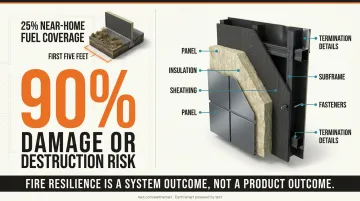
Cladding material, insulation type, subframe system, and wall detailing need to be decided together. Late changes to one component cascade through the others, and errors found after construction begins are expensive to fix.
most homes are built through a fragmented process — late decisions, disconnected teams, limited product insight, and minimum-code thinking. Homes that look complete still fail where it counts. Getting the system right means making those decisions early, with the companies behind the materials at the table before walls are framed.
Frequently Asked Questions
Is metal cladding non-combustible?
Solid steel and aluminum cladding are classified as Euroclass A1 — fully non-combustible — under EU Commission Decision 1996/603, and support Type I/II non-combustible construction classifications under US building codes. Aluminum composite panels with polyethylene cores are not non-combustible and must be distinguished from solid metal cladding products.
What is non-combustible cladding?
Non-combustible cladding is exterior wall material that does not ignite or contribute fuel to a fire. The term has a specific technical meaning: "non-combustible" (A1/A2 rated, does not burn) is different from "fire resistant" (rated to withstand fire for a measured period). Both have distinct definitions in building codes — knowing which applies to your project matters.
What is the best fireproof cladding?
Solid steel and aluminum achieve A1 classification (no contribution to fire), making them the highest-rated exterior cladding options. The best choice also depends on the full wall assembly: non-combustible insulation, subframe material, and installation detailing all affect system performance, not just the panel.
Does non-combustible cladding help with home insurance in high-risk fire zones?
California DOI now requires insurers to account for wildfire mitigation in their rating plans and models, and non-combustible exterior materials are part of that framework. Homeowners in WUI zones should document their full cladding assembly — materials, ratings, and installation details — and share it with their insurer. No universal discount applies, but insurers are now required to recognize documented mitigation measures.
What fire rating should exterior cladding have in a WUI or high-risk fire zone?
Under California's Chapter 7A, exterior wall coverings in WUI Fire Areas must be non-combustible, ignition-resistant, or meet alternative tested assembly paths. A1 or A2-rated metal cladding is the safest choice, but compliance must be documented with US code-recognized evidence. Verify current requirements with your architect or local building department — the 2025 code cycle updated Chapter 7A, and requirements may have shifted.
Can I use metal cladding over existing combustible sheathing when rebuilding?
Adding non-combustible cladding over combustible substrate or insulation does not create a fully non-combustible wall assembly. Fire can still enter through gaps and compromised layers behind the panel. For genuine fire resilience, the entire assembly: sheathing, insulation, framing, and detailing, must be evaluated and specified together with qualified design input.