That connection is the problem. IBHS research shows that embers and small flames cause 60–90% of home ignitions during wildfires — and a combustible fence gives those embers a ready fuel path straight to the structure. Fencing isn't a landscape decision. In wildfire-prone areas, it's a fire safety decision.
This guide covers how fire travels through fencing, which materials actually resist ignition, how to place and maintain fencing correctly, and the most common mistakes to avoid when rebuilding or upgrading in a WUI zone.
Key Takeaways
- Combustible fences act as ignition pathways — carrying fire straight from the property line to your home
- Steel, aluminum, concrete, or masonry are the strongest choices; fire-retardant treated wood is a viable middle-ground option
- The 0–5 foot zone immediately around your home is the highest-priority upgrade area
- Class A fire ratings and WUI/IWUI compliance are the certifications to look for in high-risk zones
- Fencing decisions must coordinate with gates, decks, vents, and siding — not be treated in isolation
Why Your Fence Is a Fire Pathway Risk
Wildfires don't always reach homes through direct flame contact. The more common mechanism is wind-driven embers landing on or near combustible surfaces — and NIST research identifies fences as "efficient carriers of fire" because they spread flame laterally and generate additional firebrands that travel to new locations.
A combustible fence, once ignited at the perimeter, acts as a wick — carrying fire horizontally across the property, bypassing defensible space efforts, and delivering flame directly to the structure, deck, or siding.
The Marshall Fire Example
That mechanism isn't theoretical. FEMA's 2025 Marshall Fire Mitigation Assessment Team report documented it in practice. Wood fences acted as "wicks" that created combustible pathways, connecting open-space fuels to residential structures across dense suburban parcels. The lesson isn't that every fence caused every ignition — it's that connected fuels created parcel-to-parcel fire pathways that defensible space efforts couldn't interrupt.
Fire-Resistant vs. Noncombustible: A Critical Distinction
These terms are not interchangeable. The distinction determines how a material performs under sustained wildfire exposure — not just in a lab:
- Fire-resistant — slows ignition or flame spread under controlled test conditions; the material can still burn
- Noncombustible — does not ignite, does not contribute fuel, does not sustain combustion under any standard test condition
A fence labeled "fire-resistant" may pass a controlled laboratory test and still contribute meaningfully to fire spread under sustained wildfire exposure. Noncombustible materials don't.
Zone 0: The Highest-Risk Area
CAL FIRE defines Zone 0 as the 0–5 foot perimeter immediately surrounding the structure. This is where ember accumulation is heaviest, where radiant heat is most intense, and where a single ignition point is closest to the building envelope. IBHS's 2025 Wildfire Prepared Home Technical Standard requires that combustible fencing within 5 feet of the home be removed or replaced as a baseline requirement.
Fire-Resistant Fencing Materials Compared
Evaluating fencing materials for wildfire risk comes down to three questions: Does it burn? How does it behave under heat? Does its performance degrade over time?
Noncombustible Options: Steel, Aluminum, and Masonry
These materials have the strongest evidence base for Zone 0 and connected fence sections:
| Material | Fire Behavior | Best Use |
|---|---|---|
| Steel | Noncombustible; maintains structural integrity under heat | Zone 0 sections, gates, full perimeter |
| Aluminum | Noncombustible metal; verify product-specific documentation | Zone 0 breaks, gates, decorative perimeter |
| Concrete / Masonry / CMU | Most non-combustible option; cannot burn, releases no combustion byproducts | Full perimeter barriers, maximum protection |
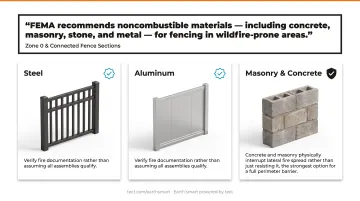
FEMA recommends noncombustible materials — including concrete, masonry, stone, and metal — for fencing in wildfire-prone areas. Concrete and masonry are the strongest option where a full perimeter barrier is needed, since they physically interrupt lateral fire spread rather than just resisting it.
One important caveat: for aluminum and powder-coated steel products, verify the specific product's fire documentation rather than assuming all assemblies qualify.
Fire-Retardant Treated Wood (FRTW)
FRTW is a legitimate middle ground for homeowners where natural wood aesthetics matter — but only if the product is properly listed and labeled.
Standard stained or sealed wood is not FRTW. True FRTW is permanently pressure-impregnated with fire-retardant chemicals, not surface-coated. For exterior WUI use in California, the product must meet:
- Flame spread index of 25 or less (Class A)
- No significant progressive combustion
- ASTM D2898 Method A weathering test for exterior exposure
- OSFM Building Materials Listing for WUI/Chapter 7A compliance
Materials to Avoid or Use with Caution
- Untreated wood — ignites readily, generates traveling firebrands; FEMA's Marshall Fire findings identify wood fences as the highest-risk common fencing material
- Standard vinyl — CAL FIRE confirms vinyl can ignite from direct flame exposure and deforms under radiant heat, losing structural integrity before it burns
- Wood-plastic composite — NIST has studied wind-driven fire spread from composite fences; treat as combustible unless the specific product has independent fire-test documentation accepted by local code
For homeowners rebuilding in communities like Pacific Palisades, fencing material selection is now a code compliance decision — and it rarely stands alone. Fencing, siding, vents, and decking all interact as a system, and selecting one without coordinating the others creates gaps that undermine the whole assembly. Earth'smart powered by tect addresses this directly: through the earth'smart powered by tectApp™ community of 70+ building product manufacturers, fencing and envelope decisions are aligned from the design phase, with the right expertise involved before materials are ever specified.
Fencing Placement and Defensible Space Guidelines
Material choice matters, but placement and installation decisions determine whether that material actually protects your home.
The 5-Foot Noncombustible Zone Rule
IBHS is specific: fencing attached to a house must be noncombustible for at least 5 feet from the structure. Where a combustible fence continues beyond that point, a metal gate or a 5-foot noncombustible section should serve as the break point. Never attach a combustible fence directly to the building wall, deck, or soffit.
Fence Design and Ember Risk
Fence geometry affects how embers accumulate and how fire spreads. Key findings from NIST research:
- Parallel combustible fences just 18 inches apart can be fully engulfed in under 4 minutes
- Closely spaced parallel fences create chimney effects that accelerate fire
- Combustible debris and mulch trapped along fence bases intensifies burning
Open fence designs reduce ember collection compared to solid privacy fences, but the most important variable is always whether the material itself is combustible — not the spacing.
Landscaping Along the Fence Line
A noncombustible fence doesn't perform in isolation. FEMA's Marshall Fire homeowner guide recommends keeping combustible landscaping at least 5 feet from combustible fences and replacing flammable mulch with stone or other ignition-resistant materials.
Clear debris regularly, avoid pine-straw mulch, and maintain spacing between plants and fence panels. The fence line is one component of defensible space — it only performs when the surrounding ground conditions support it.
Gate Selection
Gates are where fence lines physically meet the structure — and one of the highest single-risk attachment points on the perimeter. Follow these rules:
- Use steel or aluminum gates at every connection point to the structure
- Never use wood gates where the fence attaches to a home wall, deck, or entry
- Apply the same noncombustible rule to gates as to the 5-foot zone along the wall
- Ensure gate hardware (hinges, latches) is also metal, not plastic
Retrofitting vs. Replacing: Where to Start
Full fence replacement is rarely the only option — a phased approach lets you reduce risk now and upgrade further as resources allow.
Phased Upgrade Approach
Follow this sequence, starting with the highest-risk section first:
- Zone 0 (0–5 feet from structure) — Replace the fence section where it connects to the home wall, deck, or garage with a noncombustible material or metal gate. This single action breaks the ignition pathway.
- Gate upgrade — If any gate connects to the structure with combustible materials, replace it with steel or aluminum.
- Side-yard runs — Address sections where two fences run parallel close together, or where fence lines connect to decks, sheds, or neighboring fences.
- Perimeter — Work outward as resources allow, prioritizing sections adjacent to open-space edges or dense vegetation.
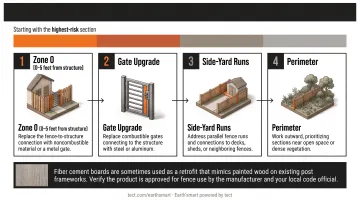
One material worth noting as you work through these zones: fiber cement boards are sometimes used as a retrofit option that mimics painted wood on existing post frameworks. If considering this, verify the specific product is approved for fence use by the manufacturer and your local code official — this application is less well-tested than its use as wall cladding.
Interim Measures (When Zone Upgrades Aren't Yet Possible)
If material replacement isn't immediately feasible, these steps reduce ignition risk while you plan the next phase.
These steps reduce risk but don't substitute for Zone 0 material upgrades:
- Clear all combustible debris from along the fence base
- Remove flammable mulch within 5 feet of the fence
- Trim vegetation away from fence panels
- Ensure no stored materials — firewood, containers, furniture — are leaning against the fence near the structure
Common Fire-Resistant Fencing Mistakes to Avoid
Even well-chosen fencing materials fail when installation decisions undercut them. These three mistakes show up repeatedly in WUI properties.
Connecting Combustible Fence Material Directly to the Structure
This is the most preventable cause of fence-driven home ignition. A direct combustible connection from fence to wall, deck, or soffit creates an uninterrupted fuel path. A metal gate or a noncombustible 5-foot section breaks it.
Treating Fire-Resistant Ratings as Equivalent to Noncombustible
A "fire-resistant" label on vinyl or composite fencing describes performance under a controlled test, not behavior under sustained wildfire exposure. In WUI zones, real-condition combustibility is what matters most. Class A ASTM E84 results describe flame spread and smoke development indices (how quickly fire travels and how much smoke a material produces) — they don't certify a fence assembly as ember-proof.
Upgrading the Fence Without Addressing the Surrounding Zone
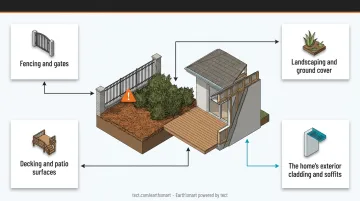
A noncombustible fence adjacent to pine-straw mulch, dense vegetation, or an unprotected wood deck gains far less value than its material rating suggests. Fire-resistant fencing performs as part of a coordinated system. All of these need to be addressed together:
- Fencing and gates
- Landscaping and ground cover
- Decking and patio surfaces
- The home's exterior cladding and soffits
Frequently Asked Questions
What is the best fireproof fencing?
Noncombustible materials (steel, aluminum, and concrete or masonry) are the strongest options because they don't ignite or contribute fuel to fire. Concrete and masonry provide the most fire-inert perimeter barrier, while metal fencing is widely used in WUI zones for Zone 0 sections and gates.
What is the difference between fire-resistant and noncombustible fencing?
Fire-resistant fencing slows ignition or flame spread under controlled test conditions but can still burn. Noncombustible fencing (the metal and masonry options above) does not ignite or add fuel under any standard test condition — a meaningful difference when a wildfire sustains exposure for hours, not minutes.
How far should a fence be from my house to reduce fire risk?
IBHS recommends using noncombustible materials within 5 feet of any structure. Never attach a combustible fence directly to the building. Use a metal gate as the break point between the fence line and the structure at every connection point.
Can I add fire resistance to an existing wood fence?
Surface-applied fire retardant coatings offer limited, temporary protection and don't match the performance of pressure-treated FRTW. The most effective approach is replacing the section nearest the structure with a noncombustible panel or metal gate, even if the rest of the fence stays in place.
Does fire-resistant fencing affect homeowners insurance?
Yes. California's Safer from Wildfires framework lists a 5-foot ember-resistant zone (including fencing) as a qualifying action for insurance discounts. Document Zone 0 upgrades and confirm specific qualifying improvements with your insurer.
What fire rating should I look for in fencing materials?
Class A under ASTM E84 standards is the highest rating, indicating a flame spread index of 0–25 and smoke-developed index of 0–450. In WUI zones, also look for WUI or IWUI compliance and, in California, OSFM Building Materials Listing approval for the specific product.