Introduction
On the night of October 8–9, 2017, the Tubbs Fire tore through Santa Rosa and unincorporated Sonoma County, burning 36,807 acres, destroying 5,636 structures, and killing 22 people. In a single night, Santa Rosa lost 3,043 housing units — the largest residential loss any California city had absorbed from wildfire in modern history.
Eight years later, most of those homes have been rebuilt. But the recovery story is more complicated than that headline suggests, and the details are worth understanding.
As communities from Pacific Palisades to Altadena face the same question in 2025, the Tubbs Fire offers something no other event can: a multi-year, documented case study of how neighborhoods actually survive, stall, and rebuild after catastrophic wildfire — with survivor accounts and rebuild data that earlier disasters simply didn't produce.
This article traces what the Tubbs recovery looked like phase by phase — timelines, bottlenecks, community tools that worked, and design decisions that anyone facing a similar path today needs to understand.
Key Takeaways
- ~2,508 residential units rebuilt in Santa Rosa as of July 2025, with 504 still under construction and 298 more with permits issued but construction pending
- Fastest individual rebuilds took roughly 22 months from fire to move-in; community-wide recovery spans a decade or more
- Insurance gaps, permitting delays, and contractor scarcity were the three biggest choke points
- The Block Captain model (structured weekly neighborhood coordination) was the most effective grassroots tool for keeping households from falling through the cracks
- Homes rebuilt to code minimum restore square footage — homes built with fire-resistive assemblies and non-combustible materials reduce the likelihood of losing them again
The Recovery Timeline: How Long Did Rebuilding Actually Take?
The honest answer is: it depends, and the range is wider than most people expect.
Santa Rosa's Resilient City Recovery dashboard, updated July 7, 2025, shows 2,508 residential units completed, with another 504 under active construction and 298 more with permits issued but construction not yet started. An additional 228 parcels still have not submitted a permit application at all — nearly eight years after the fire.
Neighborhood-Level Gaps Tell the Real Story
The gap between Coffey Park and Fountaingrove illustrates how dramatically outcomes diverged by neighborhood.
- Coffey Park: Santa Rosa Fire spokesperson Paul Lowenthal confirmed in October 2025 that the area is 96–97% rebuilt, with few vacant lots remaining
- Fountaingrove: Five years post-fire, roughly 936 of 1,619 lost units had been rebuilt or were under construction — around 70%, with construction still ongoing years later
- Larkfield Estates: Unincorporated Sonoma County, outside Santa Rosa's Resilient City zoning, faced different permitting conditions and varied timelines
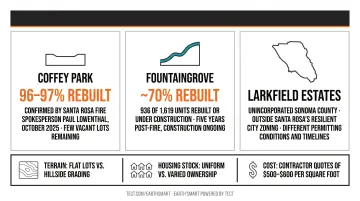
The divergence came down to terrain, housing stock, and cost. Coffey Park's flat lots and more uniform housing made it easier to standardize rebuilds and move quickly. Fountaingrove's hillside terrain, higher rebuild costs (contractors were quoting $500–$600 per square foot in some cases), and more varied ownership profiles created friction at every stage.
The Psychological Dimension
One dimension that rarely appears in recovery dashboards: residents described adapting to nearly a decade of construction noise, vacant lots, and disrupted streetscapes as a defining feature of post-fire life. Not a temporary phase — a sustained condition.
Recovery planning needs to account for sustained neighborhood livability across that entire span — not just permit counts and construction milestones.
Phase by Phase: From Debris Removal to Move-In Day
Understanding the Tubbs recovery timeline requires breaking it into distinct phases. Each has its own dependencies, and delays in one compound across all the rest.
Phase 1 — Debris Removal
Before any rebuild can begin, the lot must be cleared of hazardous materials and fire debris. For Sonoma County victims, the U.S. Army Corps of Engineers managed this process through a county cleanup program backed by a $475M contract. By June 2018, the USACE-led operation had removed 2.2 million tons of debris from more than 4,500 properties.
Federal debris removal is tied to disaster declarations and public assistance programs — it is not automatically available after every wildfire. Homeowners in future fire zones should not assume this resource will exist.
Phase 2 — Design and Builder Selection
This is where many recoveries stall. With the lot cleared, homeowners must select a builder, finalize floor plans, and prepare permit-ready documents. Every week lost here adds weeks downstream — builders move to other projects, construction windows close, and another season passes.
Homeowners who moved decisively on design had measurably better outcomes. The key actions that separated fast movers from those who fell behind:
- Organized project goals and budget before soliciting builder bids
- Locked in builder contracts before permit submission
- Finalized floor plans early to avoid redesign cycles that reset timelines
Phase 3 — Permitting
Santa Rosa created six Resilient City (-RC) combining districts — covering Coffey Park, Fountaingrove, Fountainview, Montecito Heights, Oakmont, and the Highway 101 Corridor — specifically to streamline the rebuild process. Changes included:
- Waived discretionary planning permit fees, demolition fees, and temporary housing fees
- Delegated hillside development and design review to the Director of Planning and Economic Development (target: ~6 weeks)
- Allowed temporary housing on-site during reconstruction
- Permitted new detached ADUs to be built and occupied before the primary residence was complete
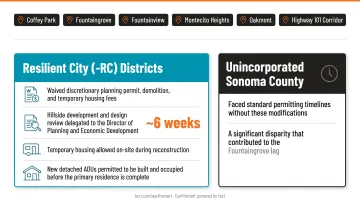
Homeowners outside these zones, in unincorporated Sonoma County, faced standard permitting timelines without these modifications — a significant disparity that contributed to the Fountaingrove lag.
Phase 4 — Construction
Once permits cleared and construction began, active build time on a typical single-family home in the Tubbs zone ran roughly 8–12 months. The complicating factor: thousands of homes were rebuilding simultaneously across the same regional contractor pool. Labor shortages slowed timelines and drove costs higher.
Homeowners who had locked in contracts early had more predictable schedules. Those who started late competed for scarce capacity — and waited. Utility restoration (power arriving at the lot) was a prerequisite milestone that couldn't be shortcut regardless of where a homeowner stood in the queue.
Phase 5 — Neighborhood and Environmental Restoration
Individual home completion does not end recovery. The Arbor Day Foundation documented a two-year vegetation management project launched in late 2019 to improve forest health in Santa Rosa — removing standing fuel, culling smaller trees and shrubs, and replacing fire-prone species with more fire-resistant oak. Road repair and community infrastructure rebuild continued well past most move-in dates.
Recovery isn't complete when one home is finished. A rebuilt house on a street still dotted with vacant lots — with roads under repair and trees missing — means the surrounding risk environment remains. Full neighborhood restoration typically trails individual move-in dates by years.
The Block Captain Model: Community Coordination That Accelerated Recovery
One of the most replicable tools to emerge from the Tubbs recovery wasn't a government program — it was a structured communication network.
The Block Captain system, created under Sonoma County Supervisor James Gore's office, appointed neighborhood-level captains who held regular meetings to relay information from FEMA, the EPA, the SBA, PG&E, California American Water, AT&T, and Permit Sonoma. The model has since been refined across 8+ fires in 4 states affecting more than 50,000 structures, per After the Fire USA.
What Block Captains Actually Coordinated
- Debris removal schedules and sequencing
- Permitting timelines, costs, and process updates
- Utility reconnection milestones
- Builder outreach and group contract discussions
- Community improvement projects (parks, sidewalks, road repair)
- Neighborhood social events to maintain cohesion between households
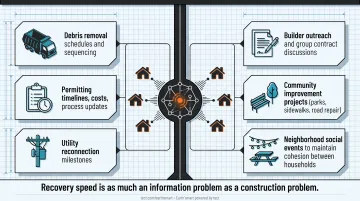
The model's value was simple: it prevented information asymmetry. When one household learned something useful — a permitting shortcut, a contractor opening, a FEMA deadline — the captain network got that information to every household on the block. Not just the ones who showed up at a town hall.
For communities navigating wildfire recovery today, the key insight is this: recovery speed is as much an information problem as a construction problem. Residents who know what's coming next — on permits, utilities, debris clearance — can make faster decisions and avoid costly delays. Structured, recurring communication between neighbors and agencies is what makes that possible.
The Biggest Barriers to Rebuilding After Wildfire
Three barriers repeatedly appeared in the Tubbs recovery as the primary reasons rebuilds stalled or failed entirely.
Insurance Gaps
Inadequate or absent insurance was identified by CBS San Francisco as a primary reason many Tubbs-zone homeowners couldn't rebuild at all. An April 2018 survey found that two-thirds of North Bay residents who lost homes were underinsured by an average of $317,000 — a staggering shortfall in a region where reconstruction costs were already climbing above $500 per square foot.
Without adequate coverage, homeowners faced three choices: self-fund the gap, take an SBA disaster loan, or walk away — and many walked away.
Permitting and Bureaucratic Delays
Even within Santa Rosa's streamlined Resilient City zones, permitting remained a significant bottleneck. Outside those zones, the standard permitting process applied in full. The cascading effect was predictable: a delayed permit pushed a homeowner past a builder's availability window, which meant another six months of searching for capacity.
Contractor Scarcity
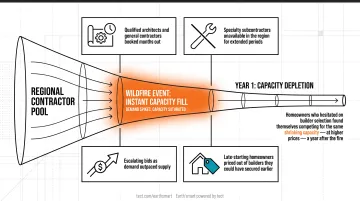
When thousands of homes in the same region need rebuilding simultaneously, the regional contractor pool is overwhelmed almost immediately. Homeowners who hesitated on builder selection found themselves competing for the same shrinking capacity — at higher prices — a year after the fire. The compounding pressures included:
- Qualified architects and general contractors booked months out
- Specialty subcontractors unavailable in the region for extended periods
- Escalating bids as demand outpaced supply
- Late-starting homeowners priced out of builders they could have secured earlier
Building Back Smarter: Resilient Design Lessons from the Tubbs Fire
The most important question a Tubbs-zone homeowner could ask wasn't "how do I rebuild what I lost?" It was "how do I build something that won't burn the same way?"
Rebuilding to Code Minimum Is Not Enough
California's WUI ignition-resistant construction requirements are codified in Building Code Chapter 7A, and they set meaningful standards for fire-exposed zones. But code minimum is the floor — it defines what's acceptable, not what performs. The IBHS Wildfire Prepared Home Standard addresses mitigation requirements beyond code, including flame- and ember-resistant vents and home-adjacent hardscaping.
The Tubbs Fire documented a critical failure mode: homes where exterior materials performed reasonably well but ember intrusion through vents caused interior ignition. NIST research has identified wind-driven embers as a primary mechanism for wildfire spread to structures — and ember-resistant vents are the specific countermeasure. Specifying fire-resistant siding while leaving standard vents in place is not a resilient home; it's a partially upgraded one.
Vegetation and Landscape Are Part of the Defense System
CAL FIRE identifies Zone 0 (0–5 feet from the structure) as the most critical ember-resistant zone. Non-combustible hardscaping, gravel, and carefully selected plantings in this zone directly affect whether a home survives a passing fire front. The Fountaingrove restoration work — replacing fire-prone Douglas fir and bay trees with fire-resistant oak species — reflects a broader understanding that the landscape is part of the structure's fire performance envelope.
Landscaping decisions made during a rebuild are not aesthetic choices made after construction. They are system-level decisions that should be coordinated alongside structure and envelope choices from the start.
Systems Integration — Where Most Rebuilds Fall Short
Fire-resistant construction requires that structure, envelope (windows, doors, vents), and mechanical systems work together as a coordinated whole. Most residential rebuilds don't achieve that coordination.
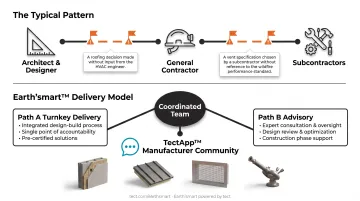
The typical pattern — homeowner hires architect, then contractor, then subcontractors independently — creates gaps where critical decisions get made too late, in the wrong order, or without the right expertise. A roofing decision made without input from the HVAC engineer. A vent specification chosen by a subcontractor without reference to the wildfire performance standard. These gaps are why rebuilds end up costing more, taking longer, and underperforming against resilience goals.
Earth'smart powered by tect's Earth'smart™ delivery model addresses this directly. Path A Turnkey Delivery coordinates architecture, engineering, construction, manufacturer input, and permit strategy from concept through construction — one aligned team rather than a sequence of independent contractors. Path B Advisory brings the same system-level coordination to homeowners who already have a builder in place, filling the gaps that typically emerge between disciplines.
The earth'smart powered by tectApp™ manufacturer community brings direct input from the companies behind fire-resistive wall assemblies (pre-insulated concrete masonry, ICF, AAC), Class A roofing, ember-resistant vents, and on-site fire suppression systems — including FIREBOZZ® water cannons — into design decisions early, when they can still change outcomes rather than only raise costs.
Build for 100 Years, Not to Replace What Burned
The aspirational lesson from Tubbs is straightforward: homeowners who rebuilt only to replace what they lost are potentially one fire season away from the same outcome. Those who built forward — with fire-resistive assemblies, non-combustible materials, coordinated systems, and intentional material selection — created homes that meaningfully reduce future risk and long-term maintenance costs.
The rebuild is not a recovery project. It's a permanent upgrade decision — and the earlier that framing takes hold, the better the outcome across every design, material, and system choice that follows.
Frequently Asked Questions
How long did it take to rebuild after the Tubbs Fire?
Individual timelines varied widely. The fastest rebuilds took approximately 22 months from fire to move-in. Community-wide, roughly 2,508 units had been completed as of July 2025, with hundreds still in construction or permit review — nearly eight years after the fire.
What neighborhoods in Santa Rosa were most affected by the Tubbs Fire?
Coffey Park and Fountaingrove were among the hardest-hit neighborhoods, along with Larkfield Estates in unincorporated Sonoma County. Santa Rosa established six Resilient City zoning areas specifically to streamline rebuilding in affected zones.
What caused the biggest delays in Tubbs Fire rebuilding?
Three factors drove most delays: insurance gaps that left homeowners unable to fund rebuilds, permitting backlogs (especially outside the Resilient City zones), and contractor scarcity as thousands of simultaneous rebuilds overwhelmed regional construction capacity.
How does the Tubbs Fire recovery compare to what LA fire victims can expect?
Tubbs is the closest large-scale precedent. The fastest individual homeowners took roughly 22 months; the broader community is still rebuilding after 8 years. LA fire victims should anticipate the same phases : debris removal, permitting, and construction — along with the same bottlenecks. Insurance adequacy is the most critical variable to address early.
What makes a home more fire-resistant during a rebuild?
Fire-resistant rebuilds depend on a coordinated system: fire-resistive exterior cladding and roofing (Class A non-combustible), ember-resistant vents, non-combustible Zone 0 landscaping, and integrated mechanical system design. No single upgrade is sufficient; the components must work together to perform under real fire conditions.