Introduction
Wildfire rebuilds. Tightening insurance markets. A new California building code cycle that took effect January 1, 2026. These aren't abstract pressures — they're the daily reality for tens of thousands of homeowners who lost homes in 2025 fires or are building in high-risk zones and trying to figure out what "doing it right" actually means.
The common assumption is that structural engineers belong on commercial job sites. That assumption has cost homeowners failed inspections, structural rework, and — in the worst cases — homes that don't survive the next event.
For homes in wildfire zones, seismic corridors, or complex sites, structural engineering isn't an optional upgrade. Engaging an engineer early — before design locks in — is what separates a home built to last from one built to minimum code and hoped for the best.
Here are 16 specific reasons why, in 2026, that decision matters more than ever.
Key Takeaways
- Residential structural engineers design load-bearing systems that resist gravity, wind, seismic, and fire-related forces
- Hiring one early prevents costly mid-construction errors, failed inspections, and expensive post-build repairs
- For WUI homeowners and wildfire rebuilds in 2026, structural engineering is a non-negotiable — not a nice-to-have
- Sound engineering supports insurance documentation and directly increases long-term property value
- Early involvement cuts change orders, avoids rework, and keeps builds on schedule and on budget
What Is a Residential Structural Engineer?
A residential structural engineer is a licensed professional who calculates how a home responds to forces — gravity, wind, seismic activity, fire exposure — and designs the systems that keep it standing safely under those conditions.
The role is distinct from the other two professionals on any residential project:
- Architects shape layout, spatial design, and how the home looks and functions
- General contractors manage construction execution, scheduling, and trades
- Structural engineers determine how the building holds itself together — the foundation system, load-bearing frame, connections between elements, and the continuous load path from roof to ground
Their deliverables are stamped drawings and engineering calculations that satisfy building department requirements, guide contractors during construction, and create a permanent record of the home's structural design.
That documentation matters long after construction ends — especially when a home faces the conditions it was originally engineered to withstand.
Reasons 1–5: Safety, Structural Integrity, and Resilience
These are the foundational reasons — the ones that protect occupants from forces that don't negotiate.
Reason 1: Seismic Safety and Earthquake Load Design
Structural engineers perform seismic analysis to determine how earthquake forces travel through a home's frame, foundation, and connections — and design the system to absorb those forces without catastrophic failure.
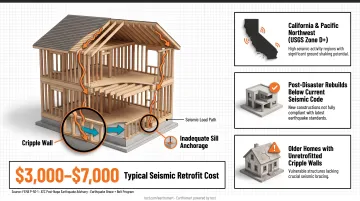
Wood-frame homes with flexible cripple walls and inadequate foundation anchorage are among the most documented vulnerabilities in residential seismic events. FEMA P-50-1 identifies these exact failure modes in detached single-family homes, and post-Napa earthquake advisory data from ATC confirms that damage from these deficiencies can be severe enough to trigger red tags.
The risk is highest for:
- Homes in California and the Pacific Northwest (USGS Seismic Design Zone D or higher)
- Post-disaster rebuilds where original construction didn't meet current seismic standards
- Older homes with unretrofitted cripple walls or inadequate sill anchorage
Seismic retrofit by a licensed contractor typically runs $3,000 to $7,000 according to the Earthquake Brace + Bolt program. Engineering the structure correctly from the start is almost always the lower-cost path.
Reason 2: Fire-Resistive Structural System Design for WUI Homes
Most homes lost in WUI fires aren't destroyed by direct flame contact. CAL FIRE OSFM estimates that 60% to 90% of home ignitions occur because of embers — and structural combustibility determines how fast that ignition becomes a total loss.
Structural engineers working on WUI homes specify and integrate fire-resistive assemblies: non-combustible framing connections, ember-resistant details, and structural systems that don't accelerate fire spread or structural collapse.
Early coordination is where this work has the most leverage. Structural decisions need to align with envelope performance, fire suppression strategy, and material selection before systems are locked in — not after. For WUI rebuilds, that means fire-resistive exterior wall systems and non-combustible assemblies selected together, not independently.
For homeowners rebuilding in Pacific Palisades or any WUI zone, structural fire-resistance is a foundational design decision. Earth'smart powered by tect's integrated approach — connecting structural, envelope, and systems decisions from the start — is built around exactly this kind of coordination.
Reason 3: Foundation Analysis and Soil Condition Assessment
Soil conditions — expansive clay, soft fill, liquefaction-prone ground — directly affect whether a foundation holds or fails over time. A structural engineer performs or interprets geotechnical reports and designs foundations to actual site conditions, not generic assumptions.
Skipping this step is expensive. According to Angi's 2026 data, most homeowners pay $2,225 to $8,133 for foundation repairs, with piering or underpinning running $1,000 to $3,000 per pier and full replacement reaching $20,000 to $100,000. Geotechnical review and engineered foundation design cost a fraction of that upfront.
For hillside and WUI sites in areas like Pacific Palisades — where soil profiles are complex and site conditions often don't match neighboring lots — this analysis isn't optional.
Reason 4: Load Path Analysis and Structural Failure Prevention
Every load in a home — roof weight, occupant activity, snow, equipment — must travel through a continuous, engineered path to the foundation. Interrupt that path and the structure begins to fail, often slowly and invisibly.
The most common way this happens: a load-bearing wall is removed during renovation without engineering review. The ceiling doesn't fall immediately. But deflection increases, cracks appear, and years later the remediation is expensive and disruptive.
A structural engineer maps and validates the load path before construction begins, ensuring every modification either maintains or properly replaces the structural continuity the home depends on.
Reason 5: Wind, Lateral, and Uplift Force Resistance
Homes in coastal, hillside, or open terrain locations face significant lateral and uplift forces from wind. Without engineered shear walls, diaphragms, and hold-downs, these forces cause racking, sliding, and roof separation — particularly in high-fire-weather corridors where wind drives both fire spread and structural vulnerability simultaneously.
Wind exposure is a compounding risk in:
- Hurricane zone construction
- Exposed hilltop sites with elevation wind exposure
- WUI zones where Santa Ana or Diablo winds create simultaneous fire and structural risk
Reasons 6–11: Cost Control, Code Compliance, and Construction Efficiency
These are the business case reasons — the ones that directly affect project budget, schedule, and your ability to get permitted and built without costly interruptions.
Reason 6: Preventing Costly Structural Mistakes Before They're Built
Structural engineers identify design conflicts and under-designed elements during the drawing phase — before concrete is poured or framing begins, when corrections cost a fraction of what mid-construction changes require.
Research from the Construction Industry Institute found that deviations requiring rework, repair, or replacement averaged 12.4% of total installed project cost — and 79% of those deviation costs were caused by design errors and omissions, not construction execution. Catching those errors before the build starts is the entire value proposition of upfront structural review.
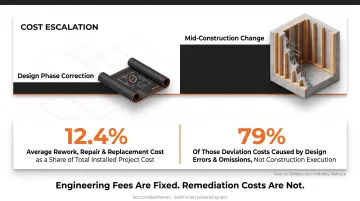
Engineering fees are fixed. Remediation costs are not.
Reason 7: Reducing Change Orders, Rework, and Inspection Failures
Stamped structural drawings reduce ambiguity on the job site. Contractors have clear specifications. There's less improvisation, less material waste, and fewer failed inspections that require re-inspection cycles and delay permit sign-off.
This matters especially for:
- Complex custom homes where framing decisions require precision
- Post-disaster rebuilds where contractors are stretched thin and schedules are compressed
- Projects where the margin for delay is low and inspection queues are long
Reason 8: Ensuring Code Compliance and Accelerating Permits
Structural engineers produce calculations and drawings that satisfy building department requirements directly, reducing back-and-forth with plan checkers. In post-disaster rebuilding environments — where plan check queues are long and incomplete submissions cause weeks of delay — this is a material advantage.
The 2025 California Building Standards Code, effective January 1, 2026, introduced updated requirements relevant to wildfire-prone construction. Rebuilds in Southern California must be checked against the current Title 24 cycle. An experienced structural engineer working in WUI environments already knows what those plan checkers are looking for.
Earth'smart powered by tect's Earth'smart™ service includes permit strategy and coordination as a core component — not an afterthought.
Reason 9: Value Engineering and Material Optimization
Experienced structural engineers design for efficiency alongside safety — finding structural solutions that meet load requirements without burning budget on unnecessary material. That optimization is measurable.
Advanced framing is one practical example:
- DOE's Energy Saver data shows optimized framing saves $500–$1,000 in material costs depending on home size
- The APA reports advanced framing reduces floor and wall framing material costs by up to 30%
These savings require structural sign-off to implement safely — a general contractor can't make those calls unilaterally.
Reason 10: Avoiding Expensive Post-Construction Structural Repairs
Structural deficiencies rarely show up immediately. They surface as cracks, deflections, and failures years later — often when the original design decisions are long forgotten and remediation costs are hard to trace back.
Removing a load-bearing wall without engineering review is one of the most common triggers. The repair isn't just reinstalling support — it's opening walls, redesigning load paths, and untangling what unpermitted work has compounded over time. A structural review before the work begins costs a known, fixed amount. Emergency remediation after the fact does not.
Reason 11: Supporting Insurance Documentation and Risk Reduction
California's residential insurance market has contracted sharply. The California FAIR Plan grew from 1.6% to 3.7% of the residential insurance market, with 788,485 voluntary-market policies non-renewed or canceled in 2023. Insurers in WUI zones are scrutinizing construction quality, materials, and documentation more carefully than ever before.
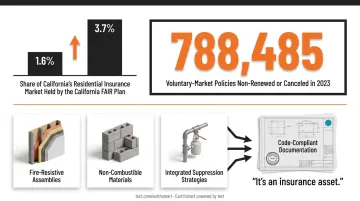
Stamped structural drawings, engineering reports, and code-compliant documentation create a record that supports underwriting in these environments. Earth'smart powered by tect's Earth'smart™ approach is explicitly designed to address this "new insurance reality" — delivering homes that reduce risk at the system level through fire-resistive assemblies, non-combustible materials, and integrated suppression strategies. That documentation isn't just a permitting artifact. It's an insurance asset.
Reasons 12–16: Long-Term Value, Integration, and Future-Proofing
These are the reasons that extend well beyond the build itself — structural decisions that determine how a home performs, holds its value, and supports future needs across decades.
Reason 12: Protecting and Increasing Property Value
A structurally sound, code-compliant home with engineering documentation commands stronger appraisal values, attracts more confident buyers, and avoids the disclosure complications that accompany unresolved structural concerns. A home with structural deficiencies — even minor ones — hands buyers negotiating leverage and can cut the sale price or stall closing entirely.
Engineering documentation is a paper trail that protects value at every transaction.
Reason 13: Supporting Home Additions and Future Renovations
A structural engineer's drawings and calculations create a documented baseline of the home's structural system. When you add a room, modify a roof line, or open up a floor plan five years later, that baseline makes the next project faster, cheaper, and far less likely to create hidden structural conflicts.
Without it, every future renovation starts from scratch — often with a structural engineer doing diagnostic work just to understand what the original builder did.
Reason 14: Enabling Integrated Resilient System Design
For a truly high-performance home, structure can't be designed in isolation. The structural system interacts with the envelope, the mechanical systems, the fire suppression strategy, and the long-term durability of every assembly. When structural decisions are made late or separately from these other systems, conflicts emerge — and resolving them mid-construction is expensive.
Earth'smart powered by tect's Earth'smart™ approach coordinates structural decisions with envelope performance, fire suppression infrastructure, and mechanical systems simultaneously — not sequentially. For Pacific Palisades rebuild projects, that means fire-resistive concrete masonry wall systems are selected alongside the earth'smart powered by tectApp™ community of 70+ building product manufacturers before construction begins, not after conflicts surface on-site.
Reason 15: Building to Last 100+ Years, Not Just to Code Minimum
Building codes establish a safety floor — not a performance standard for longevity. A structural engineer working from a long-term performance brief designs for durability, future load scenarios, and material degradation over time, not just today's pass/fail criteria.
Earth'smart powered by tect's "Build Once. Build Forward." philosophy makes this concrete: homes engineered with long-life roofing, fire-resistive exterior wall assemblies, and materials selected for decades of performance rather than minimum compliance. Most homes built to code minimum will require significant structural intervention within 30–40 years. A home designed for 100+ years is a fundamentally different brief from the start.
Reason 16: Peace of Mind Backed by Licensed Professional Accountability
A licensed structural engineer stamps their work, carries professional liability, and is legally accountable for the designs they produce. No contractor, online plan service, or generalist builder can offer that. When a structural engineer signs off, the distinction is concrete:
- Licensed engineer: Stamped drawings, professional liability insurance, legal accountability for every calculation
- Contractor or plan service: Competence assumed, no stamp, no licensed accountability if something fails
That difference matters most when something unexpected happens — a seismic event, a fire, a load-bearing failure under stress.
What Happens When Structural Engineering Is Skipped
The consequences follow a predictable pattern:
- Failed inspections that halt construction and require redesign and resubmission
- Load-bearing walls removed without replacement support, causing progressive deflection and eventual failure
- Foundation movement on sites where soil conditions weren't assessed or engineered for
- Fire or seismic events that expose structural deficiencies built in years or decades earlier
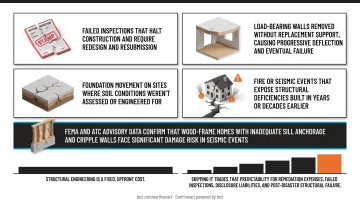
FEMA and ATC advisory data confirm that wood-frame homes with inadequate sill anchorage and cripple walls face significant damage risk in seismic events — damage severe enough to render homes unsafe to occupy. These are documented failure modes, not hypothetical ones — and they carry a direct financial consequence.
Structural engineering is a fixed, upfront cost. Skipping it trades that predictability for remediation expenses, failed inspections, disclosure liabilities, and post-disaster structural failure. That side of the ledger is always higher, and occasionally has no recovery path at all.
Frequently Asked Questions
How much does a structural engineer cost for a house?
For new home construction, structural engineering typically runs $2,000 to $10,000 depending on project complexity, according to HomeAdvisor. Simple reviews or reports start around $350 to $800, while full-scope projects can reach $8,500 or more. In every case, this cost is a fraction of what structural remediation or post-construction repair costs.
What does a structural engineer do for a house?
They analyze all loads acting on the home and design the structural systems that resist them — foundation, framing, and connections. From there, they produce stamped drawings for permit use and ensure the home meets code and performs safely under real-world conditions: gravity, wind, seismic, and fire.
What are the benefits of using a structural engineer for a housing project?
The primary benefits include:
- Safety assurance across structure, systems, and envelope
- Early detection of costly design errors before they're built in
- Code compliance and faster permitting
- Insurance documentation support
- A home built to perform well beyond its first inspection
When is a structural engineer required for a home renovation?
Any renovation involving load-bearing walls, foundation changes, roof modifications, or significant structural alterations typically requires a structural engineer. When in doubt, consult a licensed professional before starting. Retrofitting an engineering decision after demolition is always more expensive than making it upfront.
Can a structural engineer design a home to withstand wildfires or earthquakes?
Yes. Structural engineers can specify fire-resistive assemblies, design seismic load-resisting systems, and detail resilient connections that significantly improve a home's ability to survive these events. The earlier they're involved in the design process, the more effective and cost-efficient those decisions are.
Do I need a structural engineer for a new home build?
Almost always. Custom homes, high-risk zone projects, and any build requiring stamped structural drawings for permit approval will need one. In California, this includes virtually every new home in a WUI, seismic, or coastal area.