For homeowners building in seismic zones, wildfire-prone regions, or flood-prone areas, structural engineering isn't a formality. It's the technical foundation everything else depends on.
This article breaks down exactly what a structural engineer delivers across a new home build — core responsibilities, specific deliverables, high-risk design considerations, code compliance, and cost expectations.
Key Takeaways
- Structural engineers design the load-bearing systems of a new home so it safely carries its own weight and withstands environmental forces.
- Primary deliverables include structural drawings, load calculations, foundation design, and stamped permit documents.
- Virtually all new construction requires a structural engineer before permits can be issued.
- In high-risk areas (seismic zones, WUI, flood zones), structural engineering decisions directly affect resilience and insurance exposure.
- Engineering fees are a fraction of total construction cost but protect the entire investment.
What a Structural Engineer Actually Does for a New Home
The core function is straightforward: a structural engineer analyzes how forces move through a building and designs systems that safely carry those forces to the ground. Those forces include gravity loads (the weight of the structure itself, furniture, occupants), wind, snow, and seismic activity.
That role is distinct from architectural work. Architects design what a home looks like and how it functions spatially. Structural engineers design what holds it up — and those two disciplines have to work in close coordination.
Structural Engineer vs. Architect
An architect's design cannot be safely built without structural input, and structural plans must align with the architectural intent. On most projects, the structural engineer receives finalized architectural drawings and works from there — which means structural conflicts surface late, after decisions are already locked in.
The earlier a structural engineer is involved, the fewer costly redesigns occur. This is one reason earth'smart powered by tect's Earth'smart™ Path A Turnkey Delivery brings the structural engineer in at concept design — not after architectural drawings are finalized. When architecture and engineering develop together, beam sizing, wall placement, and foundation type get resolved before they become expensive change orders.
Site Evaluation and Structural Analysis
Before any drawings are produced, the structural engineer evaluates the site:
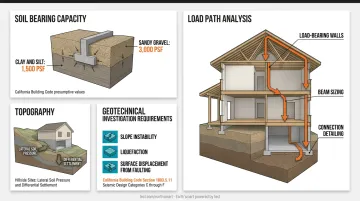
- Soil bearing capacity, which determines foundation type and depth — California Building Code tables cite presumptive values ranging from 1,500 psf for clay and silt to 3,000 psf for sandy gravel
- Topography, since hillside sites introduce lateral soil pressure and differential settlement concerns
- Geotechnical investigation requirements — in Seismic Design Categories C through F, California Building Code Section 1803.5.11 mandates coverage of slope instability, liquefaction, and surface displacement from faulting
From there, the engineer performs a load path analysis — tracing how loads travel from the roof, through walls and beams, into the foundation and soil. This analysis determines which walls are load-bearing, what size beams are required, and how connections must be detailed.
The Key Deliverables: What You Receive from a Structural Engineer
Each of these documents has a specific function in the permit and construction process — here's what a structural engineer actually delivers.
Foundation Design
The foundation design is among the most consequential deliverables. The structural engineer specifies:
- Foundation type (slab-on-grade, crawl space, basement, pier-and-beam, deep caissons)
- Depth and reinforcement based on soil bearing capacity and local code
- Connection details between foundation and structural framing
In areas with expansive soils — defined under California Residential Code Section R403.1.8.1 as soils with a Plasticity Index of 15 or greater — foundation design becomes significantly more complex. The engineer must account for lateral seismic forces, not just vertical gravity loads.
On hillside sites, high-water-table lots, or lots with expansive soil conditions, this is where the real engineering complexity lives.
Structural Framing Plans and Engineering Drawings
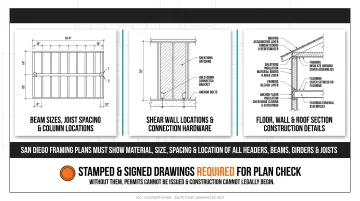
Framing plans are the documents contractors use to build the structure. They show:
- Beam sizes, joist spacing, and column locations
- Shear wall locations and connection hardware
- Floor, wall, and roof section construction details
Per San Diego's building permit requirements, framing plans must show material, size, spacing, and location of all headers, beams, girders, and joists. Stamped and signed drawings are required for plan check — without them, permits cannot be issued and construction cannot legally begin.
Roof Structural System
The structural engineer designs the roof system — whether conventional rafters, engineered trusses, or a hybrid — and confirms it can handle snow loads, wind uplift, and other site-specific forces. In WUI zones, roof-to-wall connection details also carry fire and wind resistance implications that must be engineered together.
Stamped Calculations and Material Specifications
The calculations package is the supporting math behind every design decision. It demonstrates code compliance to the building department and serves as the legal record of the engineer's professional judgment.
Material specifications are delivered alongside those calculations:
- Lumber grades and engineered wood products (per the 2024 AWC National Design Specification)
- Concrete strength and reinforcement (governed by ACI CODE-332-20 for residential construction)
- Steel sizes, anchor hardware, and connection types
What gets purchased and installed must match what was designed — specifications are what make that legally enforceable on the job site.
Structural Engineering for High-Risk Areas: Fire, Flood, and Seismic
Building code represents a minimum standard of safety. For homeowners in wildfire-prone regions, flood zones, or active seismic areas, minimum is not the same as resilient.
Designing for Seismic Loads
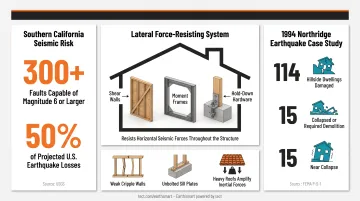
USGS data shows Southern California carries the highest earthquake risk in the United States, with more than 300 faults capable of magnitude 6 or larger earthquakes and half of expected national earthquake financial losses concentrated in that region.
In earthquake-prone areas, the structural engineer designs a lateral force-resisting system — shear walls, moment frames, and hold-down hardware — that resists the horizontal forces an earthquake generates. A home structurally adequate under gravity loads can still fail under seismic stress without this system.
FEMA P-50-1 documented that in the 1994 Northridge earthquake, 114 hillside dwellings sustained significant damage — 15 collapsed or required immediate demolition, and another 15 were on the verge of collapse. Typical vulnerabilities included weak cripple walls, unbolted sill plates, and heavy roofs that amplified inertial forces.
Seismic design requires site-specific hazard analysis and affects wall placement, connection details, and foundation anchorage throughout the entire building.
Designing for Fire and Wind Exposure
In Wildland-Urban Interface (WUI) zones, structural engineers specify materials and assemblies that resist ember intrusion, radiant heat, and direct flame contact. This includes:
- Non-combustible structural connections and framing assemblies
- Roof-to-wall connections engineered for wind-driven fire conditions
- Exterior wall systems — such as concrete masonry (CMU), insulated concrete forms (ICF), or autoclaved aerated concrete (AAC) — that resist fire while meeting seismic load requirements
The 2025 California Building Standards Code (effective January 1, 2026) places wildfire exterior exposure requirements under the California Wildland-Urban Interface Code. California's Office of the State Fire Marshal maintains a Building Materials Listing of products verified for Chapter 7A compliance.
These structural decisions also affect insurance eligibility. California's Department of Insurance requires discounts under the Safer from Wildfires program for specific mitigation measures including Class A fire-rated roofs, ember-resistant vents, and enclosed eaves — but different insurers calculate discounts differently, and no universal premium reduction percentage applies.
How earth'smart powered by tect Coordinates Structural Engineering for High-Risk Homes
For WUI and high-seismic projects, earth'smart powered by tect's Earth'smart™ Path A Turnkey Delivery integrates structural engineering directly into the design team from concept forward. The structural engineer of record works alongside the architect, construction team, and the earth'smart powered by tectApp™ community of 70+ vetted building product manufacturers.
Structural decisions around non-combustible wall systems, seismic shear wall design, and fire-resistive connection details are shaped by direct input from the manufacturers behind those materials — resolved at design, not improvised during construction. Earth'smart powered by tect's structural engineering capabilities for high-risk residential projects include:
- Concrete masonry shear-wall design for California seismicity
- Hybrid concrete/steel/wood systems for fire-hardened residences
- Structural integration with non-combustible roof and wall assemblies
Earth'smart powered by tect also produces insurance-aligned documentation packages that brokers and underwriters can use directly in coverage and pricing decisions. These include:
- Fire-resistive assembly specifications
- Non-combustible material details
- IBHS Wildfire Prepared Home alignment documentation
For homeowners rebuilding in Pacific Palisades or other WUI zones, this documentation has real financial implications.
Code Compliance, Permitting, and Inspections
Stamped structural drawings and calculations are a required submission for the building permit application. During plan check, the building department reviews these documents to confirm the design meets applicable codes: the 2025 California Residential Code (Title 24, Part 2.5), the California Building Code, and any local amendments for seismic or fire requirements.
The structural engineer's involvement continues through construction:
- Periodic site observations at critical phases — foundation pour, framing completion, shear wall installation — confirm work is being built as designed
- Special inspections under 2025 CBC Chapter 17 are required for structures in higher seismic design categories
- Structural observation is required for structures assigned to Seismic Design Category E at more than two stories, or when required by the design professional responsible for structural design
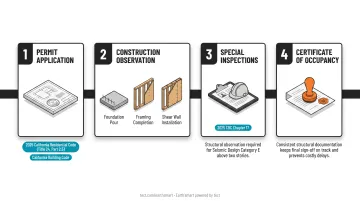
Under the 2025 California Building Code, no building may be used or occupied until the building official issues a Certificate of Occupancy. Complete, consistent documentation from the structural engineer throughout construction is what keeps that final sign-off on track — and avoids costly holds at the finish line.
How Much Does a Structural Engineer Cost for a New Home?
Cost depends on several factors:
- Project size and complexity — a straightforward single-story home on flat ground costs less to engineer than a multilevel hillside custom home
- Site conditions — high-seismic zones, hillside grading, expansive soils, and flood zones increase engineering scope
- Design iterations — changes to architectural plans after structural work begins drive costs up
- Construction observation — whether the engineer provides site visits in addition to drawings
The NAHB 2024 Cost of Constructing a Home report cites a combined architecture and engineering line item averaging $6,480, or approximately 1.5% of construction cost — though this figure combines both disciplines and is drawn from a limited national survey, not California custom home projects specifically.
For complex custom homes on difficult California sites, engineering fees run considerably higher. Even so, structural engineering fees represent a small fraction of total construction cost while protecting the entire investment.
Errors in structural design produce consequences far more expensive than the engineering itself:
- Inadequate foundations that require remediation after pour
- Undersized beams that trigger failed inspections and redesign
- Missing lateral systems that don't meet seismic code — discovered late in construction
For homeowners in WUI or seismic zones, properly documented resilient structures may also qualify for better insurance terms, making the engineering investment a risk management tool with downstream financial return.
Frequently Asked Questions
Do I need a structural engineer for a new build?
Yes — almost every new home construction requires one. Building departments require stamped structural drawings as part of the permit application — without them, permits cannot be issued. Even in jurisdictions with less prescriptive requirements, homes with unusual geometry, challenging site conditions, or high-risk exposure will require engineering.
How much does a structural engineer cost for a home?
Costs vary by scope and complexity. NAHB's 2024 data shows a combined architecture and engineering average of $6,480 on typical new construction; California custom homes on hillside or high-risk sites routinely exceed that. Request proposals from multiple firms and compare scope of services, not just price.
What is the difference between a structural engineer and an architect?
Architects design spatial layout, aesthetics, and building function. Structural engineers design the load-bearing systems that make that vision physically safe and buildable. Both are required for a new home and should work together from early design stages.
What documents does a structural engineer provide for a new home?
Primary deliverables include foundation design, structural framing plans, roof structural drawings, stamped load calculations, and material and hardware specifications — all submitted to the building department as part of plan check.
How early should I hire a structural engineer for a new home?
As early as schematic design, before architectural plans are finalized. Early involvement prevents costly redesigns when structural requirements conflict with architectural intent. In integrated delivery models like earth'smart powered by tect's Path A, structural engineering begins at concept, letting system requirements shape the layout before anything is locked in.
Does structural engineering affect my home's insurance?
In high-risk zones, yes. Engineered features like seismic lateral systems, fire-resistant assemblies, and non-combustible materials can affect both insurance availability and premiums — California's Safer from Wildfires program mandates discounts for qualifying mitigation measures. Homeowners building in WUI or seismic areas should factor insurability into engineering decisions from the start.