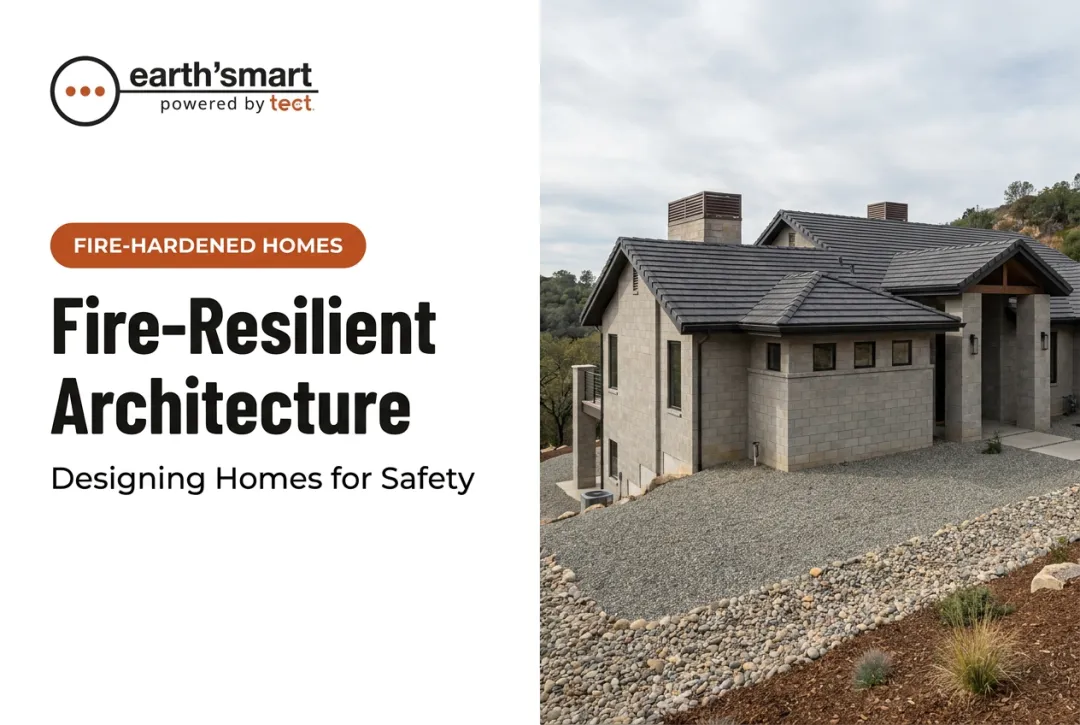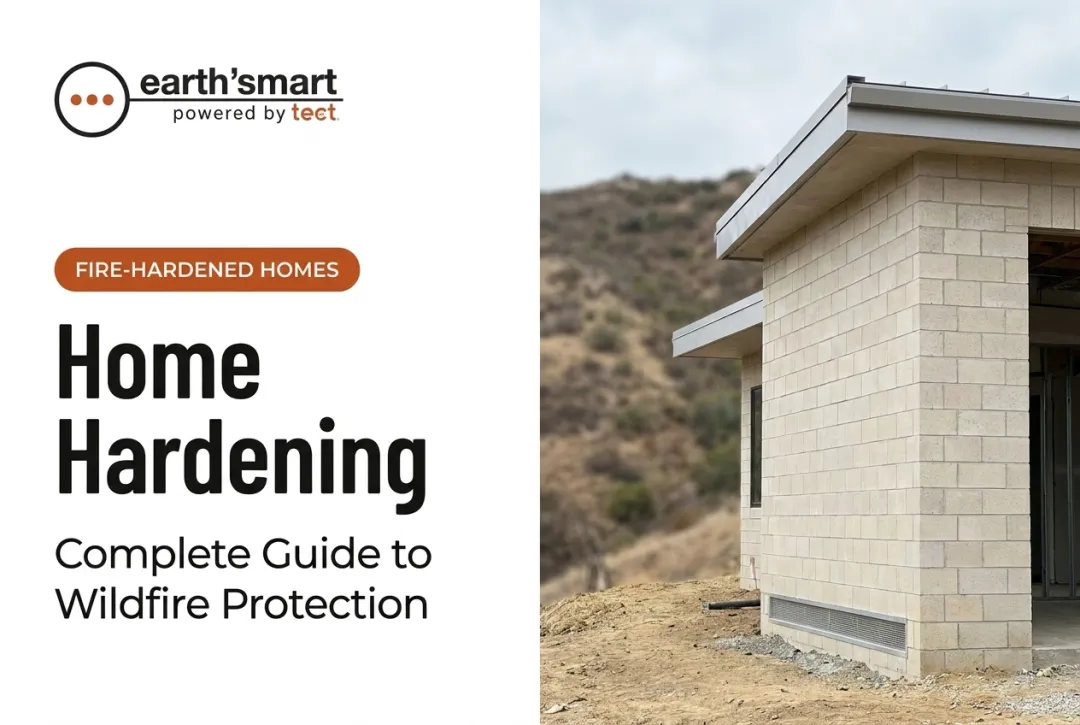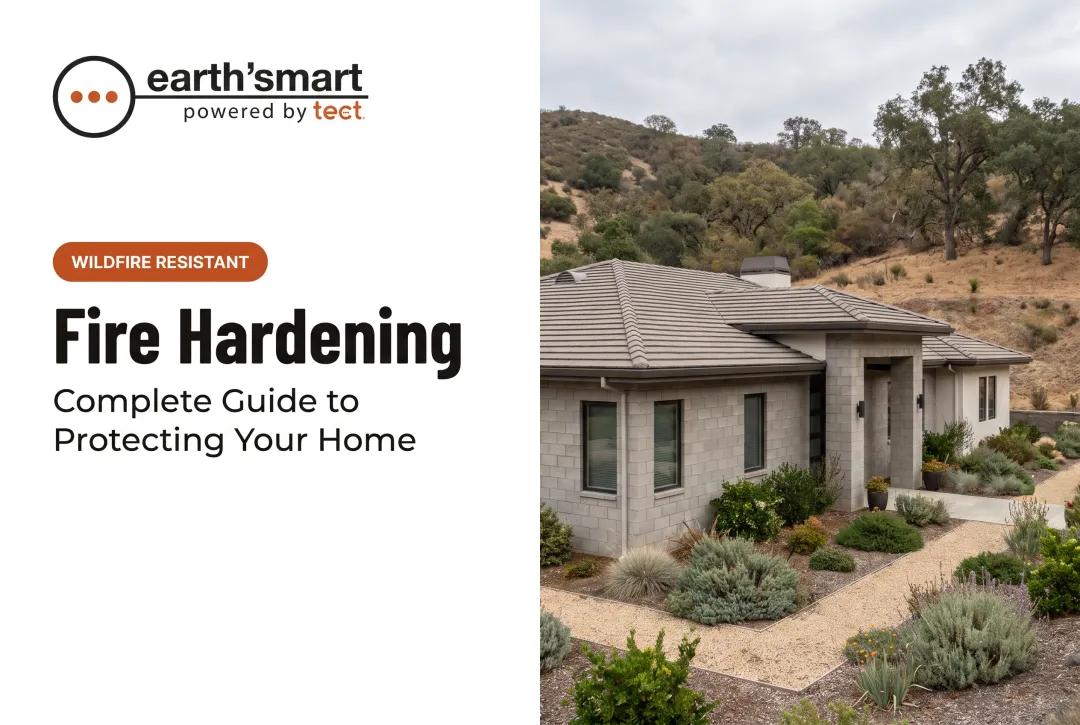

No home is completely fireproof. But the design decisions you make before a single wall goes up can mean the difference between a home that survives and one that becomes a statistic. The gap between those two outcomes comes down to materials, form, and systems working together — not any single product or upgrade.
Key Takeaways
- Fire resistance is a system — roofing, vents, windows, cladding, and building form must work together
- Embers, not direct flames, cause most wildfire home ignitions; vents and eaves are the primary entry points
- Tempered glass offers roughly 3–4x the heat resistance of standard annealed glass
- Palisades Fire survivors shared the same features: metal roofs, sealed vents, noncombustible siding, minimal overhangs
- Getting these decisions right requires early coordination, not last-minute material swaps
Why Homes Burn: Understanding Wildfire Vulnerability
Most people picture a wildfire consuming a home in a wall of flame. That's rarely what happens. According to IBHS, embers — not direct flame contact — cause most home ignitions during wildfires. Wind-carried embers travel more than a mile ahead of the fire front, landing on roofs, collecting in gutters, and finding their way through any gap in the building envelope.
The Three Structural Weak Points
Fire scientists and building code researchers consistently identify the same vulnerabilities:
- Open eaves and overhangs — sheltered pockets where embers collect and smolder, often undetected
- Unscreened vents — attic, soffit, and foundation vents act as funnels, drawing embers directly into the home's interior
- Combustible exterior materials — wood siding, vinyl cladding, and untreated wood trim ignite under radiant heat before flames even arrive

These vulnerabilities are well-documented. The harder question is why so many homes still have them.
In communities like Pacific Palisades, most homes were built long before California's current WUI building codes existed. California Building Code Chapter 7A — the core standard governing materials and construction methods for wildfire exposure — applies to new buildings in applicable WUI fire areas. Homes built before these standards weren't designed with fire behavior in mind.
California's Fire Hazard Severity Zone (FHSZ) designations exist to flag exactly this kind of accumulated risk.
Best Fire-Resistant Home Design Features
The homes that survived the Palisades Fire and other major wildfires didn't survive by luck. They shared specific, documented design features. Here's what those features are and why they work.
Fire-Resistant Roofing
The roof is the most ember-exposed surface on any home. Class A fire-rated roofing is the minimum standard for any WUI build — rated to withstand severe fire-test exposure per UL's classification criteria.
Top material options:
- Standing-seam metal (steel or aluminum) — noncombustible, no gaps, 50–100+ year service life
- Concrete tile — noncombustible, heavy, requires structural accommodation
- Clay tile — noncombustible, proven in California climates
- Slate — noncombustible, extremely durable
Material choice alone isn't enough. Embers penetrate improperly installed tile roofs through gaps at ridges, edges, and around penetrations. Every gap, crack, and underlayment detail must be sealed. Metal roofing paired with a fire-resistant underlayment offers the most complete protection when installation details are executed correctly.
Avoid: Untreated or unlisted wood shingles and shakes. Even treated products require State Fire Marshal listing under Chapter 7A to be compliant. Unsealed asphalt over flammable underlayment also fails under ember exposure.
Ember-Resistant Vents and Windows
Vents are one of the primary ignition pathways into a home's structure. Embers drawn into attic, soffit, or foundation vents can ignite a home entirely from the inside — before any exterior surface catches fire.
For vents:
- Ember-resistant vents meeting ASTM E2886 standards are required under Chapter 7A
- Fine wire mesh with code-specified opening sizes reduces ember entry
- Vent placement matters — avoid siting vents on the prevailing wind side of the home
For windows:
- Standard single-pane annealed glass cracks under radiant heat, opening a direct path for embers and flames
- Tempered glass offers approximately 3–4x the heat resistance of standard glass
- Chapter 7A requires dual-pane windows with at least one tempered pane for applicable WUI construction
- FSRI radiant-panel testing confirms double-pane windows reduce heat transfer measurably compared to single-pane assemblies
Fire-Resistant Exterior Cladding
UC ANR identifies these materials as noncombustible or ignition-resistant for WUI applications:
| Material | Fire Performance | Notes |
|---|---|---|
| Fiber cement (e.g., Hardie board) | Noncombustible | Widely available, cost-effective |
| Traditional three-coat stucco | Noncombustible | Seamless coverage reduces gaps |
| Metal panel (steel) | Noncombustible | Durable, minimal maintenance |
| Brick and stone | Noncombustible | Highest mass, excellent radiant resistance |

Vinyl siding is a different story. It's combustible, deforms under radiant heat, and can slough off at temperatures generated by fires as far as 50 feet away — exposing the sheathing beneath. It's strongly discouraged for any high-exposure WUI application.
Cladding continuity matters as much as material. Any gap at joints, window openings, or roof edges is a potential ember entry point. Poor installation defeats even the best-performing materials.
Fire-Resistant Building Form and Structural Design
Building shape directly affects fire survival odds. Overhanging eaves, decorative fascia, and complex rooflines create sheltered cavities where embers collect and ignite. Simplifying building geometry is one of the most effective — and least discussed — fire-hardening moves available.
Fire-resistant architects working in the LA area following the 2025 fires are increasingly making these moves:
- Eliminate eaves entirely or close soffits with noncombustible material
- Simplify rooflines to reduce ember-catching surface area
- Use perpendicular wall and roofline intersections that don't create concealed pockets
- Position vents away from prevailing ember-carrying wind directions
The Greg Chasen-designed passive home that survived the Palisades Fire — documented by CT Post — had no eaves, concrete walls, a sealed attic approach, and double-pane windows. Every one of those features was chosen to eliminate an ignition pathway.
Fireproof Insulation and Airtight Construction
Insulation materials vary dramatically in their fire performance:
- Mineral wool / stone wool — noncombustible, withstands temperatures exceeding 2,000°F per ROCKWOOL's fire resilience data; the recommended choice for high-risk applications
- Fiberglass — naturally resists fire but has lower temperature thresholds than mineral wool
- Spray foam — ignites at approximately 700°F; requires careful fire-barrier detailing
Airtight construction adds another layer of protection that's often overlooked. When a building envelope is sealed tightly — as in passive house-style construction — there are fewer penetration points for embers and smoke to exploit. Paired with MERV-13 or higher filtration, an airtight envelope also protects occupants from wildfire smoke infiltration, which represents a serious health risk even when structures remain intact.
Earth'smart powered by tect's Earth'smart™ projects integrate mineral wool insulation, noncombustible wall assemblies (pre-insulated CMU, ICF, or AAC systems), and tight-envelope construction as coordinated elements — not isolated upgrades. MERV-13+ filtration with HEPA stages is specified where wildfire smoke exposure is a documented risk.
Defensible Space: The Three-Zone Protection System
Building design and defensible space work together. A fire-hardened home surrounded by combustible landscaping is still at serious risk. CAL FIRE's three-zone system, mandated under California Public Resources Code 4291, defines how the land around your home should be managed:
- Zone 0 (0–5 ft): Noncombustible zone. Remove all combustibles, replace mulch with gravel, clear gutters, eliminate wood piles and stored materials against the home
- Zone 1 (5–30 ft): Managed fuel zone. Space trees, remove low branches, eliminate dead vegetation, no wood piles
- Zone 2 (30–100 ft): Extended zone. Prune and space vegetation, mow annual grasses to a maximum of 4 inches, create horizontal and vertical spacing between plants

Following these zones makes a measurable difference. A 2026 CDI study found that homes combining key hardening features with defensible space survived at nearly 50%, versus 20% for homes with no mitigation. Removing vegetation within 5 feet of the home alone was associated with a 17% reduction in structure loss.
That said, under high-wind conditions, embers can travel more than a mile. The 100-foot zone is a legal minimum and a meaningful line of defense — not a guarantee in extreme fire events.
Real Homes That Survived Wildfires
Three documented cases demonstrate what fire-resistant design looks like in practice:
Greg Chasen's passive house, Pacific Palisades (2025): Metal roof, no eaves, concrete garden walls, sealed attic approach, double-pane windows. The home stood while neighboring structures burned.
Michael Kovac and Karina Maher's home, Pacific Palisades (2025): Fiber cement siding, high-performance Class A roof, fire-resilient design features throughout. Reported by ABC7, the owners credited coordinated material choices across the building envelope.
The "Miracle House," Lahaina, Hawaii (2023): Documented by FEMA as a mitigation case study. A Class A noncombustible metal roof and noncombustible perimeter materials — stones and hardscaping near the home — distinguished it from neighboring properties lost in the fire.
None of these homes survived because of one standout feature. Each combined the same core elements simultaneously:
- Noncombustible roofing (Class A metal or equivalent)
- Ignition-resistant wall cladding
- Ember control at vents, windows, and openings
- Reduced combustible fuel at the building perimeter
Fire resistance works as a system. Each layer depends on the others — which is why homes with only partial upgrades often don't fare better than unprotected neighbors when a major fire moves through.
How to Plan a Fire-Resistant Home Build or Rebuild
The most common mistake homeowners make when rebuilding after a wildfire is treating fire resistance as a series of material substitutions. Swap the siding, add a metal roof, and call it done. That approach leaves critical vulnerabilities intact, because the decisions are disconnected.
What Needs to Be Decided Early
These decisions must be made together, at the schematic design stage — not during construction when changes become expensive:
- Roof type and fire rating — assembly, underlayment, and edge details
- Vent placement and ember screening — location, product specification, mesh sizing
- Window glazing — tempered, dual-pane, and frame material
- Cladding selection — material, installation continuity, and gap management
- Building massing and overhang design — eave elimination or enclosure strategy
- Defensible space planning — Zone 0 through Zone 2, coordinated with landscape

These decisions are interconnected — a sealed vent system that ignores roof edge gaps still has a vulnerability. And a noncombustible roof sitting over combustible wall framing isn't a complete solution; it's a partial one.
How earth'smart powered by tect Approaches This
For homeowners in Pacific Palisades and other WUI communities, earth'smart powered by tect offers two paths through its Earth'smart™ delivery model.
Path A (Turnkey) provides one coordinated team — architecture, engineering, construction, and manufacturer input — from concept through construction. Through the earth'smart powered by tectApp™ community of 70+ vetted building product manufacturers, every system is specified upstream — not retrofitted after the fact. This includes:
- Fire-resistive wall systems (pre-insulated CMU, ICF, or AAC)
- Class A roofing with ember-resistant venting and tempered glazing
- Integrated on-site fire suppression: vapor dome systems, FIREBOZZ® water cannons, and dedicated fire water supply
Path B (Advisory) works alongside a homeowner's existing architect, engineer, and contractor team — adding the Earth'smart™ standard of fire-resilient performance and system-level coordination without taking over the project. It's the right fit when a team is in place but fire-resistant system decisions need expert input before they're locked in.
Both paths produce insurance-aligned documentation — aligned with IBHS Wildfire Prepared Home standards and CAL FIRE Chapter 7A — designed for use by brokers and underwriters navigating California's challenging coverage market. Reach Bob Habian, AIA at (310) 913-5000 or bob@tect.com to discuss your project.
Frequently Asked Questions
Frequently Asked Questions
How do you design a fire-resistant home?
Fire-resistant home design combines Class A roofing, ember-resistant vents meeting ASTM E2886, tempered dual-pane windows, noncombustible siding, simplified building form with minimal overhangs, and managed defensible space. These features work as an integrated system: each layer reinforces the others, and the weakest link determines survival odds.
What type of house is most fire-resistant?
Homes with metal or concrete tile roofs, fiber cement or stucco siding, no eaves, sealed vents, tempered glass, and airtight construction perform best in real wildfire events. The passive house that survived the 2025 Palisades Fire is a real-world example of how this combination performs under extreme conditions.
Is it possible to build a completely fireproof house?
No home is completely fireproof — an all-consuming firestorm can overwhelm any structure. Fire-resistant design significantly improves survival odds by slowing ignition, preventing ember intrusion, and reducing the available fuel. The goal is to buy time and reduce risk, not eliminate it entirely.
What is the most fire-resistant roofing material for wildfire zones?
Standing-seam metal roofing over a fire-resistant underlayment is the top performer, followed by concrete and clay tile. Class A fire rating is the minimum standard for any WUI roof, and all gaps, edges, and penetrations must be sealed — material selection without proper installation still leaves gaps that fire can exploit.
How does fire-resistant home design affect homeowners insurance?
California's Safer from Wildfires framework requires insurers to offer discounts of 4%–40% for documented fire-resistant features, and homes built to IBHS Wildfire Prepared Home standards show modeled reductions in Average Annual Loss of 31–35%. With major carriers exiting California, documented fire-resistant construction and defensible space compliance are often the difference between standard coverage and the FAIR Plan.