Introduction
In the aftermath of the Pacific Palisades fires, thousands of homeowners face a question they never expected to answer under pressure: what does it actually cost to install a fire suppression system, and when should that decision be made?
There's no single number. Costs shift based on system type, home size, piping materials, water supply conditions, and — most significantly — whether you're building new or retrofitting an existing structure.
Misunderstanding this leads to underbudgeting, choosing the wrong system configuration, or discovering mid-project that permit fees and water service upgrades weren't in the estimate.
This article breaks down:
- Real cost ranges backed by NFPA research
- The factors that drive prices up or down
- What you're actually paying for in a full installation
- What WUI homeowners rebuilding in high-risk zones need to know before finalizing a budget
Key Takeaways
- New-construction installs benchmark at $1.35/sq ft (NFPA/FPRF, 2013), with historic costs reaching $3.66/sq ft for complex homes
- Retrofitting costs significantly more — pipes installed before walls close eliminate destructive access and restoration work
- CPVC pipe averaged $1.18/sq ft vs. copper at $3.19/sq ft in NFPA research; material choice drives the spread
- Well water or low-pressure sites can add $2,000–$3,600 for pump and tank infrastructure
- WUI homeowners face additional costs: exterior suppression systems and Chapter 7A compliance are separate line items from interior sprinklers
How Much Does a Home Fire Suppression System Cost?
No single price tag covers a home fire suppression system. The total installed cost depends on system type, home size, layout complexity, water supply conditions, piping material, and local permit requirements. Homeowners who budget off a rough per-square-foot estimate — without accounting for these variables — often face unexpected costs once work begins.
Typical Cost Ranges
The most authoritative new-construction benchmark comes from the Fire Protection Research Foundation/NFPA 2013 cost assessment: $1.35 per sprinklered square foot for new homes. An earlier 2008 NFPA study found a range of $0.38 to $3.66/sq ft across 30 home plans, reflecting the spread driven by layout complexity, piping material, and foundation type.
Applied to real home sizes:
| Home Size | $1.35/sq ft (2013 benchmark) | $1.61/sq ft (2008 average) | $3.66/sq ft (2008 historic high) |
|---|---|---|---|
| 2,000 sq ft | $2,700 | $3,220 | $7,320 |
| 3,500 sq ft | $4,725 | $5,635 | $12,810 |
These figures reflect new construction installs with standard wet-pipe systems and municipal water supply — retrofit costs, water supply upgrades, and WUI-specific components add to these baselines. What actually drives the final number is which setup tier applies to your home.
What Each Setup Tier Includes
Entry-Level ($1.35–$1.61/sq ft range)
- Wet-pipe CPVC or PEX piping with residential-grade sprinkler heads
- Connection to an adequate municipal water supply
- Best suited for new construction in mild climates with sufficient water pressure
- The most common configuration under NFPA 13D
Mid-Range (variable; add $0.50–$1.00+/sq ft for freeze protection or concealed heads)
- Dry-pipe or antifreeze systems for unheated garages, attics, or freeze-risk spaces
- Concealed or designer heads for finished living areas
- Minor water service upgrades if pressure or flow is marginal
- Typical for variable climates or homes with more complex layouts
High-End / WUI-Specific (approaching or exceeding $3.66/sq ft)
- Pre-action systems, dedicated storage tanks, and pump packages
- Exterior suppression components for ember and radiant heat exposure
- Custom integration with home monitoring or automation systems
- For Pacific Palisades rebuilds and other high-risk fire zones, this tier is often the appropriate starting point — not the basic setup
Key Factors That Affect the Cost of a Home Fire Suppression System
No two installations are priced identically. The following factors consistently move the final number in meaningful ways.
System Type
The system type you install sets the baseline cost:
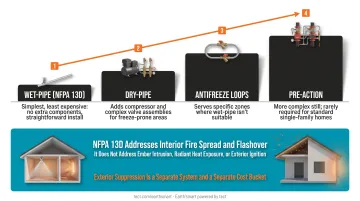
- Wet-pipe (NFPA 13D): Simplest and least expensive — no extra components, straightforward to install
- Dry-pipe: Adds a compressor and complex valve assemblies for freeze-prone areas
- Antifreeze loops: Serve specific zones where wet pipe isn't suitable
- Pre-action: More complex still; rarely required for standard single-family homes
For WUI homeowners, the important distinction is that NFPA 13D was designed for life-safety protection inside the home — it addresses interior fire spread and flashover. It does not address ember intrusion, radiant heat exposure, or exterior ignition, which are the primary wildfire threats. Exterior suppression components are a separate system and a separate cost bucket.
Home Size and Layout
More square footage means more pipe, more sprinkler heads, and more labor hours. Beyond raw size:
- Open floor plans and high ceilings affect coverage zone calculations and head placement
- Multi-story homes add vertical piping runs and coordination complexity
- Slab foundations averaged $0.81/sq ft in NFPA research vs. $1.81/sq ft for basement homes — foundation type is a real cost driver
Piping Material
The 2008 NFPA/FPRF study provides the clearest authoritative comparison: CPVC averaged $1.18/sq ft versus copper at $3.19/sq ft. PEX is also permitted under ICC P2904 for residential sprinkler applications, though current PEX pricing is bid-dependent — get quotes directly from licensed contractors.
Local code may restrict or require specific materials — verify with your Authority Having Jurisdiction (AHJ) before spec'ing pipe.
Water Supply and Infrastructure
Homes on well water or municipal lines with insufficient pressure may need a dedicated storage tank and booster pump. The 2008 NFPA study found this added $2,000–$3,600 to total system cost — that figure is now over 15 years old. Treat it as a floor, not a ceiling, and budget based on current contractor bids.
In WUI zones, on-site water supply isn't just a code workaround. It's operational capacity during a fire event, when municipal pressure may fail entirely. Earth'smart powered by tect integrates dedicated water supply as a core component of WUI home design from the project's start — part of a site-scale suppression strategy rather than a retrofit added under pressure later.
Permit Fees, Inspection, and Local Code Requirements
Permit and inspection fees vary by jurisdiction and are frequently underestimated in early budgets. For California rebuilds, the LA County February 2025 Fire Rebuild FAQ is unambiguous: rebuilds must comply with current code, including fire sprinklers. Properties in a WUI or Fire Hazard Severity Zone must also meet Chapter 7A exterior hardening requirements.
Chapter 7A is separate from NFPA 13D. It governs materials and construction methods for wildfire exposure, covering ember-resistant vents, ignition-resistant siding, and exterior assembly requirements. Homeowners rebuilding in Pacific Palisades need to budget for both, not one or the other.
Full Cost Breakdown: What You're Actually Paying For
The per-square-foot benchmark is a starting point, not a total. Here's what the complete investment covers:
One-time costs:
- Equipment and materials — pipe, fittings, sprinkler heads, control valves, backflow preventers, alarm components; scales directly with system type and home size
- Installation and labor — licensed fire sprinkler contractor time for layout, pipe runs, and commissioning; retrofit projects add wall and ceiling access work plus finish restoration
- Permit and inspection fees — jurisdiction-specific; often overlooked until the permit application is submitted
- Water service upgrades — meter resizing, pressure boosters, or dedicated tank/pump systems; these are the most common surprise line item in retrofit and some new-build projects
Ongoing costs:
- Annual maintenance — NFPA 13D residential systems keep ongoing costs low; the standard calls for monthly visual inspections, waterflow device testing every six months, and periodic professional inspection
- Inspection costs — vary by contractor and region for single-family homes; get local bids rather than relying on national averages
- Head replacements — rare under normal conditions, but any sprinkler head that shows damage, corrosion, or paint overspray should be replaced
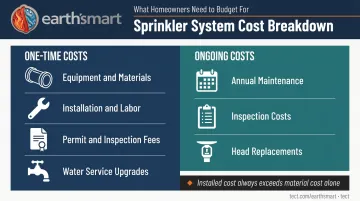
These line items add up to one consistent pattern: the installed cost is always higher than the material cost alone. Homeowners who price out equipment online and use that as their budget are missing labor, permits, and infrastructure — often the largest portions of the total.
New Construction vs. Retrofit: Why Timing Is the Biggest Cost Variable
When you integrate a fire suppression system matters more than which system type you choose.
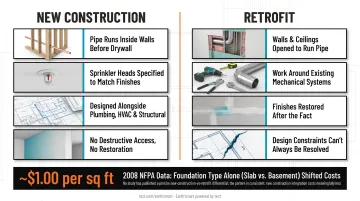
In new construction, pipe runs inside walls and ceilings before drywall closes. Sprinkler heads are specified to match finishes. The system is designed alongside plumbing, HVAC, and structural systems. No destructive access, no restoration work, no coordination compromises from working around an existing structure.
In a retrofit, contractors must open walls and ceilings to run pipe, work around existing mechanical systems, and restore finishes after the fact. This drives labor costs substantially higher and creates design constraints that can't always be resolved cleanly.
The 2008 NFPA data showed that foundation type alone (slab vs. basement) shifted costs by nearly a dollar per square foot. A full retrofit adds even more complexity on top of that. No authoritative study has published a precise new-construction-vs-retrofit cost differential, but the pattern is consistent: new construction integration is meaningfully less expensive.
The Rebuild Window
For homeowners rebuilding after wildfire, this matters more than almost any other consideration. The rebuild is the lowest-cost window to integrate suppression correctly. Once construction closes — once drywall goes up, that window closes, and any future additions become retrofit-priced projects.
Earth'smart powered by tect's approach addresses this directly. Under the Earth'smart™ framework, fire suppression system planning happens at project inception, alongside structural, mechanical, and envelope decisions. Working with earth'smart powered by tect's earth'smart powered by tectApp™ community of over 70 building product manufacturers, earth'smart powered by tect coordinates suppression systems with water supply, exterior hardening, and structural systems from the start — so decisions that affect each other get made together, not corrected later.
Insurance impact: The Home Fire Sprinkler Coalition reports that property and casualty insurers offer discounts as high as 35% for sprinklered homes. State Farm confirms that policyholders may qualify for a discount when a fire sprinkler system is installed, though specific percentages vary by insurer. In wildfire-prone areas where premiums have risen sharply and coverage is harder to obtain, every percentage point of reduction matters.
What Most Homeowners Miss When Budgeting for Fire Suppression
A few patterns consistently lead to budget surprises and safety gaps:
- Equipment cost is only part of the number. The per-square-foot benchmark covers materials — not permits, water service upgrades, labor for complex layouts, or system design fees. The true installed cost is always higher.
- Retrofit complexity is routinely underestimated. Many homeowners assume adding a system later is "just plumbing." Accessing existing wall cavities, coordinating around installed systems, and restoring finishes can push retrofit costs well beyond what new-construction integration would have cost.
- Skipping exterior suppression creates a safety gap, not just a budget trade-off. For WUI properties, an interior-only NFPA 13D system leaves the home's primary exposure risk — embers, radiant heat, exterior ignition — unaddressed. The IBHS notes that external sprinklers for wildfire defense serve a fundamentally different function than interior residential sprinklers.
- The performance data makes a strong financial case. According to NFPA's U.S. Experience with Sprinklers report (2017–2021), sprinklers were effective 98% of the time when they operated in home fires. Sprinklered homes saw 89% lower civilian death rates and 55% lower average property loss. Reduced risk, insurance savings, and resale premium belong in the financial case from the start.
Frequently Asked Questions
How much does a fire suppression system cost for a house?
The NFPA/FPRF 2013 benchmark is $1.35 per square foot for new construction, with a historic range up to $3.66/sq ft depending on layout and materials — putting a 2,000 sq ft home between $2,700 and $7,320 at baseline. Water supply upgrades, permits, and WUI-specific components are additional.
Do home fire suppression systems work?
The data is definitive. According to NFPA's 2017–2021 analysis, sprinklers were effective 98% of the time when they operated in home fires, reduced civilian death rates by 89%, and cut average property loss by 55% compared to unsprinklered homes.
Is it cheaper to install a fire suppression system during new construction or as a retrofit?
New construction is substantially cheaper. Pipes run inside walls before drywall closes, eliminating the destructive access and finish restoration required by retrofit projects. The 2008 NFPA study showed foundation type alone moved costs by nearly $1/sq ft — full retrofits add further labor and coordination costs on top.
How much can a fire suppression system lower my homeowners insurance?
The Home Fire Sprinkler Coalition reports discounts as high as 35% for sprinklered homes, with State Farm confirming sprinkler discounts are available — though specific percentages vary by insurer. Contact your insurer directly for a quote reflecting your specific policy and home.
What is the difference between a fire suppression system and a fire sprinkler system?
"Fire suppression system" is the broader term, covering water-based sprinklers, chemical agents, and specialty systems — while "fire sprinkler system" refers specifically to water-based systems. For residential applications, water-based sprinkler systems under NFPA 13D are the standard and most cost-effective choice.
Do home fire suppression systems require a lot of maintenance?
Residential systems under NFPA 13D are designed for low maintenance. NFPA 13D guidance calls for monthly visual inspections of valves and heads, waterflow device testing every six months, and periodic professional inspection. Most systems operate reliably for decades on that schedule alone.