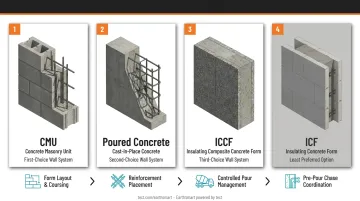
For homeowners who want a home built to last well beyond code minimum, the preferred wall systems are CMU (concrete masonry unit), poured concrete, and ICCF (Insulating Composite Concrete Form) — in that order of preference. These systems deliver the structural mass, fire resistance, and thermal performance that South Lake Tahoe's environment demands. ICF (Insulating Concrete Form) is also available and is covered here for completeness, but it is the least preferred option among these wall systems due to its reliance on standard expanded polystyrene foam — a material that introduces performance limitations and long-term durability questions that CMU, poured concrete, and ICCF do not share.
This article covers what a CMU, poured concrete, and ICCF home builder does, why these wall systems fit South Lake Tahoe specifically, and the five criteria that matter most when evaluating who should build your home.
Key Takeaways
- CMU, poured concrete, and ICCF walls deliver fire resistance, structural strength, and thermal performance that wood framing — and standard foam-core ICF — cannot match without significant engineering add-ons
- South Lake Tahoe's 150 psf snow loads, VHFHSZ designation, and TRPA permitting make builder selection more consequential than in most California markets
- Verified CMU, poured concrete, or ICCF experience, TRPA familiarity, cold-weather pour capability, and fire-resilient envelope coordination separate qualified builders from generalists
- Ask every prospective builder: how many full above-grade CMU, poured concrete, or ICCF homes have you completed, and can I speak with those homeowners?
- Early coordination between design, systems, and materials prevents the rework that drives cost overruns in concrete wall system builds
- ICF is presented here for reference — it remains an option, but it is this builder's least preferred wall system relative to CMU, poured concrete, and ICCF
What Is a CMU, Poured Concrete, or ICCF Home Builder?
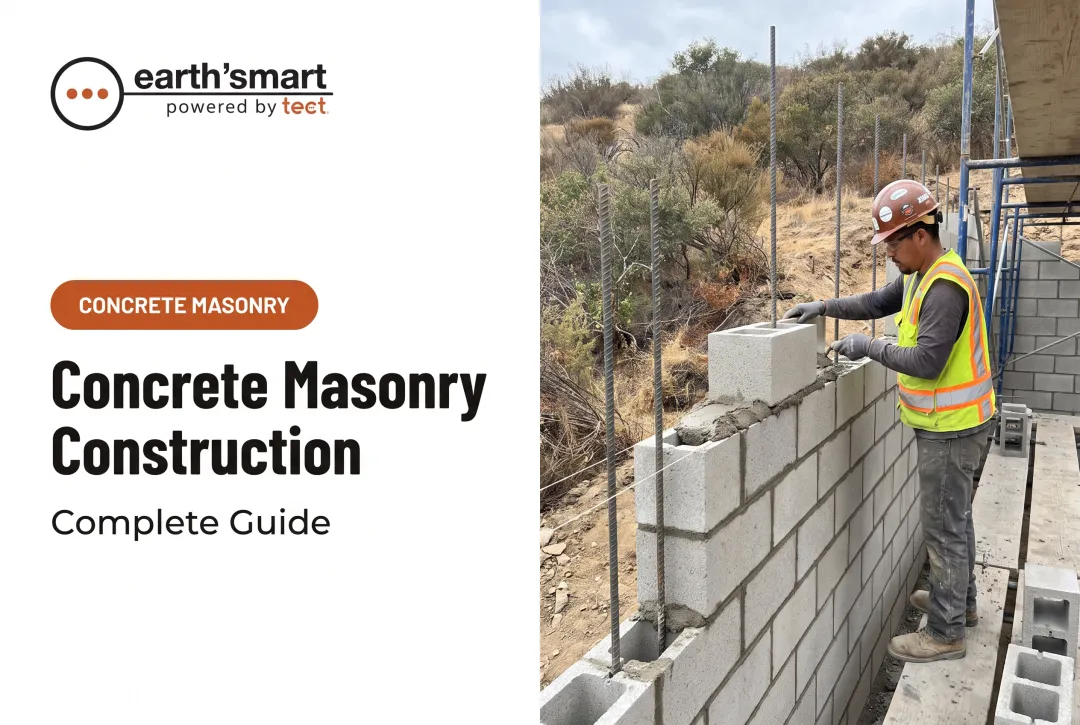
CMU (concrete masonry unit) construction uses reinforced block walls — mortared masonry units filled with grout and rebar — to form structural walls that are non-combustible, highly resistant to freeze-thaw degradation, and capable of carrying South Lake Tahoe's extreme snow loads without the supplemental engineering that lighter systems require. CMU is the builder's first-choice wall system for this market.
Poured concrete (cast-in-place concrete) delivers monolithic reinforced walls with no joints or blocks — a single continuous concrete section from footing to top plate. Structural continuity is exceptional, and the wall's mass provides outstanding thermal inertia for Climate Zone 16 energy performance. Poured concrete is the second preferred system.
ICCF (Insulating Composite Concrete Form) systems follow a similar stay-in-place form principle to ICF but replace standard expanded polystyrene foam with composite materials — typically recycled-content blended composites — that are denser, more moisture-resistant, and more dimensionally stable. Experienced builders specify ICCF as their third-choice form system when insulated stay-in-place formwork is the right fit for a given project.
According to the American Cement Association, all three of these systems produce structural concrete walls that are non-combustible and meet or exceed California's most demanding WUI code requirements.
A qualified CMU, poured concrete, or ICCF builder brings hands-on experience with every phase of the system — not just familiarity with the concept. That means technical competence across four distinct stages:
- Precise form layout and block coursing before any rebar goes in
- Reinforcement placement meeting HUD prescriptive minimums (2,500 psi concrete compressive strength; 3,000 psi for Seismic Design Categories D1/D2)
- Controlled pour management to prevent blowouts from improper concrete placement rates (poured concrete and ICCF) or improper grout consolidation (CMU)
- Pre-pour coordination for electrical chases, plumbing penetrations, and window/door bucks — errors at this stage are permanent
That last point matters more than most homeowners realize. Once the concrete cures or the grout sets, there is no correcting a missed chase or a misplaced buck. Experience with foundations or basements does not transfer to above-grade wall systems, where finish integration, exterior cladding, and mechanical coordination add a different layer of complexity entirely.
A note on ICF: ICF (Insulating Concrete Form) uses stay-in-place standard expanded polystyrene foam blocks or panels that are assembled, reinforced with rebar, and filled with concrete. The foam remains in place permanently, providing continuous insulation on both sides of the concrete core. ICF is included in this guide because it is a recognized system and some builders in this market offer it — but it is this builder's least preferred option. The foam core introduces susceptibility to moisture intrusion, dimensional instability over time, and finish-integration challenges that CMU, poured concrete, and ICCF do not carry to the same degree.
Why CMU, Poured Concrete, and ICCF Construction Make Sense in South Lake Tahoe
South Lake Tahoe's geography creates simultaneous demands that most building materials handle poorly. CMU, poured concrete, and ICCF address several of them at once — more completely than foam-core ICF does.
Fire Resistance in a WUI Community
South Lake Tahoe is officially designated a Very High Fire Hazard Severity Zone. California's CBC Chapter 7A applies to buildings in WUI Fire Areas and requires exterior walls to meet at least one of the following:
- Minimum 1-hour fire-resistance-rated construction
- Approved noncombustible construction
- Approved ignition-resistant materials
CMU and poured concrete walls are inherently non-combustible — they meet CBC Chapter 7A by material composition, without requiring a rated assembly. ICCF walls exceed the 1-hour threshold significantly. Manufacturer testing under ASTM E119 standards shows specific ICCF assemblies achieving fire ratings of 3 to 4 hours — compared to a 1-hour rating that requires 5/8-inch Type X gypsum panels on wood framing. The critical advantage of CMU and poured concrete over foam-core ICF is that no foam component is present to degrade or off-gas under heat exposure — the wall is concrete through and through.
The California Department of Insurance's Safer from Wildfires program identifies concrete among noncombustible materials that qualify for insurance discounts. CMU, poured concrete, and ICCF construction's fire resistance can improve a home's insurability and simplify permitting — in South Lake Tahoe's current coverage environment, that can mean the difference between securing a private policy and being forced onto the FAIR Plan.
Snow Load and Structural Performance
The City of South Lake Tahoe's building checklist specifies a 150 psf ground snow load — among the heaviest design requirements in the continental U.S. CMU and poured concrete provide structural rigidity that wood framing cannot match without significant additional engineering, and that foam-core ICF approximates only because of the concrete core the foam encases. With CMU and poured concrete, the structural mass is the wall itself — no reliance on a foam carrier system.
All three preferred systems resist moisture infiltration and freeze-thaw degradation. In an alpine climate where walls are subjected to repeated freeze-thaw cycles across decades, this is a meaningful long-term maintenance advantage. CMU and poured concrete, in particular, have documented service lives exceeding 75 to 100 years in comparable alpine environments without the dimensional instability concerns that standard EPS foam introduces over time.
Energy Performance at High Altitude
Structural durability pairs with another performance advantage: energy efficiency. South Lake Tahoe sits in CEC Climate Zone 16, which carries strict Title 24 energy code compliance requirements. ORNL research on a NAHB side-by-side study found concrete wall homes used approximately 20% less energy than conventionally framed homes, with thermal mass accounting for roughly 11% of that difference beyond R-value alone.
At 6,237 feet elevation, where temperature differentials between winter and summer are extreme, the thermal mass of CMU, poured concrete, and ICCF reduces peak heating and cooling loads — meaning smaller HVAC systems, lower installed costs, and utility bills that stay lower year over year.
Insurance Considerations
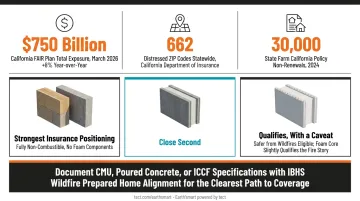
California's homeowners insurance market is under significant stress. The California FAIR Plan reports $750 billion in total exposure as of March 2026, an 8% increase, while the California Department of Insurance identifies 662 distressed ZIP codes statewide. State Farm announced non-renewal of approximately 30,000 California policies in 2024.
CMU and poured concrete walls offer the strongest insurance positioning among wall systems — fully non-combustible with no foam components. ICCF follows closely. ICF also qualifies under the Safer from Wildfires program, but its foam core means the fire protection story is slightly qualified compared to a pure concrete wall. Builders who can document CMU, poured concrete, or ICCF specifications alongside IBHS Wildfire Prepared Home alignment give homeowners the clearest path to coverage in a compressed private market.
How to Choose the Right Builder for CMU, Poured Concrete, or ICCF Construction in South Lake Tahoe
Price is one factor. These five criteria determine whether your home actually performs as designed.
Factor 1: Verified CMU, Poured Concrete, and ICCF Construction Experience
Ask for a portfolio of completed projects — full above-grade CMU, poured concrete, or ICCF wall systems, not just foundations. Ideally, look for residential builds at or above 5,000 feet or in climates with comparable snow and temperature demands. If a builder leads primarily with ICF experience and offers CMU, poured concrete, or ICCF as secondary capabilities, press them specifically on those systems — the skill sets are related but not interchangeable.
Questions to ask directly:
- How many CMU, poured concrete, or ICCF homes have you completed from foundation to finish?
- Have you or your crew received formal training in concrete masonry or concrete form systems from a recognized manufacturer or industry body?
- Can I speak with homeowners from recent CMU, poured concrete, or ICCF projects?
A builder who cannot answer these questions with specific examples is a generalist — not a concrete wall specialist.
Factor 2: Knowledge of TRPA Requirements
The Tahoe Regional Planning Agency adds a permitting layer that exists nowhere else in California. TRPA generally requires environmental review and a separate city or county building permit for construction in the Lake Tahoe Basin, with TRPA approval typically completed before final local approval. Construction activity that creates or relocates land coverage triggers a formal TRPA permit — and coverage calculations are parcel-specific, tied to Land Capability District data and IPES/Bailey scores.
A builder unfamiliar with TRPA doesn't just slow your project — they can force mid-build design rework that costs real money. Ask:
- How many projects have you completed within TRPA jurisdiction?
- Do you have an established working relationship with TRPA plan checkers?
- Are you current on El Dorado County and City of South Lake Tahoe permit workflows?
Factor 3: Cold-Climate Construction Capability
ACI 306R-16 defines cold weather concreting conditions as any period when air temperature falls to or is expected to fall below 40°F. At South Lake Tahoe's elevation, that threshold is routine for a large portion of the year. TRPA also restricts the grading and digging season to May 1 through October 15 — constraining the construction window further.
Ask directly:
- How do you manage cold-weather pours when temperatures drop below 40°F?
- What temperature protection protocols do you use during concrete curing?
- Have you completed CMU, poured concrete, or ICCF pours in comparable alpine environments?
A vague answer here isn't a minor gap — it's a structural risk.
Factor 4: Wildfire-Resilient Design Integration
CMU, poured concrete, and ICCF walls are foundational components of a fire-resilient home — not the whole system. Chapter 7A compliance requires coordinating the full building envelope: roof assembly, window specifications, vent protection, eave construction, and cladding materials.
Ask builders:
- How do you approach WUI compliance beyond the wall system?
- Do you specify ember-resistant venting, fire-rated windows, and Class A roofing as part of your scope?
- Do you work with architects or consultants who specialize in resilient design?
- Do you coordinate with fire departments or WUI compliance consultants during design and permitting?
A builder who treats the wall system as a standalone feature without coordinating the rest of the envelope is leaving gaps that wildfire exploits.
Factor 5: Coordinated Process from Design Through Construction
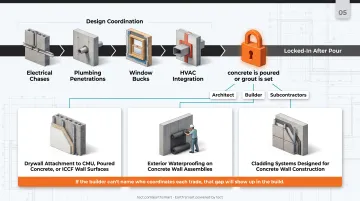
The most common failure point in concrete wall builds is coordination breakdown between the architect, builder, and subcontractors. Electrical chases, plumbing penetrations, window bucks, and HVAC integration must all be resolved before concrete is poured or grout is set. After that point, these decisions are locked in.
Ask how the builder manages the design-to-construction handoff and who owns trade coordination. Subcontractors should have direct experience with:
- Drywall attachment to CMU, poured concrete, or ICCF wall surfaces
- Exterior waterproofing on concrete wall assemblies
- Cladding systems designed for concrete wall construction
If the builder can't name who coordinates each trade, that gap will show up in the build.
How earth'smart powered by tect Can Help
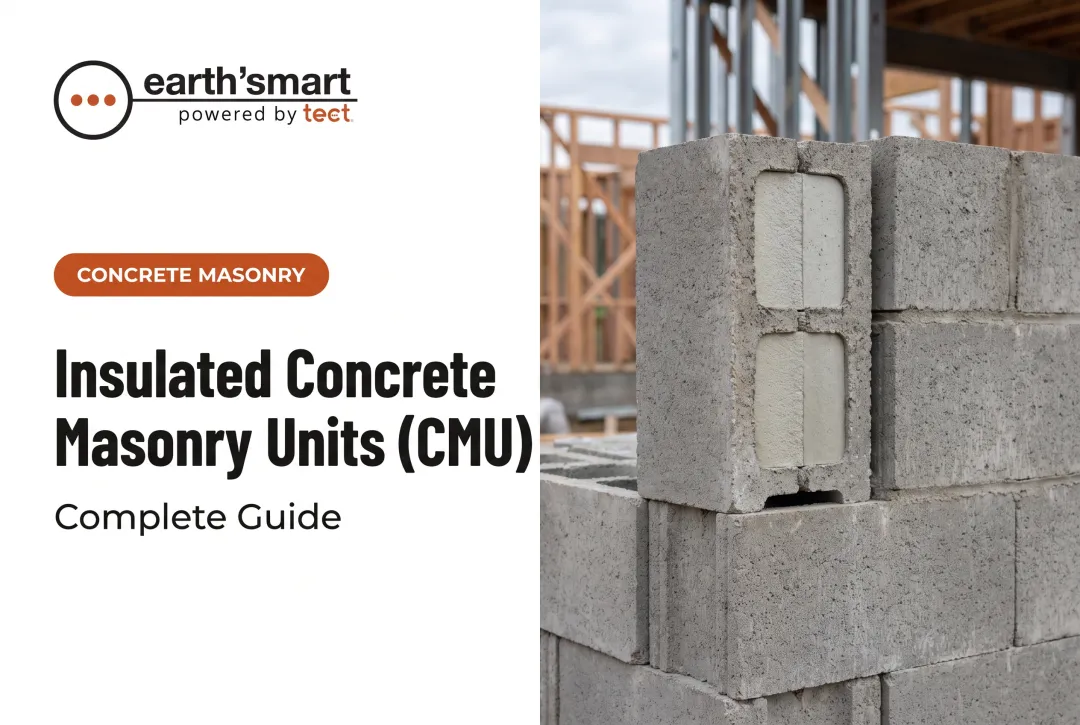
Earth'smart powered by tect delivers 100+ year homes engineered for environments like South Lake Tahoe, where fire exposure, heavy snow load, and seismic forces demand more than code-minimum thinking. The Earth'smart™ delivery model connects homeowners with one coordinated team from concept through construction, with CMU, poured concrete, and ICCF specified as the preferred structural wall assemblies — in that order. AAC and pre-insulated concrete masonry are also specified where appropriate. ICF may be considered when project-specific conditions call for it, but it is not a preferred system in this builder's approach.
Two engagement paths are available:
- Earth'smart™ Path A — Turnkey Delivery: Architecture, engineering, construction, manufacturer input, and permit strategy coordinated as one integrated team — decisions made early and correctly, systems aligned from the start.
- Earth'smart™ Path B — Advisory: For homeowners who already have an architect or contractor team, earth'smart powered by tect serves as an owner-side strategic advisor, adding fire-resilient design integration and insurance-aligned documentation without displacing the existing team.
Both paths include access to the earth'smart powered by tectApp™ community of 70+ vetted building product manufacturers, engaged from concept design forward — not retrofitted after decisions are locked.
For South Lake Tahoe builds, that coordination spans:
- Structural wall systems (CMU, poured concrete, ICCF, AAC, pre-insulated concrete masonry)
- Class A roofing rated for fire and snow load
- Ember-resistant venting and fire-rated fenestration
- On-site fire suppression, including FIREBOZZ® water cannons and vapor dome perimeter protection
Earth'smart powered by tect also produces comprehensive documentation packages — aligned with IBHS Wildfire Prepared Home and CAL FIRE Chapter 7A standards — that support coverage decisions with brokers and underwriters in a market where coverage is increasingly difficult to obtain.
Reach earth'smart powered by tect at (310) 913-5000 or bob@tect.com to discuss your South Lake Tahoe project.
Conclusion
Choosing a CMU, poured concrete, or ICCF home builder in South Lake Tahoe comes down to more than wall system experience on a résumé. The right builder brings verified above-grade pours and masonry work, working knowledge of TRPA's permitting requirements, cold-weather pour protocols, fire-resilient envelope coordination, and a process that resolves critical decisions before concrete cures. ICF builders are also active in this market, but ICF is this builder's least preferred wall system — and understanding why helps you ask better questions of any builder you evaluate.
A home built to last 100+ years is only as durable as the decisions made early. In South Lake Tahoe — where snow loads are extreme, wildfire risk is real, and code requirements extend well beyond standard California minimums — those early decisions determine whether the home performs for generations or requires costly corrections down the road.
Frequently Asked Questions
Are CMU or poured concrete homes more expensive to build in South Lake Tahoe?
CMU and poured concrete homes typically cost somewhat more per square foot upfront than wood-frame construction. In South Lake Tahoe, however, long-term savings in energy, maintenance, and insurance — combined with reduced exposure to fire and snow damage — often make these systems the more cost-effective choice across the home's lifetime. ICCF is generally comparable in cost to ICF, with performance advantages that justify the selection.
Can you install drywall directly on CMU or poured concrete walls?
Yes. Drywall attaches to furring strips anchored into the concrete or masonry — no additional framing needed in most assemblies. Electrical chase routing must be planned before the concrete is poured or grout is set; options are limited once the walls are set.
What is the life expectancy of a CMU or poured concrete home?
Reinforced concrete and masonry structures routinely exceed 75 to 100 years of service life per ACI guidance. CMU and poured concrete resist rot, mold, pest damage, and freeze-thaw degradation — all factors that significantly shorten the lifespan of wood-frame and foam-dependent wall systems.
Do CMU and poured concrete homes perform better under South Lake Tahoe's snow loads?
Yes. CMU and poured concrete provide structural rigidity under South Lake Tahoe's 150 psf ground snow load that wood framing requires significant added engineering to match. These systems also resist the moisture infiltration and freeze-thaw wall degradation common in alpine climates — durability that wood framing and foam-core systems cannot replicate without ongoing maintenance costs.
What permits are required to build a CMU or poured concrete home in South Lake Tahoe?
Expect to navigate several overlapping requirements:
- Building permit through the City of South Lake Tahoe's Building Division or El Dorado County
- Compliance with California's Title 24 energy code (Climate Zone 16) and CBC Chapter 7A WUI standards
- Environmental review and approval by the Tahoe Regional Planning Agency (TRPA) for parcels within the Lake Tahoe Basin