The consequences are worse in high-risk environments. Coastal areas like Pacific Palisades combine marine moisture with wildfire exposure, demanding insulation systems that perform on multiple fronts simultaneously. Choosing the wrong assembly isn't a minor inefficiency — it can compromise a home's durability for decades.
This guide covers the insulation types that actually work for steel frame homes, how to evaluate them against each other, and the performance criteria that matter when you're building to last.
Key Takeaways
- Steel studs conduct heat far more efficiently than wood, making cavity-only insulation inadequate — thermal bridging must be addressed at the assembly level
- Closed-cell spray foam and exterior rigid continuous insulation (CI) are the strongest performers for steel frame homes
- Mineral wool is non-combustible, fire-appropriate, and available as both cavity batt and rigid exterior board
- IECC 2021 requires R-13 cavity plus R-7.5 to R-20+ continuous exterior insulation for CFS walls in most U.S. climate zones
- Insulation must be locked in during design — wall thickness, cladding attachment, and vapor management are interdependent decisions
Why Insulating a Steel Frame Home Is More Challenging Than Wood Frame
The Thermal Bridging Problem
ACEEE research puts steel's thermal conductivity at 314 Btu-in/hr-ft²-F versus wood's 1.0 — a 314:1 ratio. In a wall assembly, that means steel studs act as direct thermal conduits, pulling heat straight through the wall and bypassing whatever insulation sits between them.
The numbers from the Cold-Formed Steel Engineers Institute thermal design guide are stark:
| CFS Wall Assembly | Stud Spacing | Assembly U-Factor | Effective R-Value |
|---|---|---|---|
| 3.5" stud, R-13 cavity, no CI | 16" | U-0.124 | R-8.1 |
| 3.5" stud, R-13 cavity, no CI | 24" | U-0.108 | R-9.3 |
| 6" stud, R-19 cavity, no CI | 16" | U-0.109 | R-9.2 |
| 6" stud, R-19 cavity, no CI | 24" | U-0.094 | R-10.6 |
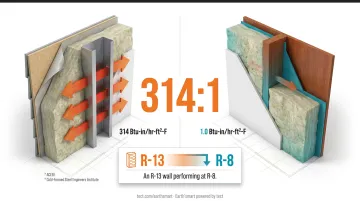
An R-13 wall that actually performs at R-8 is a significant gap — one that neither occupant comfort nor energy code compliance can absorb.
Why Exterior Continuous Insulation Is Non-Negotiable
Because steel studs bridge the entire framing plane, the only way to interrupt that heat path is to wrap insulation continuously around the outside of the framing, not just fill cavities between studs. This exterior continuous insulation (CI) layer covers studs, headers, and corners without interruption.
That change has real architectural consequences that must be designed in from the start:
- Wall assembly thickness increases, affecting interior and exterior dimensions
- Window and door jambs require extension to meet the new wall plane
- Exterior cladding fasteners must span the insulation layer and resist greater cantilever forces
These details are manageable with early coordination. They become expensive problems when addressed after framing is complete.
Condensation Risk in Coastal Climates
Steel surfaces within the wall cavity can drop to dew point temperatures in marine or mixed-humid climates, triggering condensation where warm interior air meets cold framing. In Pacific Palisades and similar coastal locations, ocean moisture compounds this risk. Vapor management must be coordinated with the insulation strategy from the beginning. That means addressing:
- Vapor retarder placement relative to the dew point within the assembly
- Air barrier continuity at all framing transitions and penetrations
Treating these as separate line items after the insulation approach is set is how condensation problems get built in.
Best Insulation Types for Steel Frame Homes
No single product solves everything. The most effective assemblies for CFS homes combine cavity insulation with exterior CI, selected for R-value per inch, moisture resistance, fire performance, and compatibility with steel framing.
Closed-Cell Spray Polyurethane Foam (ccSPF)
Closed-cell spray foam delivers the highest R-value per inch of any widely available insulation. Verified ICC-ES product data shows:
- Huntsman Heatlok HFO / Icynene HFO MAX: R-6.3 per inch
- BASF WALLTITE LWP: R-6.9 per inch
- BASF WALLTITE ONE: R-7.5 per inch
Applied to the interior face of steel framing, ccSPF creates a continuous thermal and vapor barrier that significantly reduces thermal bridging and condensation risk. It conforms tightly to irregular steel surfaces, leaving no gaps.
Key advantages for CFS assemblies:
- Creates an integrated air and vapor barrier without a separate membrane
- Fills the full stud cavity, minimizing thermal short-circuiting
- Performs well in fire-risk environments when properly covered
Important code constraint: 2021 IRC Section R316.4 requires foam plastic to be separated from building interiors by at least ½-inch gypsum wallboard or equivalent thermal barrier. Exposed SPF in habitable spaces is not code-compliant. ICC-ES reports also classify these products as nonstructural — claims about ccSPF adding structural rigidity to CFS framing are not supported by current evaluation reports.
Cost is the primary limitation. ccSPF runs significantly higher than fiberglass or mineral wool batts, and for projects managing tight rebuild budgets, hybrid systems may be more practical.
Rigid Continuous Insulation (Polyiso, XPS, EPS)
Exterior rigid foam board addresses thermal bridging directly by wrapping the entire framing plane without interruption. Verified R-values per inch by product type:
| Product Type | R-Value per Inch |
|---|---|
| Carlisle polyisocyanurate (polyiso) | R-5.6 |
| DuPont Styrofoam XPS | R-5.0 |
| Insulfoam EPS Type I | R-3.6 |
| Insulfoam EPS Type IX | R-4.2 |
Polyiso offers the highest R-value per inch among rigid boards, though its performance decreases at cold temperatures. That matters for California projects at elevation or in coastal conditions where nighttime lows are more extreme than daytime averages suggest.
Adding exterior CI changes the wall assembly in specific ways:
- Cladding fasteners must span the insulation and comply with AISI S240 or ASTM C1513 screw requirements
- CFS studs must meet minimum steel thickness requirements (33 mil for lighter studs, 50 ksi for heavier)
- Window and door jambs require extension equal to the CI thickness
- The architect, structural engineer, and product manufacturers must coordinate cladding attachment from the start of design
These coordination requirements are the reason exterior CI decisions can't wait until construction documents. For IECC 2021 compliance in most U.S. climate zones, exterior CI isn't optional for CFS walls — it's prescribed. More on the specific requirements in the R-value section below.
Mineral Wool (Stone Wool)
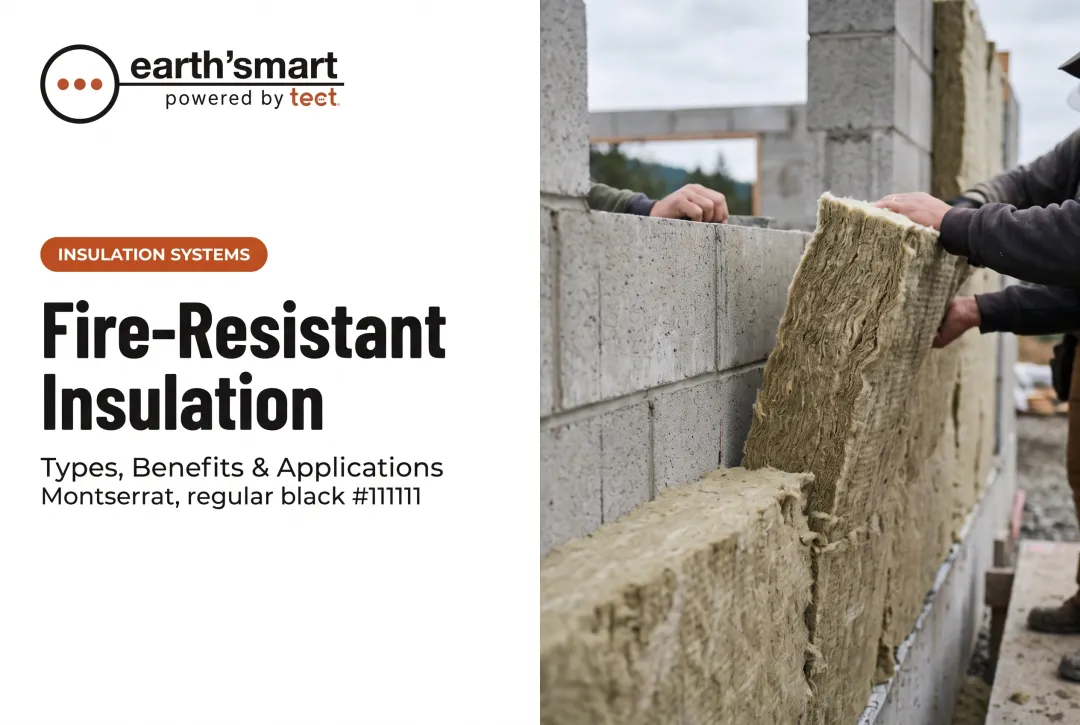
Mineral wool earns particular attention for WUI and wildfire-zone construction. ROCKWOOL's Cavityrock product data lists a melting point of approximately 2,150°F (1,177°C). It is classified as non-combustible, does not spread flames, and retains structural integrity at high temperatures, which matters when building in areas with direct wildfire exposure.
R-value per inch runs approximately R-3.7 to R-4.2, lower than foam options. That means thicker assemblies to achieve equivalent thermal performance, but the fire and moisture benefits are meaningful:
- Non-combustible classification under ASTM E136
- Highly moisture-resistant — does not absorb or retain water
- Dimensionally stable under heat exposure
- Available as cavity batt (for between-stud applications) and rigid exterior board (for CI applications)
Earth'smart powered by tect's Earth'smart™ standard explicitly specifies mineral wool as part of its non-combustible materials approach for WUI residential projects in California. For a home designed to last 100+ years in a fire-risk environment, the non-combustibility of every envelope component matters.
Mineral wool typically costs more than fiberglass but less than ccSPF, and it can be combined with exterior rigid CI to meet energy code requirements for CFS walls.
High-Performance Fiberglass and Hybrid Systems
Fiberglass batt is the most cost-effective cavity fill for CFS construction, but it can't function as a standalone solution. An R-13 fiberglass batt in a CFS wall delivers roughly R-8 effective whole-wall performance, because the steel studs themselves conduct heat around the insulation.
The practical path is a hybrid assembly: fiberglass cavity fill paired with exterior rigid CI. This approach:
- Uses fiberglass for acoustic performance and cost-effective cavity fill
- Uses polyiso or mineral wool board CI to address thermal bridging
- Typically achieves energy code compliance at lower total cost than all-spray-foam assemblies
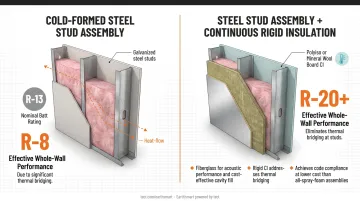
For homeowners managing rebuild budgets, hybrid systems are often the most economical route to code compliance without sacrificing durability or comfort.
How to Choose the Right Insulation for Your Steel Frame Home
The most common mistake isn't picking the wrong product — it's treating insulation as a construction-phase decision rather than a design-phase decision.
By the time framing is underway, wall assembly thickness is set, cladding attachment is designed, and the vapor management strategy is locked in. Changing insulation type at that point costs far more than money: it can require redesigning window jambs, re-engineering cladding connections, and revisiting the building permit.
Key Selection Factors
Evaluate these criteria before specifying any insulation system:
- Climate zone and energy code requirements — IECC 2021 Table R402.2.6 sets CFS-specific prescriptive requirements; California Title 24 uses assembly U-factor compliance paths
- Moisture and vapor management — coastal and marine climates like Pacific Palisades require careful vapor retarder placement to prevent condensation on steel framing
- Fire performance — WUI and Chapter 7A zones require non-combustible or ignition-resistant assemblies; non-combustibility of insulation matters alongside exterior cladding choices
- Budget — upfront material cost must be weighed against long-term energy performance and durability; hybrid systems often optimize both
- Wall assembly thickness — CI adds 1–4 inches to the wall plane, affecting interior square footage, jamb extensions, and architectural detailing
The Design Coordination Requirement
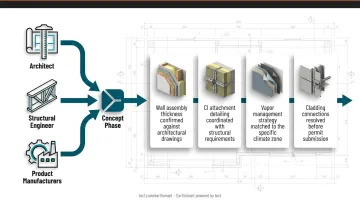
For homes in coastal, WUI, or fire-prone areas, insulation selection requires input from the architect, structural engineer, and product manufacturers — working together from the concept phase, not sequentially after the fact.
Earth'smart powered by tect's Earth'smart™ delivery model is built around exactly this sequencing. Through the earth'smart powered by tectApp™ platform, homeowners rebuilding in Pacific Palisades and across California WUI markets engage directly with vetted building product manufacturers during design — when changes are still cheap. By the time a single panel goes up, the critical decisions are already made:
- Wall assembly thickness confirmed against architectural drawings
- CI attachment detailing coordinated with structural requirements
- Vapor management strategy matched to the specific climate zone
- Cladding connections resolved before permit submission
What R-Value Does a Steel Frame Home Actually Need?
Label R-values don't tell the whole story for cold-formed steel (CFS) walls. For CFS walls, the effective whole-wall R-value is substantially lower than the nominal cavity value (the R-value of the insulation alone) due to thermal bridging. IECC 2021 accounts for this by requiring CFS walls to comply with Table R402.2.6 (steel-frame equivalents) or the U-factor path — not nominal cavity R-value alone.
IECC 2021 Prescriptive Requirements for CFS Walls
The table below shows representative steel-frame equivalents from IECC 2021 Table R402.2.6 at 16" stud spacing:
| Climate Zones | Wood-Frame Basis | CFS Equivalent (16" spacing examples) |
|---|---|---|
| 1–2 | R-13 | R-13 + R-4.2ci, or R-15 + R-3.8ci |
| 3–4 | R-20 or R-13+5ci | R-13 + R-8.9ci, or R-19 + R-7.8ci |
| 5–8 | R-20+5ci or R-13+10ci | R-13 + R-12.7ci, or R-19 + R-11.6ci |
At 24" stud spacing, CI requirements decrease slightly — but continuous insulation remains required in all zones above Zone 1.
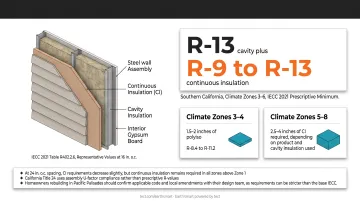
For Southern California (primarily Climate Zones 3–6), most CFS-framed residential walls need a minimum of R-13 cavity plus approximately R-9 to R-13 of continuous exterior insulation to meet IECC 2021 prescriptive requirements.
California Title 24 uses assembly U-factor compliance rather than prescriptive R-values. Homeowners rebuilding in Pacific Palisades should confirm applicable code and local amendments with their design team, as requirements can be stricter than the base IECC.
To put those numbers in practical terms, typical CI thicknesses break down as follows:
- Climate Zones 3–4: 1.5–2 inches of polyiso (R-8.4 to R-11.2) typically meets requirements
- Climate Zones 5–8: 2.5–4 inches of CI required, depending on product and cavity insulation used
Conclusion
Insulation for a steel frame home is an assembly decision, not a product decision. The right system integrates thermal performance, moisture management, fire resistance, and code compliance into a wall assembly designed with all of those factors in mind from day one.
Picking an R-value off a spec sheet and ordering batts is how you end up with an R-8 wall that was supposed to be R-13.
That assembly logic matters even more in WUI and wildfire-prone areas. Insulation is one component of an envelope system that must hold up across decades of fire exposure, coastal moisture, and seismic movement. Getting it right means involving the right people early — architect, structural engineer, and product manufacturers coordinating before the wall assembly is finalized.
The Earth'smart™ approach from earth'smart powered by tect connects homeowners directly with vetted building product manufacturers through the earth'smart powered by tectApp™ community — so insulation systems are specified against the full envelope, not in isolation, before construction begins.
If you're rebuilding in Pacific Palisades or anywhere in California's wildfire zones, start with the right conversation. Contact Bob Habian, AIA, at (310) 913-5000 or bob@tect.com to understand how insulation and every other building system are integrated into a home designed to last 100+ years.
Frequently Asked Questions
What is a good R-value for a metal building or steel frame home?
Requirements depend on your climate zone. For residential CFS-framed walls, IECC 2021 typically requires R-13 cavity insulation plus R-4 to R-13+ of continuous exterior insulation depending on the zone. The effective whole-wall R-value will always be lower than the nominal cavity value due to thermal bridging through steel studs — energy codes account for this by requiring assembly-level compliance, not just cavity R-value.
What is the best insulation for metal building walls?
For residential steel frame homes, closed-cell spray foam and exterior rigid continuous insulation (polyiso or mineral wool board) are the strongest performers. Both address thermal bridging across steel studs — the core problem that cavity-only fiberglass cannot solve on its own. Hybrid systems combining fiberglass cavity fill with exterior CI are the most cost-effective path for budget-conscious projects.
How much does it cost to insulate a 30x40 metal building?
Costs vary by insulation type and local labor rates. According to HomeAdvisor's 2024 insulation cost data, wall insulation runs approximately $1–$4 per square foot installed — fiberglass batts at the lower end ($1–$1.50/sf), spray foam considerably higher. Calculate walls and roof separately, as insulation type and thickness typically differ between the two planes.
How does thermal bridging affect insulation performance in a steel frame home?
Steel studs create a direct heat path through the wall assembly, bypassing cavity insulation entirely. A CFS wall with R-13 cavity fiberglass and no exterior CI delivers an effective whole-wall R-value closer to R-8 — a 38% reduction. This is why exterior continuous insulation that wraps the framing plane is required by energy code for CFS construction, not optional.
Can insulation be added to a steel frame home after construction is complete?
Some types — like spray foam applied to interior framing — can be added after the fact. Exterior continuous insulation and proper air/vapor barrier placement, however, must be designed into the wall assembly from the start. Retrofitting exterior CI means removing cladding, re-engineering fasteners, extending window jambs, and pulling new permits, which makes it far more expensive than building it right the first time.
Is mineral wool a good insulation choice for homes in wildfire-prone areas?
Yes. Mineral wool is non-combustible, does not melt or spread flames, and holds structural integrity at temperatures up to approximately 2,150°F — making it one of the most fire-appropriate insulation materials for WUI and wildfire-risk zones. It functions as both a cavity batt and rigid exterior board, and it's the preferred choice under earth'smart powered by tect's Earth'smart™ non-combustible materials standard.