Introduction
Most residential construction projects don't fail during framing or finishing. They fail before a single nail is driven — through vague scope, deferred decisions, and teams that were never properly coordinated in the first place.
Residential construction project management is the structured framework for preventing this: coordinating every person, decision, and resource involved in building a home from the first site assessment through final handover. According to the NAHB, it encompasses planning, leadership, trade-contractor management, and technical issue resolution across every phase.
This guide is written for homeowners, builders, and anyone overseeing a residential build — particularly those rebuilding in wildfire-affected or high-risk areas where coordination failures carry real consequences. It covers what residential construction project management actually involves, how it works phase by phase, and what separates projects that finish on time and on budget from those that don't.
Key Takeaways
- Residential construction project management coordinates every phase of a home build — from planning through handover
- Good management keeps projects on schedule, on budget, and built to spec by aligning subcontractors, permits, quality, and risk
- Four phases shape every outcome: planning, pre-construction, construction, and post-construction — earliest decisions carry the most weight
- Fragmented teams, late system decisions, and misreading a general contractor's actual scope are the most common failure points
- In high-risk environments, coordination quality from concept through construction determines whether a home truly performs
What Is Residential Construction Project Management?
Residential construction project management is the structured process of coordinating all people, systems, decisions, and resources required to complete a home — from initial planning through final handover.
The goal: deliver a home that meets the client's functional, financial, and quality expectations — on time, within budget, and in full compliance with applicable codes. The CMAA defines construction management as professional oversight from inception to completion, controlling time, cost, scope, and quality.
Residential PM differs from commercial PM in one critical way: the client is directly and emotionally involved in every decision. Fewer stakeholders, but far more personal stakes. Local zoning, residential building codes, and site-specific conditions add a regulatory layer that's distinct from commercial work — and in WUI or high-risk fire zones, considerably more demanding.
The Role of a Residential Construction Project Manager
The residential PM is the central decision-maker across the project's full lifecycle — translating the client's vision into an executable plan while serving as the primary communication hub for every party involved.
Core responsibilities include:
- Defining project scope and objectives with the client
- Developing and managing the project budget and schedule
- Procuring materials and qualifying subcontractors
- Enforcing quality standards and conducting phase inspections
- Managing permitting, documentation, and change orders
- Overseeing final handover, warranties, and as-built documentation
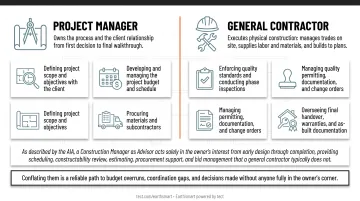
The PM is not a general contractor. The GC executes physical construction — managing trades on site, supplying labor and materials, building to plans. The PM owns the process and the client relationship from first decision to final walkthrough.
As the AIA describes it, a Construction Manager as Advisor acts solely in the owner's interest from early design through completion — providing scheduling, constructability review, estimating, procurement support, and bid management that a GC typically does not. On complex residential projects, these are distinct roles. Conflating them is a reliable path to budget overruns, coordination gaps, and decisions made without anyone fully in the owner's corner.
The Four Phases of Residential Construction Project Management
Residential construction follows four sequential phases. Errors in earlier phases don't stay contained — they compound into larger, more expensive problems downstream.
Planning Phase
The planning phase defines the project at the highest level. This is where the foundational decisions happen:
- Site selection and feasibility assessment
- Project objectives and scope definition
- Initial budget and timeline development
- Identification of site-specific constraints (fire hazard zones, coastal setbacks, seismic classifications)
Everything produced here sets the constraints that all future decisions must respect. A site in a fire hazard severity zone or coastal setback area has fundamentally different planning requirements than a standard suburban lot. Getting these constraints wrong creates cascading problems through every phase that follows.
Pre-Construction Phase
Pre-construction is where plans are finalized, permits obtained, contractors selected, and materials procured. It's also the highest-leverage phase of the entire project.
Decisions made here — about structural systems, building envelope, mechanical systems, and finish materials — have more impact on cost, schedule, and performance than any decision made during construction. When system decisions get deferred to mid-build, the cost and schedule impact is rarely minor — late changes to structural or mechanical systems typically trigger subcontractor remobilization, permit amendments, and design rework that could have been avoided entirely.
Construction is where the plan is executed, and the PM's role shifts from planning to enforcement and communication.
Key construction-phase responsibilities:
- Site preparation and trade mobilization
- Sequencing trades to eliminate conflicts and dry runs
- Conducting phase inspections before authorizing payments
- Managing daily schedule updates and two-week lookahead schedules
- Surfacing and resolving deviations before they compound
- Maintaining documented communication with the client (at minimum weekly)
NAHB's residential superintendent framework requires daily schedule control, trade coordination, signed change orders before any change is executed, and homeowner communication logs. These aren't formalities — they're the controls that keep a project from drifting.
Post-Construction Phase
Post-construction closes out the project properly. This includes final inspections, punch list resolution, regulatory closeout, and formal handover.
A well-managed closeout delivers:
- Warranties and manufacturer documentation
- As-built drawings and permit closeout
- System walkthrough with the client
- Maintenance guides and operational instructions
This phase protects both the client and the project manager. Disputes that arise post-delivery trace back to missing documentation or a handover that was never properly completed.
Key Factors That Determine Residential Construction Project Outcomes
Five variables consistently separate residential projects that finish on time and on budget from those that don't:
- Scope clarity — Vague or evolving scope is a leading driver of cost overruns. A 2025 peer-reviewed study on residential building cost overruns identified design changes and inaccurate estimates among the top causes. Lock scope early and manage change orders rigorously — NAHB requires homeowner signature before any work proceeds.
- System selection timing — Pre-construction decisions carry the highest leverage on cost and schedule. Mid-construction changes to structural systems or envelope assemblies force rework across multiple trades. Earlier decisions made correctly cost far less than late corrections.
- Site and regulatory conditions — Zoning, building codes, and permitting timelines directly shape what can be built and how long it takes. In WUI and high-risk zones, Chapter 7A assemblies, fire hazard severity zone classifications, and defensible-space requirements must be resolved before permit submission.
- Subcontractor qualification and sequencing — NAHB recommends superintendents maintain lists of qualified local trades and understand each trade's performance criteria before bids are accepted. Poor sequencing creates dry runs, rework, and schedule losses that are hard to recover from.
- Communication cadence — Delayed client decisions are a leading cause of schedule overruns. Weekly logs, documented decision records, and clear escalation paths keep decisions moving without back-and-forth delays.
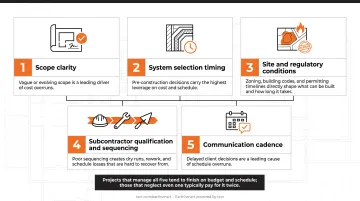
These factors don't operate independently — scope drift invites poor sequencing, which compounds when client decisions stall. Projects that manage all five tend to finish on budget and schedule; those that neglect even one typically pay for it twice.
Common Challenges and Misconceptions in Residential Construction PM
"Residential is simpler than commercial"
This is the most persistent and damaging misconception in the industry. Residential construction still demands:
- Daily schedule control and trade coordination
- Phase inspections and change-order authorization
- Homeowner communication and permitting coordination
- In WUI environments: Chapter 7A compliance, fire-hardening specs, insurance documentation, and jurisdictional permit complexity
The coordination requirements are real. What residential projects typically lack is the formal management structure that commercial work assumes from day one.
Scope creep and budget pressure
Homeowner-clients are emotionally invested in their projects in ways commercial clients are not. That investment drives scope expansion — upgrades, additions, and changes that feel incremental but accumulate into substantial cost and schedule impacts.
Strict change order discipline isn't bureaucracy. It's the mechanism that protects the client from unexpected cost exposure and protects the PM from disputes. Every change should be priced, documented, and approved in writing before it's executed.
Assuming the GC provides complete project management
Many homeowners believe their general contractor is managing the whole project. In practice, the GC's focus is construction execution — managing trades on site and building to plans. Pre-construction planning, design coordination, budgeting, system selection, and owner-side decision support fall outside the GC's core role.
Without a dedicated PM or owner's advisor, critical early-phase decisions get made by whoever happens to be available, not whoever has the right expertise. Earth'smart powered by tect's Path B Advisory model is built for exactly this gap. Working alongside an existing architect, engineer, and contractor team, it provides early system guidance, design integrity review, and owner-side decision support at the points where those inputs matter most.
Best Practices for Delivering a High-Performance Residential Project
Plan for risk before construction starts
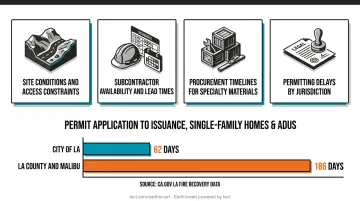
Pre-construction risk identification is where schedule and budget protection actually begins. The categories to map early include:
- Site conditions and access constraints
- Subcontractor availability and lead times
- Procurement timelines for specialty materials
- Permitting delays by jurisdiction
In California WUI markets, permitting timelines alone can derail a project. The CA.gov LA fire recovery data shows average permit application-to-issuance times ranging from 62 days in the City of LA to 186 days in LA County and Malibu for single-family homes and ADUs. Building contingency around known variables is basic risk management — discovering them mid-project costs far more than planning for them upfront.
Engage the right expertise early
The highest-value decision a homeowner or PM can make is who to involve and when. For high-risk environments, that means more than an architect and a GC. It means structural system specialists, envelope experts, and the manufacturers behind the home's critical assemblies — all engaged before design is finalized.
Earth'smart powered by tect puts this into practice through the earth'smart powered by tectApp™ community. Manufacturer input on fire-resistive wall assemblies (ICF, AAC, pre-insulated CMU), Class A roofing systems, ember-resistant venting, and integrated fire suppression is incorporated during design — not discovered during procurement. Systems are coordinated as integrated packages, so critical decisions are made early and correctly, without the cost and friction of mid-construction changes.
Standardize documentation and communication protocols
Clear, consistent documentation across all project phases protects every party and keeps the project moving.
Minimum documentation standards for any residential project:
- Written RFI and response process
- Signed change orders before work proceeds
- Phase inspection records tied to payment authorization
- Weekly stakeholder communication logs
- As-built documentation and warranty package at closeout
These aren't optional administrative tasks. They're the evidence trail that resolves disputes, supports insurance claims, satisfies warranty requirements, and proves the home was built to the standard the client paid for. In high-risk markets especially, that documentation is also what an insurer will ask for first.
Conclusion
Residential construction project management is the mechanism through which a home gets built correctly — the first time, to the standard the client actually needs. It isn't overhead. It's the work.
For homeowners building in demanding environments — high fire risk, seismic exposure, or building once and expecting the home to outlast them — the quality of project management, and specifically the quality of coordination engaged from the earliest phases, is the single most consequential variable in the outcome.
The difference between a home that performs and one that needs to be replaced isn't always the materials. It's whether the critical decisions were made correctly, early enough to matter, by people whose interests were aligned with the homeowner's — not the contractor's schedule or the supplier's margins.
That's what owner-side coordination actually delivers.
Frequently Asked Questions
What does a home building project manager do?
A home building PM oversees the entire project lifecycle — from defining scope and budget through coordinating subcontractors, managing permits, enforcing quality standards, and completing final handover. They are the central point of accountability for all project decisions and the communication hub between the client, design team, and construction team.
What are the 7 stages of a construction project?
Most residential projects operate within four core phases: planning, pre-construction, construction, and post-construction. Longer frameworks (7 stages) break planning and pre-construction into more granular steps, but pre-construction consistently carries the highest leverage for final cost and schedule outcomes.
What are the 5 C's of project management?
The 5 C's are Clarity (defined scope and goals), Communication, Coordination (of people and resources), Control (of budget, schedule, and quality), and Closeout. In residential construction, each maps to a distinct phase — making this framework a useful checkpoint at every project stage.
What is the difference between a general contractor and a construction project manager?
A GC focuses on physical construction execution — managing trades on site, supplying labor and materials, and building to plans. A construction project manager oversees the full project lifecycle, including pre-construction planning, design coordination, budgeting, and client communication from concept through handover.
What are the most common reasons residential construction projects go over budget?
The primary causes are inadequate pre-construction planning, vague initial scope, and late material and system decisions that force costly mid-build changes. Poor change order discipline — where changes proceed without pricing or written approval — and insufficient contingency reserves for site conditions or permitting delays also contribute significantly.
How long does residential construction project management typically take?
According to NAHB's 2024 data, contractor-built custom homes averaged 12 months from authorization to completion, while owner-built custom homes averaged 15.1 months. Projects in complex regulatory environments — such as California WUI zones — often require extended permitting timelines, ranging from 62 to 186 days depending on jurisdiction.