Introduction
The January 2025 Palisades Fire burned 23,448 acres and destroyed 6,845 structures. The 2018 Camp Fire wiped out 18,804 structures across 153,336 acres. In both events, exterior siding was a frontline variable — not a cosmetic afterthought.
For homeowners rebuilding or building new in fire-prone zones, siding is a life-safety decision. The wrong material — or an unverified "Class A" claim without proper certification — can mean code violations, denied insurance claims, or a home that doesn't survive the next fire.
Not all fire-resistant siding performs equally. Material composition, fire rating certification, system integration, and local code compliance all determine whether a product protects your home — or just looks like it does. What follows covers the six strongest options for WUI-zone homeowners, along with the documentation criteria you need to specify them correctly.
Key Takeaways
- Class A (Flame Spread Index 0–25) is the highest fire resistance rating and required in most WUI zones, but Class A alone doesn't equal WUI compliance.
- The six top options are: fiber cement, steel/metal, brick and stone veneer, stucco/concrete, FRT wood, and engineered composite/fused bamboo.
- Non-combustible materials (fiber cement, metal, brick, stucco) offer the strongest baseline protection.
- FRT wood and composite products must carry verified exterior WUI listings to qualify.
- California's SFM 12-7A-1 standard for exterior walls in high-fire-severity zones is stricter than ASTM E84 compliance alone.
- Siding is one component. Eaves, soffits, ventilation gaps, and wall assemblies must all be addressed or siding performance is undermined.
Why Siding Is Your Home's First Line of Fire Defense
Wildfire doesn't just arrive as a wall of flame. IBHS identifies ember storms as the greatest threat to homes in WUI zones, and NIST experiments confirm the mechanism: firebrands lodge in siding gaps, corner-post details, and joints. Vinyl melts. Weather barriers burn. Once sheathing ignites, the house is lost no matter how the interior was built.
This makes siding selection a system question, not a product question.
Understanding Fire Resistance Ratings
The ASTM E84 test classifies siding materials by Flame Spread Index (FSI):
| Class | FSI Range | Protection Level |
|---|---|---|
| Class A | 0–25 | Highest — required in most WUI zones |
| Class B | 26–75 | Moderate |
| Class C | 76–200 | Minimal |
Class A is the starting point for WUI-zone siding. But ASTM E84 is a surface-burning test — it doesn't simulate real wildfire conditions. For full WUI compliance, products must also meet ASTM E2707 (exterior wall assembly performance) or California's SFM 12-7A-1, which applies a 150 kW direct flame for 10 minutes and requires no flame penetration.
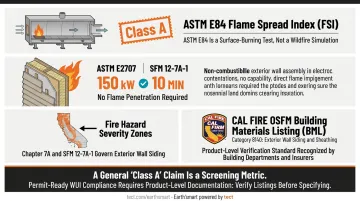
In California, Chapter 7A and SFM 12-7A-1 govern exterior wall siding in designated Fire Hazard Severity Zones.
The CAL FIRE OSFM Building Materials Listing (BML) — Category 8140 for exterior wall siding and sheathing — is the product-level verification standard that building departments and insurers recognize.
A general "Class A" claim is a screening metric. Permit-ready WUI compliance requires product-level documentation — verify listings before specifying.
6 Fire-Resistant House Siding Options
These options were selected based on fire rating certification, WUI-zone applicability, long-term durability, and availability for residential builds. Match your choice against your climate zone, local code requirements, and the aesthetic you're building toward.
Fiber Cement Siding
Fiber cement — Portland cement, sand, water, and cellulose fibers — is inherently non-combustible. It consistently earns a Class A rating under ASTM E84 and is WUI-compliant in most U.S. jurisdictions when installed as a listed assembly. James Hardie's ICC-ES ESR-2290 covers fiber-cement panels, plank lap siding, and cladding shingles as listed exterior wall coverings.
It's also the most design-flexible non-combustible option. Manufacturers produce profiles that mimic wood grain, brick, and stucco, making it suitable for a wide range of architectural styles without sacrificing fire performance.
| Attribute | Detail |
|---|---|
| Fire Rating | Class A (ASTM E84); WUI-compliant in most U.S. jurisdictions |
| Key Features | Non-combustible, rot-resistant, low maintenance, wide profile range |
| Best For | Proven fire protection with the widest range of design profiles |
Steel / Metal Siding
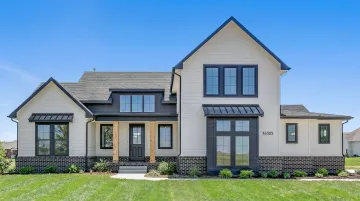
Steel and aluminum are both non-combustible — neither ignites from direct flame or radiant heat. For WUI applications, heavier-gauge steel is the stronger specification. ICC-ES ESR-4646 covers Innovative Metals exterior wall panels with an ASTM E84 flame-spread index under 25, qualifying as non-combustible composite material under IBC Section 703.5.2.
The distinction between steel and aluminum matters. Aluminum can buckle and warp under sustained heat, potentially exposing flammable substrate materials. Steel retains structural integrity longer under fire exposure — a meaningful difference in a WUI fire event.
Modern steel siding profiles offer clean, contemporary aesthetics with factory-applied finishes that resist corrosion and UV degradation.
| Attribute | Detail |
|---|---|
| Fire Rating | Class A (non-combustible); suitable for WUI assemblies with proper installation |
| Key Features | Non-combustible, structural integrity under heat, durable factory finishes |
| Best For | Maximum fire resistance paired with a clean, contemporary exterior |
Brick and Stone Veneer
Brick and natural stone don't burn, melt, or warp. The Brick Industry Association's Technical Note 16 confirms that fire resistance is directly related to wall mass and thickness — thicker assemblies perform better.
Beyond fire performance, brick and stone carry high thermal mass (moderating interior temperatures), strong resale value, and minimal maintenance over a long service life. The tradeoffs are real: higher installation cost, heavier structural load, and limited profile variety compared to engineered options.
For stone veneer specifically, verify product-level assembly documentation. Generic "Class A stone" claims without listing support don't satisfy local building departments.
| Attribute | Detail |
|---|---|
| Fire Rating | Class A (non-combustible); no flame spread |
| Key Features | Proven non-combustibility, high thermal mass, minimal maintenance, classic aesthetic |
| Best For | Traditional aesthetics with maximum fire protection and long-term low maintenance |
Stucco / Concrete Siding
Three-coat stucco and concrete-based siding systems are non-combustible and widely used in California's high-fire-severity zones. One meaningful advantage over lap siding systems: stucco creates a continuous exterior surface with no joints or gaps where embers can lodge and accumulate.
Concrete-based panel systems (including fiber-reinforced concrete) add dimensional stability and impact resistance. When properly detailed per SFM 12-7A-1, stucco systems meet California Chapter 7A requirements — confirm thickness and assembly acceptance with your local authority having jurisdiction (AHJ).
| Attribute | Detail |
|---|---|
| Fire Rating | Class A (non-combustible); compliant with Cal Fire 12-7A-1 when properly detailed |
| Key Features | Seamless ember-resistant surface, non-combustible, impact-resistant, low maintenance |
| Best For | California WUI zones where code compliance and cost-effectiveness both matter |
Fire-Retardant Treated (FRT) Wood Siding
FRT wood uses pressure-impregnated fire-retardant chemistry to reduce ignitability and flame spread. Products treated with Thermex-FR can achieve Class A ratings under ASTM E84 extended testing (30 minutes). For homeowners who want genuine wood aesthetics without untreated combustible material, this is the only credible path.
One critical caveat: not all FRT products are equivalent. ICC-ES ESR-4584 for Dricon FS lists it as Interior Type A — not for exterior use, direct wetting, or California Chapter 7A FHSZ applications.
Specify only exterior-rated, WUI-listed FRT products, and require a current ICC-ES evaluation report that explicitly covers exterior wall use.
| Attribute | Detail |
|---|---|
| Fire Rating | Class A (ASTM E84 / E84 Extended); WUI-compliant when exterior-listed (ESR required) |
| Key Features | Natural wood appearance, pressure-impregnated treatment, meets IBC/IRC and WUI codes when certified |
| Best For | Wood aesthetics where verified WUI compliance documentation is non-negotiable |
Engineered Composite / Fused Bamboo Siding
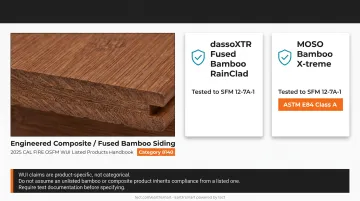
Fused bamboo siding — strand bamboo compressed with phenolic resins — is one of the newer Class A-capable options with WUI documentation. The 2025 CAL FIRE OSFM WUI Listed Products Handbook (Category 8140) includes dassoXTR Fused Bamboo RainClad and MOSO Bamboo X-treme, both tested to SFM 12-7A-1. MOSO confirms Bamboo X-treme cladding reaches ASTM E84 Class A.
These products are dimensionally stable, lighter than most non-combustible alternatives, and well-suited for LEED-aligned projects. The important qualifier: WUI claims are product-specific, not categorical. Do not assume an unlisted bamboo or composite product inherits compliance from a listed one. Require test documentation before specifying.
| Attribute | Detail |
|---|---|
| Fire Rating | Class A (ASTM E84); WUI-compliant; ICC-ES and Miami-Dade certified (product-dependent) |
| Key Features | Natural appearance, dimensionally stable, sustainable, no VOCs (per manufacturer) |
| Best For | Sustainable, high-performance builds where WUI compliance and LEED alignment are priorities |
How We Chose These 6 Siding Options
These options were selected on three criteria: verified fire rating, long-term material durability, and demonstrated applicability in high-fire-severity zones. Each has a legitimate documentation path — not just a material-category reputation.
The Most Common Specification Mistake
Homeowners regularly select siding based on appearance or a general "Class A" description — without verifying whether the specific product, in the specific assembly, with the specific substrate and fasteners, carries documentation that the local building department will accept.
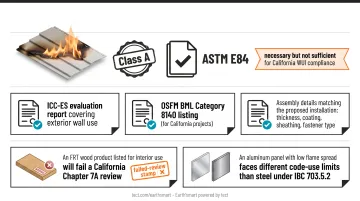
A Class A surface-burning result under ASTM E84 is necessary but not sufficient for California WUI compliance. The product also needs:
- An ICC-ES evaluation report covering exterior wall use
- OSFM BML Category 8140 listing (for California projects) or equivalent state fire marshal documentation
- Assembly details matching the proposed installation: thickness, coating, sheathing, fastener type
That last point matters more than most homeowners realize. An FRT wood product listed for interior use will fail a California Chapter 7A review. An aluminum panel with low flame spread faces different code-use limits than steel under IBC 703.5.2. The product and the assembly both have to be right.
Siding Is Never a Standalone Decision
Siding selection interacts directly with eave and soffit materials, ventilation gap protection, wall assembly composition, and underlayment. Ember intrusion through an unprotected soffit vent or gap at the wall base can ignite a structure regardless of what the siding itself is rated for.
Earth'smart powered by tect addresses this through both Earth'smart Path A Turnkey and Path B Advisory by bringing manufacturer expertise into the design phase early. The earth'smart powered by tectApp community of 70+ vetted building product manufacturers coordinates siding, eaves, soffits, venting, and wall assemblies as an integrated system — with direct input from the manufacturers behind each component. That coordination extends to:
- Confirming assembly compatibility across all materials
- Verifying code documentation before permit submission
- Eliminating assumptions about compliance based on material category alone
Conclusion
For homeowners in Pacific Palisades, the North Bay, or any California WUI zone, siding is not a cosmetic decision. It is a fire-hardening decision with real consequences for code compliance, insurance documentation, and whether the home survives.
The six options above — fiber cement, steel, brick and stone veneer, stucco, FRT wood, and fused bamboo — are each tested and listed for fire resistance. The right choice depends on your site conditions, your wall assembly, and what your local authority will accept. A material category is not a specification — a verified product listing is what gets you through plan check and keeps your insurer satisfied.
Getting those listings right — and aligning them with the rest of your assembly — is where most projects fall short. Homeowners rebuilding or building new in fire-risk zones need a team that understands these distinctions before design begins, not after permits are submitted. Earth'smart powered by tect coordinates architecture, engineering, construction, and direct manufacturer input from day one, so material decisions are documented and defensible at every stage. Reach out to start the conversation at (310) 913-5000 or bob@tect.com.
Frequently Asked Questions
What is a Class A fire rating for siding?
Class A is the highest fire resistance classification, awarded to materials with a Flame Spread Index of 0–25 under ASTM E84. Materials at this level resist flame spread and produce minimal smoke. Most WUI zones and California high-fire-severity areas require Class A as a minimum.
What siding materials are Class A fire rated?
Non-combustible materials — fiber cement, steel, brick, stone, and stucco — inherently achieve Class A. Treated wood and engineered composite products like fused bamboo can also reach Class A when properly certified under ASTM E84 or extended fire testing, but you'll need product-specific test reports to verify compliance.
What is the difference between fire-resistant and fireproof siding?
No siding material is fireproof — every material has a thermal threshold. "Fire-resistant" means the material resists ignition and slows flame spread long enough to protect the structure. The degree of resistance is classified as A, B, or C based on standardized testing.
Does fire-resistant siding lower homeowners insurance?
Many insurers offer reduced premiums for homes with Class A fire-rated siding in high-risk zones. California's Safer from Wildfires program confirms that mitigation actions qualify for discounts, though actual savings vary by insurer and the full mitigation package. Ask your insurer which specific documents they need — requirements vary, especially in CAL FIRE-designated zones.
Is fire-resistant siding required in California WUI zones?
Yes. California Chapter 7A requires exterior wall materials to meet SFM 12-7A-1 in designated high and very high fire severity zones. This effectively mandates Class A-rated or WUI-approved siding assemblies on new construction and reconstruction in those areas.
Can a single siding material fully protect a home in a wildfire?
No. Siding is one component of a fire-hardened building envelope. Eaves, soffits, windows, ventilation openings, and wall assemblies must all meet WUI requirements. Ember intrusion through any unprotected gap can cause ignition regardless of the siding material.