Choose the wrong contractor and you're looking at permit rejections, costly redesigns, inadequate elevation, and insurance problems that follow the home for decades. Choose the right design-build partner and those risks get resolved at the drawing board, where they cost far less to fix.
This guide covers exactly what to look for, what questions to ask, and what red flags signal a contractor who's learning on your dime.
Key Takeaways
- Floodplain design-build contractors handle architecture and construction under one roof, resolving flood compliance decisions early before they become costly
- Key selection factors: FEMA compliance knowledge, elevation and floodproofing experience, flood-resistant material expertise, local agency relationships
- The 50% substantial improvement rule (44 CFR 59.1) can trigger full structural elevation requirements on renovations; your contractor must know this threshold before pricing
- Verify past flood zone projects, permit history, and elevation certificate experience before hiring
- Contractors without floodplain-specific experience create compliance risk — confirm flood zone credentials before signing any contract
What Is a Floodplain Design-Build Contractor?
A floodplain design-build contractor is a firm that manages both architectural design and physical construction of a home within a FEMA-designated Special Flood Hazard Area (SFHA) under one contract and one unified team. The scope can include new construction, substantial renovations, additions, or complete rebuilds — each triggering different regulatory requirements under NFIP rules and local ordinances.
The Design-Build Advantage in Flood Zones
In a traditional design-bid-build model, architects and contractors work in separate phases. That separation creates a specific problem in flood zone projects: compliance decisions need to happen during design, not after construction drawings are finalized.
The decisions that can't be retrofitted once design is locked include:
- Foundation type and flood-compatible structural approach
- Floor elevation relative to Base Flood Elevation (BFE)
- Drainage routing and stormwater management
- Material specifications for flood-resistant assemblies
The design-build model eliminates that disconnect. When the architect and builder operate as one coordinated team from concept through permit submission, flood zone decisions get made once and correctly — rather than revised after each phase uncovers gaps the last one left behind.
Why Floodplain Construction Requires Specialized Expertise
FEMA's NFIP regulations impose requirements that most general contractors have never encountered. Under 44 CFR 60.3, residential structures in A, AE, and AH zones must have their lowest floor elevated to or above the Base Flood Elevation (BFE) — the water-surface elevation associated with a flood that has a 1% annual chance of occurring.
In V and VE coastal zones, the requirement tightens further: buildings must be on pilings or columns with the lowest horizontal structural member at or above BFE.
Three specific requirements trip up non-specialist contractors most often:
- Renovations reaching 50% of the structure's pre-improvement market value trigger full elevation compliance under 44 CFR 59.1 — a threshold that's easy to cross on any meaningful remodel.
- Below-BFE applications require Class 4 or Class 5 flood-damage-resistant materials that can withstand 72 hours of direct floodwater contact (FEMA Technical Bulletin 2). Most standard materials don't qualify.
- Projects routinely require coordinated review by the local building department, a Floodplain Administrator, and state agencies — in California, CDFW or USACE when work affects waterways. Topographic surveys, grading plans, and compensatory storage calculations are standard deliverables.
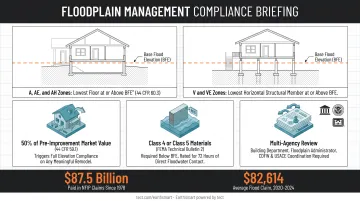
FloodSmart reports the NFIP has paid $87.5 billion in claims since 1978, with the average flood claim running $82,614 for 2020–2024. A contractor who misses an elevation requirement or uses non-compliant materials doesn't just create a code violation — they can void your flood insurance coverage entirely.
Key Factors to Look for in a Floodplain Design-Build Contractor
Not all design-build firms have flood zone experience. These are the factors that separate contractors who can deliver a code-compliant, durable home from those who are figuring it out as they go.
FEMA Compliance Knowledge and Permit Experience
Ask whether the contractor has filed permit applications in NFIP-regulated flood zones and coordinated directly with a local Floodplain Administrator. Then ask for documentation:
- Prior projects requiring elevation certificates (FEMA Form FF-206-FY-22-152)
- Experience with Letters of Map Revision (LOMRs) or LOMR-F submissions for fill-elevated properties
- Completed compensatory storage calculations accepted by the local authority
Each of these is a real permit deliverable, not a theoretical checklist item. A contractor who can't point to specific examples doesn't have the regulatory fluency the project needs.
Experience with Elevation and Floodproofing Techniques
Confirm the contractor understands both primary approaches and knows when to use each:
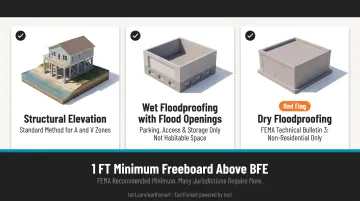
- Structural elevation (pilings, columns, raised foundations) — the standard residential compliance method in both A and V zones
- Wet floodproofing with flood openings — applicable to below-BFE enclosures limited to parking, access, and storage, not habitable space
- Dry floodproofing — note that FEMA Technical Bulletin 3 restricts this to non-residential buildings; proposals to dry-floodproof a new residence should be treated as a red flag
Also confirm the contractor designs to local freeboard requirements. FEMA recommends 1 foot of freeboard above BFE as a minimum safety factor; many jurisdictions require more.
Integrated Design and Construction Under One Roof
The design-build structure only delivers its advantages if the architect and builder are genuinely working together — not if design is outsourced to a third-party firm with no construction accountability.
Verify that:
- Foundation type, floor elevation, and drainage approach are resolved during schematic design, before construction drawings are finalized
- The same team responsible for design is accountable for construction outcomes
- Permit strategy is embedded in the design process, not handed off to an expediter after drawings are complete
Knowledge of Flood-Resistant Materials and Systems
Material selection carries real consequences, and it starts with how a contractor specifies below-BFE assemblies. For any below-BFE application, materials must meet FEMA's Class 4 or Class 5 standard. Acceptable examples include cast-in-place concrete, ceramic tile, and preservative-treated lumber. "Waterproof" or "mold-resistant" labeling is not the same thing and doesn't satisfy the requirement.
Ask how the contractor specifies flood-resistant systems for mechanical equipment, insulation, and wall assemblies below BFE — and whether they involve product manufacturers or technical specialists in those decisions. According to NIBS/MMC hazard mitigation research, flood-specific mitigation delivers a 6:1 benefit-cost ratio. Getting those specifications right during design is where that return is earned or lost.
Local Knowledge and Agency Relationships
Beyond federal NFIP minimums, many jurisdictions impose stricter requirements: higher freeboard, watershed management ordinances, or HOA design guidelines specific to flood-prone neighborhoods. A contractor without local fluency won't know what they don't know — and you'll find out during permit review.
Ask directly whether the contractor has active relationships with the local building department, county engineers, and any environmental agencies that review flood zone work in your jurisdiction.
Questions to Ask and Red Flags to Watch For
Before signing any contract, get direct answers to these questions:
- How many flood zone projects have you completed in the last five years, and can you provide homeowner references? Reluctance to share specific project history is a red flag.
- Who handles FEMA coordination and permit submissions internally? If they rely entirely on a third-party expediter with no internal flood zone knowledge, design and permitting will not stay aligned.
- Who performs or commissions the topographic survey and compensatory storage calculations — and who is responsible if the calculations are rejected? Who performs or commissions the topographic survey and compensatory storage calculations — and who is responsible if the calculations are rejected? A contractor who can't answer this clearly is passing accountability to someone else — or no one.
- How do you handle material specification for below-BFE applications? The answer should reference FEMA material classes, not generic waterproofing.
The answers to those questions will tell you a lot. So will the warning signs below:
- A fixed-price bid delivered without reviewing FEMA flood maps, an existing elevation certificate, or the local floodplain ordinance — the change orders will come later
- Proposing the same foundation approach for AE and VE zones without explaining the distinction
- Describing dry floodproofing as a viable option for a new residential building
- No documented experience with elevation certificates or LOMRs
How earth'smart powered by tect Can Help
Earth'smart powered by tect is a design-build firm built to deliver homes that perform across structure, systems, and envelope in high-risk environments — including flood exposure — serving homeowners in Pacific Palisades and surrounding areas.
The Earth'smart™ Path A Turnkey Delivery connects clients with one fully aligned team covering architecture, engineering, construction, and permit strategy from concept through completion. Flood compliance decisions — elevation, foundation design, drainage approach, material specification — are made early and correctly, before they become mid-construction problems.
Through the earth'smart powered by tectApp™ community of 70+ vetted building product manufacturers, earth'smart powered by tect brings direct technical input from the companies behind a home's materials and systems into the project from the start. For flood zone work, that means expertise on structure, envelope, mechanical systems, and below-BFE assemblies is engaged before drawings are finalized — not after a permit rejection.
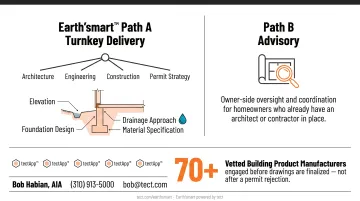
Earth'smart powered by tect serves homeowners at two points of entry:
- Path A — Turnkey Delivery: One fully integrated team from concept through construction, covering architecture, engineering, and permit strategy
- Path B Advisory: Owner-side oversight and coordination for homeowners who already have an architect or contractor in place
Reach Bob Habian, AIA, directly at (310) 913-5000 or bob@tect.com.
Frequently Asked Questions
What is a design-build contractor?
A design-build contractor is a single firm that manages both architectural design and physical construction under one contract. This integration eliminates the handoff gaps between separate architects and builders, which are especially costly in regulated environments like flood zones where compliance decisions must be made during design.
How do you design a building in a flood zone?
The core process includes four steps:
- Establish the Base Flood Elevation (BFE) from FEMA's Flood Insurance Rate Map
- Design the lowest finished floor at or above BFE plus local freeboard
- Select FEMA Class 4 or Class 5 materials for all below-BFE applications
- Choose between structural elevation or compliant floodproofing based on flood zone and site conditions
Do builders build in flood zones?
Yes — flood zone construction is permitted but requires compliance with NFIP rules under 44 CFR 60.3, local floodplain ordinances, and permit approvals from the local Floodplain Administrator. The regulatory complexity is why selecting a contractor with specific flood zone experience matters.
What is the 100-year flood rule?
The "100-year flood" refers to a flood with a 1% annual probability of occurrence — not a flood that happens once per century. FEMA uses this benchmark to establish Base Flood Elevations on Flood Insurance Rate Maps, which govern construction requirements and insurance obligations in designated flood hazard areas.
What is the 50% substantial improvement rule?
Under 44 CFR 59.1, if renovation costs equal or exceed 50% of a structure's pre-improvement market value, the entire building must be brought up to current floodplain standards, including elevation above BFE. Accurate pre-construction cost estimation is essential; this threshold is easier to cross than most homeowners expect.
Do I need a special permit to build in a floodplain?
Yes. Any construction, renovation, grading, or fill work in a regulated floodplain requires a floodplain development permit, typically involving architectural plans, a grading plan, compensatory storage calculations, and Floodplain Administrator review. This process is substantially more involved than a standard residential building permit.