This guide is for homeowners planning new construction, major rebuilds, or significant renovations — particularly those in high-risk environments like seismic zones, wildfire-prone areas, or flood-prone terrain. If you're rebuilding in Pacific Palisades or anywhere in the Wildland-Urban Interface (WUI), understanding what's in your structural engineer's scope is not a formality. It's a critical project decision.
The core problem: most homeowners know they need a structural engineer but have little clarity on what that engagement actually covers, what it excludes, and what happens when scope is left undefined.
Key Takeaways
- A structural engineer's scope covers design, analysis, documentation, and construction oversight — but only what is explicitly contracted
- Services are organized by project phase, from pre-design through construction administration — each with distinct deliverables
- What is NOT in scope matters as much as what is — undefined services cause delays, cost overruns, and liability gaps
- In high-risk regions (fire, seismic, flood), a standard scope is rarely sufficient — expect additional analysis and coordination
- Engage a structural engineer at the concept phase, not at permit submission — earlier involvement reduces redesign, cost overruns, and permit delays
What Is the Structural Engineer Scope of Services?
The scope of services is the formal agreement between a structural engineer and a client specifying which tasks will be performed, at what project phase, to what standard of deliverable, and for what fee. It is distinct from a general description of what structural engineers do — it is the contractual record of what this engineer will do on this project.
Structure Magazine's guidance on structural scope identifies four things a well-written scope should define:
- Services included in the agreed fee
- Additional services available for an extra fee
- Recommended services the client has declined
- Required third-party services the engineer is not responsible for
Two standard contract frameworks govern how this scope gets documented. The AIA C401-2017 is used for architect-consultant agreements and is commonly applied to structural, mechanical, and electrical engineering services. The EJCDC E-500 2020 governs engineer-owner agreements for a single project under design-bid-build delivery. Neither automatically defines what the structural scope contains — they define the legal container. The scope content itself is negotiated separately.
Structural vs. Architectural Scope
These two scopes are complementary but not interchangeable. Their responsibilities divide along clear lines:
- Architect: Spatial design, aesthetics, code occupancy, and permit coordination
- Structural engineer: Load-bearing system design, structural calculations, and code-compliant documentation
A common homeowner assumption — that the architect manages everything and the structural engineer simply executes — leads to missed deliverables, liability gaps, or permit failures. The structural engineer holds independent professional liability for the structural system and must be engaged directly and substantively.
How Scope Is Organized
Scope is structured around project phases, each with distinct tasks and deliverables. Not all phases are automatically included in a standard residential engagement. When phases are omitted without documentation, homeowners often discover it too late — during construction, at permit review, or when a dispute arises over who was responsible for what.
Why the Scope of Services Matters for Residential Projects
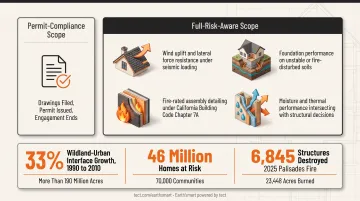
In residential construction, structural engineering scope is frequently minimized to a permit-compliance exercise. The engineer produces drawings, the permit gets issued, and that's treated as the end of the engagement. This creates real risk — structural failures, code violations, and costly field changes that a broader scope would have prevented.
The stakes are higher in hazard-exposed environments. Homes in seismic zones, wildfire-prone areas, or flood-prone terrain require structural analysis that goes well beyond gravity loads:
- Wind uplift and lateral force resistance under seismic loading
- Foundation performance on unstable or fire-disturbed soils
- Fire-rated assembly detailing under California Building Code Chapter 7A
- Moisture and thermal performance intersecting with structural decisions
According to USFA/FEMA, the Wildland-Urban Interface grew 33% from 1990 to 2010 to more than 190 million acres, with more than 46 million homes in 70,000 communities now at risk from wildfire. The 2025 Palisades Fire alone destroyed 6,845 structures across 23,448 acres. For homeowners rebuilding in that environment, a structural scope sized for a simple residential permit isn't adequate.
What adequate looks like in practice: structural decisions coordinated with fire-resistant assemblies, non-combustible materials, and site-specific hazard analysis from the first design meeting forward. Earth'smart powered by tect works this way by default — architecture, engineering, and construction aligned as a single team from concept through completion, so the structural scope reflects the full risk environment the home will face.
A structural scope that ends at permit documents without construction administration leaves homeowners without independent verification that what was designed is what gets built. On a WUI rebuild, that gap between design intent and field execution is where resilience gets lost.
Structural Engineering Services by Project Phase
Structural engineering services are delivered across five recognizable phases. Knowing what each covers helps homeowners ask the right questions before signing a contract.
Pre-Design and Schematic Design
Pre-design is where the structural engineer reviews the site, assesses existing conditions — soil reports, topography, hazard exposure — and establishes the structural concept that will support the architect's design intent. System decisions are made here, not just documented later.
For WUI and seismic-zone projects, this phase carries particular weight. Fire-disturbed soils, steep topography, and elevated lateral load requirements all shape the structural approach before a single schematic drawing is produced.
Schematic-phase deliverables typically include:
- Preliminary structural system selection (wood framing, concrete, steel, or hybrid)
- Initial load assumptions based on site hazard exposure
- Coordination with the architect to confirm structural feasibility within budget and site constraints
Structure Magazine notes that early determination of lateral-load-resisting and foundation systems is critical for cost influence. The earlier a system decision is made, the lower the cost to change it.
Design Development
During design development, the structural engineer refines the system layout — beam and column sizing, foundation type, lateral force-resisting system — and coordinates with MEP, civil, and geotechnical consultants to resolve conflicts before they reach the field.
This is the most consequential phase for high-risk projects. Fire-rated assemblies, seismic detailing, and moisture control all intersect here. Late coordination is expensive — redesign fees, schedule delays, and disrupted construction sequencing compound quickly.
Key coordination that happens in this phase:
- Resolving structural conflicts with mechanical, electrical, and plumbing systems
- Confirming seismic detailing and fire-rated assembly compatibility
- Locking foundation type before civil and geotechnical work advances
Earth'smart powered by tect addresses this directly. By integrating architecture, engineering, and input from the earth'smart powered by tectApp™ community of 70+ building product manufacturers from the start, critical decisions get made while they're still inexpensive to execute — before drawings are fully coordinated and changes carry real cost.
Construction Documents
The construction documents (CD) phase produces the full permit-ready structural drawing set:
- Foundation plans
- Framing plans
- Connection details
- Structural specifications
- Calculations submitted to the authority having jurisdiction
This is the phase most people associate with "what the structural engineer does." But it is only one phase. A scope limited to CDs means no structural involvement before this point — no system concept refinement, no early coordination — and no involvement after permit approval.
Construction Administration
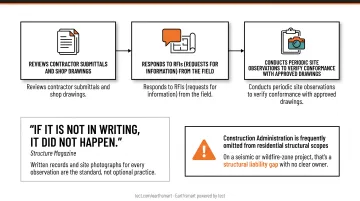
Construction administration (CA) is where the structural engineer:
- Reviews contractor submittals and shop drawings
- Responds to RFIs (requests for information) from the field
- Conducts periodic site observations to verify conformance with approved drawings
Documentation matters throughout this phase. Structure Magazine is direct on this point: "If it is not in writing, it did not happen." Written records and site photographs for every observation are the standard — not optional practice.
CA is frequently omitted from residential structural scopes. Without it, no licensed engineer is verifying that the structure being built matches what was designed. On a seismic or wildfire-zone project, that's not a minor omission — it's a structural liability gap with no clear owner.
What's Typically Excluded From a Standard Structural Engineering Scope
Standard residential structural scopes generally do not include the following without separate engagement:
- Geotechnical investigation — soil testing and report preparation are typically third-party services
- Special inspections — required by code on many structural systems but contracted separately
- Peer review coordination — required on some high-risk or high-complexity projects
- Post-occupancy structural assessments — not part of any standard phase
Structure Magazine's guidance on scope creep identifies additional items that commonly trigger extra services: investigation of existing conditions, design for special fire resistance requirements, contractor-proposed substitutions, changes from newly adopted codes, and extended site representation beyond what was contracted.
The "Services Performed by Others" Problem
Work that must be done but isn't the structural engineer's responsibility unless explicitly contracted has a name in scope management: "services performed by others." Homeowners often don't discover these gaps until something goes wrong — a failed inspection, a field conflict requiring redesign, or a structural element that wasn't built to the approved drawings.
The practical risk is real. Knowing where your engineer's responsibility ends before construction starts is the only way to make sure nothing falls through the cracks.
Integrated Systems Coordination
Ensuring structural decisions align with mechanical, electrical, fire-resistive, and building envelope systems is rarely included in a standard residential structural scope. The downstream impact of this gap is significant, particularly on high-performance homes.
Earth'smart powered by tect addresses this directly through the earth'smart powered by tectApp™ community of 70+ building product manufacturers. When the companies behind a home's structural systems, fire-resistive wall assemblies, and mechanical equipment are brought in early, coordination is built into the process. Conflicts that typically surface during framing or inspections are resolved at the design stage — before they cost time or money.
Basic vs. Additional Services
AIA contract documents distinguish between basic services and additional services. Homeowners should ask their structural engineer to explicitly list both categories. Common items that fall under additional services include redesign triggered by contractor substitutions, extended site visits beyond what was originally scoped, and coordination required after a code update mid-project. Confirm in writing who is responsible for any required work not covered under either category.
Common Misconceptions About Structural Engineering Scope
Homeowners navigating a rebuild often carry assumptions about structural engineering that lead to gaps in their project — or gaps they don't discover until construction is underway. Three misconceptions come up repeatedly.
"The architect manages the structural engineer."
The architect coordinates design intent. The structural engineer holds independent professional liability for the structural system. These are separate engagements with separate scopes.
On any structure in a hazard-exposed environment — seismic zones, WUI hillsides, flood-mapped lots — the structural engineer must be engaged directly. Treating them as a subcontractor who stamps whatever the architect hands over creates a liability gap and a performance gap.
"The scope ends when permits are issued."
Permit approval means the jurisdiction accepted the documents. It doesn't mean the structure will be built to those documents.
Construction administration is a distinct phase of service, separately contracted. It's the only mechanism providing independent professional review of what's actually being constructed — and without it, there's no professional verification that the approved design was followed.
"All structural engineering scopes are equivalent."
A scope written for a simple room addition is not appropriate for a new custom home in a fire or seismic zone. The load categories defined by ASCE 7-22 — covering dead, live, seismic, wind, snow, flood, and fire loads — differ substantially between a benign suburban addition and a WUI rebuild.
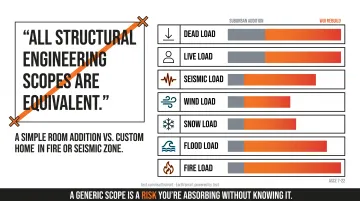
Ask for a scope that specifically addresses your project's location, hazard exposure, and rebuild standard. A generic scope is a risk you're absorbing without knowing it.
Frequently Asked Questions
What is the scope of services of a structural engineer?
The scope of services defines all tasks a structural engineer will perform under contract — typically spanning pre-design through construction administration. It varies based on project type, hazard exposure, and what the client contracts for. Standard residential engagements rarely include every phase automatically.
Does a structural engineer need to visit a site?
Site visits occur during two phases: pre-design (for site assessment) and construction administration (for field observations). Whether visits are included, and how many, depends on what is written into the scope of services contract — they are not automatic.
What are the 4 types of structural loads?
The four primary load categories are dead loads (permanent weight of the structure), live loads (occupants and moveable objects), lateral loads (wind and seismic), and environmental loads (snow, rain, thermal). ASCE 7-22 also includes soil, flood, tsunami, and fire — all of which may apply depending on the site.
What is the difference between a structural engineer and an architect?
Architects design the spatial and aesthetic experience of a building. Structural engineers design the load-bearing system that makes it safe and buildable. Both roles are essential, and their scopes must be coordinated from day one.
When should I hire a structural engineer for a home project?
At the pre-design or schematic design phase — earlier than most homeowners expect. Structural decisions made late cost more to change, and early involvement lets the engineer shape system selection rather than retrofit input around choices already made.
What is construction administration in structural engineering?
Construction administration is the phase where the structural engineer reviews contractor submittals, responds to field questions, and conducts site observations. The goal is to verify the structure is built in conformance with the approved drawings. Engineers often treat it as optional on residential projects — on complex or high-performance builds, skipping it carries real risk.