That's a costly mistake. Envelope technologies account for roughly 30% of primary energy consumed in residential buildings, according to the DOE. And unlike an HVAC system you can swap out in 15 years, the envelope is largely permanent. Getting it wrong means paying for that decision indefinitely.
This article breaks down how each layer of a well-designed envelope creates measurable improvements in energy efficiency, comfort, and long-term cost — and why the decisions that matter most need to happen early.
Key Takeaways
- A building envelope — walls, roof, foundation, windows, and doors — controls everything that enters or leaves your home, from heat and cold to air and moisture
- High-performance envelopes reduce heating and cooling loads, cutting energy costs year over year
- The three biggest advantages: thermal resistance, airtightness and moisture control, and resilience under extreme conditions
- Poorly designed envelopes cause persistent heat loss, moisture damage, HVAC overload, and compounding maintenance costs
- Envelope decisions made during design deliver the best performance and the lowest lifetime cost — retrofits rarely match what's possible from the start
What Is a Building Envelope?
The building envelope is the set of physical components that separate a home's conditioned interior from the exterior environment. That includes exterior walls, the roof assembly, the foundation and below-grade elements, windows, and doors. Every surface where inside meets outside is part of the envelope.
More important than what it's made of is what it does. The envelope performs four functional jobs:
- Structural support: bears loads and keeps the building intact
- Temperature regulation: slows heat transfer in and out of conditioned space
- Moisture management: controls vapor, rain intrusion, and condensation
- Airflow control: limits uncontrolled infiltration and exfiltration
Energy efficiency is the outcome when all four functions work together. The envelope is a system, not a checklist. A wall with excellent insulation but poor air sealing still leaks energy. A fire-rated assembly with a standard soffit vent creates an ember entry point that undermines everything else. Performance depends on how components are integrated — not just what materials are selected.
Key Advantages of a High-Performance Building Envelope
The advantages below aren't theoretical. They show up in utility bills, HVAC sizing decisions, moisture repair costs, and insurance outcomes. Each one is tied to something a homeowner can measure.
Advantage 1: Thermal Resistance Reduces Heating and Cooling Loads
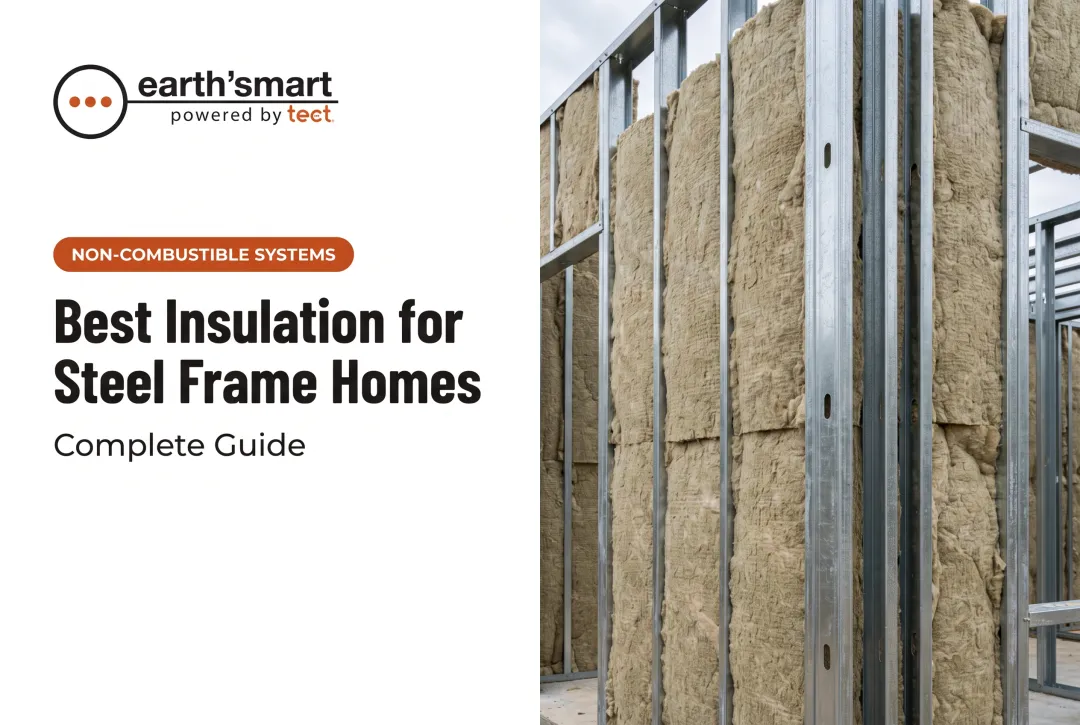
Thermal resistance — measured by R-value — describes how well an assembly slows heat transfer. A high-performance envelope uses insulation materials with high R-values installed continuously, without gaps at framing members or structural connections.
That continuity matters because of thermal bridging. Wood studs carry an R-value of roughly R-1.25 per inch, while fiberglass cavity insulation runs about R-3.3 per inch. Heat takes the path of least resistance — straight through the studs. Research published in HUD Cityscape found that thermal bridging through wood framing can account for as much as 30% of total heat loss in a wood-framed wall assembly. Continuous exterior insulation eliminates that "short-circuit" by insulating over the framing, not just between it.
What this means in practice:
- Reducing heat transfer lowers the energy demand placed on HVAC systems — the building needs less mechanical energy to hold a set temperature
- According to EPA ENERGY STAR, attic and wall insulation combined with air sealing can reduce energy use by 30%–50% in cold climates; deeper improvements including continuous exterior insulation can push reductions to 50% or more
- A home built with high thermal resistance requires smaller, less expensive HVAC equipment — and lower utility bills across its entire lifespan
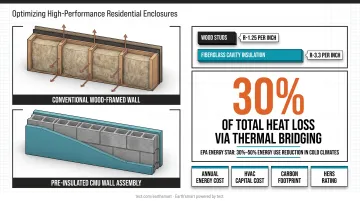
KPIs directly affected: annual energy cost, HVAC capital cost, carbon footprint, HERS rating
When it matters most: Thermal resistance has the highest impact in climates with significant temperature swings — hot summers, cold winters, or both. In WUI and wildfire-prone areas, the calculus goes further: the same continuous insulation that improves thermal performance also needs to meet fire-rated assembly requirements, making material selection doubly consequential.
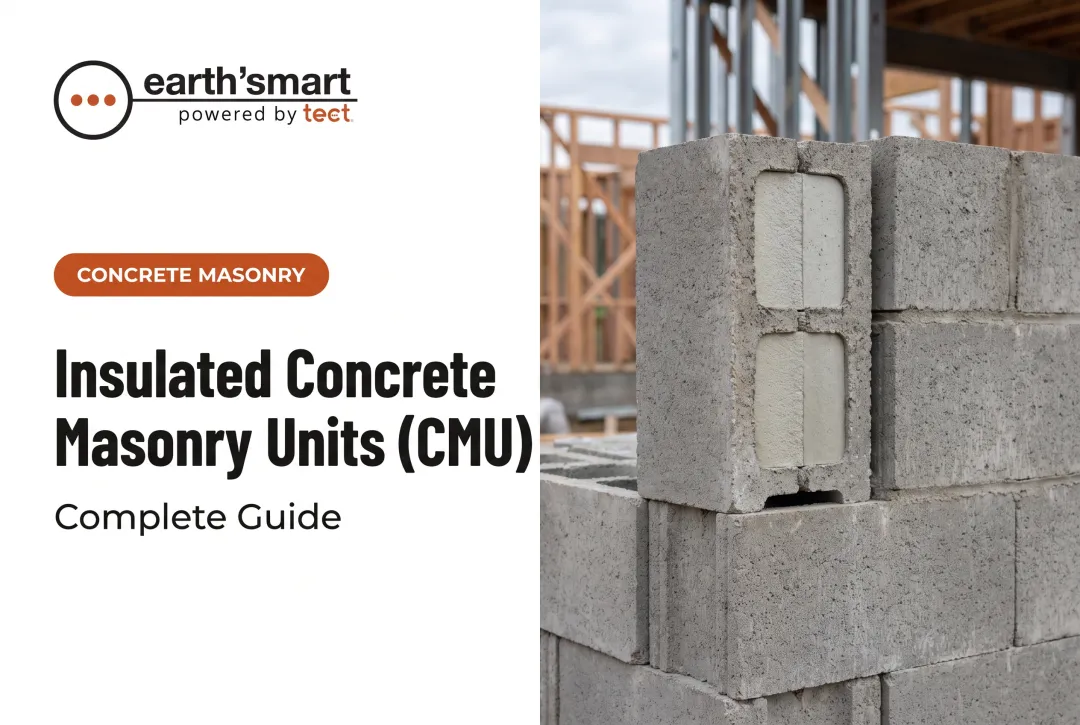
Earth'smart powered by tect's Earth'smart™ projects address this directly. Pre-insulated concrete masonry (CMU) — the cornerstone wall assembly across Earth'smart™ projects — integrates structural masonry, continuous insulation, and fire-resistive performance into a single system. It provides superior thermal performance compared to conventional wood-framed assemblies while also satisfying the fire-resistance demands of California WUI construction.
Advantage 2: Airtightness and Moisture Control Prevent Invisible Energy Waste
Uncontrolled air leakage is one of the largest sources of energy waste in homes, and among the least visible. Conditioned air escapes through gaps around windows and doors, unsealed penetrations, and poorly detailed roof-wall intersections.
The HVAC system runs continuously to compensate, burning energy to replace air that never should have left.
Air leakage accounts for 25%–40% of the energy used for heating and cooling in a typical residence, according to EPA ENERGY STAR. The DOE estimates that sealing uncontrolled leaks alone can save 10%–20% on heating and cooling bills.
The difference between a tight envelope and a loose one comes down to intent and execution:
| Envelope Type | Air Exchange | Energy Impact |
|---|---|---|
| Tight (controlled) | Managed through ventilation system | Predictable, efficient HVAC runtime |
| Loose (uncontrolled) | Random infiltration through gaps and cracks | HVAC overwork, unpredictable energy use |
Moisture compounds the problem. When air infiltrates through the envelope, it carries moisture with it. Wet insulation doesn't perform at its rated R-value. Over time, moisture degrades framing, promotes mold, and accelerates structural decay. Building Science Corporation identifies water as the primary durability risk in building construction — and the repair costs that follow can dwarf the original investment in proper sealing.
A tight envelope requires:
- Continuous air barriers at walls and roof assemblies
- Vapor retarders appropriate to climate zone
- Careful sealing at all penetrations, windows, doors, and transitions
- Mechanical ventilation (ERV or HRV) to provide controlled fresh air exchange
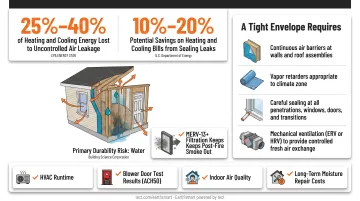
In wildfire-prone areas, airtightness has an additional function. Earth'smart powered by tect's Earth'smart™ homes integrate MERV-13+ filtration alongside tight envelope construction specifically because post-fire smoke ingress is one of the most significant indoor air quality risks after a wildfire event. A tight envelope paired with filtered mechanical ventilation keeps smoke out while maintaining interior air quality.
KPIs directly affected: HVAC runtime, blower door test results (ACH50), indoor air quality, long-term moisture repair costs
Advantage 3: Resilience Keeps the Envelope Performing Under Extreme Conditions
A high-performance envelope maintains its performance when conditions become extreme. For homeowners in the WUI, coastal zones, or seismically active areas, envelope resilience determines whether a home survives an event intact or requires total replacement.
CAL FIRE's Office of the State Fire Marshal reports that flying embers cause 60%–90% of home ignitions in wildfire events. Embers don't just land on roofs — they find pathways through vents, eaves, and gaps in the envelope. A fire-resistant wall assembly paired with a standard soffit vent undermines the whole approach.
A resilient envelope integrates:
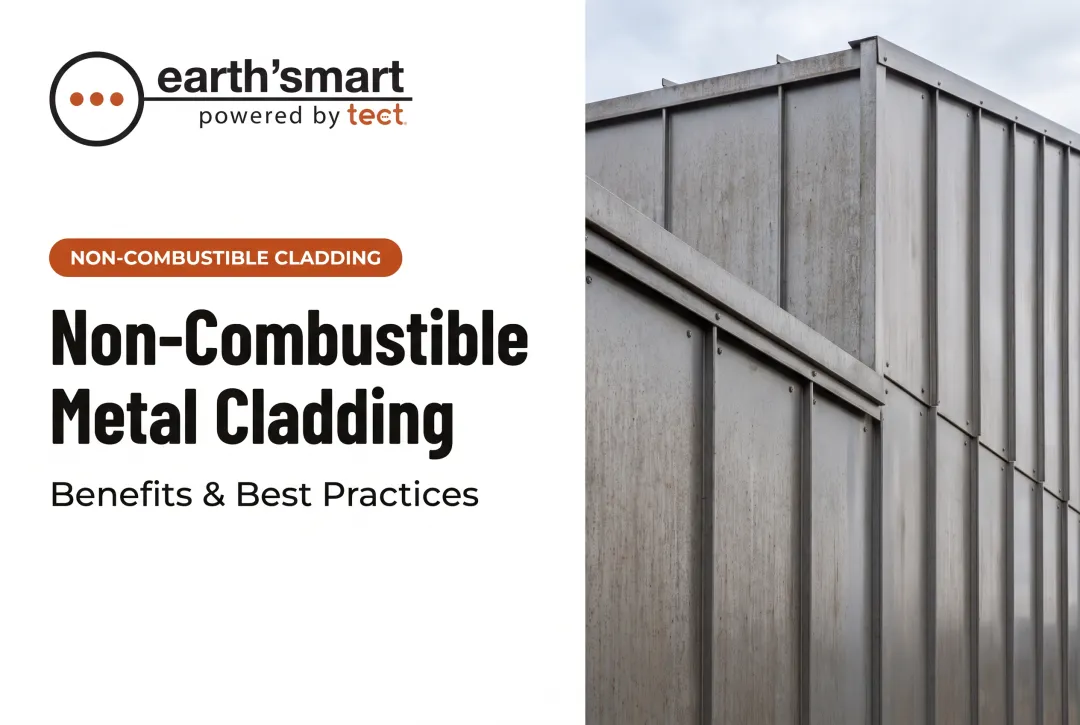
- Fire-rated wall assemblies (pre-insulated CMU, ICF, AAC, non-combustible steel-framed systems)
- Class A non-combustible roofing (standing-seam metal, clay tile, concrete tile)
- Ember-resistant vents with corrosion-resistant noncombustible mesh (1/16" to 1/8" openings) or listed ember-resistant vents
- Non-combustible eaves and soffits
- Multi-pane tempered glazing at windows and doors
The IBHS Wildfire Prepared Home standard provides a science-based framework for this approach, with Base and Plus designation levels. California's Safer from Wildfires regulation requires insurers to offer discounts to policyholders who take verified mitigation steps — and the California FAIR Plan offers wildfire-hardening discounts for dwelling fire policies. While specific premium reductions vary by insurer, verified fire-hardened envelopes measurably improve insurability in markets where coverage is increasingly difficult to obtain.
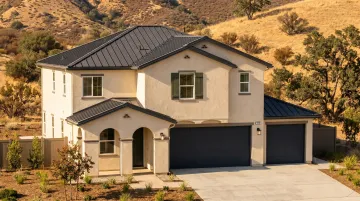
Resilience and energy efficiency reinforce each other. Building Science Corporation has documented that wall assemblies using ignition-resistant or noncombustible cladding with fire-resistant continuous exterior insulation can satisfy both fire performance and thermal goals simultaneously. The same continuous insulation and tight air barrier that reduces heat transfer also limits the pathways through which fire, smoke, or moisture can enter.
KPIs directly affected: insurance premiums, expected repair/replacement costs after extreme events, structural longevity, occupant safety
Earth'smart powered by tect's Earth'smart™ assemblies are designed to meet CAL FIRE Chapter 7A, ICC 600, NFPA 1144, and IBHS Wildfire Prepared Home standards — with insurance risk reduction documentation produced as part of the delivery process.
What Happens When the Building Envelope Is Ignored
Deferring envelope decisions doesn't eliminate the problem. It just moves the cost downstream — and makes it larger.
Thermal bridging causes persistent heat loss that no HVAC upgrade fully compensates for. Air leaks and moisture infiltration gradually degrade insulation, framing, and finishes over years — well before visible damage appears.
By the time a homeowner sees water staining, warped sheathing, or mold, the repair scope has already grown well beyond what proper detailing would have cost at construction.
The retrofit math is consistently unfavorable:
- Wall air-sealing retrofits in existing homes often require removing existing insulation to access framing cavities
- The DOE states directly that adding insulation during construction is more cost-effective than retrofitting after a house is complete
- In wildfire-prone areas, a code-minimum home with standard vents, combustible cladding, and no fire-rated assembly faces a materially higher probability of total loss in a WUI fire event
Reactive fixes such as resealing windows, replacing moisture-damaged sheathing, or adding exterior insulation over finished surfaces are consistently more expensive and less effective than getting the envelope right during design. In high-risk areas, the cost difference between a properly detailed envelope and a post-fire rebuild can equal the entire replacement value of the home.
How to Get the Most Value from Your Building Envelope
Envelope performance depends on early, integrated decision-making. Insulation type, air barrier continuity, cladding fire rating, and fenestration performance must be coordinated with structural and mechanical decisions — not resolved after framing is complete. Late decisions are almost always compromises.
The sequence that produces the best outcomes:
- Set performance targets early — establish R-value goals, air leakage rate benchmarks, and fire-rating requirements before design development begins
- Involve the right manufacturers at concept stage — early input from manufacturers prevents coordination failures and costly substitutions later
- Review the envelope as a whole system — a wall assembly and roof assembly that each meet code can still fail where they meet
- Verify through construction — blower door testing, thermal imaging, and assembly inspections confirm that what was designed was actually built
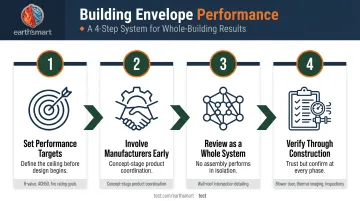
That sequencing is exactly what earth'smart powered by tect's coordination model is built around. Through the earth'smart powered by tectApp™ community of 70+ vetted building product manufacturers, homeowners rebuilding in Pacific Palisades and across California's WUI zones get the product expertise and system coordination that commercial projects take for granted. Manufacturer input happens at concept design — when it still shapes decisions — not during construction when changes carry real cost penalties.
The outcome is a building envelope that performs as designed: no field corrections, no missed intersections, no late-stage compromises.
Frequently Asked Questions
What is the building envelope in simple terms?
The building envelope is the physical shell separating a home's conditioned interior from the outside — comprising walls, roof, foundation, windows, and doors. Its job is to regulate temperature, control moisture, and limit uncontrolled airflow between inside and outside.
What is building envelope efficiency?
Building envelope efficiency refers to how well the envelope's components work together to minimize unwanted heat transfer, air leakage, and moisture infiltration. The outcome is lower energy demand and less strain on mechanical heating and cooling systems.
What is the most energy-efficient building envelope?
The most energy-efficient envelope combines high R-value continuous insulation, a continuous air barrier, controlled moisture management, and high-performance windows — designed as an integrated system rather than isolated layers. Passive House standards (0.6 ACH50 airtightness; space heating/cooling demand below 15 kWh/m²/year) set the performance ceiling for residential envelope design.
What are the main components of a building envelope?
The primary components are the roof assembly, exterior walls (including insulation, air barrier, sheathing, and cladding), foundation and below-grade assembly, windows, and doors. Each component must be detailed to work with the others — the envelope performs as a system, not as independent layers.
How does a building envelope reduce energy costs?
Lower utility bills follow directly from a well-designed envelope. By limiting heat transfer through walls and roof and reducing conditioned air loss, the envelope cuts how hard and how often HVAC systems must run — translating into measurable monthly savings.
Why does the building envelope matter more in wildfire-prone areas?
In WUI and high-fire-risk zones, the envelope must perform under extreme ember and radiant heat exposure. Fire-rated assemblies, non-combustible materials, and ember-resistant vents become part of the envelope design — not optional upgrades. A resilient envelope can be the difference between a home surviving a fire event and requiring complete replacement.