The instinct is to move fast. Get the debris cleared, pull permits, and get back to normal. That instinct is understandable, but it's also the source of most expensive mistakes in post-fire rebuilds.
This guide walks through every phase: debris removal, foundation decisions, LA's permit pathways, resilient design, and construction — with an emphasis on making the decisions that matter long-term, not just the ones that feel urgent today.
Key Takeaways
- Two debris phases: EPA/FEMA clears hazardous materials first; structural debris follows through Army Corps or a private contractor — opting out of the government program is a permanent choice.
- Most existing foundations aren't worth keeping: Wildfire heat damages concrete in ways that aren't always visible — and many older foundations won't meet current code anyway.
- Two permit tracks: Non-Eligible (full design freedom) is the better fit for most total rebuilds; Eligible (like-for-like within 110%) suits simpler replacements.
- Resilience is a system, not a material: IBHS research found a complete fire-hardening system produced 54% likelihood of avoiding damage versus 36% for a single mitigation action.
- Rebuilding is underway: 340+ projects have started construction in Pacific Palisades, and the first Certificate of Occupancy was issued in November 2025.
Site Cleanup and Debris Removal
Before any permit or design work begins, the lot must be properly cleared — and the sequence matters legally, not just logistically.
Phase 1 vs. Phase 2: What Each Covers
The cleanup program runs in two distinct phases:
- Phase 1 — Hazardous material removal, managed by the EPA under FEMA direction. This includes paints, solvents, batteries, asbestos, and pressurized cylinders. The EPA reported that Phase 1 was completed across the Palisades and Eaton fire areas in late February 2025, with more than 1,700 staff deployed.
- Phase 2 — Structural debris removal. Homeowners can participate in the government-run Consolidated Debris Removal Program through the U.S. Army Corps of Engineers, or they can opt out and hire a private contractor. The Army Corps completed Phase 2 Palisades cleanup in September 2025, clearing over 3,500 properties and more than one million tons of debris.
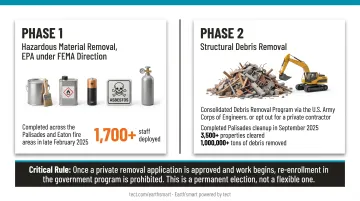
Critical rule on opting out: Once a private removal application is approved and work begins, re-enrollment in the government program is prohibited. This is a permanent election, not a flexible one.
Choosing a Private Contractor
Private removal makes sense when a homeowner wants to preserve part of an existing structure or cannot wait on government scheduling. But the bar is high:
- Contractors must hold a Class A or Class B license with Hazardous Substance Removal Certification
- All debris, ash, contaminated soil, and hazard trees must go to an approved solid waste facility, with weight tickets and disposal documentation
- Some disposal facilities only accept debris from officially contracted crews
Vet carefully. A contractor with wildfire-specific debris experience is not the same as a general excavation crew.
Why Proper Remediation Cannot Be Skipped
Regardless of which removal path you choose, remediation quality directly affects what comes next. Burned plastics, electronics, treated wood, and household chemicals leave chemical residues in the soil. Building on incompletely remediated ground creates both a health risk and long-term legal liability.
Before any construction begins, confirm:
- Written site clearance documentation from the responsible agency or contractor
- Disposal manifests and weight tickets for all removed material
- Soil test results if contamination is suspected in the build footprint
This documentation is required for permitting — and for your own protection.
Foundation: Reuse or Replace?
For most Pacific Palisades lots, the answer is replace — and the structural evidence behind that position is hard to argue with.
What Fire Does to Concrete
The City of LA does not typically permit reuse of existing footings and slabs in buildings completely consumed by fire — elevated temperatures degrade concrete through thermal stress and internal pore pressure, irreversibly reducing structural capacity.
NIST research on concrete fire performance documents a visible indicator: concrete paste turns pink above approximately 550–570°F. When 50% or more of a foundation system shows that damage, engineering guidance calls for full replacement.
The harder problem is invisible damage. Core sampling can identify visible deterioration, but thermal stress at the microscopic level leaves no visible trace — and no test can confirm the concrete will hold decades from now.
The Design Freedom Argument
Beyond structural concerns, keeping an old foundation locks in the original footprint, shape, and site positioning. Those constraints limit:
- Layout improvements and flow between spaces
- Natural light optimization for the new design
- How the home is positioned relative to the lot's topography and fire exposure
A new foundation lets the site plan be reconsidered from scratch — one of the highest-leverage decisions in any rebuild.
What a New Foundation Can Do
Modern foundations for Pacific Palisades WUI lots can incorporate:
- Reinforced concrete with updated seismic detailing
- Fireproof barriers at the slab perimeter
- Design positioning that reduces ember accumulation zones
- Structural integration with non-combustible wall systems from the ground up
For older homes — many of which predate current seismic and fire codes — a new foundation isn't just a structural upgrade. It's where a 100+ year home actually starts.
Navigating the LA Permit System
Los Angeles has restructured its rebuild permitting since January 2025. Knowing which track fits your project — and which tools are available to speed review — can cut weeks off the permit phase.
Eligible vs. Non-Eligible: What Each Means
Eligible Rebuild is the expedited track for like-for-like projects. Officially, it applies to projects that stay within 110% of the prior footprint and height (not square footage), in substantially the same location. Benefits include:
- CEQA, Specific Plan, and California Coastal Act waivers
- 30-day initial permit review target
- Ability to rebuild nonconforming structures as they were
- Exception from the all-electric mandate (now repealed citywide regardless)
Non-Eligible Rebuild applies to projects that go beyond those limits — or simply choose full design freedom within standard zoning.
Why the Eligible Benefits Are Often Overstated
Each Eligible benefit deserves a critical look:
- The CEQA exemption matters primarily for properties in the coastal zone. For most Palisades lots, it's irrelevant.
- The 30-day review applies to the first submission only — not correction cycles. Both tracks are being expedited.
- The all-electric exception is now moot since the ordinance was repealed citywide.
- Basements cannot be added under the Eligible track — a real constraint for many homeowners.
For a complete rebuild, Non-Eligible is worth a close look. It provides full design freedom, retains gas line access under fire-rebuild exceptions, and the city's dedicated review team covers both tracks equally. The trade-offs are smaller than most homeowners expect.
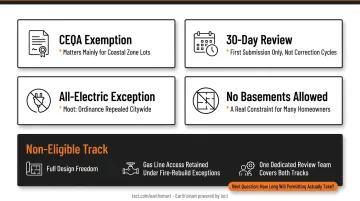
That decision made, the more pressing question is how long permitting will actually take.
Tools Currently Accelerating the Process
According to the state's rebuilding tracker, permits are moving at an average of 51 calendar days from application to issuance, with only 16 days in agency review. Mayor Bass reported permits are being approved nearly 3x faster than pre-fire norms, with more than 70% of single-family permit clearances waived.
Additional tools available now:
- Bypass full plan check with the Standard Plan Pilot Program — pre-reviewed, code-compliant plans for single-family homes
- Skip the plan check queue entirely via the Self-Certification Pilot (EO6) — qualifying licensed architects can self-certify CRC compliance for single-family homes up to three stories
- Pay no plan check or permit fees under EO7's Fee Suspension — currently in effect for fire-affected single-family homes and duplexes, with the City Council approving permanent fee waivers in February 2026
Designing a Home Built to Last
Resilience as a System, Not a Checklist
IBHS data from the 2025 Palisades and Eaton fires is instructive: a complete system of Class A roofing, noncombustible siding, double-pane windows, and enclosed eaves produced a 54% likelihood of avoiding damage. A single mitigation action alone produced 36%. When Zone 0 fuel coverage exceeded 25%, damage or destruction risk rose to nearly 90%.
Materials matter — but only when they're part of a coordinated system. The envelope, structural system, mechanical system, and suppression strategy must be designed together to perform under actual fire conditions.
Fire-Resilient Features That Make a Measurable Difference
Per the 2025 Wildfire Prepared Home Technical Standard:
- Roofing: Class A materials tested under ASTM E108 or UL 790; wood shakes or shingles prohibited regardless of rating
- Vents: Must meet ASTM E2886 for flame and ember resistance, or use noncombustible mesh no larger than 1/8 inch
- Exterior walls: Noncombustible materials — fiber-cement, masonry veneer, or stucco — with at least 6 inches vertical noncombustible clearance at wall bases
- Windows: Multi-paned with at least two tempered panes, or a 20-minute fire-resistance rating under NFPA 257
- Defensible space: Zone 0 (0–5 ft) noncombustible, Zone 1 (5–30 ft) managed, Zone 2 (30–100 ft) reduced fuel load
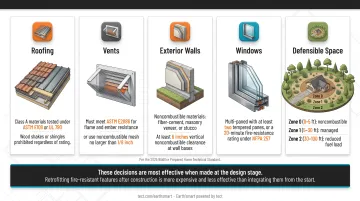
These decisions are most effective when made at the design stage. Retrofitting fire-resistant features after construction is more expensive and less effective than integrating them from the start.
Systems Integration in Practice
For Pacific Palisades rebuilds, wall assembly matters as much as roofing. Non-combustible systems — pre-insulated concrete masonry (CMU), insulated concrete forms (ICF), or autoclaved aerated concrete (AAC) — provide structural, thermal, acoustic, and fire-resistive performance in a single coordinated assembly. When combined with seismic detailing for California conditions, these systems address fire and earthquake exposure simultaneously.
On-site fire suppression is another decision that must happen at the design stage, not after construction. Vapor dome perimeter systems, dedicated on-site water supply, and FIREBOZZ® water cannons function as a coordinated asset-protection strategy — but only when engineered alongside the structural and mechanical systems from the start.
Earth'smart powered by tect's earth'smart powered by tectApp™ community of 70+ building product manufacturers addresses this directly: manufacturer expertise is engaged during design, not discovered mid-construction when changes are costly.
Multi-Hazard Resilience
Pacific Palisades sits in a WUI zone with documented exposure to fire, seismic activity, and landslide risk. A resilient home addresses all three hazard types through coordinated structural and site decisions — not just fire-code compliance.
Each hazard has a corresponding authoritative source worth consulting early in the design process:
- Landslide risk: USGS landslide mapping for the Palisades area
- Seismic hazard: CGS seismic hazard zones with parcel-specific classifications
- Flood exposure: FEMA flood-map lookup by address
Insurance Implications
California Department of Insurance requires insurers to offer wildfire-mitigation discounts under Safer from Wildfires for every listed mitigation action. Discount amounts vary by insurer and property — no single percentage is mandated.
What is documented: State Farm sought emergency rate hikes of up to 22% for non-tenant homeowners following more than $1 billion in Palisades and Eaton fire payouts. The insurance market reality makes code-minimum construction increasingly inadequate for both coverage availability and pricing.
Earth'smart powered by tect's Earth'smart™ projects include full insurance-aligned documentation — IBHS Wildfire Prepared Home alignment and CAL FIRE Chapter 7A compliance packages — that brokers, MGAs, and underwriters can use to support coverage and pricing decisions. This documentation is prepared as part of every project engagement, whether turnkey or advisory.
Construction Timeline and Choosing Your Team
What to Expect on Timeline
A full Pacific Palisades rebuild — from debris clearance through Certificate of Occupancy — typically spans 18 to 36 months depending on design complexity, permit track, and contractor availability. The permit phase under current 2025–2026 conditions is averaging 51 calendar days from application to issuance.
The construction phase varies most. Conventional custom builds typically run 18–24 months from permit. Teams using pre-approved standard plans from the city's pilot program can compress the construction phase, with the final duration driven by design scope, crew availability, and subcontractor coordination.
Why a Coordinated Team Changes Outcomes
The most common sources of delay and cost overrun in rebuilds are:
- Late design changes driven by undecided product selections
- System conflicts discovered in the field rather than on paper
- Permitting corrections from incomplete or inconsistent submittals
Having architect, engineer, builder, and product specialists aligned from the beginning prevents all three. Making critical decisions early — when they're least expensive to get right — is the single biggest cost-control lever on any rebuild.
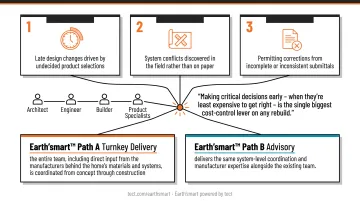
When earth'smart powered by tect engages through Earth'smart™ Path A Turnkey Delivery, the entire team — including direct input from the manufacturers behind the home's materials and systems — is coordinated from concept through construction. For homeowners who have already committed to an architect or contractor, Path B Advisory delivers the same system-level coordination and manufacturer expertise alongside the existing team.
Questions to Ask Any Builder or Architect
Before committing to a team, ask these directly:
- "What is your specific experience with WUI fire-resilient construction?" Not just California residential — specifically WUI and non-combustible assemblies.
- "How are subcontractors and product specialists coordinated, and at what project stage?" Late manufacturer engagement is a red flag.
- "What does your permit track record look like on recent LA fire rebuilds?" Ask for specifics on correction cycles and review timelines.
- "What warranty and post-occupancy support is included?" A 100-year home requires accountability beyond the Certificate of Occupancy.
Frequently Asked Questions
How much will it cost to rebuild a home in Pacific Palisades?
No verified $/sf benchmark exists from City of LA or established industry databases for 2025–2026 Pacific Palisades custom rebuilds. Final costs depend on:
- Design scope and materials selection
- Foundation decisions and site conditions
- Team structure and delivery path
Plan check and permit fees are currently suspended under city emergency orders for fire-affected single-family homes and duplexes.
Are people rebuilding their homes in Pacific Palisades?
Yes — active rebuilding is well underway. Mayor Bass reported that 340+ projects had started construction by November 2025, and the first Certificate of Occupancy for a rebuilt Pacific Palisades home was issued November 21, 2025. The city is processing permits nearly 3x faster than pre-fire norms.
How long does it take to rebuild a home in Pacific Palisades?
From debris clearance through move-in, expect 18–36 months depending on design complexity, permit track, and contractor availability. The current permit phase averages 51 calendar days from application to issuance. Teams using pre-approved plans and coordinated delivery can shorten the construction phase by months.
Should I keep my existing foundation or start fresh?
The City of LA states that foundations in buildings completely consumed by fire are not typically permitted for reuse. Wildfire heat compromises concrete in ways that aren't always visible, and older foundations may not meet current seismic and structural codes regardless of fire damage.
What is the difference between an Eligible and Non-Eligible rebuild in Los Angeles?
Eligible rebuilds stay within 110% of the original footprint and height, with certain expedited benefits including CEQA waivers and 30-day initial review. Non-Eligible projects allow full design freedom within standard zoning. For most complete rebuilds, Non-Eligible is the practical choice — you retain full layout flexibility, and both tracks are processed by the same dedicated city team on an expedited basis.
Do I need an architect to rebuild in Pacific Palisades?
Yes. An architect is essential for navigating permit pathways, optimizing site planning, and integrating fire-resilient systems correctly. WUI rebuilds involve a level of permit complexity and system coordination that requires professional expertise from the start.
To discuss your Pacific Palisades rebuild, contact Bob Habian, AIA at earth'smart powered by tect: (310) 913-5000 or bob@tect.com.