A poor fit means failed plan checks, costly revisions, construction delays, and — in the worst cases — a structure that isn't built to code for your specific hazard zone. This guide covers what structural engineers actually do, how to evaluate candidates beyond price, and the right questions to ask before you sign anything.
Key Takeaways
- A structural engineer goes beyond what an architect covers — verifying your home can handle its own load plus wind, seismic, snow, and fire forces
- Confirm a valid PE (Professional Engineer) or SE (Structural Engineer) license issued by your state before any other conversation
- Residential-specific experience matters — especially if your home sits in a wildfire, seismic, or flood hazard zone
- Get a written scope that covers construction-phase availability, not just drawing delivery
- The cheapest bid is usually the riskiest — under-scoped proposals lead to surprise costs mid-project
What Does a Structural Engineer Do for Your Home?
A structural engineer is responsible for the load-bearing logic of your home. Where an architect handles spatial design and aesthetics, a structural engineer ensures those designs are physically safe and buildable — calculating how forces move through the structure and specifying the systems that resist them.
Under California law, structural engineering is defined as the application of specialized knowledge to the design and analysis of buildings to resist vertical and horizontal static and dynamic loads. They figure out what holds your house up and what keeps it standing when the ground shakes or wind loads increase.
What They Deliver
For a residential project, you should expect these concrete outputs:
- Foundation design — soil-appropriate bearing, anchorage, and lateral resistance
- Framing plans — load path documentation for floors, walls, and roof
- Load calculations — gravity, wind, seismic, and snow loads per local code
- Material specifications — structural grades, connector requirements, fastening details
- Permit-ready drawings — signed and sealed by the licensed engineer of record
- Construction-phase observations — site visits to confirm field conditions match approved plans
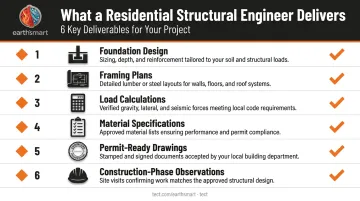
California guidance defines structural observation as visual review by a registered design professional for general conformance with approved construction documents. An engineer who stops at plan delivery gives you no verification that what gets built actually matches what was approved — a gap that matters most during complex or high-risk construction.
Structural Engineer vs. Architect
Both roles are required on most meaningful residential projects, but they cover different ground:
| Role | Handles |
|---|---|
| Architect | Layout, aesthetics, spatial flow, code occupancy |
| Structural Engineer | Load paths, structural calculations, hazard resistance |
Both are typically needed for meaningful residential work. In California, if a project departs from conventional wood-frame requirements, the affected plans and calculations must be prepared and signed by a licensed architect or registered engineer — not an unlicensed designer.
Key Factors to Consider When Choosing a Structural Engineer
Not all structural engineers are suited for residential work. Within residential work, not all are equipped for high-risk environments. The criteria below go beyond price — they help you find someone who can actually handle your project.
Licensure and Credentials
Any engineer submitting structural drawings for a building permit must hold a valid PE (Professional Engineer) license issued by your state. In California, a Civil PE can legally design most residential structures. An SE (Structural Engineer) license represents an additional credential — requiring further examination and qualifying experience — and is the higher standard for complex seismic, wind, or non-prescriptive structural work (designs that go beyond standard code-prescribed methods).
You can verify current California license status directly through the BPELSG License Lookup.
Residential-Specific Experience
Commercial and residential structural engineering are different disciplines — each has its own code framework, coordination norms, and construction sequencing. An engineer whose portfolio is 90% commercial projects may technically be licensed to do residential work, but their familiarity with residential framing systems, local plan check processes, and contractor communication won't match someone who does it daily.
Ask specifically:
- How many residential projects have you completed in the past three years?
- Have you worked on projects similar to mine — new construction, addition, or post-event rebuild?
Local Hazard Zone Knowledge
An engineer who knows your jurisdiction's seismic design categories, wildfire exposure classification, and flood zone requirements will make fundamentally different design decisions than one without that context. Regional experience isn't a nice-to-have — it directly affects what gets designed and what gets approved.
Consider what's at stake in California alone:
- According to USFS research, California has the highest WUI housing exposure nationally — approximately 5.1 million housing units in wildland-urban interface areas
- The January 2025 Palisades and Eaton fires burned a combined 37,000+ acres, driving demand for engineers who understand WUI code requirements
- California's Title 24 (effective January 1, 2023) includes significant Chapter 7A amendments covering WUI materials and construction methods — details that generalist engineers often miss
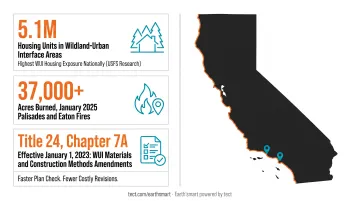
An engineer experienced in your jurisdiction navigates plan check and permit submission faster, with fewer costly revisions.
Construction Coordination and Post-Design Availability
Confirm upfront whether the following are included in scope:
- Site visits during foundation and framing stages
- Responses to contractor RFIs (Requests for Information)
- Plan check revision support
- As-built condition review for any field deviations
If these services are available only as hourly extras — and not clearly priced — you'll likely face unexpected costs mid-project.
Scope Clarity and Fee Transparency
A written proposal should define:
- Specific deliverables (drawings, calculations, site visits, reports)
- Revision policy and how additional rounds are priced
- Timeline and permit submission responsibilities
- Total fixed fees or a capped estimate with clear hourly overage rates
Fee benchmarks to know: HomeAdvisor's 2025 data puts the typical structural engineering range at $344–$776 for targeted inspections and $2,000–$10,000 for new-home structural plans. Thumbtack's 2026 figures show a national average range of $566–$1,650 for common residential services. These are marketplace benchmarks — not California-specific fee schedules — but they're useful for flagging bids that seem implausibly low.
An unusually low bid almost always reflects an under-scoped proposal. The savings disappear when change orders arrive.
References and Track Record
A reputable engineer should provide references from recent residential clients. When you call those references, ask:
- Did the project stay on schedule?
- How did the engineer respond when unexpected field conditions came up?
- Was communication consistent and clear throughout construction?
Questions to Ask Before You Hire
Use these questions to move past credentials and find the engineer who actually fits your project.
"Are you licensed as a PE or SE in this state, and do you carry professional liability insurance?"
Both matter. State licensure confirms legal authority to seal drawings and submit for permits. Professional liability (errors and omissions) insurance protects you if a design error causes a problem. Ask for a Certificate of Insurance naming you as an additional insured — don't accept verbal confirmation.
"What residential projects have you completed in this region or hazard zone?"
A general resume rarely answers this directly. An engineer who has designed homes in high-seismic or high-fire zones has encountered the specific code requirements, material constraints, and field conditions that matter for your project. Ask for comparable project examples.
"What is your process, and what exactly will I receive?"
This forces a clear description of workflow: how they assess the structure, what drawings and calculations they'll produce, whether they handle permit submissions, and what their typical timeline looks like. Vague or evasive answers here are a red flag.
"Will you be available during construction for observations and contractor questions?"
An engineer who commits only to delivering plans — and goes quiet once construction starts — leaves the build without a technical backstop. Construction-phase involvement is often the difference between a smooth build and one interrupted by rework, delays, or structural corrections mid-build.
Red Flags to Watch Out For
Don't proceed if you encounter any of these:
- Unwillingness to provide proof of licensure or insurance
- No residential portfolio or client references available
- A scope of work that is unusually brief or vague
- Pressure to skip permitting or avoid plan check
- Fee estimates dramatically lower than others with no clear explanation
- Refusal to sign and seal final construction documents
How earth'smart powered by tect Can Help Homeowners in High-Risk Areas
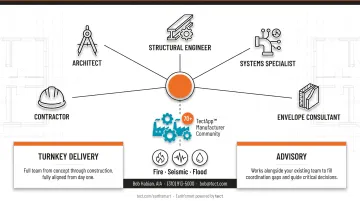
For homeowners rebuilding in Pacific Palisades or the broader Wildland-Urban Interface, finding a qualified structural engineer is only part of the problem. The harder part is coordinating that engineer with architects, systems specialists, envelope consultants, and contractors in a way that actually produces a cohesive result.
Earth'smart powered by tect's Earth'smart™ approach addresses this directly. Rather than treating structural engineering as a standalone engagement, earth'smart powered by tect operates as one coordinated team from concept through construction — integrating architecture, engineering, and construction under a single aligned process. The goal is to make sure critical decisions are made early, when they still influence outcomes, not late when fixing them is expensive.
A key part of this is the earth'smart powered by tectApp™ community of 70+ building product manufacturers. Instead of systems being selected in isolation by individual team members, manufacturers are engaged early — providing direct input on materials and assemblies before those decisions are locked in. The result is integrated system performance rather than disconnected components that create gaps mid-build.
In wildfire-exposed, seismically active, or flood-prone areas, structural decisions need to account for all of those forces at once — not just the primary hazard the general contractor happened to ask about.
Siloed decision-making is how you end up with a structurally sound home with a failing envelope, or a fire-resistive assembly that was never coordinated with the mechanical system behind it.
Earth'smart powered by tect offers two paths for homeowners who want more than minimum-code outcomes:
- Turnkey Delivery — full team from concept through construction, fully aligned from day one
- Advisory — earth'smart powered by tect works alongside your existing team to fill coordination gaps and guide critical decisions
To learn more, contact Bob Habian, AIA at (310) 913-5000 or bob@tect.com.
Conclusion
Choosing a structural engineer comes down to three things: credentials that match your project's legal requirements, experience that matches your specific hazard environment, and a scope that keeps them engaged through construction — not just at the drawing stage.
The structural decisions made at the design stage shape everything that follows: construction quality, permitting speed, insurance outcomes, and how the home performs over decades. For homeowners in high-risk areas especially, the cost of a mismatched hire shows up years later — in failed inspections, denied claims, or a structure that wasn't built for the environment it sits in. Choose with that long-term lens in mind.
Frequently Asked Questions
How do I select a structural engineer?
Verify state licensure (PE or SE), confirm they have residential project experience relevant to your home type and hazard zone, and request a written scope and client references. Evaluate how clearly they communicate before signing anything. Vague answers at the proposal stage only get worse during construction.
How much does a structural engineer cost for a house?
Costs vary by scope and complexity. Industry data puts targeted inspections around $344–$776 and new-home structural plans at $2,000–$10,000. Unusually low bids usually mean under-scoped proposals — expect change orders later.
What do structural engineers look for in a house?
They assess foundation integrity, load-bearing walls and framing, roof structure, lateral force resistance (wind and seismic), and material condition. Post-event inspections after fire or earthquake also include evaluating the structural capacity of compromised framing elements — critical context for any home in a wildfire or seismic zone.
Do I need a structural engineer or an architect for my home project?
Architects handle spatial design and aesthetics; structural engineers handle load-bearing logic, safety calculations, and permit-ready structural drawings. Most residential projects of meaningful scope require both, working in coordination from early in the design process.
What is the difference between a PE and an SE license?
A PE is the standard professional engineering license required in all states. An SE is an advanced credential requiring additional exams and qualifying experience. In California, the SE designation goes beyond the Civil PE with structural-specific requirements, making it the stronger credential for seismic or non-prescriptive residential work.