This isn't just about choosing finishes. It demands a systems-level approach from day one — where land selection, team assembly, design decisions, and construction sequencing are all coordinated before a single permit is submitted.
This guide is written specifically for California homeowners — particularly those in high-risk zones like Pacific Palisades, the North Bay, and other Wildland-Urban Interface (WUI) communities — who want a home built to last generations, not one that requires full replacement within 20 years.
TLDR: Key Takeaways
- Custom home builds in California typically cost $200–$500/sq ft for standard construction; luxury builds exceed $800/sq ft
- Permitting timelines vary significantly by jurisdiction — plan for months, not weeks, of review time
- The team you assemble before design begins determines quality and cost control for the entire project
- In wildfire-prone and high-seismic zones, resilience-first design is a direct factor in insurability and long-term resale value
- Homes with four fire-hardening features have a 54% chance of avoiding fire damage vs. 36% with just one, per IBHS
What Makes Building a Custom Home in California Uniquely Challenging
A Layered Regulatory Environment
California homeowners must navigate multiple overlapping regulatory frameworks simultaneously:
- Local building codes — every jurisdiction has its own plan check process and requirements
- Title 24 Energy Standards — California's energy code governs insulation, windows, HVAC efficiency, solar-readiness, and more
- Seismic engineering requirements — foundation design, shear walls, and structural connections are all affected
- Environmental and coastal overlays — Coastal Commission review, CEQA triggers, and fire hazard zone designations can add months to approval timelines
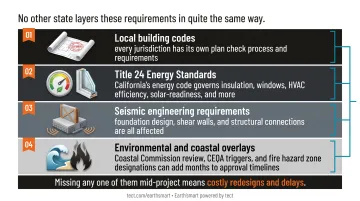
No other state layers these requirements in quite the same way. Missing any one of them mid-project means costly redesigns and delays.
The Wildfire Insurance Crisis
California's insurance market is contracting fast, and new construction is directly caught in the fallout. According to a 2025 C.A.R. report, 55.3% of California Realtors cited insurance access as their top industry concern — up from just 26.8% the prior year. State Farm alone announced approximately 30,000 residential policy non-renewals beginning in mid-2024.
This reality is reshaping how buyers and builders think about new construction. Homes that merely meet code minimums are increasingly difficult to insure in high-risk markets. Resilience-first design is now a practical prerequisite for obtaining coverage — not a premium upgrade.
Cost and Labor Realities
Insurance access shapes what gets built. What gets built is shaped by cost — and California's are steep. The state consistently ranks among the most expensive places to build in the country. According to HomeAdvisor's 2024 California data, construction costs run $200–$500 per square foot for standard builds, with an average total cost of $1.35 million for a custom home (excluding land). Local union labor rates, high demand, and supply chain pressures all push costs well above national averages. For context, NAHB's 2024 national survey found an average construction cost of roughly $162/sq ft — less than half California's starting point.
Step 1: Define Your Vision, Choose Your Land, and Set Your Budget
Build a Complete Budget Before Anything Else
Underestimating a single budget category is the most common cause of project overruns. A realistic California custom home budget must account for:
- Land acquisition — the single largest line item in high-cost markets
- Architecture and engineering fees — typically 5–15% of total build cost for architecture alone
- Permits and fees — building, grading, electrical, mechanical, and plumbing permits plus potential environmental review
- Site preparation — clearing, grading, utility connections, and temporary infrastructure
- Construction hard costs — framing, foundation, mechanical, and envelope systems
- Finishes — one of the widest cost variables in the entire project
- Landscaping — often underbudgeted in the planning phase
- Contingency reserve — plan for at least 10–15%; site surprises and change orders are the rule, not the exception
Evaluating a California Lot
Not every piece of land is equally buildable. Before purchasing, evaluate:
- Zoning and allowable use — confirm the parcel allows the intended structure and density
- Fire Hazard Severity Zone designation — CAL FIRE's updated 2024–2025 FHSZ maps now designate more than 2.3 million acres of local-responsibility land as high or very high wildfire risk
- Soil conditions and geotechnical requirements — expansive soils, slope instability, and liquefaction zones all affect foundation design and cost
- Utility access — water, sewer, gas, and electric connections can add significant cost on infill or rural lots
- Topography — steep slopes require grading that can add six figures to site costs
In dense urban markets, "scrape and rebuild" on an existing lot is frequently the only path forward — vacant parcels simply don't exist at scale.
Financing Your Build
Construction financing works differently from a standard mortgage. The most common structure is a construction-to-permanent loan — interest-only during the build phase, converting to a traditional mortgage at completion.
Engage a construction-savvy lender early. Key financing factors to align before breaking ground:
- Carrying costs — interest during a 12–18 month build can add 2–4% to your total project cost
- Draw schedules — lenders release funds in stages tied to construction milestones, not on demand
- Contingency reserves — most lenders require documented reserves before approving the loan
- Appraisal basis — construction loans appraise on projected completed value, not current land value
Step 2: Assemble Your Project Team
The Core Team California Custom Homes Require
Most projects need all of the following before design begins:
- Licensed architect — verify AIA credentials and state licensure
- Structural engineer — California seismicity makes this non-negotiable
- Civil engineer — for grading, drainage, and site work
- Geotechnical consultant — soil report is required in most California jurisdictions
- Energy compliance specialist — Title 24 documentation must accompany permit applications
- Licensed general contractor — verify licensure with the California Contractors State License Board (CSLB), check bonding and insurance, and obtain multiple bids
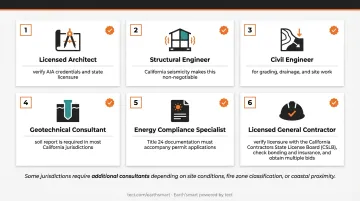
Some jurisdictions require additional consultants depending on site conditions, fire zone classification, or coastal proximity.
Why Early Integration Matters
The most expensive mistake in custom home building is discovering a structural, mechanical, or site constraint after construction documents are complete. Assembling the full team before design begins — rather than adding consultants reactively — allows those constraints to shape the design rather than derail it.
How earth'smart powered by tect Approaches This Differently
Most custom homes are delivered through a fragmented process: decisions made too late, limited manufacturer input, and disconnected teams working in sequence rather than together.
Earth'smart powered by tect's Earth'smart™ Path A Turnkey Delivery assembles a fully aligned single team covering architecture, engineering, construction, permit strategy, and coordination. It brings in the earth'smart powered by tectApp™ community of 70+ vetted building product manufacturers from concept forward — not late in construction, but during design, when system decisions can actually be made correctly.
Earth'smart powered by tect offers two paths depending on where a homeowner starts:
- Earth'smart™ Path A Turnkey Delivery — a single coordinated team covering architecture, engineering, construction, manufacturer input, and permit strategy from day one
- Earth'smart™ Path B Advisory — owner-side strategic guidance alongside an existing architect or contractor, adding system-integration expertise and manufacturer coordination without replacing the assembled team
This is the level of coordination typically reserved for sophisticated commercial projects — brought to residential construction. Bob Habian, AIA, leads earth'smart powered by tect's client engagements and can be reached at (310) 913-5000.
Step 3: Design Your Home and Navigate the Permitting Process
Design Development Phases
Custom home design moves through four phases, and decisions made early are far harder to reverse later:
- Conceptual design — massing, site orientation, and primary layout
- Schematic design — refined floor plans, building envelope strategy, structural approach
- Design development — detailed system decisions, material selections, mechanical strategy
- Construction documents — permit-ready drawings coordinating all disciplines
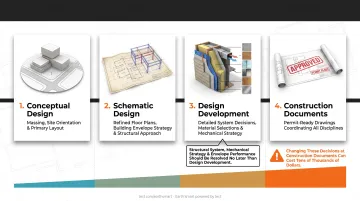
Structural system selection, mechanical strategy, and envelope performance should be resolved no later than design development. Changing these decisions at the construction document stage can cost tens of thousands of dollars.
California Title 24 Energy Compliance
Title 24 governs how your home performs energetically and must be addressed during design, not at permit submission. Key requirements include:
- Wall insulation minimums (R-15 for 2x4 framing; R-21 for 2x6)
- Maximum window U-factor of 0.40 (prescriptive standard pushes to 0.27 in many climate zones)
- Heat pump and electric-readiness requirements
- Solar PV sizing and battery-ready provisions for new homes with electrical panels over 125 amps
Note: The 2025 Energy Code applies to permit applications submitted on or after January 1, 2026 — confirm which code edition applies to your project's submittal date.
Seismic Design Requirements
California's building codes require homes in Seismic Design Categories C through E to meet specified seismic provisions. These requirements add cost but are not negotiable. Four areas of your design are directly affected:
- Foundation type — engineered for site-specific soil and seismic exposure
- Shear wall placement and sizing — resists lateral forces during ground movement
- Framing connections — hardware-specified to transfer loads through the structure
- Roof and floor diaphragm detailing — ties the system together as an integrated unit
This is why California homes survive events that destroy structures built to lesser standards.
The Permitting Process
The seismic calculations, energy compliance report, and geotechnical study you've just developed all become required permit submittal documents — making design and permitting tightly linked, not sequential. Most California custom homes require:
- Building permit — architectural drawings, structural calculations, energy compliance report, and geotechnical report
- Grading permit — for any significant earthwork
- Separate permits for electrical, mechanical, and plumbing
- Environmental review or Coastal Development Permit where applicable
Permitting timelines vary significantly by jurisdiction. San Diego's development services publishes weekly queue estimates. San Francisco offers over-the-counter review for straightforward applications in under one hour, while complex projects enter in-house review with longer timelines. Los Angeles offers multiple review routes through LADBS. Plan for months, not days, and build that timeline into financing and scheduling from the start.
Common causes of permitting delays:
- Incomplete applications missing engineering documentation
- Zoning conflicts discovered after design is complete
- Changes requested by plan check reviewers unfamiliar with complex assemblies
- Missing energy compliance or geotechnical reports
Working with a team experienced in local jurisdictions reduces these delays significantly.
Step 4: Construction — From Foundation to Final Walkthrough
Site Preparation and Foundation
Construction begins with site clearing, grading, excavation, and temporary utilities. Slab-on-grade is the most common foundation type in California; basements are rare due to the seismic engineering costs they require. Soil conditions and seismic zone classification directly affect foundation design — soft soils in liquefaction zones require engineered solutions that add significant cost.
Framing, Envelope, and Fire-Resistive Assemblies
In California — especially in WUI and fire-risk zones — material choices during framing and exterior envelope installation are not just aesthetic decisions. California Building Code Chapter 7A mandates specific requirements for homes in designated fire hazard zones:
- Class A roof assemblies under ASTM E108 or UL 790
- Exterior walls must use noncombustible, heavy timber, or 1-hour fire-resistance-rated assemblies
- Ember-resistant vents approved by the State Fire Marshal
- Multipane glazing with at least one tempered pane on all exterior windows and glazed doors
- Noncombustible or fire-retardant-treated decking with metal flashing at deck-to-wall intersections
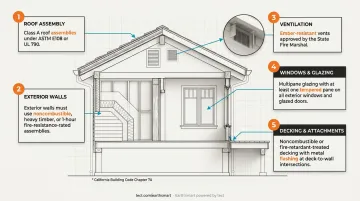
These requirements should be designed in from the start. Retrofitting them after framing is complete costs significantly more and often compromises performance.
Mechanical Rough-In and Systems
California's energy code shapes what mechanical systems make sense — and increasingly, that means all-electric. Most new California builds now specify:
- Heat pumps for space conditioning and water heating
- Induction cooking in place of gas ranges
- Tight air sealing and high-performance insulation assemblies
These choices directly affect Title 24 compliance scores and long-term operating costs. Getting mechanical system sizing right also depends on the envelope decisions made during framing — a well-sealed, well-insulated building needs a properly sized system to perform correctly.
Finish Phase and Certificate of Occupancy
Finishes represent one of the widest cost variables in any custom home. Standard finishes and luxury finishes both meet code — but the cost gap between them can be hundreds of dollars per square foot.
Inspections occur throughout construction, not just at the end:
- Foundation inspection
- Framing inspection
- Rough mechanical (plumbing, electrical, HVAC)
- Insulation inspection
- Final inspection
The Certificate of Occupancy is issued only after all inspections pass. It's the document that legally authorizes occupancy — and the milestone that triggers conversion on most construction loans.
Building for Long-Term Resilience in California's High-Risk Zones
What Resilience-First Design Actually Means
Resilience is a design philosophy baked into every system decision from the start. In California's WUI communities, that means engineering a home to withstand fire exposure, seismic events, and drainage risk as core performance criteria — not afterthoughts.
CAL FIRE's ember research underscores the stakes: embers are responsible for 60–90% of home ignitions in wildfire events. Homes that survive are built differently:
- Non-combustible or fire-resistive exterior wall assemblies (CMU, ICF, AAC, or steel-framed systems)
- Class A non-combustible roofing with 50–100+ year service life
- Ember-resistant venting and sealed eaves and soffits
- Dual-pane tempered windows and fire-rated doors
- Integrated on-site fire suppression — dedicated water supply, vapor dome perimeter systems, and FIREBOZZ® water cannons for asset protection
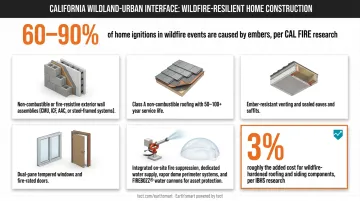
IBHS research found that adding fire-hardening features doesn't require enormous additional investment — a wildfire-resistant build adds roughly 3% to the cost of critical components like roofing and siding. The financial case for doing it right the first time is straightforward.
The Insurance Connection
Resilient construction directly affects insurability — not just safety. Every Safer from Wildfires action qualifies for an insurance discount under CDI guidelines. Homes aligned with IBHS Wildfire Prepared Home standards and documented to Chapter 7A compliance give underwriters the evidence they need to offer coverage in markets where code-minimum homes increasingly cannot get insured at all.
Earth'smart powered by tect's Earth'smart™ projects produce documentation packages built for brokers, surplus-lines wholesalers, and underwriters, including:
- Fire-resistive assembly specifications and non-combustible material specs
- Integrated suppression engineering records
- Defensible-space coordination documentation
- Referral pathways through earth'smart powered by tect's Insurance Broker & Underwriter Partnership Program for homeowners facing carrier non-renewals
Build Once. Build Forward.
Earth'smart powered by tect delivers 100+ year homes engineered to perform across structure, systems, and envelope for homeowners in Pacific Palisades, the North Bay, the East Bay Hills, and similar high-risk California communities. The Earth'smart™ model applies commercial-grade coordination to residential projects: manufacturer expertise from the earth'smart powered by tectApp™ community of 70+ building product manufacturers is integrated during design, not specified late in construction when changes are costly.
Systems are not guessed. They are understood, integrated, and delivered correctly — which is the difference between a home built to last and one already scheduled for replacement.
How Much Does It Cost to Build a Custom Home in California?
Cost Per Square Foot
According to HomeAdvisor's 2024 California data, California custom home construction costs break down as follows:
| Build Type | Cost Per Square Foot |
|---|---|
| Standard construction | $200–$500/sq ft |
| Luxury / high-complexity | $800+/sq ft |
| Average total project cost | ~$1.35M (excluding land) |
Market-specific figures vary considerably. High-cost markets like San Francisco and coastal Los Angeles push toward the upper end of these ranges; Central Valley markets are generally lower. No single authoritative source provides reliable city-by-city benchmarks for custom single-family homes, so treat any hyperlocal figure you encounter with appropriate skepticism.
The Full Project Budget
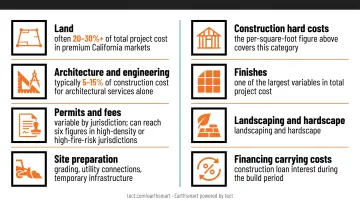
Per-square-foot cost only tells part of the story. A complete project budget includes:
- Land — often 20–30%+ of total project cost in premium California markets
- Architecture and engineering — typically 5–15% of construction cost for architectural services alone
- Permits and fees — variable by jurisdiction; can reach six figures in high-density or high-fire-risk jurisdictions
- Site preparation — grading, utility connections, temporary infrastructure
- Construction hard costs — the per-square-foot figure above covers this category
- Finishes — one of the largest variables in total project cost
- Landscaping and hardscape
- Financing carrying costs — construction loan interest during the build period
Hidden Costs That Catch Homeowners Off Guard
- Loan interest accumulation — on an 18–30+ month build, carrying costs compound fast and are rarely budgeted accurately upfront
- Permitting delays — every month of delay adds carrying costs and may escalate material prices
- Change orders — modifications after construction documents are complete are expensive
- Site conditions discovered after groundbreaking — soil problems, buried utilities, and drainage issues can each add six figures
Build a contingency reserve of at least 10–15% into your budget from the start. Projects that skip this step routinely run short when the inevitable surprises hit — and in California custom construction, surprises are the rule, not the exception.
Frequently Asked Questions
How much does it cost to build a custom home in California?
Custom home costs in California typically run $200–$500 per square foot for standard construction, with luxury builds exceeding $800/sq ft. For a 2,000 sq ft home, total project costs — including land, permits, architecture, and finishes — commonly exceed $1 million in most California markets.
How long does it take to build a custom home in California?
From initial design through Certificate of Occupancy, most California custom homes take well over a year — often longer in complex jurisdictions or on challenging sites. Permitting alone can add months to the timeline depending on jurisdiction, project complexity, and application completeness.
What permits do I need to build a custom home in California?
At minimum: a building permit, grading permit, and separate permits for electrical, mechanical, and plumbing work. Location may also require environmental review, a Coastal Development Permit, HOA approvals, or fire hazard zone compliance documentation.
Do I need an architect to build a custom home in California?
California law (BPC Section 5537) exempts standard two-story wood-frame homes from mandatory architect involvement, but most lenders and jurisdictions still require stamped drawings. Given California's seismic and energy code complexity, working with a licensed architect is strongly recommended.
What are the biggest challenges of building a custom home in California?
Permitting timelines, high labor and materials costs, regulatory complexity (Title 24, seismic requirements, WUI codes), and insurance availability in fire-risk areas are the most common obstacles.
How do I build a fire-resistant home in California?
Homes in designated Fire Hazard Severity Zones must meet California Building Code Chapter 7A requirements — including Class A roofing, fire-resistive or noncombustible exterior wall assemblies, ember-resistant vents, and multipane tempered windows. Designing these features in from the start is both more effective and more cost-efficient than retrofitting them later. IBHS research shows homes with four hardening features have a 54% chance of avoiding fire damage entirely.