Introduction
The 2025 Palisades Fire destroyed 6,845 structures in Los Angeles County alone. Across Southern California, the Palisades and Eaton fires combined erased over 16,000 structures — a number that should concern anyone living in a Wildland-Urban Interface (WUI) zone.
Many of those losses were preventable. IBHS research from its 2025 LA County fire analysis found that homes with just four hardening features — Class A roof, noncombustible siding, double-pane windows, and enclosed eaves — had a 54% likelihood of avoiding damage.
Homes with only a single hardening action dropped to 36%. That gap is the difference between a home that survives and one that doesn't.
Most homes don't fail because the main fire front rolls through — they ignite from flying embers landing on roofs, sneaking through vents, or accumulating in gutters. Radiant heat cracks windows. Spot fires catch on wood decks. Home hardening addresses each of these vulnerabilities directly.
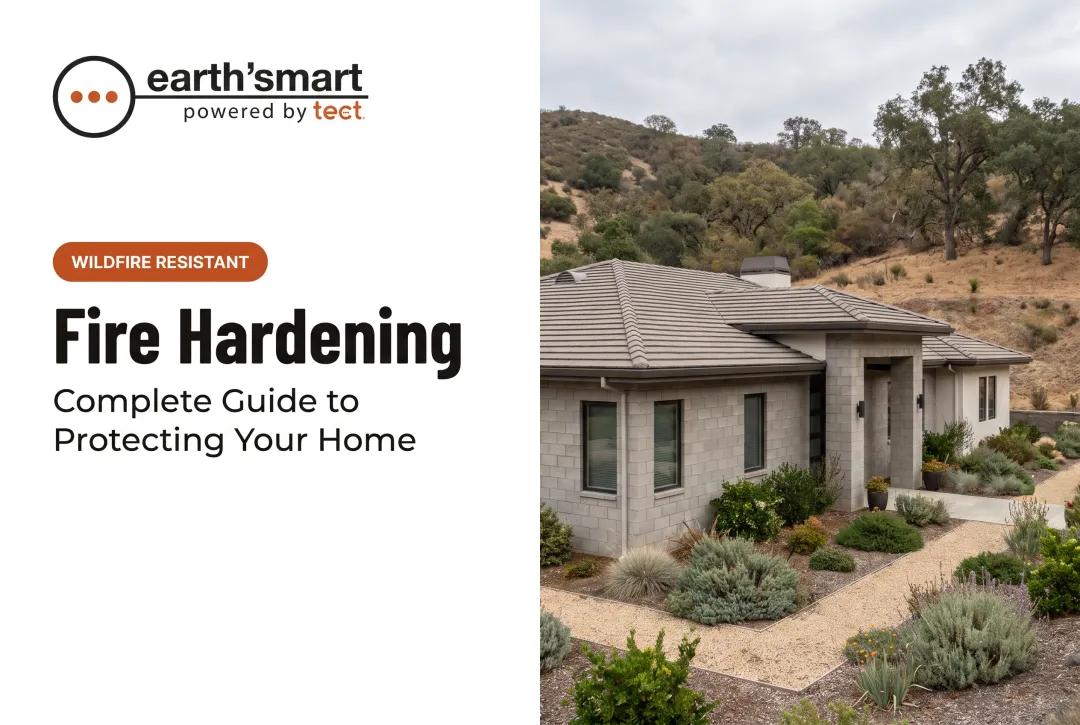
This guide covers every critical zone — roof assembly, vents, windows, walls, decks, and defensible space — and applies whether you're retrofitting an existing home or rebuilding from scratch.
Key Takeaways
- Home hardening means upgrading materials, sealing openings, and maintaining your property to resist ignition from embers, radiant heat, and flame
- Your roof, vents, windows, siding, and attached decks are the highest-risk zones and require fire-resistant materials with sealed gaps
- The 0–5 foot zone around your home is the single highest-priority defensible space action
- Hardening isn't a one-time project — gutters, vents, and decks need regular debris clearing
- For rebuilds, decisions made at the design stage are more effective and less expensive than post-construction retrofits
What Is Home Hardening and Why Does It Matter?
CAL FIRE defines home hardening as using construction features, building materials, and maintenance practices to increase a building's resistance to ignition from direct flame contact, radiant heat, and embers. It's distinct from evacuation planning or community-level vegetation management. Home hardening addresses the building itself.
The Ember Problem
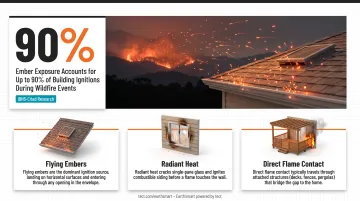
IBHS-cited research indicates ember exposure accounts for up to 90% of building ignitions during wildfire events. Embers travel miles ahead of the fire front, landing on roofs, entering through vents, and accumulating in gutters and under decks. By the time the fire front arrives, the building may already be igniting.
Hardening must address three distinct attack vectors:
- Flying embers are the dominant ignition source, landing on horizontal surfaces and entering through any opening in the envelope
- Radiant heat cracks single-pane glass and ignites combustible siding before a flame touches the wall
- Direct flame contact typically travels through attached structures — decks, fences, pergolas — that bridge the gap to the home
Where Survivability Is Decided
A home's resistance to wildfire is determined almost entirely at the building envelope: roofing, vents, windows, walls, and attached structures. The interior rarely matters if the exterior fails first.
Hardening applies to both existing homes and new construction. For rebuilds, the decisions made at the design stage — materials selection, vent specifications, deck attachment details — are far less expensive to get right early than to correct mid-construction.
Zone-by-Zone Home Hardening Guide
Wildfire attacks a home in layers. Embers land on horizontal surfaces first, then work through openings, then ignite attached structures. Hardening only works when every zone is addressed: a Class A roof paired with unscreened vents still allows ember entry.
Roof and Chimney
The roof is the largest horizontal target. Embers land, accumulate, and ignite.
Required standard: Class A fire-rated roofing assemblies — composite shingles, metal, clay tile, or concrete tile. The 2025 California WUI Code and 2022 CBC Chapter 7A both mandate Class A for covered construction.
What to avoid: Untreated wood shake roofs are the highest-risk configuration. CAL FIRE specifically identifies them as combustible and recommends replacement with Class A materials.
Chimney requirements:
- Install a spark arrestor with 3/8" to 1/2" metal mesh openings (California Building Code Section 2802.1)
- Close fireplace flues during fire season
- Seal gaps under tiles and shingles where embers can lodge
Vents and Attic Openings
Unprotected vents are one of the most common ember entry points. An open soffit vent gives embers a direct path into the attic structure.
Code standard: 2022 CBC Chapter 7A requires noncombustible, corrosion-resistant metal mesh with openings not less than 1/16" and not more than 1/8". The 2025 WUI Code limits openings to no larger than 1/8".
- Plastic and fiberglass mesh are explicitly prohibited under both codes
- Higher-protection option: California State Fire Marshal/OSFM-listed WUI flame- and ember-resistant vents
- All attic, foundation, and soffit vents must meet these standards — not just some of them
Windows and Doors
Single-pane annealed glass fails under radiant heat at low radiant heat exposure, allowing embers and flames to enter before the fire front arrives.
Code requirement: The 2025 WUI Code requires exterior glazing to use insulating glass units with at least one tempered pane, glass block, or a 20-minute fire-resistance rating.
Additional steps:
- Minimize window area facing dense vegetation
- Add ember-catching exterior screens
- Exterior doors should use approved noncombustible construction or meet 20-minute fire-resistance ratings
Walls, Siding, and Eaves
Fire-resistant siding options (CAL FIRE and 2025 WUI Code compliant):
- Three-coat stucco
- Fiber cement
- Metal
- Pre-insulated concrete masonry
High-risk materials to replace:
- Untreated wood siding — supports vertical flame spread
- Vinyl siding — can allow flame penetration through lap joints into stud cavities
Replacing high-risk materials is only part of the equation. Protection must be continuous from foundation to roofline — gaps at the eave or soffit line, even small ones, create combustible pathways. The 2025 WUI Code requires eaves and soffits to use noncombustible, ignition-resistant, or 1-hour fire-resistance-rated materials on the exposed underside.
Decks, Patios, and Gutters
Attached decks are a direct flame pathway to the home. Embers ignite debris in deck-board gaps, and combustibles stored underneath act as fuel.
Deck requirements (2025 WUI Code): Approved noncombustible materials, ignition-resistant materials, 1-hour fire-resistance-rated materials, or fire-retardant-treated wood.
Key maintenance steps:
- Clear all combustible material from beneath and around decks
- Remove stored items, firewood, and dead vegetation from deck surfaces
- Install noncombustible gutter covers and keep gutters debris-free — accumulated leaf litter is a prime ember catch point
Defensible Space: Your Home's First Line of Defense
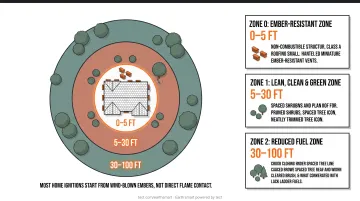
Most homes that burn in wildfires ignite from embers — not direct flame contact. California's defensible space framework addresses this by establishing three zones around your home, each with specific requirements:
| Zone | Distance | Primary Goal | |------|----------|--------------|\n| Zone 0 | 0–5 feet | Ember-resistant buffer — noncombustible materials only | | Zone 1 | 5–30 feet | Lean, clean, green — remove dead plants and combustibles | | Zone 2 | 30–100 feet | Reduce fuel continuity — space plants and reduce density |
Why Zone 0 Matters Most
CAL FIRE calls the first five feet from your home "the most important" zone. AB 3074 (2020) directed creation of a formal ember-resistant zone here, and research from the Insurance Institute for Business & Home Safety (IBHS) found that a noncombustible ember-resistant buffer can reduce a home's wildfire ignition risk by up to 50%.
Zone 0 rules:
- Remove all wood mulch and combustible bark — replace with gravel, pavers, or concrete
- No stored firewood, propane tanks, or flammable plants within 5 feet
- Clear dead leaves, pine needles, and debris from hardscape regularly (noncombustible surfaces still accumulate organic material that can carry embers to the structure)
Defensible Space Requires Ongoing Maintenance
Defensible space erodes with every fire season. Vegetation grows back, debris accumulates, and screens degrade. Stay current with:
- Clearing debris from roofs and gutters before fire season
- Removing dead or dry vegetation in Zones 1 and 2 throughout summer and fall
- Inspecting under decks for accumulated leaves and debris after wind events
- Replacing degraded vent screens and gutter covers annually
Common Mistakes Homeowners Make When Hardening Against Wildfire
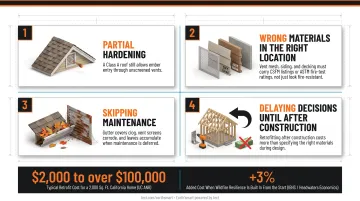
Wildfire hardening fails more often from overlooked gaps than from a lack of effort. These are the four mistakes that consistently undermine otherwise solid work:
1. Partial hardening — one zone, not all A Class A roof still allows ember entry through unscreened vents. Noncombustible siding doesn't help if the deck is wood and cluttered. Every attack vector needs to be addressed — partial hardening produces partial protection.
2. Wrong materials in the right location Some products look fire-resistant but lack proper ratings. Watch for these common substitution failures:
- Vent mesh that appears metallic but is actually fiberglass
- Siding that looks like fiber cement without a CSFM listing
- Decking marketed as "fire-treated" without an ASTM fire-test rating
Products should meet California State Fire Marshal listings or relevant ASTM fire-test standards — not just appear noncombustible.
3. Skipping maintenance after hardening Gutter covers clog. Vent screens corrode and tear. Leaves accumulate on decks. Even correctly installed systems fail when maintenance is deferred. Hardening installed and then ignored will not perform when it's needed.
4. Delaying hardening decisions until after construction Retrofitting vents, windows, or siding after a home is built is more disruptive and expensive than specifying the right materials during design. According to UC ANR research, wildfire retrofits for a typical 2,000 sq. ft. California home range from $2,000 to over $100,000 depending on scope — with priority measures often achievable for $2,000–$10,000.
By contrast, integrating wildfire resilience from the start adds approximately 3% to building component costs, according to IBHS and Headwaters Economics research on new construction in Altadena.
Home Hardening During a Rebuild: Getting It Right from the Start
Homeowners rebuilding after wildfire have something most homeowners never get: the opportunity to implement comprehensive hardening from the ground up, with no existing structure to work around.
That opportunity is also time-limited. Decisions made at the design phase — roofing assemblies, vent specifications, siding systems, eave details — are far cheaper to get right before construction begins than to correct afterward.
The Coordination Problem Most Rebuilds Miss
Home hardening is not a single trade decision. It requires alignment across architecture, engineering, construction, and the manufacturers behind the actual materials. When those decisions happen in isolation — roofing specified without accounting for soffit detailing, or vents selected without coordination with wall assemblies — gaps appear. Those gaps are exactly where embers enter.
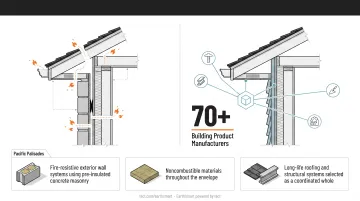
This is the problem earth'smart powered by tect's fully coordinated approach is designed to solve. By connecting homeowners with 70+ building product manufacturers through earth'smart powered by tectApp, the system ensures that critical material decisions happen early, with direct input from the companies producing the actual components. Structural, mechanical, and finishing decisions are aligned before construction begins — which is far less costly than correcting them mid-build.
Earth'smart powered by tect's Pacific Palisades work specifies:
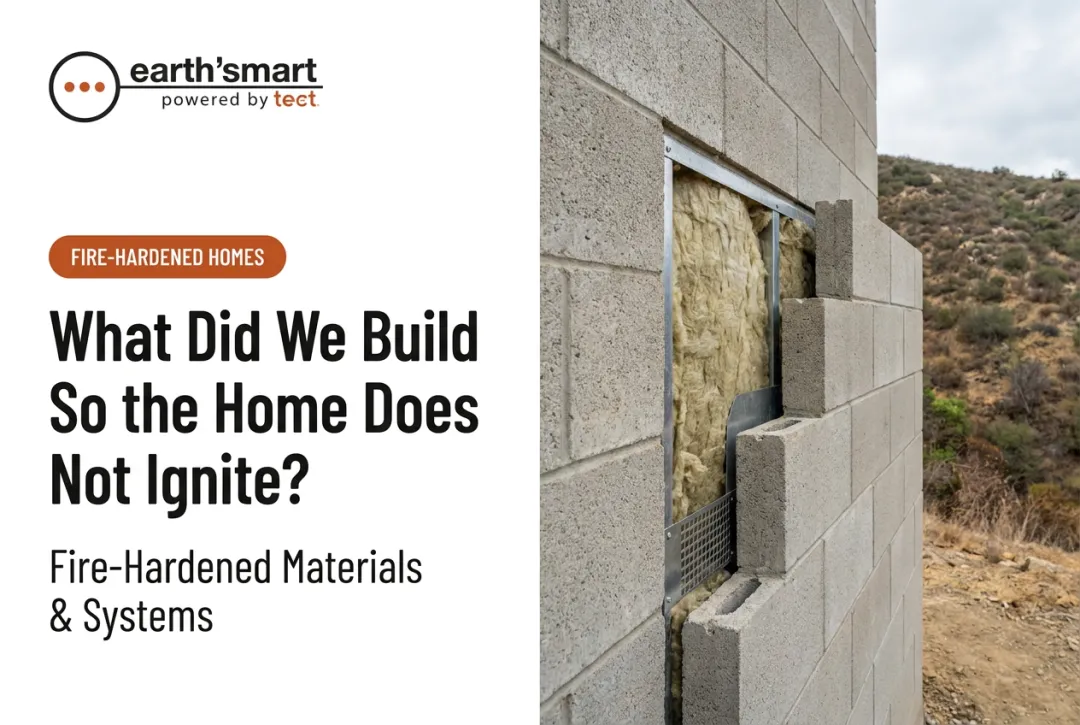
- Fire-resistive exterior wall systems using pre-insulated concrete masonry
- Noncombustible materials throughout the envelope
- Long-life roofing and structural systems selected as a coordinated whole
Insurance and Long-Term Risk
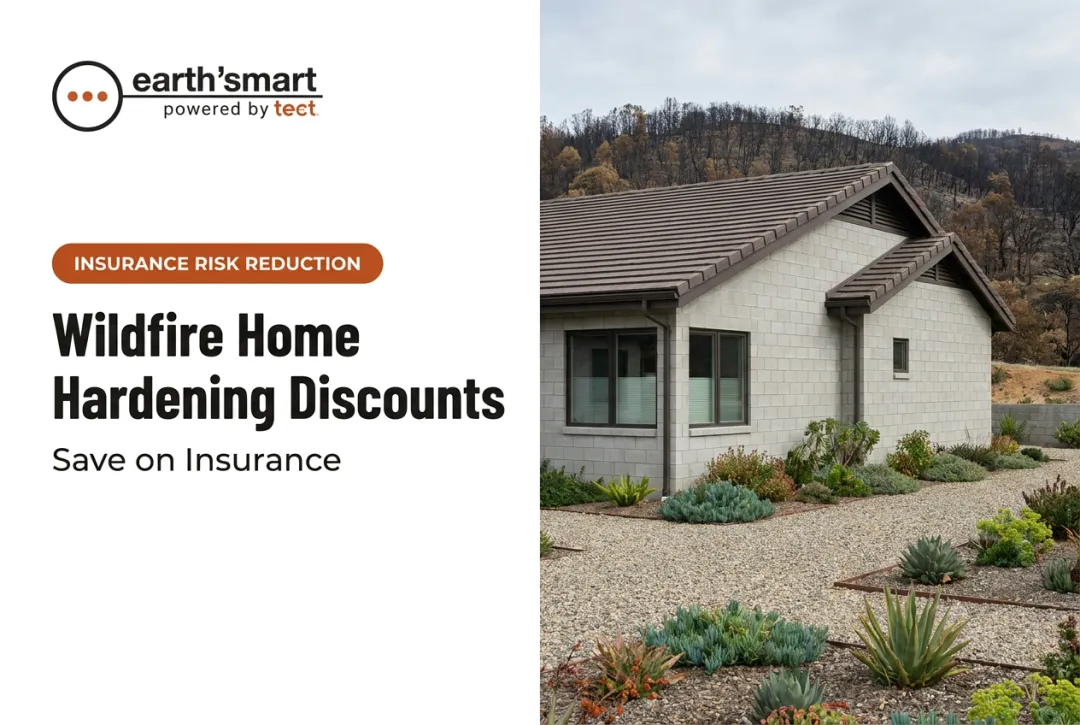
Fire-resilient construction directly affects insurance availability in high-risk California ZIP codes. California's Department of Insurance confirmed that every Safer from Wildfires action qualifies for a discount. CDI's 2026 briefing reports those discounts range from 4% to 40% depending on the combination of measures implemented.
Qualifying actions include:
- Class A roofing assemblies
- Ember-resistant vents
- A 5-foot noncombustible zone around the foundation
Earth'smart powered by tect explicitly positions its approach as designed to address the risk insurers are reacting to — not just meet code minimums. Homes built to system-level performance standards are better positioned for today's tightening insurance market than code-minimum homes.
Frequently Asked Questions
What does home hardening mean?
Home hardening refers to upgrading a home's building materials and design details — roofing, vents, windows, siding, decks — to resist ignition from embers, radiant heat, and direct flame. It also includes maintenance practices like clearing debris from gutters and roofs to eliminate ember catch points.
What is the 5-foot rule in California?
California's 5-foot rule refers to the ember-resistant zone immediately surrounding a structure, established under AB 3074. All combustible materials — wood mulch, stored items, flammable plants — must be removed and replaced with noncombustible materials like gravel, pavers, or concrete within this zone.
What is the most important part of the home to harden against wildfire?
The roof and vents are the highest-priority zones. The roof is the primary surface that catches embers, and vents are the primary openings through which embers enter the structure. Both must be addressed — a hardened roof with unprotected vents still leaves the home vulnerable.
How much does home hardening typically cost?
Costs vary based on scope. UC ANR reports priority retrofit measures can often be completed for $2,000–$10,000, though full retrofits on a 2,000 sq. ft. home can reach $100,000+. Check Cal OES's California Wildfire Mitigation Program for financial assistance options.
Does home hardening lower homeowners insurance in California?
It can. California's Department of Insurance requires insurers to provide discounts for documented Safer from Wildfires actions, with discounts ranging 4%–40% depending on measures implemented — so document upgrades and confirm which apply under your policy.
Do I need a permit to harden my home in California?
Some hardening measures — vent replacement, re-roofing, siding replacement — may require building permits, particularly in WUI zones. Check with your local building department before beginning work. WUI zones often carry stricter requirements, so confirming early prevents project delays.