The January 2025 Palisades Fire destroyed 6,845 structures and generated more than 2.5 million tons of debris, according to CAL FIRE and California Governor's office reports. A home with a perfect LEED score that burns to the foundation is not a sustainable home. That tension — between conventional green building discourse and what high-risk homeowners actually need — is where the real conversation begins.
True sustainable luxury isn't about checking environmental boxes. It's about building a home so well-designed and durable that it never needs to be replaced. A 100-year home is, by definition, the most sustainable home you can build.
This article covers the key pillars of that approach: material selection, energy systems, resilience, wellness, and certifications — and why all of them must be designed as a single integrated system, not a collection of add-ons.
Key Takeaways
- Luxury buyers are shifting: 55% of luxury buyers say they'd pay more for sustainability features they value
- A home built to last 100+ years avoids the enormous embodied carbon of rebuilding — that's the most durable sustainability argument there is
- Resilience is sustainability: In high-risk regions, fire-resistant, flood-tolerant, seismically sound homes are the most environmentally responsible choice
- Systems designed in isolation underperform — envelope, energy, and structure must be coordinated from the start
- The financial case is lifecycle, not upfront: Lower energy bills, reduced maintenance, insurance positioning, and avoided rebuilding costs change the equation entirely
The New Definition of Luxury: Why Green Homes Are Leading the Market
The definition of luxury in residential real estate is changing. What once meant excess — more square footage, more materials, more everything — has given way to something more precise: intentionality.
According to Luxury Portfolio International's State of Luxury Real Estate 2023, 55% of luxury buyers said they would pay more for a home with sustainability features they care about. Sustainability, environmental consciousness, and long-term performance have become status markers, not compromises.
From Aesthetic to Performance
This shift shows up most clearly in high-risk regions. Homeowners who have watched neighborhoods burn, flood, or shake apart are rethinking what a luxury home actually means. Beauty and comfort are still expected. Now durability and resilience are expected alongside them.
Sotheby's International Realty's 2025 Luxury Outlook identified the January 2025 Los Angeles County wildfires as among the costliest climate disasters in U.S. history. For the luxury market, resilience is no longer optional.
The result: buyers now screen on performance. Move-in-ready homes that demonstrate quality command premiums of 11% to 30%, per Coldwell Banker Global Luxury's 2026 Trend Report. Homes that need redesign or remediation are the hardest to sell.
For homeowners building or rebuilding today, the market rewards documented performance. A home that delivers on all three counts is the stronger financial choice:
- Engineered for a 100-year service life
- Certified to recognized performance standards
- Built with verified, coordinated systems
Sustainable Materials That Define High-End Design
Every surface, structural element, and finish in a home contributes to two things simultaneously: its environmental footprint and how long it will last. The best sustainable materials tend to be the most durable ones — and that connection runs through every design decision worth making.
Embodied Carbon — The Decision That Matters Most
Before a building ever operates, it has already generated significant emissions. Embodied carbon — the CO2 locked into materials during extraction, manufacturing, and transport — accounts for 11% of global greenhouse gas emissions annually, according to Architecture 2030.
Choosing durable, long-lasting materials with low embodied carbon is the highest-impact sustainability decision a homeowner can make at the design stage. The AIA notes that selecting durable materials can reduce embodied carbon by up to 30% compared with standard construction methods.
Material Choices That Perform
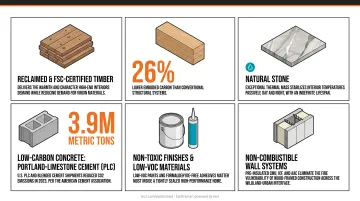
Reclaimed wood and FSC-certified timber deliver the warmth and character high-end interiors demand while reducing demand for virgin materials. Locally sourced timber reduces transportation emissions and tends to perform better in the local climate. Mass timber can reduce embodied carbon by 26% compared to conventional structural systems.
Natural stone offers exceptional thermal mass — it absorbs heat during the day and releases it at night, stabilizing interior temperatures passively. Its lifespan is effectively indefinite, making it one of the most durable materials available.
Low-carbon concrete alternatives — including Portland-limestone cement (PLC), which contains up to 15% ground limestone — reduce CO2 emissions meaningfully at scale. U.S. PLC and blended cement shipments reduced national CO2 emissions by more than 3.9 million metric tons in 2023, according to the American Cement Association.
Non-toxic finishes, low-VOC paints, and formaldehyde-free adhesives directly affect occupant health. In a tightly sealed high-performance home, airborne compounds have nowhere to escape — making material chemistry as critical as structural performance.
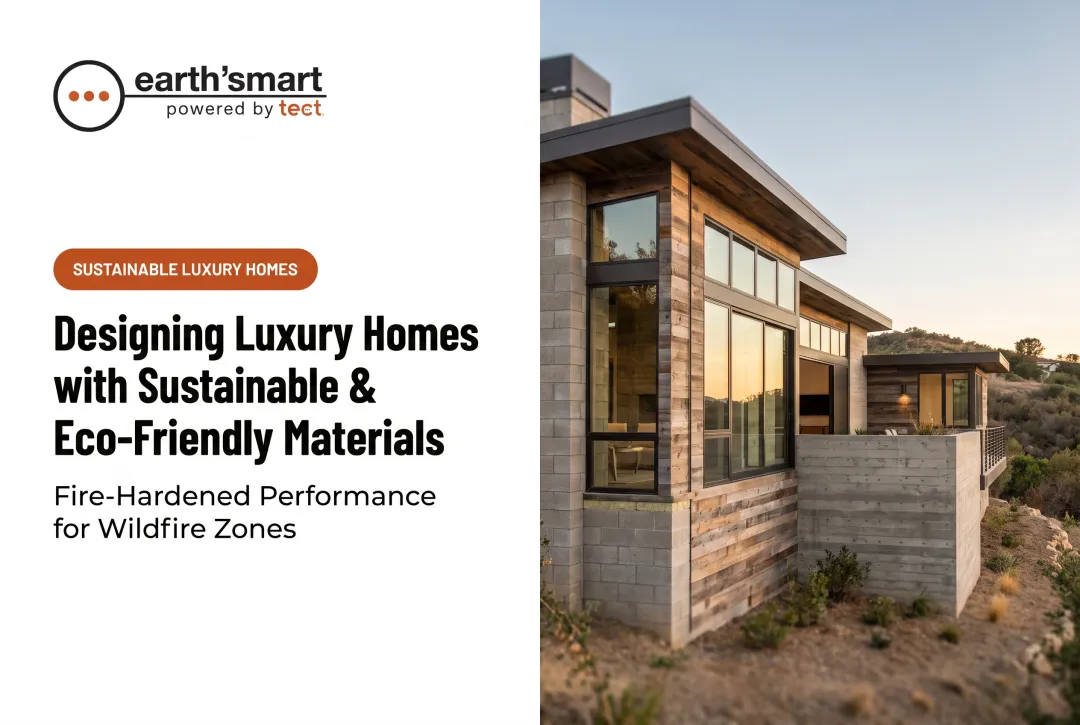
Material performance takes on a different dimension entirely when fire risk enters the picture. For homeowners building in the Wildland-Urban Interface, non-combustible wall systems — pre-insulated concrete masonry (CMU), insulated concrete forms (ICF), or autoclaved aerated concrete (AAC) — eliminate the fire vulnerability wood-framed construction carries. They also deliver superior thermal and acoustic performance.
Energy Systems: High Performance Without Compromise
High-performance homes don't use less energy because occupants make sacrifices. They use less energy because the building is engineered to waste almost none. That's the real definition of luxury: a home that simply performs.
Start With the Envelope
Passive strategies come first. Active systems (solar, HVAC) should only be sized after the building envelope has been optimized.
- Super-insulated assemblies with continuous exterior insulation eliminate thermal bridging (the invisible heat pathways through wall framing responsible for significant energy loss in conventional construction)
- Triple-glazed windows can improve a new home's energy efficiency by 40% or more and reduce perceived noise by approximately half, per the DOE
- Passive House-standard envelopes deliver 40% to 60% energy savings compared to code-built homes, according to PHIUS
Once the envelope is right, active systems can be sized accurately — and much smaller than a conventional design would require.
Active Systems: Solar, Storage, and Geothermal
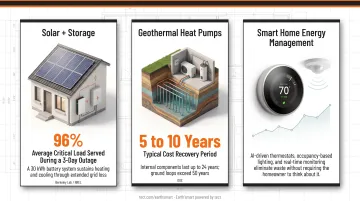
Solar PV with battery storage provides on-site power generation and grid independence — a real advantage in fire- and storm-prone areas. A 30 kWh battery system can serve an average 96% of critical load during a 3-day outage, including heating and cooling, per Berkeley Lab and NREL research.
Geothermal heat pumps use the earth's stable subsurface temperature to deliver highly efficient heating and cooling year-round. Installation costs are typically recovered through energy savings within 5 to 10 years, and internal components last up to 24 years with ground loops exceeding 50 years, according to the DOE.
Smart home energy management (AI-driven thermostats, occupancy-based lighting, real-time monitoring) eliminates waste without requiring the homeowner to think about it.
Where Coordination Fails
The most common failure point in high-performance energy systems is early-stage isolation. Insulation gets specified without HVAC input. HVAC gets sized without solar integration. The result is systems that technically work but consistently underperform against their design intent.
Earth'smart powered by tect's Earth'smart™ model addresses this directly. Through the earth'smart powered by tectApp™ community of 70+ building product manufacturers, energy system decisions across envelope, mechanical, solar, and storage are made together from the concept phase forward. The right system experts are in the project before the first design decision is locked — not discovered after problems appear in the field.
Resilience as the Ultimate Form of Sustainability
Here's the argument that most green home conversations skip entirely: a home that burns, floods, or requires major reconstruction is not a sustainable home — regardless of what it scored on an energy rating before the event.
For homeowners in the Wildland-Urban Interface, resilience isn't a separate topic from sustainability. It's the foundation of it.
Fire-Resistant Design
IBHS research shows that creating an ember-resistant buffer around a home cuts its wildfire ignition risk in half. Once a single-family home ignites from ember exposure, there's a 90% chance of total loss.
Prevention is the most environmentally responsible outcome possible. The construction measures that achieve it include:
- Non-combustible cladding (CMU, ICF, AAC, fiber cement, stucco over non-combustible substrate)
- Class A fire-rated roofing — standing seam metal, clay or concrete tile, slate
- Ember-resistant vents and screening
- Fire-rated glazing and non-combustible eaves and soffits
- Defensible space integration and on-site fire water supply
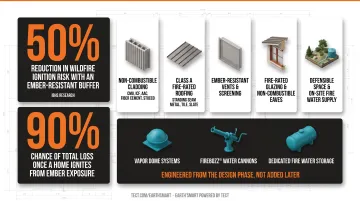
Earth'smart powered by tect's Earth'smart™ homes integrate on-site fire suppression — vapor dome systems, FIREBOZZ® water cannons, and dedicated fire water storage — engineered from the design phase, not added later.
The 100-Year Home Argument
A home built to last a century, engineered for regional hazards, and finished with low-maintenance durable systems is more sustainable than a home replaced every 30 years — even if the replacement home has better energy ratings.
Rebuilding generates debris, consumes new materials, and restarts the embodied carbon clock. Avoiding that outcome through superior construction is the most impactful sustainability decision available.
That durability doesn't happen through a single material choice. Structural systems, building envelope, and mechanical and suppression systems must be designed together — and that coordination starts at concept, not during construction. Closing that gap is the core purpose of earth'smart powered by tect's Earth'smart™ Path A (Turnkey Delivery) and Path B (Advisory) models.
Wellness, Water, and Biophilic Living
Biophilic Design
Natural light, living walls, indoor gardens, natural textures, and unobstructed views of the landscape do more than look beautiful. Research from Terrapin Bright Green's 14 Patterns of Biophilic Design documents that biophilic environments reduce stress, enhance clarity of thought, and improve overall wellbeing. In a well-designed home, these outcomes are built into the architecture itself — not added on as features, but achieved through the choices made from day one.
Water Conservation
A high-end home can dramatically reduce municipal water dependence without any lifestyle adjustment. The combination typically includes:
- Rainwater harvesting and greywater recycling
- Low-flow fixtures with no performance compromise
- Smart irrigation that responds to weather data
Greywater reuse alone has the potential to reduce residential water consumption by up to 40% for households that implement it. Earth'smart powered by tect specifies SMARTVALVE® water-conservation technology as a standard Earth'smart™ component, delivering 15–25%+ whole-home water savings from day one — with a secondary benefit of preserving on-site fire-event water reserves.
Indoor Air Quality and Circadian Lighting
A tightly sealed high-performance home cannot rely on air leakage for ventilation — it requires intentional mechanical strategies. Earth'smart powered by tect specifies ERV/HRV ventilation systems with MERV-13+ filtration and HEPA stages as a standard Earth'smart™ component, particularly important in wildfire-exposed regions where smoke ingress is a documented post-fire risk.
Healthy air is one layer. Circadian-tuned lighting systems — shifting from cool to warm tones throughout the day — support the body's natural rhythm without sacrificing ambiance. Paired with low-VOC finishes and all-electric mechanical systems, every element works together to make the home a measurable asset to the health of the people living in it.
Green Certifications and Long-Term Investment Value
Key Certifications
LEED (Leadership in Energy and Environmental Design) evaluates a home's design, construction, and performance across energy, water, materials, and indoor environment. Third-party certification provides a construction quality check and a verified performance signal to future buyers.
ENERGY STAR for Homes focuses specifically on energy performance, with verification by an independent rater. ENERGY STAR certified homes show sale and resale price premiums of 2% to 8% in most markets, with a Freddie Mac study finding a 2.7% average premium for rated energy-efficient homes nationally.
For WUI homeowners, IBHS Wildfire Prepared Home certification and CAL FIRE Chapter 7A compliance carry weight that energy certifications alone do not — they signal to insurance underwriters that the home has been built to a documented risk-reduction standard. In California's current insurance environment, that documentation directly supports coverage availability and pricing.
The Financial Case
Those certifications translate directly into financial outcomes. The right comparison isn't construction premium versus conventional build cost — it's total lifecycle cost:
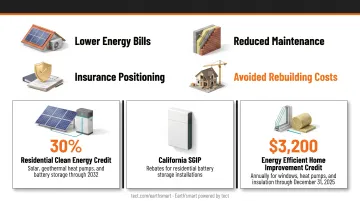
- Lower energy bills from high-performance envelopes and efficient mechanical systems
- Reduced maintenance from long-life materials and systems
- Insurance positioning through documented risk reduction
- Avoided rebuilding costs — the largest financial variable in high-risk regions
Federal and state incentives also strengthen the upfront math:
- Residential Clean Energy Credit: 30% federal tax credit for solar, geothermal heat pumps, and battery storage through 2032
- California SGIP program: rebates for residential battery storage installations
- Energy Efficient Home Improvement Credit: up to $3,200 annually for qualifying windows, heat pumps, and insulation improvements through December 31, 2025
A home engineered to last 100 years, built with materials that won't need replacement in 15, and designed to survive the hazard events most likely to occur in its region carries a different upfront number. Over its service life, it consistently costs less than the alternative — once you account for what rebuilding actually costs.
Frequently Asked Questions
What is the difference between a green home and a sustainable luxury home?
Green homes prioritize environmental performance — energy efficiency, reduced emissions, water conservation. Sustainable luxury homes combine that performance with high-end materials, refined design, and long-term durability — engineered to perform for generations, not just meet a minimum rating.
Are sustainable homes more expensive to build than conventional luxury homes?
High-performance systems and durable materials carry upfront cost premiums. But the relevant comparison is total lifecycle cost — lower energy bills, reduced maintenance, insurance advantages, and the avoided cost of rebuilding after a hazard event. Across a 30- to 100-year horizon, the premium typically offsets or reverses entirely.
What green building certifications should I look for in a luxury home?
LEED and ENERGY STAR are the most widely recognized certifications for energy and environmental performance. For high-risk California markets, IBHS Wildfire Prepared Home and CAL FIRE Chapter 7A compliance carry additional weight with insurers. Certification provides both quality assurance during construction and a verified performance signal for future buyers and underwriters.
Can a sustainable home also be built to resist fire, floods, and earthquakes?
Resilience and sustainability are complementary. Fire-resistant, flood-tolerant, and seismically sound homes avoid the enormous environmental and financial cost of reconstruction — making resilience the most impactful form of sustainability available in high-risk regions.
What is passive design and how does it differ from active sustainable systems?
Passive design uses the building's form, orientation, insulation, and glazing to reduce energy demand before any mechanical systems are introduced. Active systems — solar, geothermal, smart HVAC — then meet that reduced demand efficiently, which is why the two work best when designed together from the start.
How do I ensure all the sustainable systems in my home actually work together?
Early-stage coordination is the critical factor. Systems specified in isolation — insulation without HVAC input, HVAC without solar integration — consistently underperform. An integrated design-build approach that brings structural, envelope, and mechanical expertise together from concept through construction ensures everything is sized, sequenced, and installed correctly. That coordination is the core of what earth'smart powered by tect's Earth'smart™ model delivers.