Introduction
When a contractor or building official tells you a stairway needs to be "fire rated," what exactly does that mean for the physical structure holding it up? Most people assume the requirement stops at the walls around the stair. It doesn't — at least not always.
Building codes treat the stair enclosure (the walls and doors surrounding the stairway) and the supporting construction beneath and around it as separate but linked systems. Getting one right without the other can leave the structure itself unprotected.
This guide cuts through that ambiguity. Here's what you'll find:
- Which code regime governs your project
- When fire-rating applies to the stair structure itself
- What's required to actually achieve a rating
- Why these decisions carry extra weight in WUI communities like Pacific Palisades
Key Takeaways
- Fire-rating requirements depend on building type, stair classification, and number of stories served — there's no single universal answer
- Under IBC, interior exit stairways require 1- or 2-hour enclosures, and per IBC 707.5.1, the supporting structure must match that same rating
- IRC single-family homes don't require rated stair enclosures — but exempt doesn't mean protected
- Exceptions exist for construction type, sprinklers, and single-story EAS — but each is narrow and condition-specific
- Achieving a rating requires a complete tested assembly — not just a single layer of drywall
What "Fire-Rated Stair Structure" Actually Means
Fire-resistance rating (FRR) measures how long a building element — wall, floor, column, or assembly — can resist fire while maintaining structural integrity and containing the spread of flame. Ratings are expressed in hours (1-hour, 2-hour) and are determined by standardized testing under ASTM E119 or the equivalent ANSI/UL 263, not by material type alone.
A product isn't fire-rated because it's made from gypsum or steel. It achieves a rating when a complete assembly — specific materials, fastener spacing, layer sequences, and joint detailing — has been tested and listed.
Two Things Commonly Confused
These two terms get conflated, but they're distinct compliance categories:
- Stair enclosure — the fire barriers surrounding the stairway: walls, doors, and horizontal assemblies forming a protected corridor (IBC Chapter 7)
- Supporting construction — the structural elements holding those barriers up: beams, columns, floor framing, and stair stringers, which fall under IBC Section 707.5.1
IBC 707.5.1 states directly: the supporting construction for a fire barrier must be protected to the required fire-resistance rating of the barrier it supports. So if a stair enclosure wall requires a 2-hour fire barrier, the structural beams and columns supporting that wall must also achieve a 2-hour rating. The enclosure and the structure are separate compliance checks, but they're linked.
When Fire-Rating Is Required by Code
Two codes govern most residential and commercial stair construction in the US — and they take very different positions on fire-rating.
IBC vs. IRC: The Starting Point
| Code | Applies To | Stair Enclosure Requirement |
|---|---|---|
| IBC 2021 | Commercial, multi-family, mixed-use | Yes — varies by stair type and stories |
| IRC 2021 | Single-family and two-family homes | Generally no rated enclosure required |
Under the IRC, only enclosed accessible under-stair spaces require protection — ½-inch gypsum board per IRC R302.7. The stair structure itself has no rated enclosure requirement. The IBC is a different story entirely.
IBC Interior Exit Stairway Requirements
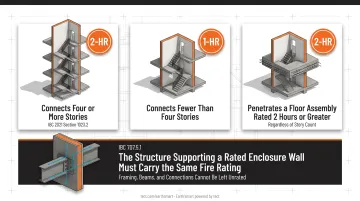
Under IBC 2021 Section 1023.2, interior exit stairways must be enclosed with fire barriers rated as follows:
- 2 hours when connecting four or more stories
- 1 hour when connecting fewer than four stories
- 2 hours if the stairway penetrates a floor assembly rated at 2 hours or greater, regardless of story count
Per IBC 707.5.1, the structural elements supporting those enclosure walls must carry the same fire rating. In practice, this means the stair's framing, beams, and connections can't be left unrated just because the wall beside them is — the rating obligation travels to the structure holding it up.
How Construction Type Affects Ratings
IBC Chapter 6 Table 601 establishes independent rating obligations for structural elements based on construction type:
- Types I and II require non-combustible materials throughout
- Type V allows combustible construction but may still carry structural frame rating requirements depending on occupancy, height, and use
Run Table 601 as a parallel check alongside the enclosure analysis — one doesn't replace the other.
How Stair Classification Drives Fire-Rating Requirements
Not every stair in an IBC building is an interior exit stairway. The classification determines which requirements apply.
The Three IBC Stair Categories
| Stair Type | IBC Reference | Enclosure Required? | Fire-Rating on Structure? |
|---|---|---|---|
| Interior Exit Stairways (IES) | IBC 1023, 707.5.1 | Always — fire barrier shaft enclosure | Yes, inherits the same FRR |
| Exit Access Stairways (EAS), multi-story | IBC 1019.3, Section 713 | Generally yes — 1-hour or 2-hour by story count | Yes, with more exceptions available than IES |
| Exit Access Stairways (EAS), single-story | IBC 1019.2 | Not required | No — no enclosure means no rating obligation |
The practical takeaway: classify the stair before selecting an assembly. The code path and the cost look very different depending on where the stair sits within the means of egress sequence.
Exceptions: When Fire-Rating Is NOT Required
Several narrow code exceptions can remove or reduce the fire-rating obligation for stair structures. Each requires exact condition matching.
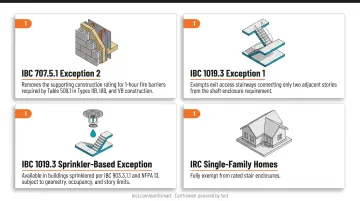
The four exceptions most likely to apply:
- IBC 707.5.1 Exception 2 — Removes the supporting construction rating for 1-hour fire barriers required by Table 509.1 in Types IIB, IIIB, and VB construction. Widely misapplied: it covers only those three construction types, only barriers triggered by Table 509.1, and only the 1-hour threshold.
- IBC 1019.3 Exception 1 — Exempts exit access stairways connecting only two adjacent stories from the shaft enclosure requirement. No enclosure means no rating obligation on the supporting structure.
- IBC 1019.3 Sprinkler-Based Exception — Available in buildings sprinklered per IBC 903.3.1.1 and NFPA 13, subject to geometry, occupancy, and story limits. It does not broadly eliminate stair enclosure requirements across sprinklered buildings.
- IRC Single-Family Homes — Fully exempt from rated stair enclosures. The IRC does not carry IBC exit stairway requirements into one- and two-family dwellings.
How Fire-Rating Is Achieved in Stair Construction
A fire-resistance rating belongs to an assembly, not a material. This distinction is what causes the most errors in practice.
1-Hour Assemblies
The most common approach in residential and light commercial work involves gypsum board applied to the underside of stair framing. UL design BXUV.L501 identifies a 1-hour wood-joist floor-ceiling assembly using 5/8-inch Type X gypsum board as a ceiling membrane component. GA-610-02 identifies a one-hour ceiling membrane (GA File Nos. FC 5406 and RC 2601) using two layers of 5/8-inch Type X gypsum board applied directly to framing or furring.
Important caveat: these are floor-ceiling assemblies. No current UL or GA stair-specific listing for a sloped wood stair underside was verified in the research. If applying a floor-ceiling assembly to a stair soffit, the authority having jurisdiction (AHJ) or a design professional needs to accept that application explicitly.
2-Hour Assemblies
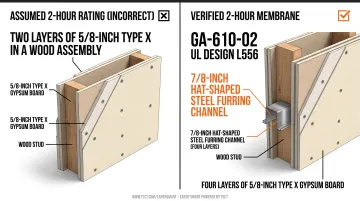
GA-610-02's verified 2-hour membrane is based on UL Design L556 and requires four layers of 5/8-inch Type X gypsum board plus a 7/8-inch hat-shaped steel furring channel between the third and face layers. This contradicts the widespread assumption that two layers of 5/8-inch Type X achieves a 2-hour rating in a wood assembly.
Steel Stair Stringers
Wood assemblies aren't the only concern — steel introduces its own fire performance challenges. Steel performs differently in fire than most people expect. NIST research confirms that structural steel yield strength drops to roughly 50% of room-temperature capacity at approximately 550°C. Unprotected steel loses structural capacity rapidly — often faster than wood, which chars at the surface and can maintain load capacity longer.
Steel stair stringers in commercial settings require additional protection to achieve a rated assembly:
- Spray-applied fireproofing
- Intumescent coatings
- Full encasement
Each method has specific listed assemblies. No protection method should be selected without confirming the applicable UL or IBC design listing.
Penetrations
Every penetration through a rated assembly — electrical boxes, recessed fixtures, any opening — must be treated with a listed firestop product tested under ASTM E814 or UL 1479. The F-rating must be at least equal to the assembly rating per IBC 714.4.1.2.
A single untreated opening compromises the entire assembly.
Beyond Minimum Code: Why This Matters More in Fire-Prone Homes
Building codes are calibrated for average risk scenarios. In WUI communities like Pacific Palisades, the exposure profile is different. NIST research has documented adjacent-wall heat flux peaks of 60 to 110 kW/m² from wildfire exposure — conditions that can stress assemblies well beyond the parameters of a standard compartment fire test.
For a home being rebuilt or constructed for resilience in a high-fire-risk area, the stair structure isn't just a code-compliance checkbox. It's part of the evacuation path. Whether a stair assembly holds long enough for occupants to safely exit depends on decisions made during design, not adjustments made during construction documents.
That design-stage timing is where earth'smart powered by tect's approach to 100+ year homes diverges from minimum-code practice. Fire-resistance decisions are made at the concept stage — not flagged during construction documents. That coordination covers:
- Stair structure ratings and enclosure specifications
- Supporting construction protection requirements
- Assembly selection aligned across architecture, engineering, and the earth'smart powered by tectApp community of 70+ building product manufacturers
The right assembly gets specified before framing begins, not after someone asks whether the underside of the stair needs drywall.
In a WUI home, exceeding the code minimum on stair fire-resistance isn't overbuilding — it's the margin that determines whether occupants can actually get out.
Frequently Asked Questions
Do staircases need to be fire rated?
It depends on building type, stair classification, and stories served. Under the IRC, stair enclosures in single-family and two-family homes are generally not required to be fire-rated. Under the IBC, interior exit stairways require 1-hour or 2-hour rated enclosures, and the supporting structure must match that rating per Section 707.5.1.
What is the 17-18 rule for stairs?
This is a stair geometry rule, not a fire-rating requirement. It limits the combined sum of one riser height and one tread depth to promote safe, comfortable stair proportions. It has no bearing on fire-resistance rating requirements.
What fire-resistance rating is required for interior exit stairways?
Per IBC 2021 Section 1023.2: not less than 2 hours when connecting four or more stories, and not less than 1 hour when connecting fewer than four stories. If the stairway penetrates a floor assembly rated at 2 hours or more, the 2-hour barrier is required regardless of story count.
Does a single-family home staircase need to be fire rated?
Under the IRC, no — stairway enclosures in single-family and two-family homes are generally not required to be fire-resistance rated. In high-risk fire zones, however, many homeowners choose to exceed code minimums with rated assemblies as part of a broader wildfire resilience strategy.
What is IBC Section 707.5.1 and why does it matter for stairs?
Section 707.5.1 requires the supporting construction beneath a fire barrier to carry the same fire-resistance rating as the barrier itself. If a stair enclosure wall requires a 2-hour rating, the structural beams and columns supporting that wall must also be protected to 2-hour standards. This is a frequently missed compliance requirement during design and field inspection.
What materials are used to fire-rate the underside of stairs?
The most common approach uses 5/8-inch Type X gypsum board for 1-hour assemblies. Two-hour assemblies per GA-610-02 require four layers of 5/8-inch Type X with hat-shaped steel furring, not two. Doubling the layer count is a common assumption that does not meet the standard. All penetrations must use listed firestop products to maintain the assembly's integrity.