This guide doesn't minimize either. What it does is lay out the clearest possible path through the decisions, permits, costs, and design choices that define a rebuild — drawn from current LA County data, verified research, and the realities Altadena homeowners are actually facing.
Whether you're weighing whether to rebuild at all, trying to understand the permit process, or figuring out how to close the gap between what insurance pays and what construction actually costs — this is where to start.
TLDR: What Altadena Homeowners Need to Know
- Total rebuild timeline runs roughly 2 to 2.5 years from fire date to move-in, including decision-making, permitting, and an 18-month construction phase
- Construction costs run approximately $570/sq ft in the Eaton fire area, per a Project Recovery survey — before landscaping, roofing, windows, or finishes
- 82% of Eaton-area homeowners were uncertain or lacked sufficient resources to cover rebuilding expenses beyond insurance
- Permits go through LA County (not the City of LA) — a distinction that catches many homeowners off guard
- Over 1,025 homes are under construction across the burn area, though timelines vary significantly by neighborhood and permit stage
The State of Rebuilding in Altadena: One Year Later
The Eaton Fire burned 14,021 acres and destroyed 9,419 structures, making it California's second most destructive wildfire by structures lost. The LA Times estimated roughly 6,000 homes destroyed — though CAL FIRE's official count combines residential, commercial, and other structures.
Where the Recovery Stands
According to data from Supervisor Kathryn Barger's office, reported by Pasadena Now:
- Roughly 3,000 rebuild applications filed
- Approximately 2,000 building permits issued
- More than 1,025 homes actively under construction across the Eaton burn area
Nearly 7 in 10 severely damaged homes showed no visible rebuilding activity as of UCLA's October 2025 analysis. Most of the burn zone has yet to break ground.
The Equity Dimension
Those permit numbers don't tell the full story. UCLA's Bunche Center research shows recovery is not reaching all households equally:
- 61% of Black households in Altadena were inside the fire perimeter, compared to 50% of non-Black households
- 48% of Black-owned units were destroyed or majorly damaged, versus 37% of non-Black households
- 73% of Black homeowners with severely damaged homes remained stalled on recovery as of October 2025
- Latino homeowners filed rebuild permits at the highest rate — still only 30%
Altadena has historically been one of California's most significant hubs of Black homeownership. For many of those families, rebuilding determines whether generational wealth — built over decades — survives into the next generation.
Your First 90 Days: Key Decisions and Priorities
The first weeks after a fire are for grief, stabilization, and safety — not spreadsheets. But within 30 to 60 days, the decisions that shape your entire rebuild begin to have real cost consequences. Delays in hiring, permitting, and design add up fast in a contractor market already stretched thin.
Treat the rebuild as a project with defined phases, and protect the rest of your life from it as much as possible. Setting a deadline to resolve "rebuild vs. sell" before moving to team assembly prevents months of drift.
Rebuild, Sell, or Wait?
Each option carries different financial exposure and timeline:
| Option | Timeline | Key Trade-Off |
|---|---|---|
| Rebuild like-for-like | 2–2.5 years | Maximum control, maximum commitment |
| Rebuild with ADU addition | 2.5–3 years | Potential rental income, higher upfront cost |
| Sell the lot | 2–6 months | Immediate liquidity, no rebuild stress |
| Buy replacement property | Variable | Avoids rebuild complexity, new location |
Burned lots in Altadena have sold for $330,000 to $1.865M, with most transactions in the $500,000–$700,000 range as of June 2025. That market is active — but roughly two-thirds of the lots that sold went to outside investors, not families rebuilding.
Before deciding, build a 10-year financial model that accounts for: estimated construction cost versus insurance payout, current lot value, appreciation trajectory, and ongoing insurance costs after rebuilding to current fire code.
The UCLA Anderson Forecast found that post-Tubbs Fire areas saw 8% lower home-value appreciation compared to nearby markets — a number that belongs in any honest projection.
Assembling Your Rebuild Team Early
Once the financial decision is made, team assembly becomes the next critical action — and timing here matters more than most homeowners expect. Hire your architect, contractor, and structural/civil engineer as a coordinated group, not sequentially. The biggest cost driver in most rebuilds isn't materials or labor; it's design changes made mid-project when systems don't align.
Three places coordination prevents cost overruns:
- Structural decisions affect mechanical systems, which affect envelope design
- Changes after permit submission restart review timelines entirely
- Architects experienced in LA County (not City of LA) regulations matter — the portals, code requirements, and review processes differ significantly from City of LA
Earth'smart powered by tect's model offers one example of what full coordination looks like in practice: architect, systems experts, and building product manufacturers aligned from concept through construction, with direct input from the companies behind your home's materials and systems.
For homeowners who already have part of a team, earth'smart powered by tect's advisory path works alongside existing professionals to strengthen coordination without replacing them. Reach Bob Habian, AIA at (310) 913-5000 or bob@tect.com.
The like-for-like rule: County records govern what you're allowed to rebuild. Most homeowners can rebuild their previously permitted square footage, plus up to 200 sq ft or 10% (whichever is greater). The catch: your permitted footprint may differ from what you thought you owned. Verify it early through county records — this affects your design scope from day one.
How the Altadena Permit Process Works
Altadena is unincorporated LA County — not the City of Los Angeles. This means permits go through LA County Public Works and Regional Planning, not LADBS. Many homeowners find this out after submitting to the wrong agency.
The Altadena One-Stop Permit Center at 464 W. Woodbury Rd., Suite 210 (Mon–Fri, 8:00 AM–4:30 PM) handles rebuild consultations, county assessor access, and coordination questions. Start there if you're uncertain.
Phase 1: Zoning and Planning Approval
Phase 1 involves submitting your site and footprint plan to LA County Regional Planning for zoning review. This step evaluates:
- Lot coverage and setbacks
- Footprint compliance with your permitted square footage
- Eligibility for the like-for-like expedited review pathway
This phase does not require full architectural drawings. LA County's streamlined fire-recovery pathway was specifically designed to move this step faster than standard review.
The practical obstacle: the EPIC-LA online permitting portal is not intuitive. Missing documents or upload errors reset the review clock. Complete applications receive a first review within 10 business days and subsequent reviews within 5 business days — but only if the submission is clean.
Find the correct document upload workflow before you submit, not after.
Phase 2: Construction Permits
Once zoning clears, Phase 2 requires:
- Architectural plans
- Structural engineering plans
- Civil/grading plans
- Title 24 energy compliance report
- Soils/geotechnical report (verify with the county whether required for your property)
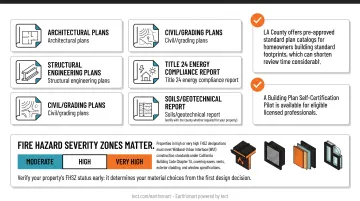
LA County offers pre-approved standard plan catalogs for homeowners building standard footprints, which can shorten review time considerably. A Building Plan Self-Certification Pilot is available for eligible licensed professionals.
Fire Hazard Severity Zones matter here. Properties in high or very high FHSZ designations must meet Wildland-Urban Interface (WUI) construction standards under California Building Code Chapter 7A , covering eaves, vents, exterior cladding, and window specifications. Verify your property's FHSZ status early — it determines your material choices from the first design decision.
Real Costs, Insurance Gaps, and Financial Planning
A Project Recovery survey reported by the LA Times estimated Eaton-area rebuild costs at approximately $570 per square foot. That figure covers structural construction only. Several major cost categories fall outside it — and they're the ones that most often blindside homeowners mid-project.
What's Not in the Per-Square-Foot Number
These cost categories are separate from the base construction estimate and frequently catch homeowners off guard:
- Landscaping — often the most underestimated line item
- Driveway and hardscape
- Windows and doors (fire-resistant glazing adds cost)
- Roofing system (Class A fire-rated or metal options)
- Exterior cladding (non-combustible materials per WUI code)
- Appliances and interior finishes
Collectively, these line items can add hundreds of thousands of dollars to a project. Knowing this upfront shapes how you approach your insurance claim, your financing, and your contractor conversations.
The Insurance Gap
This is where many Altadena families are getting hit hardest. The same Project Recovery survey found:
- 19% of Eaton-area homeowners expected insurance to cover only 0%–50% of rebuild costs
- 82% were uncertain or lacked sufficient resources to cover rebuilding expenses and additional living costs not covered by insurance
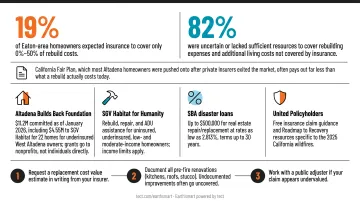
California Fair Plan — which most Altadena homeowners were pushed onto after private insurers exited the market — often pays out far less than what a rebuild actually costs today.
Financial assistance programs available:
- Altadena Builds Back Foundation — Committed $11.2M as of January 2026, including $4.55M to SGV Habitat for 22 homes for underinsured West Altadena owners (grants go to nonprofits, not individuals directly)
- SGV Habitat for Humanity — Provides rebuild, repair, and ADU assistance for uninsured, underinsured, low- and moderate-income homeowners; income limits apply
- SBA disaster loans — Up to $500,000 for real estate repair/replacement at rates as low as 2.813%, terms up to 30 years
- United Policyholders — Free insurance claim guidance and Roadmap to Recovery resources specific to the 2025 California wildfires
What to do on insurance right now:
- Request a replacement cost value estimate in writing from your insurer
- Document all pre-fire renovations (kitchens, roofs, stucco) — undocumented improvements often go uncovered
- Work with a public adjuster if your claim appears undervalued
Building Forward: Designing a More Resilient Home
Most homeowners who rebuild after wildfire build back to what they had. Altadena's position in the Wildland-Urban Interface means fire risk isn't diminishing — and rebuilding to the same standards leaves the same vulnerabilities. The rebuild is a rare chance to close those gaps permanently.
Fire resilience also increasingly determines insurance availability. The California Department of Insurance's Safer from Wildfires program recognizes home hardening actions as factors in insurance decisions. Building to WUI standards isn't just about safety; it's about staying insurable.
The Design Decisions That Matter
These choices must be made early — they affect structural framing, mechanical systems, and permit specifications:
- Class A fire-rated roofing — the first line of defense against ember intrusion
- Enclosed eaves — open eaves are one of the most common ember entry points
- Multi-pane tempered glass windows — single-pane windows fail quickly in radiant heat
- OSFM-approved ember-resistant vents — standard vents are a known vulnerability
- Non-combustible or fire-resistant exterior cladding — required in many FHSZ zones
- Defensible space integration — Zone 0 (first 5 feet), Zone 1 (lean, clean, green), extending to 100 feet where applicable
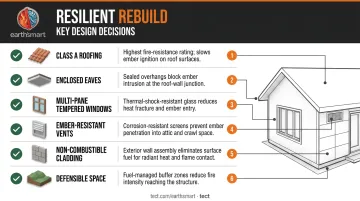
These aren't add-ons. A roofing choice affects eave design; a cladding choice affects wall assembly; an ember-resistant vent affects framing around penetrations. Sequence matters.
What Coordinated System Design Looks Like
Earth'smart powered by tect's approach to WUI rebuilds centers on what they call a "100+ year home" — not a code-minimum replacement but a home engineered across systems, envelope, and structure. Their Earth'smart™ model specifies:
- Pre-insulated concrete masonry for exterior wall systems
- Non-combustible materials throughout
- Long-life roofing systems
- On-site water supply integrated with site-scale fire suppression
What separates this from standard design-bid-build is when decisions get made. Through the earth'smart powered by tectApp™ community — 70+ building product manufacturers engaged from the concept phase — systems are specified with direct input from the companies that make them, not selected from a catalog after the design is locked. That early coordination is where fire-resistant rebuilds either hold to their promise or quietly fall short.
Frequently Asked Questions
Are people rebuilding in Altadena after the fire?
Yes. According to data from Supervisor Barger's office, more than 1,025 homes are actively under construction across the Eaton burn area, with roughly 3,000 applications filed and approximately 2,000 permits issued. That said, progress is uneven — nearly 7 in 10 severely damaged homes had shown no visible recovery progress as of October 2025.
How long does it take to rebuild a house in Altadena?
Plan for 2 to 2.5 years total: roughly 1–3 months for key decisions, 2–6 weeks for permit review (assuming a complete submission), and 12–18 months for construction. Delays at permitting or team-assembly compound quickly — early preparation is the biggest time lever you have.
How much does it cost to rebuild after the Eaton Fire in Altadena?
A Project Recovery survey estimated $570/sq ft for Eaton-area construction. That baseline excludes landscaping, driveway, fire-resistant roofing, windows, cladding, appliances, and finishes — which can push total costs well above that baseline.
What permits do I need to rebuild in Altadena?
The process runs in two phases. Phase 1 is zoning and planning approval through LA County Regional Planning (site plan only). Phase 2 requires full construction documents — architectural, structural, civil, and Title 24 energy compliance. All permits go through LA County, not the City of Los Angeles.
Does insurance cover the full cost of rebuilding in Altadena?
For most homeowners, especially those on California Fair Plan, no. Nineteen percent of Eaton-area homeowners expected insurance to cover less than half of rebuild costs. SBA disaster loans, SGV Habitat for Humanity, and the Altadena Builds Back Foundation are the primary options for bridging the gap.
What should I build differently when rebuilding after a wildfire?
Meet WUI Chapter 7A standards as a baseline, then go further. The core elements are Class A roofing, enclosed eaves, ember-resistant vents, tempered windows, and non-combustible cladding. Build defensible space into the site plan from the start — these decisions need to be made before permit submission, not after.