Introduction
Wildfires have made one thing painfully clear: homes built from combustible materials are not just at risk — they are fuel. In the 2025 Palisades Fire alone, CAL FIRE recorded 6,845 destroyed structures against just 975 damaged, meaning over 87% of affected buildings were total losses. For homeowners rebuilding or building in fire-prone areas, that data demands a different construction approach.
Non-combustible construction is that approach: a codified building classification in which structural elements are made from materials that won't ignite, burn, or contribute fuel to a fire. The category isn't uniform, though. Different types exist, different standards govern them, and the right choice depends on local codes, insurance requirements, and risk exposure.
This article covers:
- What non-combustible construction is and how it's defined
- IBC and ISO classifications that govern it
- Materials that qualify under each standard
- How to choose the right approach for a resilient home
Key Takeaways
- Non-combustible construction uses materials like steel, concrete, masonry, and mineral wool that do not ignite or contribute fuel to a fire
- IBC Type I (fire-resistive) and Type II (standard non-combustible) are the two primary code classifications
- ISO Classes 3 and 4 provide the parallel insurance framework, directly affecting premiums in fire-prone areas
- Fire-retardant-treated wood does not qualify as non-combustible — a common and costly misconception
- Choosing the right construction type requires weighing local fire risk, adopted codes, and insurance classification goals alongside material cost
What Is Non-Combustible Construction?
Non-combustible construction is a building classification in which the structural elements — framing, walls, floors, and roof — are made from materials that will not ignite, burn, or add fuel to a fire when exposed to it.
The International Building Code (IBC) organizes all buildings into five construction types (I through V) based on the combustibility and fire-resistance ratings of structural elements. Types I and II are the non-combustible categories. Types III through V permit combustible structural materials, with Type V — standard wood frame — being the most common and most fire-vulnerable.
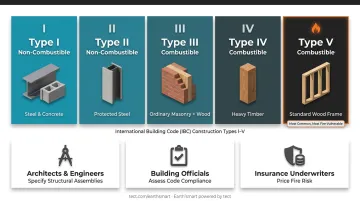
Non-combustible construction is a practical, enforceable system applied by:
- Architects and engineers specifying structural assemblies
- Building officials assessing code compliance
- Insurance underwriters pricing fire risk
Where your planned home falls within this system determines which materials are required, which ratings must be met, and what insurers will charge to cover it.
Why Non-Combustible Construction Matters for High-Risk Homes
The USDA Forest Service reports that WUI housing in the U.S. grew from 30 million to 44 million units between 1990 and 2020 — a 46% increase — with WUI areas now containing roughly a third of all homes in the contiguous United States. More people live in fire-exposed areas than ever before, and most of those homes are wood-frame construction.
The Problem with Combustible Framing
Standard wood-frame homes don't just burn — they fail structurally while burning. NIST research on single-story wood-frame structures found that roof collapse occurred approximately 17 minutes after ignition in structural fire tests. That timeline compresses evacuation windows, increases firefighter risk, and turns fires that might have been contained into total losses.
Non-combustible construction removes the structural fuel load entirely. Steel, concrete, and masonry don't ignite or contribute to fire spread — so when the structural system can't burn, the building holds up rather than accelerating the fire around it.
The WUI Rebuilding Context
For homeowners rebuilding in Wildland-Urban Interface zones — Pacific Palisades, the North Bay, the Sierra Foothills, Butte County — this isn't academic. Local codes, insurance underwriters, and resilience standards increasingly require or incentivize non-combustible approaches. In markets where coverage is being non-renewed and premiums are rising, code-minimum wood-frame construction is no longer a viable default.
That insurance and code pressure makes the design phase the critical decision point — material and system choices locked in early determine long-term performance. Earth'smart powered by tect's earth'smart powered by tectApp™ platform connects homeowners directly with 70+ vetted building product manufacturers during design, so the right non-combustible assemblies are specified correctly from the start, with manufacturer input before construction begins.
Types of Non-Combustible Construction
Non-combustible construction covers a range of approaches. The IBC defines two distinct types based on fire-resistance requirements; the ISO adds a parallel insurance classification that directly affects premiums and coverage eligibility.
IBC Type I: Fire-Resistive Construction
Type I requires all structural elements — walls, floors, columns, and roof — to be both non-combustible and formally fire-resistance rated. Per IBC Chapter 6, Type IA requires primary structural frames to carry a 3-hour rating; Type IB requires 2 hours. Floor construction carries 2-hour ratings under both subtypes; roofs carry 1.5 hours (IA) or 1 hour (IB).
The primary materials are reinforced concrete and protected (fireproofed) structural steel — steel with intumescent coatings or spray-applied fireproofing that maintains structural integrity under sustained fire exposure.
Best suited for: High-rise buildings (occupied floors above 75 feet), large commercial and institutional structures where egress time and structural integrity under fire load are paramount.
For residential applications: Direct Type I classification is uncommon in single-family homes, but the principles — rated assemblies, protected structural elements, non-combustible framing — transfer directly to resilient custom residential design. Earth'smart powered by tect's pre-insulated concrete masonry and ICF wall systems apply this same approach, engineering structural integrity under fire exposure rather than simply slowing it.
Type I is the most protective approach and the most expensive, driven by fireproofing requirements and rated assembly specifications.
IBC Type II: Standard Non-Combustible Construction
Type II uses non-combustible structural materials — typically metal framing, metal roof and floor decking, masonry walls — but does not require the fire-resistive coatings and formal hourly ratings mandated under Type I.
| Element | Type IIA | Type IIB |
|---|---|---|
| Primary structural frame | 1 hour | 0 hours |
| Bearing walls (exterior/interior) | 1 hour | 0 hours |
| Floor construction | 1 hour | 0 hours |
| Roof construction | 1 hour | 0 hours |
Type IIB, in particular, uses non-combustible materials with zero required hourly ratings. The building won't add fuel to a fire, but unprotected steel elements can lose structural integrity under sustained high temperatures. AISC data shows structural steel retains roughly 50% of its yield strength at 1,100°F — well within the range of a sustained structural fire.
For homeowners: Metal roofing, steel framing, and masonry block walls meet Type II standards and are well-suited to WUI residential construction — especially when paired with fire-suppression systems that compensate for the absence of hourly fire-resistance ratings.
ISO Class 4: Masonry Non-Combustible (Insurance Classification)
Where the IBC governs how buildings are built, the Insurance Services Office (ISO) governs how they're priced. ISO classifies buildings for underwriting purposes on a six-class scale, from Class 1 (wood frame, most combustible) to Class 6 (fire-resistive). Two classes are directly relevant to non-combustible residential construction:
| ISO Class | Name | Definition |
|---|---|---|
| 3 | Non-Combustible | Exterior walls, floors, roofs, and supports are non-combustible or slow-burning |
| 4 | Masonry Non-Combustible | Masonry exterior walls (minimum 4 inches thick) or fire-resistive construction with 1-hour rating; non-combustible floors and roofs |
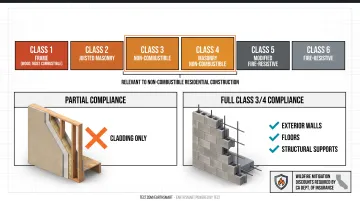
Achieving ISO Class 3 or 4 classification can materially improve insurability and pricing in high-risk markets — California's Department of Insurance requires insurers to provide wildfire mitigation discounts, and construction classification is a key factor in how risk is priced.
Critical detail: Partial non-combustible material use doesn't qualify. Per Verisk's ISO classification guidance, the exterior walls, floors, and structural supports must all meet the material definitions — not just the exterior cladding.
Non-Combustible Materials: What Qualifies
Per NFPA 220 and the IBC, a non-combustible material is one that, when tested under ASTM E136, does not ignite, burn, support combustion, or release flammable vapors at temperatures up to 1,382°F (750°C). "Limited-combustible" is a separate, less stringent category that may be permitted for specific applications under NFPA 220 but does not qualify a building for non-combustible classification.
Qualifying Materials
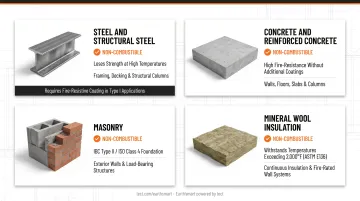
Steel and structural steel — Does not ignite or combust. Used for framing, decking, and structural columns. Loses strength at high temperatures, which is why fire-resistive coatings (intumescent paint, spray-applied fireproofing) are required in Type I applications. Non-combustible; not automatically fire-resistive without protection.
Concrete and reinforced concrete — Non-combustible and highly fire-resistant due to mass and low thermal conductivity. Provides long fire-resistance ratings without additional coatings. Used in walls, floors, slabs, and columns — and forms the structural foundation of pre-insulated CMU wall assemblies designed for WUI applications.
Masonry — Concrete block, brick, and reinforced masonry are non-combustible with strong fire and impact resistance. Foundational to IBC Type II classification and ISO Class 4 qualification. Commonly used for exterior walls and load-bearing structures.
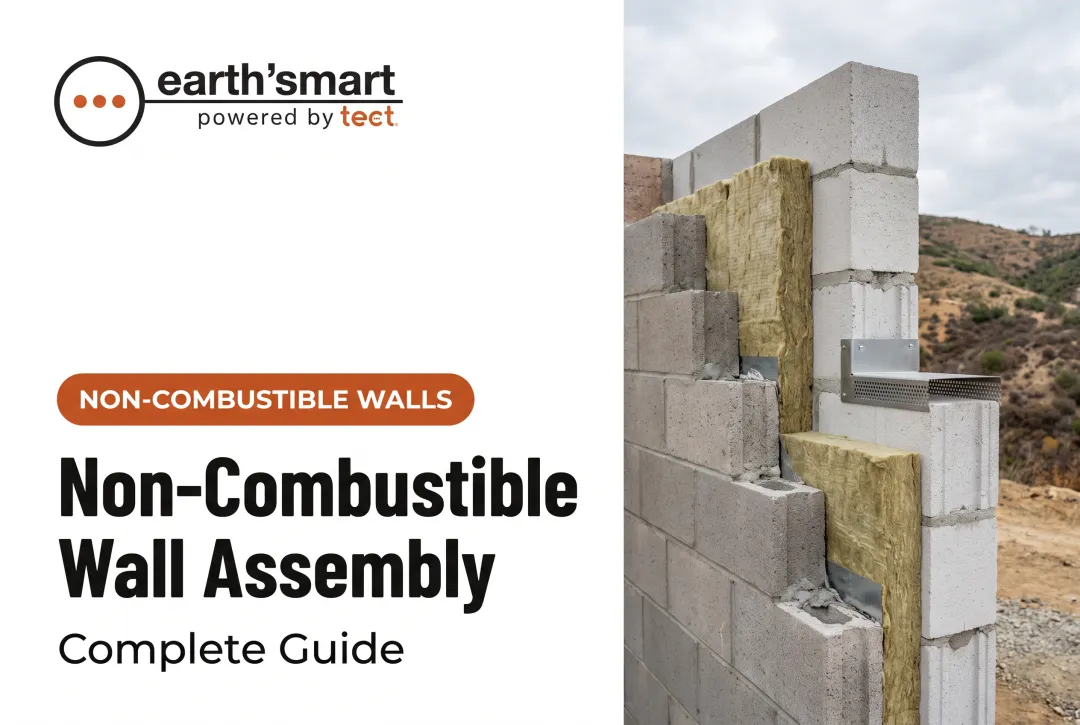
Mineral wool insulation — Stone wool and slag wool are non-combustible per ASTM E136 and withstand temperatures exceeding 2,000°F without igniting. Used in exterior continuous insulation, cavity wall assemblies, and fire-rated wall systems. A clear performance advantage over foam plastic insulation, which does not meet the non-combustible threshold.
What Does Not Qualify
Common materials that fail the non-combustible threshold include:
- Standard wood framing
- OSB sheathing
- Foam plastic (EPS, XPS, polyiso) insulation
- Combustible cladding materials
The most common misconception: Fire-retardant-treated (FRT) wood is a combustible material with delayed ignition properties. IBC Section 603 permits it in limited Type I/II applications — but it is not classified as non-combustible. The distinction matters for code compliance and insurance classification.
Standards Governing Non-Combustible Construction
Three primary bodies define non-combustible construction for U.S. buildings. Depending on whether you're pursuing code compliance, insurance classification, or both, all three may apply:
- IBC Chapter 6: The model code adopted across most U.S. jurisdictions. Defines Types I–V construction; Table 601 sets required fire-resistance ratings for each structural element. Types I and II are the non-combustible categories.
- NFPA 220: The NFPA's parallel classification standard, defining construction types based on combustibility and fire-resistance ratings. Works alongside NFPA 285 (exterior wall fire propagation) and NFPA 268 (radiant heat ignition) to govern assembly performance.
- ISO Commercial Lines Manual: The insurance industry's classification framework. Classes 1–6 rank buildings from most to least fire-resistant. Classes 3 and 4 are the non-combustible tiers most relevant to residential construction in fire-prone areas.
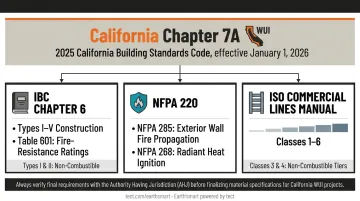
For California projects — especially in WUI Fire Areas — a fourth layer sits on top of all three. Chapter 7A of the California Building Code governs exterior materials, systems, and assemblies for new buildings in these zones. The 2025 California Building Standards Code became effective January 1, 2026.
Local jurisdictions in high-risk zones may layer additional fire ordinance requirements on top of both IBC and CBC minimums.
Always verify final requirements with the authority having jurisdiction (AHJ) before finalizing material specifications for any California WUI project.
How to Choose the Right Non-Combustible Construction Type
The right construction type follows from the building's specific conditions — not from what's most common or lowest in first cost.
Key factors to evaluate:
- Local fire hazard severity zone designation and WUI status
- The jurisdiction's adopted building code and local amendments
- ISO classification target for insurance purposes
- Whether fire-resistive ratings (Type I) or standard non-combustible (Type II) are required or sufficient
Common Mistakes to Avoid
- Selecting Type II without verifying local fire-resistance requirements — some WUI jurisdictions and insurance markets require rated assemblies beyond Type IIB's 0-hour standard
- Assuming a material is non-combustible without ASTM E136 verification — product marketing terms like "fire-resistant" or "fire-retardant" don't equal non-combustible under code
- Specifying non-combustible exterior cladding over combustible wood framing — this hybrid approach may not achieve the intended ISO classification or satisfy code requirements for the construction type
The Coordination Problem
Each of those mistakes shares a root cause: material and system decisions made in isolation. For homeowners rebuilding after wildfire or constructing in high-risk zones, non-combustible material choices affect structural systems, envelope performance, thermal performance, and long-term maintenance costs simultaneously.
A masonry exterior wall that qualifies for ISO Class 4 must also handle California seismic loads, interface correctly with a Class A roof assembly, and integrate with ember-resistant venting at penetrations.
Earth'smart powered by tect's Earth'smart™ approach — Path A Turnkey Delivery and Path B Advisory — addresses this directly by locking in material classification decisions during the early design phase. Manufacturer input from the earth'smart powered by tectApp™ community of 70+ manufacturers happens before design documentation, not during construction. That sequence is what ensures the correct classification is achieved and maintained across the full building assembly, rather than surfacing as a problem at permit review.
Conclusion
Non-combustible construction is a defined, codified system — governed by IBC Chapter 6, NFPA 220, and the ISO Commercial Lines Manual — that uses materials like steel, concrete, masonry, and mineral wool to eliminate combustible fuel from a building's structural elements. IBC Types I and II represent the two primary classifications, with ISO Classes 3 and 4 providing the parallel insurance framework.
For homeowners in fire-prone areas, understanding which type applies, which materials qualify, and which standards govern the build is foundational knowledge. A home built to the right non-combustible classification delivers outcomes that wood-frame construction simply cannot match:
- Withstands fire conditions that destroy neighboring structures
- Maintains insurability in markets where coverage is disappearing
- Lasts 100+ years without the lifecycle costs of combustible assemblies
Getting there requires more than good material selection. The decisions that determine classification, qualify materials, and align structural systems with envelope and code requirements need to be made early — well before permit drawings are submitted.
Frequently Asked Questions
What is non-combustible construction?
Non-combustible construction is a building classification in which the structural elements — walls, floors, framing, and roof — are made from materials that do not ignite, burn, or contribute fuel to a fire. IBC Types I and II both fall under this category, with Type I adding mandatory fire-resistance ratings on top of non-combustibility.
What are examples of non-combustible materials?
The primary qualifying materials are steel, reinforced concrete, masonry (brick, concrete block, reinforced masonry), and mineral wool insulation. Non-combustibility is verified through ASTM E136 testing at temperatures up to 1,382°F.
Is drywall considered non-combustible?
Standard gypsum wallboard (drywall) is typically classified as "limited-combustible" under NFPA 220 — a separate, less stringent category than non-combustible. This distinction matters when determining IBC construction type compliance.
What is the difference between non-combustible and fire-resistive construction?
Non-combustible construction uses materials that won't ignite or burn. Fire-resistive construction (IBC Type I) goes further — those materials must also carry formal hourly fire-resistance ratings. All fire-resistive construction is non-combustible, but not all non-combustible construction is fire-resistive.
Does non-combustible construction affect home insurance rates?
Yes. ISO construction classifications directly inform underwriting. Buildings rated ISO Class 3 (Non-Combustible) or Class 4 (Masonry Non-Combustible) carry lower fire risk than Class 1 wood-frame structures, which can improve insurability and premium pricing — especially in California markets subject to the Safer from Wildfires regulation.
What building codes govern non-combustible construction?
The IBC (Chapter 6) and NFPA 220 are the primary model codes. California adopts and amends these through Title 24, with Chapter 7A adding WUI-specific exterior assembly requirements. Local jurisdictions may layer additional fire ordinances on top — always confirm with the authority having jurisdiction (AHJ) before finalizing specifications.