Most homeowners know they need an architect. What they don't know is how to evaluate candidates, which service model fits their situation, or what actually happens between the first meeting and groundbreaking.
This guide covers all of it: whether you legally need an architect, how to choose between plans-only and full-service engagements, how to find and vet candidates, what to ask before you sign, and what to expect through construction.
Key Takeaways
- Most jurisdictions require a licensed architect for stamped custom home plans — meeting that bar is the minimum, not the goal
- Decide early on scope: plans-only (design and handoff) vs. full-service (architect manages the build) — your choice shapes budget, timeline, and workload
- Evaluate architects on portfolio ingenuity, communication process, and local experience — not just aesthetic style
- Bring your budget, rough square footage, site location, and a list of non-negotiables to every interview
- In fire, flood, or seismic zones, screen specifically for resilient design experience before signing anything
Do You Need an Architect to Build a Custom Home?
The short answer: probably, but it depends on where you're building.
Architect stamp requirements for residential construction vary significantly by jurisdiction. Some states require a licensed architect of record for any new single-family home. Others carve out exemptions based on square footage, construction type, or structure height. For example:
- California exempts single-family wood-frame dwellings of two stories or less under certain conditions (California Business and Professions Code §5537), but with notable limits
- New York exempts residences of 1,500 sq ft or less, with the final call resting with the local authority
- Texas lists new single-family and duplex construction as generally exempt from the Texas Architectural Act
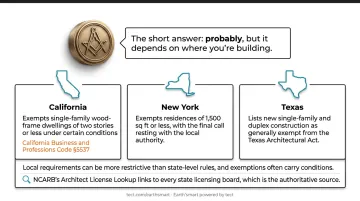
Local requirements can be more restrictive than state-level rules, and exemptions often carry conditions. Before assuming you don't need a stamp, check directly with your local building department. NCARB's Architect License Lookup links to every state licensing board, which is the authoritative source.
What Architects Do That Others Don't
An architect translates a site, a budget, and a set of priorities into buildable plans. A simple way to think about scope: flip the house upside down and shake it. Whatever falls out — tile, plumbing fixtures, built-ins, overhead lighting, cabinetry — belongs to the interior designer. Everything that stays embedded in the structure belongs to the architect.
The scope split in practice looks like this:
- Architect: structural systems, envelope design, mechanical/electrical routing, permit drawings, site integration
- Interior designer: finishes, fixtures, furnishings, lighting fixtures, cabinetry selection
In full-service engagements, the architect also coordinates the entire project team: structural engineers, MEP consultants, landscape architects, and contractors.
The design-build alternative is worth knowing about. Design-build firms house architects and builders under one roof, which shortens timelines and simplifies communication. For budget-conscious projects or faster-turnaround builds, the trade-off is less design flexibility — you move faster, but with fewer opportunities to customize the process as you go.
Plans-Only vs. Full-Service: The Decision That Shapes Everything
Most architects can operate either way. This is a homeowner-driven choice, and it's the first consequential one you'll make after deciding to hire.
Plans-Only
The architect produces a complete, stamped set of construction drawings and hands them off. After delivery, the homeowner works directly with their chosen builder. The architect may remain available for questions or change requests, but they're not a standing member of the project team during construction.
When it works well:
- You already have a strong, experienced builder relationship you trust
- You're comfortable managing construction-phase decisions yourself
- Budget is a primary constraint and you're willing to absorb more hands-on involvement
Fee structure: typically a flat fee or hourly rate.
Full-Service
The architect manages the project through construction. Under AIA's B110-2021 custom residential agreement, full-service basic services include five phases: schematic design, design development, construction documents, bidding and negotiation, and construction administration.
In practice, construction administration means:
- Weekly site visits to verify work matches documents
- Review of contractor invoices before they reach you
- Material substitution decisions when something discontinues or changes price
- Coordination with structural engineers, MEP consultants, and all trades
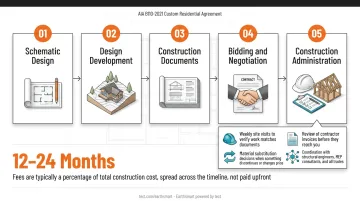
Fee structure: typically a percentage of total construction cost, though the range varies by geography, project size, and firm structure. Because these projects run 12–24 months, fees are spread across the timeline — not paid upfront.
How to Choose Between Them
The deciding factor is risk tolerance, not budget.
Custom home construction produces surprises: a material gets discontinued, a subsurface condition changes the foundation design, a cost spike forces a mid-project redesign. In full-service, the architect absorbs those pivots and coordinates the response. In plans-only, those calls land on you, in real time, with the builder waiting for an answer.
Plans-only with an experienced builder is a proven path. It does require genuine availability on your part and careful upfront investment in contractor selection — because once construction starts, the decisions don't wait.
How to Find the Right Custom Home Architect
Where to Start
The most useful referrals come from people who have seen architects at work — not just their finished photography:
- Interior designers who collaborate on full projects and can assess communication, responsiveness, and detail follow-through
- Builders who have executed architect-designed plans and know which architects produce clean, buildable documents
- Drive neighborhoods — when a house stops you in the street, it's often traceable to an architect
- AIA's chapter directory covers more than 200 chapters across the U.S.
- Houzz and Instagram surface portfolio work, but treat them as a starting point, not a vetting tool
How to Evaluate a Portfolio
Residential architecture portfolios work differently than interior design portfolios. The goal is not consistency — it's ingenuity. A strong custom home architect may have designed a craftsman in New England and a desert modernist in Arizona. Both should demonstrate a point of view that adapts to site, climate, and client rather than repeating a formula.
Ask for work beyond the website. Privacy concerns mean many completed projects never get published, but architects will often share unpublished work in a first meeting.
What to Look for Beyond the Portfolio
Practical vetting checklist:
- Verify state licensure through NCARB's lookup tool — architects are licensed by state, and out-of-state practice typically requires reciprocal licensure
- Ask about project minimums before going deeper in the conversation
- Confirm relevant local experience if your site is in a regulated area: flood zone, historic district, Wildland-Urban Interface (WUI), or steep topography
- In larger firms, identify who you'll work with day to day — not just who brings you in
One question worth asking directly: For homeowners in fire, flood, or seismic exposure zones, ask whether the architect has experience designing to current resilience standards. A home in a WUI zone or coastal flood plain requires system-level thinking across structure, envelope, and mechanical systems — visual appeal is secondary to whether the home will perform when conditions test it.
USDA Forest Service data shows WUI housing in the continental U.S. grew from 30 million to 44 million homes between 1990 and 2020. The population building in these zones has expanded — but not all architectural practices have kept pace.
Red Flags to Watch
- Quotes that come in very low without enough questions asked about scope
- Vague answers about process and timeline in early conversations
- Firms where the lead architect signs off but a junior team member runs the project — without disclosing this upfront
- Any architect unwilling to have the builder at the table during the design phase
What to Look for and Ask Before You Sign
Questions Worth Asking on the First Call
- How do you structure the design phase timeline, and how many revision rounds are included?
- Who else is on the team, and who will I speak with day to day?
- How do you handle changes that come up mid-construction?
- Have you worked on sites with [your specific constraint: flood zone, fire zone, historic district, steep topography]?
One underrated question: ask where the architect stops and the interior designer begins. Not every architect wants to handle finish selections — tile, plumbing fixtures, hardware. If yours doesn't, a qualified interior designer needs to be retained early.
In-wall rough plumbing gets ordered well before walls close — that decision needs to be locked before the interior designer ever shows up.
What to Bring to the First Meeting
Come prepared. The more context you bring, the faster the first conversation becomes productive:
- Rough construction budget
- Approximate square footage
- Site location (address or general area)
- A visual reference collection — screenshots, Pinterest boards, photos of hotels or spaces you've responded to. Architects can identify design patterns in a visual collection faster than most clients can describe their style verbally
- Your five non-negotiables — the things that are genuinely not optional: a home office, accessibility features, an outdoor living priority, specific structural requirements
What to Look for in the Contract
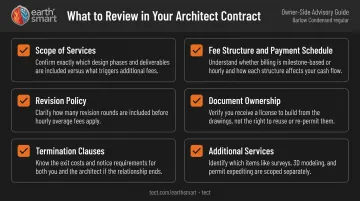
Before you sign, read these sections carefully — not just skim them:
- Scope of services: Confirm exactly what's included and what gets billed as an add-on. Ambiguity here is where cost surprises originate.
- Fee structure and payment schedule: Milestone-based billing versus hourly arrangements affect your cash flow across a multi-year project — know which applies.
- Revision policy: How many rounds are included, and what triggers additional fees?
- Document ownership: Under standard AIA agreements, architects retain copyright on their instruments of service. You receive a non-exclusive license to build the specific project — not to reuse the drawings elsewhere.
- Termination clauses: Understand what you owe if you need to exit the relationship early, and under what conditions either party can walk.
- Additional services: Site surveys, 3D modeling, structural coordination, and permit expediting are frequently billed separately unless explicitly written into scope.
What Happens After You Hire: Design Through Construction
Feasibility and Site Analysis
Before any design work begins, a competent architect evaluates what the site actually permits:
- Zoning setbacks and allowable building envelope
- Flood plain or fire hazard overlays (FEMA requires permits for any construction in a Special Flood Hazard Area)
- Septic capacity, which is directly tied to bedroom count
- Foundation requirements based on soil and topography
- Special review processes: historic boards, HOA architectural committees, WUI compliance reviews
Skipping or rushing this phase is a reliable way to trigger a mid-project redesign. The design you fall in love with in schematic design needs to be buildable on the actual site under actual regulatory constraints.
Design Development and Engineering
AIA identifies five basic service phases:
- Schematic design — rough layouts, exterior massing, site positioning
- Design development — materials, architectural elements, window and door placement
- Construction documents — the full permit-ready set
- Bidding and negotiation — contractor selection support
- Construction administration — ongoing project oversight
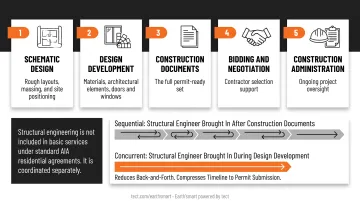
Structural engineering is not included in basic services under standard AIA residential agreements — it's coordinated separately. The timing matters: when structural engineers are brought in concurrently during design development rather than sequentially after construction documents are drafted, it reduces back-and-forth and compresses the timeline to permit submission.
The Architect's Role During Construction
How involved your architect stays after permit approval depends on which service model you've agreed to.
Full-service means weekly site visits, invoice review, material substitution decisions, and coordination with all trades. The architect is your representative on the job site.
Plans-only means the architect's primary work is complete, but they can be re-engaged for structural surprises, specification changes, or selections that come up mid-build.
Things will change during construction. Materials discontinue. Costs shift. Surprises emerge once ground is broken. Having an architect available — even in a plans-only model — gives you backup when the builder hits an interpretation question that doesn't have a clean answer in the drawings.
How earth'smart powered by tect Approaches Custom Home Architecture
For homeowners building or rebuilding in high-risk areas — particularly in California's WUI communities — the standard architectural engagement often leaves a critical gap: the home gets designed, but not necessarily engineered to perform under the conditions that define risk in those zones.
Earth'smart powered by tect, led by Bob Habian, AIA, is structured specifically to close that gap. The practice operates through two paths under the Earth'smart™ program:
- Path A: Turnkey Delivery — a fully aligned team from concept through construction, including architecture, engineering, construction management, manufacturer input, and permit strategy. One coordinated team making early decisions correctly.
- Path B: Advisory — earth'smart powered by tect works alongside a homeowner's existing architect, engineer, and contractor team, providing early system guidance, critical decision support, and coordination with the manufacturers behind the home's materials and systems.
What differentiates earth'smart powered by tect's model is the earth'smart powered by tectApp™ community: 70+ vetted building product manufacturers whose materials and systems will actually be in the home. Product and system decisions get made early, when they're easiest to integrate — not revised under cost pressure during construction. That's the level of coordination most custom home projects never see.
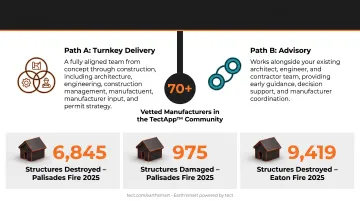
For a homeowner in Pacific Palisades or any other WUI community, this matters practically. The 2025 Palisades Fire destroyed 6,845 structures and damaged 975 more. The Eaton Fire, burning at the same time, destroyed 9,419 structures. Homes in these communities aren't just an aesthetic statement — they're an asset that needs to perform against real risk.
Earth'smart powered by tect's approach addresses fire-resistive assemblies, non-combustible materials, integrated on-site fire suppression, and coordinated system performance. The result: lower insurance risk, reduced lifecycle costs, and a home built to last 100+ years — not just to code minimum.
Frequently Asked Questions
How much does it cost for an architect to design a house?
Fees vary by scope and service model. Full-service engagements are often structured as a percentage of construction cost, while plans-only work is typically a flat fee or hourly rate. The right measure isn't the cheapest quote — it's what's included in the scope and the architect's track record on comparable projects.
Do you need an architect to build a custom home?
Most jurisdictions require a licensed architect of record to produce stamped plans for new residential construction, though exemptions exist based on size, construction type, and location. Beyond the legal requirement, an architect is best positioned to translate site constraints and homeowner priorities into a buildable design. Confirm the specific rule with your local building department.
Should I hire an architect or a builder first?
Both approaches work. Starting with a builder helps establish budget clarity — builders know what things cost per square foot in your specific market. Starting with an architect makes sense when design vision is driving the project. Design-build firms compress this decision by housing both disciplines under one roof.
What's the difference between plans-only and full-service architecture?
Plans-only ends when stamped drawings are delivered. Full-service means the architect stays through construction, handling site visits, invoice reviews, and mid-build decisions. The right choice depends on how much construction-phase oversight the homeowner wants to carry directly.
How long does it take for an architect to design a custom home?
Design development through permit-ready documentation typically takes several months, with municipal permit review adding time on top. Integrating the structural engineer during design development rather than after can noticeably shorten the path to permit submission. Ask your local building department for current review timelines.
What should I bring to my first meeting with an architect?
Bring a rough budget, approximate square footage, site location, a list of your top priorities or non-negotiables, and a visual reference collection — images, saved posts, or a mood board. Architects can identify design patterns in a visual collection faster than most clients can describe their style in words. The more specific your inputs, the more useful the first conversation.