Vetting for a luxury build isn't a portfolio review. It requires evaluating process discipline, technical depth, coordination systems, and resilience expertise before a single contract is signed.
This guide covers: distinct criteria for vetting architects versus contractors, the right questions to ask each, and the red flags that should stop a conversation entirely.
Key Takeaways
- Verify all licenses and insurance independently — never rely on self-reported claims
- Vet architects for resilient design knowledge and construction-phase involvement, not just aesthetics
- Vet contractors for subcontractor quality, budget transparency, and written change order processes
- Ask for artifacts — sample budgets, redacted contracts, references — not assurances
- In high-risk areas, technical alignment between architect, contractor, and manufacturers from day one determines whether critical systems are built correctly
How to Vet an Architect for a Luxury Home Build
In luxury home construction, the architect shapes structural decisions, material specifications, system integration, and code compliance from first concept through construction. You're not vetting a stylist — you're vetting a technical lead.
Credentials and Licensure
A licensed architect (RA or AIA designation) is the floor, not the finish line.
- Verify the license number directly through the California Architects Board license search — don't rely on a business card or website
- Request a pocket license and photo ID to confirm the individual matches the record
- Check for any disciplinary history or advertising complaints
Why this matters: CAB's 2024 background paper reports an average of 308 complaints per year since FY 2018–19, including 81 unlicensed activity complaints annually. Many come from homeowners who trusted referral websites where unlicensed individuals identify themselves as architects.
Note: AIA membership and RA licensure are distinct. AIA letters indicate membership, not licensure — CAB verification is the only reliable check.
Resilient and Performance-Focused Design Experience
This is where most homeowners under-vet. A strong portfolio of interior finishes tells you nothing about wall assembly performance, building envelope water management, or code-compliant construction in a wildfire or seismic hazard zone.
Ask directly: "What fire-resistant or resilient design strategies have you implemented, and can you show examples?"
For California WUI and fire-hazard severity zones, a qualified architect should be able to speak specifically to:
- Chapter 7A materials and construction methods for exterior wildfire exposure (2025 CBC)
- Ember-resistant venting meeting ASTM E2886 or noncombustible mesh with openings no larger than 1/8 inch
- Class A roofing tested to ASTM E108 or UL 790
- Noncombustible exterior wall assemblies — masonry, stucco, fiber cement, or ICF
- 0–5 ft noncombustible zone requirements per IBHS Wildfire Prepared Home standards
- Defensible space integration and site-scale vegetation management
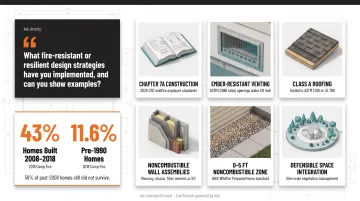
Data from the 2018 Camp Fire is instructive: homes built 2008–2018 had 43% survival rates versus 11.6% for pre-1990 homes — but 56% of post-2008 homes still did not survive. Code compliance is necessary; it isn't sufficient on its own.
System Integration Thinking
Luxury homes involve complex interactions between structural systems, mechanical/electrical/plumbing systems, and the building envelope. A competent architect coordinates these relationships during the design phase — not after drawings are complete.
Ask: "Do you conduct integrated design reviews with engineers and contractors before construction documents are finalized?"
Late-stage coordination failures are a primary driver of cost overruns in high-performance builds. An architect who designs in isolation introduces rework, delays, and compounding risk. A strong answer to this question includes:
- Specific integrated review sessions scheduled before construction documents are finalized
- Documented decisions with input from structural, MEP, and envelope engineers
- Early contractor involvement on constructability and sequencing
Construction Administration Involvement
Many architects deliver drawings and step away. In a luxury build, that's a problem.
Active construction administration — site visits, RFI responses, submittal reviews — is how the built home gets confirmed against design intent. Ask specifically:
- What construction-phase services are included in your contract?
- How frequently do you visit the site during framing, envelope, and finish stages?
- How do you handle a field condition that differs from what the drawings show?
AIA Document B101 defines the architect's services; A201 covers construction administration protocols. If a candidate can't explain what those documents govern, that's a red flag worth probing — it suggests limited experience with formal project delivery.
References from Comparable Projects
Construction administration competency is hard to evaluate on paper alone — references are where it gets confirmed. References should match your project's complexity and risk profile.
Ask each reference:
- Did the architect remain actively involved through construction?
- Were design details ever changed in the field without notification?
- How did they respond when problems arose?
A referral from a satisfied client on a low-complexity project doesn't tell you how this architect performs when a WUI permitting issue or a structural conflict shows up mid-build.
How to Vet a Contractor for a Luxury Home Build
A contractor controls quality, schedule, and budget execution. In a luxury build, that means evaluating the systems behind how they run a job — not just photos of past work.
License, Insurance, and Bonding Verification
These are non-negotiable. California's Contractors State License Board (CSLB) handled 20,092 contractor complaints in 2024 and paid out $64.1 million in consumer restitution in FY 2023–24.
Verify independently through the CSLB Check a License tool:
- Active general contractor license — confirm status, not just existence
- Workers' compensation coverage (failure to maintain can suspend the license)
- General liability insurance — LLC licensees require at least $1M for five or fewer listed personnel
- Contractor license bond ($25,000 minimum effective January 2023)
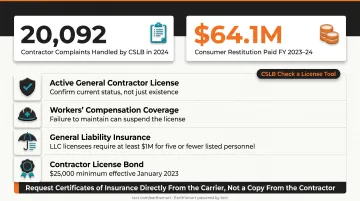
Request certificates of insurance directly from the carrier — not a copy from the contractor.
Subcontractor Network Quality
The final quality of a luxury build is driven by the subs a GC uses. A stable, vetted sub network — with documented relationships and quality standards — produces consistent outcomes. A contractor who rebids every trade on every project doesn't have one.
Ask directly:
"Who are your regular trade partners for framing, MEP, and finish work? How long have you worked with them?"
Under California law, homeowners have the right to request a full list of subcontractors involved in their project.
Budget Transparency and Allowance Realism
Allowances are one of the most common sources of budget drift on luxury builds. A contractor who sets artificially low placeholder allowances to win a bid will recover the difference during construction.
To catch this before it costs you, verify the numbers before signing anything:
- Request a sample redacted budget from a comparable project
- Confirm allowances reflect the actual finish standard you intend to pursue
- Ask how the contractor distinguishes between a fixed-price line item and an allowance
California home improvement contracts over $500 must be in writing, with down payments capped at 10% of the contract price or $1,000 — whichever is less.
Change Order Documentation and Process
Every scope or cost change should be handled through a written change order signed before work begins. CSLB is explicit: if the contract price or scope changes, it must be documented in writing and signed by both parties before the changed work starts.
Ask the contractor to walk through their change order process and provide a sample. AIA Document G701 is the standard form.
Red flag: any answer suggesting work proceeds before written approval.
Schedule Discipline and Accountability Systems
A credible luxury contractor maintains a detailed, living construction schedule — not a Gantt chart produced at kickoff and never revisited. Ask:
- How often is the schedule updated?
- Who owns it?
- How are long-lead procurement items and permit inspection windows built in?
- How are owner decision delays tracked and accounted for?
The schedule is a management tool. If a contractor can't describe how they use it, expect the same absence of discipline on your job site.
Red Flags That Should End the Conversation
Vague Process Answers
Any architect or contractor who cannot clearly explain how they document decisions, manage scope changes, coordinate with other disciplines, or handle surprises is telling you something important. Reassurance without documented systems is a disqualifying answer, not a reason to proceed with caution.
The Low-Bid Problem
A bid that comes in significantly below comparable proposals is rarely good news. The most common explanations:
- Something is excluded from scope entirely
- Allowances are underspecified, leaving cost exposure for later
- The contractor plans to recover margin through change orders
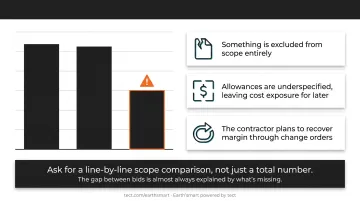
Ask for a line-by-line scope comparison, not just a total number. The gap between bids is almost always explained by what's missing.
Reluctance to Share Verifiable Credentials
Any professional who resists providing their license number, insurance certificate, or client references for independent verification should be disqualified — regardless of portfolio quality or reputation claims. Credential transparency is the minimum bar for any legitimate professional. Resistance here isn't a quirk — it's a pattern.
How earth'smart powered by tect Can Help
Earth'smart powered by tect, led by licensed architect Bob Habian, AIA, was built specifically to address the coordination and expertise gaps that cause luxury home builds — particularly in fire-prone areas like Pacific Palisades — to fail to perform over time.
Through Earth'smart™ Path A Turnkey Delivery, earth'smart powered by tect provides one fully aligned team from concept through construction: architecture, engineering, construction, permit strategy, and manufacturer input coordinated from the earliest design stage. This is the level of integration typically reserved for sophisticated commercial projects: structural, systems, and envelope decisions made correctly and without friction, before they become expensive to fix.
For homeowners who already have an architect or contractor in place, Earth'smart™ Path B Advisory functions as an owner-side strategic advisor — providing early system guidance, design integrity review, and direct manufacturer coordination layered on top of an existing team.
Both paths are powered by the earth'smart powered by tectApp™ community of 70+ vetted building product manufacturers, including FIREBOZZ® water cannons and SMARTVALVE® water conservation systems. That means the right expertise is built into your project before design decisions are locked — not sourced late, not disconnected from intent, and not left to chance. Your fire suppression, wall assemblies, roofing, and mechanical systems are integrated by the people who built them.
Reach Bob Habian directly at (310) 913-5000 or bob@tect.com.
Conclusion
Vetting architects and contractors for a luxury home build is not a one-time checklist. It's a process of evaluating accountability, technical depth, and coordination discipline before you sign anything.
The right team earns the job by showing you how they work, how they communicate, and how they've handled the complexity that comes with every project of this scope — not by having the most impressive portfolio shots.
Frequently Asked Questions
What not to tell your contractor?
Avoid volunteering your maximum budget, expressing urgency that could reduce negotiating leverage, or making verbal agreements outside of written contracts. Each of these shifts control away from the homeowner during a complex build where scope and cost are constantly in motion.
How do I verify a contractor's license for a luxury home project?
Use the CSLB's online Check a License tool at cslb.ca.gov, searchable by company name and license number. Confirm active status and check for any disciplinary actions or suspensions before inviting a contractor to bid.
Should I hire an architect and contractor separately or use a design-build firm?
Separate hiring gives more control over each selection but places all coordination on the homeowner. A design-build or integrated model consolidates accountability under one contract, reducing scope gaps and miscommunication — an important advantage on complex or high-risk builds.
What questions should I ask an architect about high-risk area experience?
Ask about WUI construction standards, fire-resistant wall assemblies, Chapter 7A compliance, and local hazard-zone permitting experience. Confirm that resilient design priorities are built into drawings from the concept phase, not retrofitted at permit submission.
How do I evaluate a contractor's subcontractor network?
Ask for the names of primary trade partners in framing, electrical, plumbing, and finish work, how long those relationships have been active, and whether those subs carry their own licenses and insurance. Stable, long-term sub relationships are a reliable signal of consistent project quality.
What does construction administration mean, and why does it matter?
Construction administration refers to the architect's continued involvement during the build — reviewing submittals, responding to contractor questions (RFIs), and conducting site visits to confirm work matches design intent. Without it, field deviations from the approved drawings often go uncorrected until they surface as a code issue or costly rework.