Introduction
Homeowners rebuilding in Pacific Palisades or anywhere along California's Wildland-Urban Interface face a choice that goes beyond aesthetics: what material do you trust to stand between your home and the next fire or earthquake?
AAC blocks come up frequently in these conversations — and for good reason. The real questions are narrower: specific fire ratings, real weight reductions, and thermal performance that compounds over decades.
What follows is a direct look at what AAC blocks genuinely deliver across fire resistance, structural performance, and long-term cost. The material choice made before the first wall goes up shapes everything that follows.
Key Takeaways
- AAC blocks are precast units made from cement, lime, sand, gypsum, water, and aluminum powder — cured under high pressure and steam until roughly 60–85% of the block is air by volume
- AERCON 6-inch Standard Blocks carry a verified 4-hour fire resistance rating under ICC-ES evaluation, compared to 1–2 hours for typical wood-frame assemblies
- Weighs approximately 50% less than standard CMU blocks, directly reducing seismic load demand and foundation costs
- Thermal conductivity of 0.08–0.16 W/m·K — significantly lower than hollow concrete block or conventional brick, cutting thermal transfer at the wall
- Early specification in the building system unlocks the full performance stack — fire, thermal, seismic, and acoustic benefits compound when integrated from concept forward
What Are AAC Blocks?
AAC stands for Autoclaved Aerated Concrete. The European AAC Association describes the manufacturing process clearly: cement, lime, fine sand or other siliceous materials, gypsum, water, and a small amount of aluminum powder are combined and then cured in an autoclave — a pressurized steam chamber operating at roughly 190°C and 800–1,200 kPa for 6 to 12 hours.
The aluminum powder reacts with the alkaline mixture to produce hydrogen bubbles. Those bubbles create the cellular structure that makes up 60–85% of the block's total volume. The result is a block that is genuinely lightweight yet structurally solid — not a compromise between the two.
Where AAC Is Used
AAC blocks are appropriate for:
- Exterior and interior non-load-bearing walls — the most common application
- Partition walls in residential construction
- Floor and roof panel systems in some configurations (product-specific, requires engineering review)
AAC is not a replacement for structural load-bearing elements in high-seismic zones without specific engineering and product approval. In California, code compliance requirements for structural wall systems are product-specific — confirm approval before specifying.
What makes AAC worth specifying is its range across multiple performance categories — fire exposure, thermal resistance, sound attenuation, and moisture management — delivered without the weight penalties or long-term maintenance demands that come with conventional masonry.
Key Advantages of AAC Blocks in Modern Construction
The advantages below focus on measurable outcomes backed by third-party evaluation reports, engineering research, and verified manufacturer data. They are most impactful when AAC is selected early, specified correctly, and integrated with the rest of the building system — not substituted in late.
Fire Resistance and Safety Performance
AAC blocks are non-combustible. Their mineral composition contains no organic material that can ignite, off-gas, or structurally degrade under direct fire exposure. The porous mineral structure resists heat transfer, and the block itself does not contribute to flame spread — which makes it fundamentally different from wood-framed construction in a wildfire scenario.
What the ratings actually show:
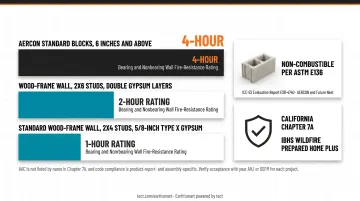
According to ICC-ES Evaluation Report ESR-4740, AERCON Standard Blocks at 6 inches and above carry 4-hour bearing and nonbearing wall fire-resistance ratings. Both AERCON and Future Nest products are classified as noncombustible under ASTM E136 testing.
For comparison:
- Standard wood-frame wall with 2x4 studs and 5/8-inch Type X gypsum: 1-hour rating
- Wood-frame wall with 2x6 studs and double gypsum layers: 2-hour rating
A 4-hour rating for an AAC assembly versus 1–2 hours for typical wood construction is not a marginal difference — it's the difference between a wall that fails in the first hour and one that holds through a sustained fire event.
The WUI connection:
California's Chapter 7A applies to new buildings in designated WUI Fire Areas. Compliant exterior wall coverings can include noncombustible materials — which is the route AAC takes via its ASTM E136 noncombustibility classification. The IBHS Wildfire Prepared Home Plus standard also requires all exterior wall covering to be noncombustible.
One practical consequence: non-combustible wall assemblies affect how insurers classify a home's risk. Earth'smart powered by tect's Earth'smart projects are structured specifically to produce insurance-aligned documentation packages — fire-resistive assembly specifications, Chapter 7A compliance records, and IBHS alignment documentation — that brokers and underwriters can use to support coverage decisions in markets where standard construction is being non-renewed.
Note: AAC is not listed by name in Chapter 7A, and code compliance is product-report- and assembly-specific. Verify acceptance with your AHJ or OSFM for each project.
Seismic and Structural Performance
Seismic engineering follows a direct relationship: lighter buildings experience lower forces during an earthquake. The base shear formula V = CsW includes the building's effective seismic weight (W), which accounts for dead load. Reduce the wall mass, and you reduce the seismic demand the structure must resist.
AAC's density tells the story:
| Material | Approximate Density |
|---|---|
| AERCON AAC (AC-4) | 31 pcf |
| AERCON AAC (AC-6) | 40 pcf |
| Standard CMU (normal weight) | 125 pcf+ |
| Face brick | 120–130 pcf |
AERCON states its blocks are approximately 50% lighter than standard CMU blocks. That weight reduction flows through the entire structural system — lower wall mass means lower seismic force demand, which affects foundation sizing, shear wall design, and connection requirements.
For multi-story builds, the cumulative dead load reduction is especially significant. Each floor multiplies the weight differential — and the foundation bears the cumulative total.
California seismic caveat: AERCON's ICC-ES evaluation (ESR-4740) carries restrictions that matter in California:
- Evaluated AAC masonry wall system is limited to Seismic Design Categories A or B
- Non-load-bearing envelope and structural seismic-force-resisting applications are distinct design problems
- Each requires separate engineering analysis and product-specific approval
Earth'smart powered by tect's Earth'smart Path A engineering coordination addresses this directly. Structural engineers working within the coordinated team evaluate seismic requirements project-specifically, so AAC is specified in the correct application for the site's seismic zone — rather than assumed to be approved for uses it hasn't been evaluated for.
Thermal Efficiency and Long-Term Cost Performance
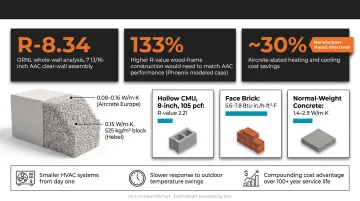
AAC's thermal performance comes from its cellular structure. Millions of closed air pockets slow heat transfer in a way that solid masonry cannot replicate. Aircrete Europe reports AAC thermal conductivity of 0.08–0.16 W/m·K; Hebel's technical data for a 525 kg/m³ block shows 0.15 W/m·K.
For comparison:
- Hollow CMU (8-inch, 105 pcf): R-value of 2.21
- Face brick: thermal conductivity of 5.6–7.8 Btu-in./h-ft²-F
- Normal-weight concrete: 1.4–2.9 W/m·K
An ORNL whole-wall analysis found that a 7 13/16-inch AAC clear-wall assembly achieved an R-value of 8.34, and a Phoenix modeled case showed conventional wood-frame construction would need an R-value 133% higher than AAC to achieve equivalent energy performance — largely because of AAC's thermal mass effect on temperature buffering.
What this means in practice:
- HVAC systems in AAC-walled buildings can be sized smaller because the envelope is doing more of the thermal work
- Interiors respond more slowly to outdoor temperature swings — reducing peak load demand
- Lower mechanical load from day one means reduced operating cost every year of the building's life
Aircrete states AAC can produce approximately 30% savings on heating and cooling costs — that figure is manufacturer-stated and should be treated as directional, not a guaranteed outcome.
What is well-supported is the underlying mechanism: lower thermal conductivity combined with thermal mass reduces HVAC demand year-round. Over a 100+ year service life, that reduction in mechanical load represents a meaningful and compounding cost advantage.
What Happens When the Wrong Materials Are Used
Material choices made under time pressure or driven by lowest upfront cost tend to reveal their consequences years after construction — not on the day of installation.
Common failure patterns in high-risk areas:
- Low fire-rated wall assemblies increase vulnerability in WUI zones and can affect insurability or Chapter 7A compliance, issues that don't surface until a fire event or an insurance renewal conversation
- Heavy conventional masonry increases structural dead load, raising foundation costs and seismic force demand (costs that compound floor-by-floor in multi-story builds)
- Poor thermal performance means HVAC systems are oversized from day one — a recurring operating cost that runs for the life of the building
- Inconsistent material behavior — moisture absorption, thermal bridging, pest infiltration — adds maintenance cycles that erode the value of the initial investment over time
Every one of these failures shares the same root cause: a material decision that optimized for day-one cost while ignoring decade-one performance. The window to avoid them closes when the structural and mechanical systems get locked in — which is exactly why material selection belongs at the front of the project, not the back.
How to Get the Most Value from AAC Blocks
AAC blocks perform best as part of a coordinated system. Selecting the right block and then installing it incorrectly — or specifying it after structural decisions have already been made — produces a different outcome than integrating it from the start.
What correct application looks like:
- Specify the right block type and density for each application — standard, high-density, or fire-resistant variants — based on the wall's structural role, required fire rating, and thermal performance target
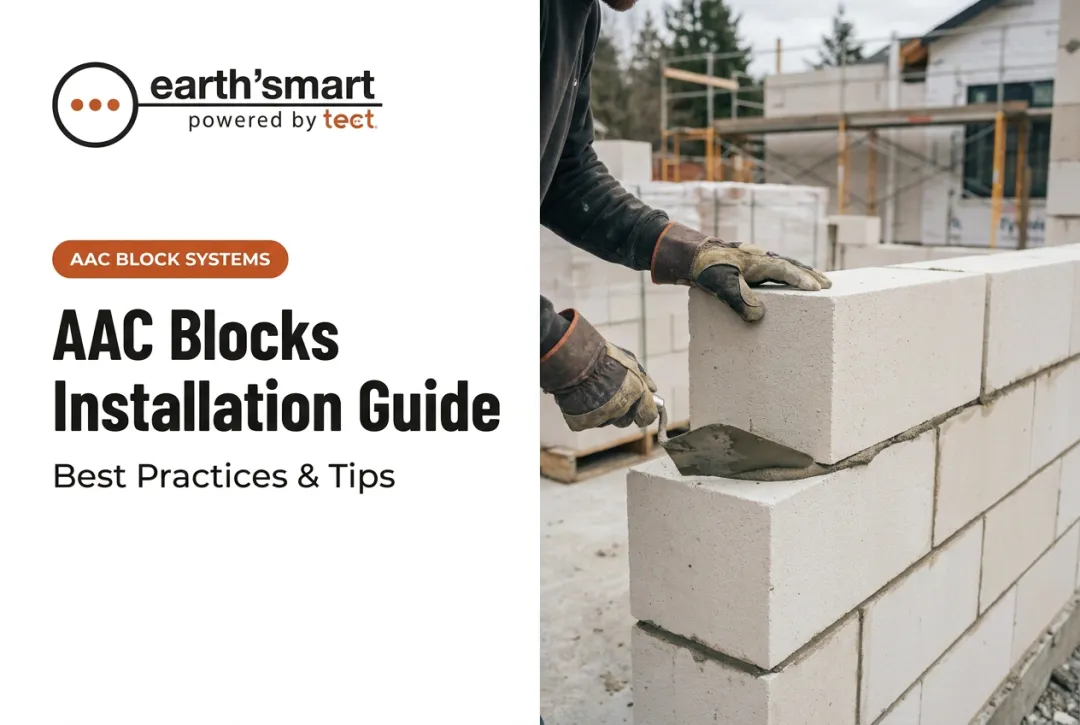
- Use compatible thin-bed mortar and proper adhesives to ensure joints are tight and consistent — improper mortar application is one of the primary causes of premature cracking and moisture issues in AAC installations
- Integrate material selection into the full building envelope design early: before structural shear wall layouts, foundation sizing, and mechanical system specifications are finalized
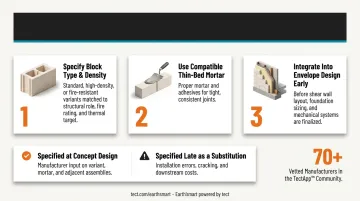
This is where the timing of the decision matters most. AAC specified at concept design, with manufacturer input on block variant selection, mortar compatibility, and integration with adjacent assemblies, performs differently than the same material specified late as a substitution.
Earth'smart powered by tect's Earth'smart delivery model (both Path A Turnkey and Path B Advisory) is structured to close that gap. Through the earth'smart powered by tectApp™ community of 70+ vetted building product manufacturers, AAC suppliers and non-combustible wall system manufacturers are engaged during concept design, not during construction.
Manufacturer technical representatives contribute specifications for block variants, density selection, and application-specific performance requirements as part of the coordinated design process. That coordination — architecture, engineering, construction, and manufacturer input working from the same decisions — is what prevents late substitutions, installation errors, and the downstream costs they create.
Conclusion
AAC blocks offer three performance advantages directly relevant to homeowners building or rebuilding in California's high-risk areas: non-combustible fire resistance rated at 4 hours for 6-inch and larger AERCON blocks, structural dead load reduction that decreases seismic demand across the entire building, and low thermal conductivity that reduces HVAC load over the lifetime of the structure.
Each of these advantages depends on correct execution. A block specified and installed within a coordinated wall assembly performs differently than one substituted in late or installed with incompatible mortar. The manufacturers and engineers who understand where it fits in the full system need to be involved before construction begins — not called in after problems appear.
A 100+ year home in a fire zone or seismic zone is the product of deliberate, coordinated decisions made early. The right material, in the right assembly, with the right team — that's what turns performance specifications into a home that actually performs.
Frequently Asked Questions
Why use AAC blocks?
AAC blocks combine non-combustibility, low structural weight, and strong thermal insulation — properties most conventional wall materials cannot deliver together. That combination makes them well-suited for fire-prone, seismically active, or climate-extreme environments.
What is the lifespan of an AAC block?
The European AAC Association cites a 150-year reference service life for AAC. The material is inorganic and does not rot, corrode, or harbour pests the way organic building materials do — a meaningful advantage for homes designed to outlast their first owners.
Which is better, AAC blocks or hollow blocks?
AAC outperforms hollow concrete block on thermal insulation (0.08–0.16 W/m·K vs. R-2.21 for an 8-inch hollow CMU) and fire resistance ratings. Hollow blocks may be preferred in purely structural load-bearing applications where higher compressive strength is required and thermal performance is less critical.
Are AAC blocks fire resistant enough for wildfire-prone areas?
AERCON 6-inch Standard Blocks carry a 4-hour fire-resistance rating under ICC-ES evaluation and are classified as noncombustible under ASTM E136. This makes them a strong candidate for WUI construction, though project-specific code compliance should be verified with the authority having jurisdiction.
Can AAC blocks be used in earthquake-prone regions?
AAC's low density reduces the seismic mass a structure must carry, decreasing lateral force demand during ground movement. For non-load-bearing envelope applications, this is a genuine structural advantage. Structural use in high-seismic California requires product-specific engineering review and evaluation report confirmation.
Do AAC blocks cost more than traditional materials upfront?
AAC typically carries a higher per-unit cost than conventional brick or hollow block. Savings in foundation sizing, faster installation, reduced mortar use, and lower long-term energy and maintenance costs frequently offset that premium over a building's lifetime, particularly for homes built to a 100-year performance standard.