Introduction
Building a custom home involves hundreds of decisions that compound on each other — structure, envelope, mechanical systems, finishes — and the sequence in which those decisions get made determines whether you end up with a home that performs for 20 years or one built for 100+.
Most homeowners don't realize the biggest risk isn't the budget or the build timeline. It's the coordination gap between design, construction, and material suppliers. Architects make decisions that contractors quietly modify. Material specs get swapped on-site without notice. By the time quality failures surface, you've moved in — and fixes are expensive and disruptive.
This guide is for homeowners planning a new custom build or rebuilding after loss — particularly in high-risk WUI and fire-prone areas like Pacific Palisades — who want a fully finished, move-in-ready home without the fragmentation of managing separate architects, contractors, and suppliers.
This guide covers:
- What a turnkey custom home is and what it isn't
- Why integrated delivery produces better quality outcomes
- How the process works from site assessment to handover
- What separates genuine turnkey builds from ones that use the label without the substance
Key Takeaways
- A turnkey custom home is delivered by one integrated team — architecture, engineering, construction, and manufacturer input — from concept through a move-in-ready handover
- Quality is determined by early coordination, not finishing choices — systems specified late or in isolation cause most performance failures
- The biggest risk in any custom build is the coordination gap between design, construction, and suppliers
- In WUI and fire-prone zones, performance-specified systems and resilient materials are not optional — they're fundamental to a home that survives
- Evaluate the team's process, not just their portfolio — shared accountability across every phase is what genuine integration looks like
What Is a Turnkey Custom Home?
A turnkey custom home is one where a single integrated team manages the entire project — from initial concept through construction — and hands the homeowner a completed, move-in-ready property. The name is literal: you turn the key and move in. No further coordination required.
This is different from two common alternatives:
| Model | Who designs | Who builds | Homeowner's role |
|---|---|---|---|
| Spec home | Builder (builder's plans) | Builder | None — buy as-is |
| Traditional custom | Separate architect | Separate contractor | Manages coordination between all parties |
| Turnkey custom | Integrated team | Same integrated team | Directs the vision; team executes everything |
The "custom" in a turnkey custom home doesn't just mean paint colors and tile selections. It means structural systems, building envelope performance, and material specifications are all tailored to the homeowner's specific site, environment, and long-term goals — including risk exposure.
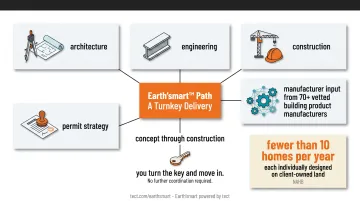
NAHB notes that custom builders typically build fewer than 10 homes per year, each individually designed on client-owned land. A quality turnkey model goes further: it integrates the design team, construction team, and manufacturer input under one accountable structure, rather than leaving the homeowner to manage handoffs between separate parties.
Earth'smart powered by tect's Earth'smart™ Path A Turnkey Delivery is built on this model. One coordinated team covers architecture, engineering, construction, manufacturer input from 70+ vetted building product manufacturers, and permit strategy, all aligned from concept through construction.
Why the Turnkey Approach Produces Better Quality Custom Homes
The Coordination Gap Problem
In a traditional fragmented build, the architect designs, the contractor prices, and suppliers deliver. But no single party owns the outcome end to end.
The result is predictable:
- Design decisions get modified in construction because the contractor wasn't in the room when specs were written
- Material substitutions happen on-site, made by whoever is available that week
- When performance failures surface after handover, blame-shifting between architect, contractor, and supplier becomes the homeowner's problem to resolve
Earth'smart powered by tect describes this pattern directly: most homes are delivered through a fragmented process where late decisions, disconnected teams, limited product insight, and minimum-code thinking produce homes that look complete but underperform where it matters most.
Research from the Charles Pankow Foundation found that integrated design-build delivery outperformed traditional design-bid-build with 36% faster construction and 3.8% less cost growth — though that data covers general construction, not single-family residential specifically. The core mechanism is the same: remove the sequential handoffs between separate design and construction parties, and you remove the gaps where quality slips.
How Integrated Delivery Closes the Gap
When design and construction operate under one accountable team:
- Plans are buildable by definition, because the construction team helped write them
- Budgets reflect real costs from the start, not post-design repricing surprises
- System choices are made with full knowledge of how they'll be installed
- Manufacturer input happens during design, when it shapes decisions rather than arriving too late to matter
Why This Matters More in WUI Environments
In fire-exposed areas like Pacific Palisades, integrated delivery isn't optional — it's a baseline performance requirement.
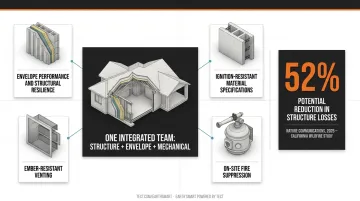
These systems cannot be afterthoughts bolted on at permit review:
- Envelope performance and structural resilience
- Ignition-resistant material specifications
- Ember-resistant venting
- On-site fire suppression
Each must be integrated from the first design session, aligned across structure, envelope, and mechanical systems. A 2025 study published in Nature Communications found that combined home hardening and defensible space could hypothetically reduce structure losses by 52% across studied California wildfires. That outcome depends on those systems being specified and installed correctly as an integrated package — which only happens when the team is aligned from the start.
How the Turnkey Custom Home Process Works
Step 1: Site Evaluation and Vision Definition
Before any design work begins, a quality turnkey team conducts a thorough site assessment covering:
- Topography and solar orientation: how the site drains, where the sun tracks, prevailing wind direction
- Risk exposure: fire hazard severity zone classification, flood and seismic factors, proximity to WUI
- Zoning constraints: setbacks, height limits, FAR, any local WUI overlay requirements
- Homeowner vision and performance goals: what the home needs to do across its full lifecycle, not just at move-in
Getting this right before design starts prevents the costliest mistakes: redesigns, permit resubmittals, and field substitutions that cost multiples of what the upfront assessment would have required.
Step 2: Design, System Specification, and Permitting
Turnkey delivery separates from a fragmented build most clearly at this stage.
In an integrated process, structural systems, mechanical systems, and building envelope materials are all specified during the design phase — not improvised on-site. That means:
- Structural engineering is coordinated with architectural layout from day one
- HVAC, electrical, and plumbing are located and sized before walls are framed
- Envelope systems (insulation, air barriers, cladding, roofing, windows) are specified together, not as independent product selections
- Fire suppression systems and on-site water supply are engineered alongside the structure, not bolted on later
All trades work from the same integrated design intent, and systems are installed per manufacturer specifications — not approximated in the field by whoever is available that week.
The upfront work pays off here. When specifications are locked before breaking ground, field substitutions become the exception rather than the default. The design intent established in Step 2 is what gets built.
Step 4: Final Inspection, Handover, and Move-In
A quality turnkey handover includes:
- All required city and county inspections completed
- Final walkthrough confirming every system and finish meets the agreed specification
- Punch-list items resolved before handover, not left for the homeowner to chase
- Full documentation of all installed systems for insurance, maintenance, and future reference
The homeowner receives a fully documented, move-in-ready home.
Key Factors That Determine Quality in a Turnkey Custom Home
Structural System and Envelope
Quality begins with how the structure is engineered. For WUI and fire-exposed sites, that means moving past conventional wood framing as the default.
Earth'smart powered by tect's Earth'smart™ model specifies non-combustible structural systems as the foundation for resilient construction:
- Pre-insulated concrete masonry (CMU) — integrates structural masonry, continuous insulation, and fire resistance in a single assembly
- Insulated concrete forms (ICF) and autoclaved aerated concrete (AAC) — non-combustible alternatives with strong thermal performance
- Hybrid masonry-steel systems for larger or more complex structures
The building envelope is treated as one integrated performance system. Insulation, air barriers, cladding, roofing, and windows are specified together for fire resistance, moisture control, and energy performance — not selected independently.
California's 2025 Title 24 energy standards prescriptively require heat pump space heating and water heating, MERV 13 or better filtration, and wall insulation minimums. All of these need to be coordinated with the overall envelope specification from the start, not patched in at permit.
WUI Code Compliance as a Performance Floor
California's Chapter 7A WUI requirements include Class A roofing, ignition-resistant exterior materials, ember-resistant vents with mesh openings between 1/16 and 1/8 inch, and multipane tempered glazing. Headwaters Economics estimates the wildfire-resistant construction premium in Southern California at roughly 2% to 3% of total construction cost — about $13,000 on a $500,000 baseline 1,750-square-foot home.
Earth'smart powered by tect uses these requirements as a baseline, then builds beyond them. In practice, that means fire-resistive wall assemblies engineered beyond minimum cladding requirements, vapor dome perimeter suppression systems, dedicated on-site fire water supply, FIREBOZZ® water cannon integration, and IBHS Wildfire Prepared Home documentation — all specified and coordinated during design.
Mechanical Systems and Indoor Air Quality
The decisions made in structural and envelope design directly shape what your mechanical systems can achieve. HVAC and mechanical systems installed reactively — after walls are framed — create code conflicts, performance gaps, and costly remediation.
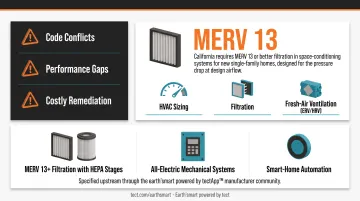
California requires MERV 13 or better filtration in space-conditioning systems for new single-family homes, designed for the pressure drop at design airflow. Getting HVAC sizing, filtration, and fresh-air ventilation (ERV/HRV) coordinated at the design phase is what makes the system perform as specified.
Earth'smart powered by tect's integrated approach includes MERV 13+ filtration with HEPA stages where smoke exposure is a concern, all-electric mechanical systems, and smart-home automation — all specified upstream through the earth'smart powered by tectApp™ manufacturer community.
Common Misconceptions About Turnkey Custom Home Projects
"Turnkey means I lose design control."
Homeowners retain full decision-making authority over layout, materials, and finishes during the design phase. The turnkey model means the team executes that vision without requiring the homeowner to manage construction logistics. Design input and project management are entirely separate things.
"Any builder can call their process turnkey."
A related concern involves the label itself — and it's a fair one. The meaningful test is whether design and construction share accountability and real-time communication, or whether the builder is simply offering one contract over a still-fragmented process. Earth'smart™ distinguishes itself through genuine operational integration: architecture, engineering, construction, and manufacturer input aligned under one team from concept forward. Not sequential handoffs dressed up under a single contract cover.
"Turnkey is just a convenience option."
Beyond credentials and process, some homeowners treat turnkey as a premium convenience — a nice-to-have rather than a structural advantage. The real value is quality precision. When one team coordinates design and construction from the start, fewer substitutions occur, system decisions are made correctly the first time, and the finished home performs closer to the original specification. Convenience is a byproduct.
Frequently Asked Questions
How much does it cost to build a house?
NAHB's 2024 construction cost survey reported an average single-family construction cost of $428,215, or about $162 per square foot nationally — though California custom builds, particularly in WUI zones, run significantly higher. Earth'smart powered by tect's Earth'smart™ projects typically range from under $2M to $5M+, with estate-scale work up to $10M+.
Are custom-built homes better quality?
They can be — but only when design and construction are properly coordinated. Custom homes allow systems, materials, and structure to be specified for the specific site and homeowner requirements. A fragmented build process undercuts quality regardless of the budget; an integrated process is what delivers on the potential.
What is the difference between a turnkey custom home and a spec home?
A spec home is built to the builder's design and sold as-is with no homeowner input. A turnkey custom home is built entirely around the homeowner's vision and performance requirements. The "turnkey" label describes the delivery model — one accountable team from concept through completion — not a limit on personalization.
How long does it take to build a custom home with a turnkey process?
NAHB data for 2024 shows the Pacific division averaging 10.8 months from authorization to completion — 2.1 months for permitting and 8.7 months for construction. Larger homes (5,000–6,000 sq ft) average around 14 months. A well-coordinated turnkey process typically moves faster than fragmented builds because design, permitting, and construction planning happen in parallel.
What should I look for when choosing a turnkey custom home builder?
Look beyond the portfolio. Evaluate:
- Whether design and construction are under shared accountability
- How system specification and manufacturer selection actually happen
- Whether the team has direct WUI experience (Chapter 7A, local fire severity zone)
- What quality control looks like during construction
Can I make design changes once construction starts?
Changes after construction begins create schedule delays and cost increases — systems and materials are already ordered and staged. The turnkey process is specifically designed to finalize all decisions before breaking ground. Thorough design review upfront protects both quality and budget.