
This guide covers the key insulation types, how fire resistance is measured, where each material belongs in your home, and what actually matters when building for wildfire resilience rather than just passing inspection.
One thing worth clarifying upfront: "fireproof" doesn't exist as a recognized code classification. Some materials are dramatically better than others, and in homes built to last generations, that difference matters.
Key Takeaways
- Mineral wool and unfaced fiberglass are the only truly non-combustible insulation options — nothing else comes close
- No insulation is code-classified as "fireproof"; fire resistance measures how an assembly performs, not whether it survives all conditions
- All foam-based insulations are combustible and require a code-approved thermal barrier (typically ½" drywall) to be installed
- Class A (ASTM E84, flame spread index 0–25) is the minimum standard for insulation in fire-prone areas
- For WUI homeowners, insulation is one component of a whole-envelope system and cannot be selected in isolation
Fire-Resistant vs. Fireproof: What the Terms Actually Mean
"Fireproof insulation" is one of the most searched terms in this category — and one of the most misleading. It isn't a recognized classification in the International Building Code, the International Residential Code, or California's Chapter 7A. No insulation product carries a "fireproof" certification because no building material is immune to fire under sustained, extreme conditions.
What the codes do recognize:
- Noncombustible — materials that don't ignite or burn, verified by ASTM E136
- Fire-resistance rating — the period of time a building element or assembly maintains its ability to confine fire or perform structurally, per the IBC Chapter 2 definition
- Flame spread index and smoke-developed index — surface-burning values measured by ASTM E84
- Ignition-resistant — a California-specific designation under Chapter 7A requiring a flame spread index ≤25 plus an additional 20-minute test condition
Those definitions also point to a second critical distinction: fire ratings are assigned to assemblies, not individual materials. A wall system's fire-resistance rating reflects how the entire construction — sheathing, insulation, framing, cladding, barriers — performs together under ASTM E119 testing.
Specifying a Class A insulation product doesn't automatically produce a Class A wall assembly. How those materials are combined, detailed, and installed determines the actual rating — which is why system-level coordination matters as much as product selection.

Types of Fire-Resistant Insulation: A Material-by-Material Breakdown
Mineral Wool (Rock Wool and Slag Wool)
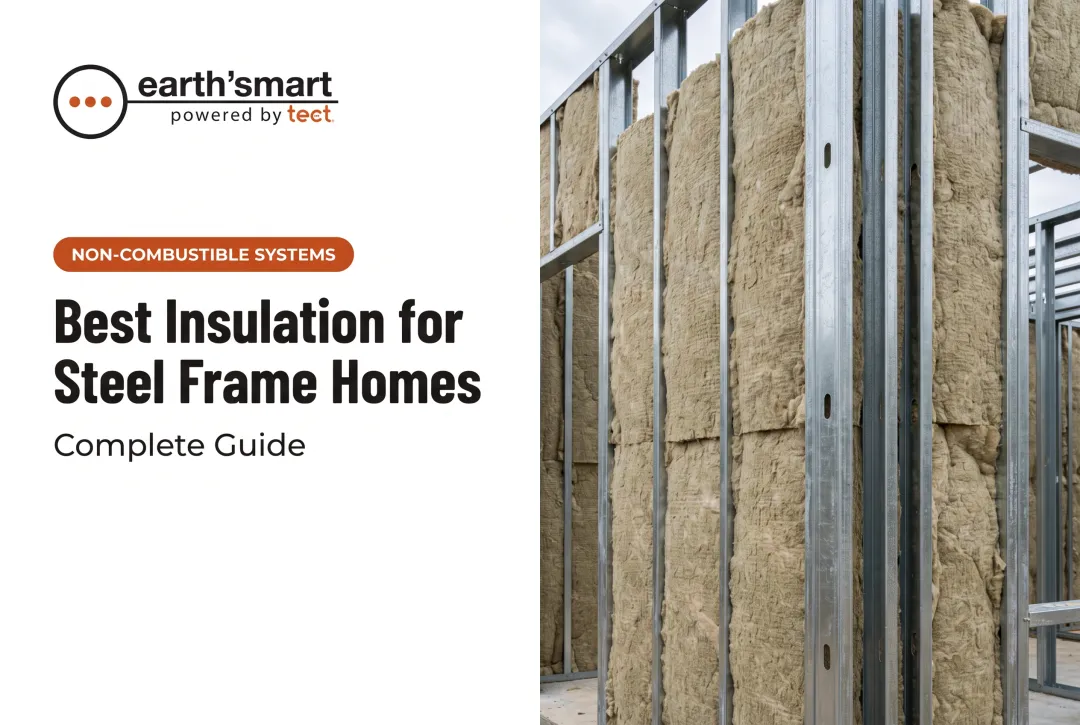
Mineral wool — manufactured from molten basalt or recycled steel slag — is the strongest option for non-combustible residential insulation. Per ROCKWOOL's ICC-ES Evaluation Report ESR-3773, stone wool carries an ASTM E84 flame spread index of 0 and smoke-developed index of 0. ROCKWOOL's Comfortbatt product has a reported melting point of 1,177°C / 2,150°F — well above temperatures reached in most residential fires.
Key advantages for WUI homeowners:
- Inherently non-combustible — no thermal barrier required under foam-plastic code provisions
- Available in batts and rigid board formats for walls, attic floors, and continuous exterior sheathing
- Naturally water-repellent and mold-resistant
- No formaldehyde, strong acoustic performance alongside fire performance
- Costs more per batt than fiberglass, but the premium is modest relative to total construction
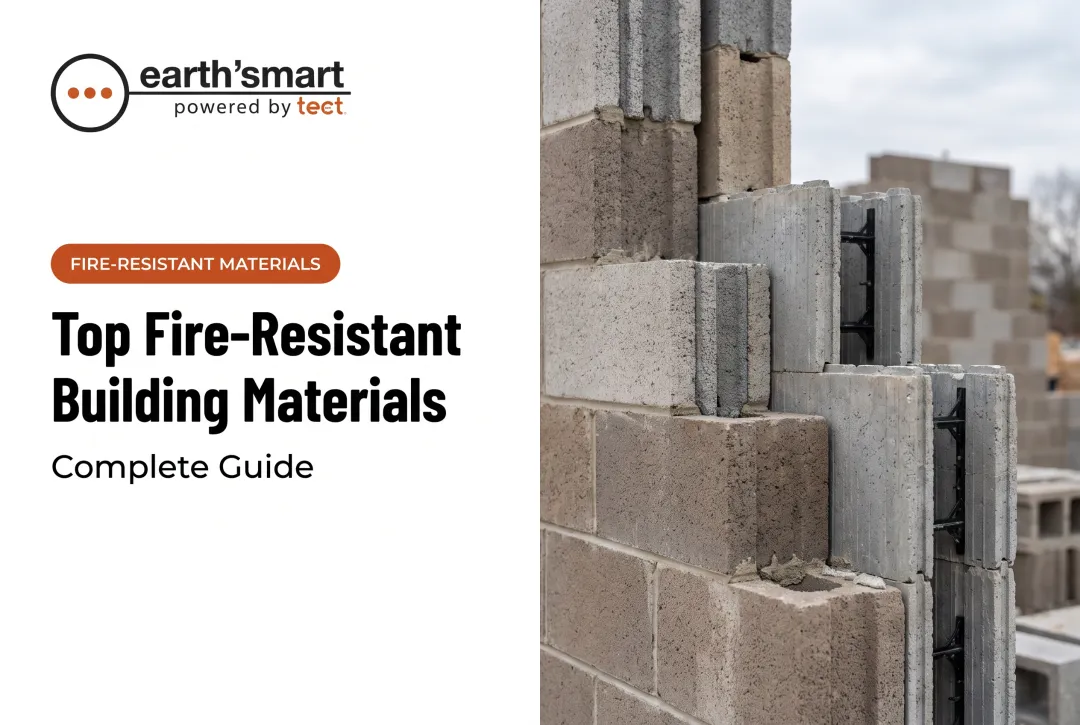
Earth'smart powered by tect specifies mineral wool as a core component of its Earth'smart™ fire-resistive assemblies, integrated with pre-insulated concrete masonry wall systems rather than treated as a standalone product selection.
Fiberglass (Unfaced)
Unfaced fiberglass is non-combustible under ASTM E136, with a flame spread index below 25 and smoke-developed index below 50 — a Class A result. Owens Corning and Johns Manville both document this for their unfaced residential products.
One critical caveat: kraft paper or foil facings change everything. Owens Corning lists kraft-faced fiberglass as NR/NR (not rated) for flame spread and smoke development. Johns Manville states directly that kraft and standard foil facings will burn and must not be left exposed. In high-risk settings, unfaced fiberglass is the only version worth specifying.
Fiberglass is installation-sensitive — gaps, compression, and poor detailing around penetrations compromise both thermal and fire performance. It's a code-compliant, accessible option, but mineral wool is the more defensible choice when fire performance is the priority.
Cellulose
Cellulose is made from recycled paper and is inherently combustible — treated with fire-retardant compounds (typically borate-based) that cause it to smolder rather than flame up. It's regulated under 16 CFR Part 1209, which sets minimum critical radiant flux and smoldering weight-loss thresholds; the CPSC has acknowledged fire risks from inadequate treatment or improper installation near heat sources.
Cellulose is not noncombustible under ASTM E136. Dense-pack cellulose does fill irregular cavities well, limiting air movement that can accelerate fire spread — a real performance advantage in wall assemblies. For WUI homeowners where risk tolerance is lower, mineral wool or unfaced fiberglass are the appropriate choices.
Rigid Foam Boards (PIR, XPS, EPS)
All three rigid foam types are combustible and fall under foam-plastic code requirements. IRC R316.4 requires foam plastic to be separated from building interiors by an approved thermal barrier — typically ½" gypsum wallboard — unless specific code exceptions apply. IBC 2603.4 carries the same requirement.
A quick comparison:
| Foam Type | Fire Behavior | Code Requirement |
|---|---|---|
| PIR (Polyisocyanurate) | Forms char layer, built-in retardants | Thermal barrier required |
| XPS (Extruded Polystyrene) | Combustible, lower performance than PIR | Thermal barrier required |
| EPS (Expanded Polystyrene) | Most flammable of the three | Thermal barrier required |
High R-values in thin profiles make foam boards useful in certain assemblies — but only where their fire limitations are fully addressed by assembly design. They're not the right choice when fire resistance is the primary concern.
Spray Foam
Both open- and closed-cell spray foam are combustible. Fire performance varies by formulation, density, thickness, and end use — ICC 1100-2019 requires product-specific testing at intended maximum thickness and density, and applications exceeding 4 inches require additional large-scale fire testing such as NFPA 286.
Building codes require an approved thermal or ignition barrier over spray foam in all finished spaces. Spray foam's air-sealing performance does limit air-driven fire spread within an envelope — but that benefit only holds when the installation is done right.
For WUI homeowners, three requirements are non-negotiable:
- Professional application at tested thickness and density
- Code-compliant thermal or ignition barrier coverage throughout
- Product-specific fire testing documentation on file before installation

Benefits of Fire-Resistant Insulation Beyond Stopping Flames
The case for non-combustible insulation goes beyond fire performance alone.
Structural Preservation
Non-combustible insulation — particularly mineral wool — helps maintain structural integrity longer during a fire event. This buys occupants more evacuation time and slows the pace of structural collapse. Whether a home is salvageable after a fire often comes down to how long the structure held.
Building Performance
Mineral wool also delivers day-to-day performance advantages beyond fire resistance:
- Strong thermal performance (R-value per inch comparable to fiberglass)
- Moisture resistance without vapor barriers in some assemblies
- Acoustic dampening — especially valuable in rebuilt neighborhoods where construction noise from adjacent sites continues for years
Insurance Implications
Insurance implications are real, though they operate at the envelope level — not the insulation-product level. The California Department of Insurance's Safer from Wildfires program links whole-home mitigation actions to insurance outcomes. An IBHS and Headwaters study found that meeting Wildfire Prepared Home standards can support lower insurance costs and greater coverage availability. Insulation is one input into that system — not a standalone lever.
For homeowners rebuilding in Pacific Palisades, where coverage has become genuinely difficult to obtain following the January 2025 Palisades Fire, this system-level framing matters most. That's the thinking behind earth'smart powered by tect's Earth'smart™ approach: projects are documented for insurer review with performance packages aligned to IBHS Wildfire Prepared Home and Chapter 7A requirements — treating insulation as part of a coordinated whole, not a product swap.
Where Fire-Resistant Insulation Matters Most
Not all insulation locations carry equal risk. In wildfire exposure, some areas of the building envelope are significantly more vulnerable than others.
Highest priority locations:
- Attic floor and roof assembly — IBHS research confirms wind-blown embers are the principal cause of building ignitions during wildfires, and attic vents are a primary entry point. Non-combustible insulation at the attic floor reduces ignition risk once embers penetrate
- Exterior walls — radiant heat and ember contact make the exterior wall assembly the first line of thermal defense; continuous non-combustible insulation as part of the assembly is critical
- Building envelope perimeter — air sealing and insulation continuity at the perimeter limit the air-driven fire spread that accelerates interior damage

High-risk interior zones:
- Garage-to-living-space walls
- Areas around chimneys, flues, and mechanical equipment
- Mechanical rooms and electrical panel locations
- Any location where combustible insulation is exposed or improperly detailed
Each of these zones represents a potential failure point — and insulation choices in each one affect how the overall assembly performs under fire exposure. For homeowners rebuilding in Pacific Palisades and similar WUI communities, insulation is one layer within a coordinated system that includes non-combustible cladding, fire-rated sheathing, ember-resistant venting, and Class A roofing.
Specifying these components together — from concept through construction — is what closes the gaps. Selecting them independently, without a shared performance target, is where fire-hardened homes most often fall short.
Fire Ratings, Building Codes, and WUI Requirements
Understanding ASTM E84 and Assembly Ratings
ASTM E84 (the "tunnel test") measures surface-burning characteristics — flame spread index (FSI) and smoke-developed index (SDI). The classifications:
| Class | Flame Spread Index | Smoke-Developed Index |
|---|---|---|
| Class A | 0–25 | 0–450 |
| Class B | 26–75 | 0–450 |
| Class C | 76–200 | 0–450 |
Class A is the floor for insulation in fire-prone areas — not the finish line. But ASTM E84 tests material surfaces, not full assemblies. Full assembly fire-resistance ratings come from ASTM E119 (wall and floor endurance) and NFPA 285 (exterior wall propagation), which assess how a complete wall or roof system performs as an integrated unit.

In WUI construction, a Class A product in a non-rated assembly still fails — the assembly rating is what stands between your home and ignition.
California Chapter 7A takes this further, layering state-specific ignition-resistance requirements on top of federal testing standards.
California Chapter 7A Requirements
California Building Code Chapter 7A applies to exterior building materials, systems, and assemblies in Fire Hazard Severity Zones and designated WUI areas. It uses both noncombustible and ignition-resistant pathways, where ignition-resistant requires a flame spread index ≤25 plus a 20-minute additional test condition.
The California Office of the State Fire Marshal maintains the Building Materials Listing — the authoritative reference for verified Chapter 7A-compliant products in California WUI zones, not a manufacturer's generic Class A claim.
The right questions for WUI rebuilders:
- What is the fire-resistance rating of the full wall assembly, not just the insulation?
- Does the assembly meet California Chapter 7A requirements?
- Is the specified assembly tested under ASTM E119 or NFPA 285 — not just the individual product?
- Are all products on the OSFM Building Materials Listing?
Choosing the Right Fire-Resistant Insulation for High-Risk Zones
Material Hierarchy for WUI Applications
For WUI homeowners, the question is which materials — in which locations — contribute to a building envelope that resists ignition, limits flame spread, and maintains structural performance long enough to matter.
| Priority | Material | Best Use Case | Limitation |
|---|---|---|---|
| 1 | Mineral wool | Exterior walls, attic, continuous sheathing | Higher cost than fiberglass |
| 2 | Unfaced fiberglass | Interior cavities, secondary locations | Installation-sensitive; no facings |
| 3 | PIR/XPS/EPS rigid foam | Continuous insulation where R-value is priority | Thermal barrier required; not for fire-priority applications |
| 4 | Spray foam | Air sealing in specific assemblies | Thermal barrier required; formulation-dependent |

Cost in Context
Mineral wool costs more per batt than fiberglass. Exact pricing varies by region and supplier, but the premium over fiberglass is modest relative to total construction costs — and negligible compared to the cost of rebuilding again. In the $2M–$5M+ range typical of WUI custom homes, the material differential rarely moves the budget needle.
Installation Quality Is Non-Negotiable
Even non-combustible insulation underperforms when:
- Compressed into cavities (reduces R-value and fire performance)
- Installed with gaps around penetrations, electrical boxes, or framing interfaces
- Left without proper detailing at the building envelope perimeter
For WUI rebuilds, installation quality is as consequential as material selection.
The Integration Requirement
Insulation cannot be specified in isolation. It needs to be coordinated with wall assembly design, cladding selection, air barrier specification, and Chapter 7A compliance from the start — not resolved late in construction when changes are expensive and assemblies are already framed.
This is where integrated delivery changes the outcome. Through earth'smart powered by tect's Earth'smart™ Path A Turnkey Delivery, insulation is specified as part of the wall assembly from day one — typically pre-insulated concrete masonry — with mineral wool, cladding, sheathing, and air barriers resolved as a single coordinated system.
Through Path B Advisory, earth'smart powered by tect reviews existing team specifications against the same integrated performance framework. In both cases, the earth'smart powered by tectApp™ community of 70+ vetted building product manufacturers is engaged before commitments are made — so systems are understood and delivered correctly from concept through construction, not corrected after framing is complete.
Frequently Asked Questions
Frequently Asked Questions
What is the most fire-resistant insulation?
Mineral wool (rock wool or slag wool) is the strongest option for residential use — non-combustible under ASTM E136, Class A rated with a flame spread index of 0, and stable at temperatures exceeding 1,177°C / 2,150°F. Unfaced fiberglass is the next best non-combustible option and more widely available.
Is anything 100% fireproof?
No building material — insulation or otherwise — is certified as truly fireproof. Fire resistance describes how long and how well a material or assembly resists fire; under extreme, sustained heat, all materials have limits. The goal is maximizing that resistance within a well-designed assembly.
What are the benefits of using fire-resistant insulation?
The core benefits are slowing fire spread, preserving structural integrity long enough for evacuation, and reducing smoke production. Non-combustible options like mineral wool also deliver strong thermal and moisture performance — and in high-risk zones, a documented fire-resilient envelope strengthens a home's insurability profile.
What fire rating should insulation have in a wildfire-prone area?
Class A (ASTM E84, flame spread index 0–25) is the minimum. In California WUI zones, Chapter 7A's ignition-resistant designation adds a 20-minute test condition beyond Class A. Full wall assembly ratings under ASTM E119 and NFPA 285 matter as much as the individual material rating.
Does fire-resistant insulation help with home insurance in high-risk zones?
In California's WUI markets, insurers increasingly evaluate construction materials and assembly quality when determining coverage eligibility and premiums. Non-combustible materials and a documented fire-resilient envelope reduce your risk profile — but insulation is one input into a whole-home system, not a standalone discount trigger.
Can fire-resistant insulation be retrofitted into an existing home?
Yes — mineral wool batts can be added during renovations in open wall or attic applications. Full performance benefits require coordination with the wall assembly, barriers, and cladding, so professional assessment is recommended before retrofitting in high-risk zones.