
Introduction
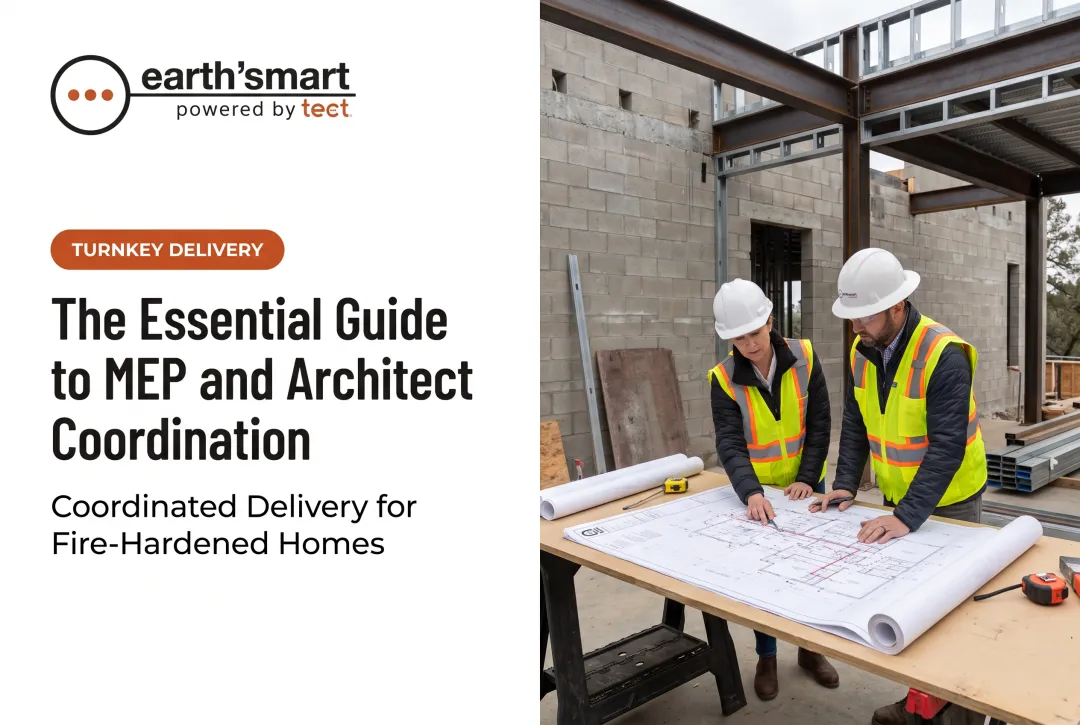
After the Palisades Fire — or any wildfire — the rebuilding process drops homeowners into a fragmented system. An architect designs the spaces. A structural engineer sizes the beams. A general contractor hires subcontractors who execute from drawings they had no hand in creating. Nobody owns the full picture.
The result? Homes that pass inspections but underperform for decades. Systems that weren't coordinated. Envelope details that leak air and water. Mechanical equipment that was sized without accounting for the actual building loads.
This guide covers two disciplines that, when working together, prevent exactly that:
- Architectural engineering — the application of engineering principles to a building's integrated systems (structural, envelope, mechanical, electrical)
- Construction management — the professional practice of planning, coordinating, and executing a build on behalf of the owner
This guide explains what each discipline involves, how they work together, and what to look for when assembling — or evaluating — a team for a high-performance rebuild.
Key Takeaways
- Architectural engineering focuses on how building systems are designed to perform together — not just independently
- Construction management protects the owner's interests across schedule, budget, quality, and scope — especially critical in high-stakes resilience projects
- The most consequential project decisions happen in the first 20% of a project's timeline
- Fragmented AE-CM delivery leads to envelope failures, mechanical errors, and costly change orders
- Integrated AE-CM coordination, aligned from concept through construction, produces measurably better outcomes
What Is Architectural Engineering?
Systems Engineering, Not Just Design
ASCE's Architectural Engineering Institute defines architectural engineering as the application of engineering principles and technology to building design and construction. Where an architect shapes the spatial and aesthetic vision of a building, an architectural engineer engineers the systems that make that vision safe, functional, durable, and efficient.
The distinction matters. Architects are trained in design. Architectural engineers are trained as systems engineers: professionals who think about how each component performs relative to all others. ABET's accreditation criteria for AE programs require coverage of building structures, mechanical systems, electrical systems, and construction management.
AEs can pursue licensure as Professional Engineers (PEs) through NCEES, which requires an accredited degree, the FE exam, the PE exam, and typically four years of progressive experience.
What Architectural Engineers Actually Oversee
On a complex custom home, an AE's scope typically includes:
- Structural systems — foundation, framing, load paths, lateral resistance
- Building envelope — walls, windows, roof assemblies (the home's primary weather, fire, and air barrier)
- Mechanical/HVAC systems — sizing, zoning, ventilation strategy
- Electrical and lighting systems — loads, distribution, integration with renewables
- System integration — how each of the above interacts with the others

According to ENERGY STAR, air leakage accounts for 25% to 40% of heating and cooling energy in a typical residence — a direct result of how the envelope is specified and constructed. These decisions compound over decades; getting them right at the design stage is far cheaper than correcting them in the field.
Why AE Expertise Is Rare in Residential Construction
Commercial projects routinely engage dedicated AE consultants for each building system. Most residential projects don't. In California, for example, state law permits unlicensed plan preparation for wood-frame single-family homes up to two stories — unless portions deviate from conventional framing. That regulatory latitude leaves many custom homes without the systems-level engineering a comparable commercial project would require.
For homes in fire-prone, flood-prone, or seismic zones, this gap has direct consequences:
- Material selection and envelope detailing directly affect fire and flood resistance
- Structural redundancy determines how a building performs under seismic load
- System-level decisions made early determine whether a home survives an extreme event or needs full replacement within a generation
What Is Construction Management?
The Owner's Professional Representative
The Construction Management Association of America defines CM as a professional management practice applied from project inception through completion to control time, cost, scope, and quality. In agency CM (the model most relevant to custom home clients), the CM acts as the owner's principal agent, advising on or managing the process across the full project lifecycle.
The CM represents the owner, not the contractor. This fiduciary alignment is what distinguishes a construction manager from a general contractor, even when the roles appear similar from the outside.
The Bureau of Labor Statistics projects construction management employment to grow 9% from 2024 to 2034, with approximately 46,800 openings annually — a signal of how much more complex building delivery has become as systems, codes, and performance expectations evolve.
Three Phases a CM Owns
Pre-construction
- Feasibility analysis and scope definition
- Design coordination and permit strategy
- Budget development and procurement planning
- Contract structure and subcontractor selection
Construction
- Site supervision and quality control
- Subcontractor coordination and schedule management
- Submittal review, RFI management, and change order oversight
- Milestone inspections at critical system junctures
Post-construction
- Final inspections and punch list management
- System documentation and commissioning
- Project closeout and owner handover

CM vs. General Contractor
These roles are frequently confused, but the distinction is meaningful:
| Role | Primary Allegiance | Core Function |
|---|---|---|
| Construction Manager | Owner | Manage process, schedule, cost, quality |
| General Contractor | Contract execution | Build the work, coordinate trades |
A GC's interests are partially tied to construction efficiency and contract margin. A CM's single obligation is to the owner's goals. On complex custom or resilient-home projects, knowing which model you're working under — and whether that advisor actually answers to you — determines how disputes get resolved, where costs get cut, and whose priorities drive the schedule.
How Architectural Engineering and Construction Management Work Together
The Coordination Gap That Costs Homeowners
In fragmented project delivery, engineers hand off drawings and construction teams implement them without deep system knowledge. Whether a wall assembly can actually be built in the sequence the framing contractor uses goes unreviewed. When window specifications change mid-design, HVAC equipment sized for the original assumptions stays on the drawings uncorrected.
This gap produces predictable outcomes: envelope failures (air leakage, water intrusion, thermal bridging), mechanical systems that don't perform to design intent, and structural issues discovered during framing that require expensive field corrections.
Research from the Construction Industry Institute found that Front End Planning returns $3 to $7 for every $1 spent on non-residential capital projects, with construction-ready projects showing 20% cost savings, 22% schedule reduction, and 7% less rework. The underlying principle — that early coordination between design and construction disciplines prevents exponentially more costly problems downstream — applies directly to complex residential work.

What True AE-CM Coordination Looks Like
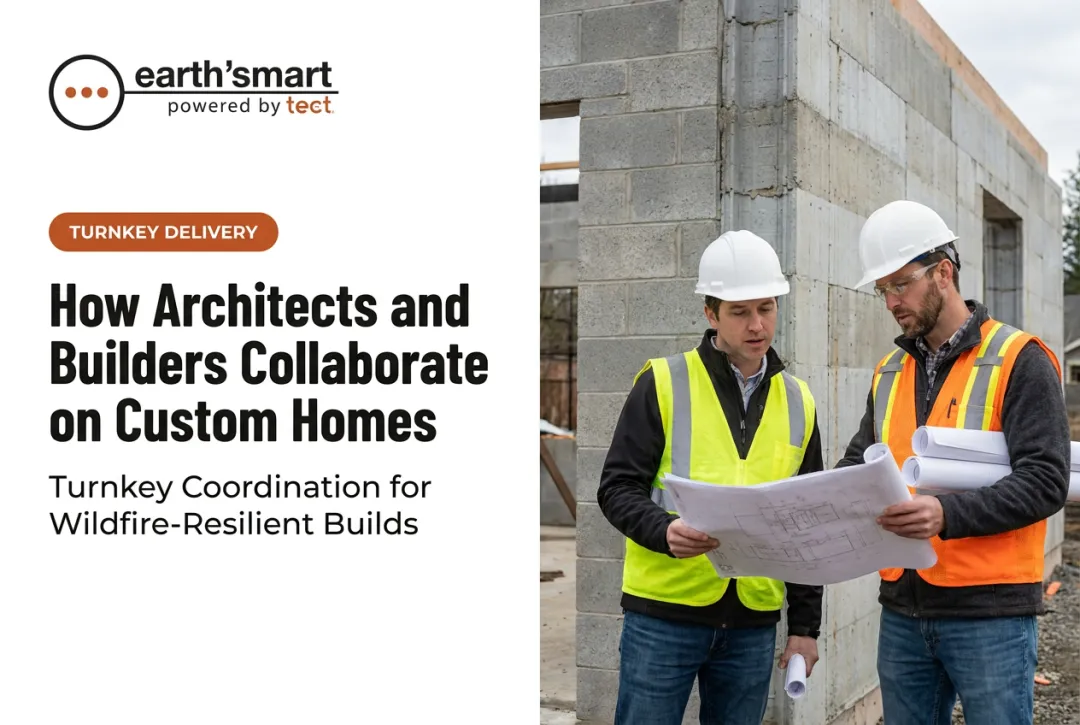
The construction manager is engaged during the design phase, not after documents are issued. This single change enables:
- Buildability review before details are finalized
- Long-lead procurement of specialty systems (structural masonry, mechanical equipment, glazing) that can't be substituted without engineering review
- Interface resolution — where structure meets envelope meets MEP — handled on paper rather than in the field
- Cost validation of system decisions while changes are still inexpensive
Early Decisions, Long-Term Consequences
The coordination advantages listed above matter most at the earliest stage of a project. The most consequential choices — structural system, envelope assembly, mechanical strategy — are made in the first 20% of a project's timeline but affect 80% of long-term performance and cost.
When AE and CM are aligned from the start, those decisions reflect simultaneous knowledge of cost, constructability, and performance. Without that alignment, they get made reactively — driven by subcontractor schedules and whoever happens to be available, not by engineering judgment.
earth'smart powered by tect's Integrated Approach
Earth'smart powered by tect's Earth'smart™ delivery model demonstrates what full AE-CM integration looks like in residential construction. Under Path A Turnkey Delivery, a single coordinated team delivers architecture, engineering, construction, and manufacturer input from concept through completion. Under Path B Advisory, earth'smart powered by tect functions as an owner-side strategic advisor working alongside an existing architect, engineer, and contractor — providing design and construction integrity review, critical decision support, and direct coordination with manufacturers at the points that matter most.
Central to both paths is the earth'smart powered by tectApp™ community of 70+ vetted building product manufacturers. Rather than making product decisions late in construction with limited input, earth'smart powered by tectApp™ connects projects directly with the companies behind the home's structural systems, roofing assemblies, mechanical equipment, and fire suppression components during the design phase. Systems are specified correctly from the start — not corrected after installation.
This level of coordination is standard on large commercial projects. In residential construction, most homeowners never have access to it — which is precisely the gap earth'smart powered by tect was built to close.
Why the AE-CM Relationship Matters for Homeowners
The Standard Model and Its Limits
Most homeowners hire an architect for design, a GC for construction, and rely on the GC to coordinate subcontractors with no dedicated engineering oversight of system integration. For simple projects in low-risk environments, this works adequately.
For custom homes — and particularly for homes in fire, flood, or seismic zones — it consistently underdelivers. Homes meet code minimums. Systems are installed without coordinated review. Performance gaps don't appear until years of operation reveal them.
A peer-reviewed ASCE study of residential construction found 1 in 8 homes reported defects, with rectification averaging 4% of construction contract value. On a $2M custom home, that's $80,000 in corrective work on systems that should have been right the first time.

A Generational Investment Decision
DOE-certified Zero Energy Ready single-family homes are typically 40% to 50% more efficient than homes built to standard energy code requirements. That gap comes down to coordination, not product selection. It reflects whether envelope, mechanical, and electrical systems were engineered together or assembled independently.
For homeowners rebuilding after the January 2025 Palisades Fire — which destroyed 6,831 structures — the stakes are different in kind, not just degree. This is a generational decision about what gets built on that parcel and how it performs for the next 50 to 100 years — not a routine upgrade cycle.
Earth'smart powered by tect's Earth'smart™ standard is built around exactly this challenge. A home rebuilt to that standard is engineered for a 100+ year service life — designed for fire, seismic, and flood exposure from the first drawing, not retrofitted after the fact.
What determines whether that investment holds over decades comes down to what happens during design:
- Envelope, mechanical, and electrical systems are coordinated together, not assembled independently
- Fire-resistive assemblies and suppression systems are specified early, before conflicts emerge
- Long-term maintenance costs are minimized through integrated system decisions made at the right stage
Key Roles in an Integrated AE and CM Team
The Core Team
A well-coordinated AE+CM project involves professionals who communicate continuously rather than pass documents sequentially:
- Architectural engineer — systems design and integration across structure, envelope, and MEP
- Construction manager / owner's representative — schedule, budget, subcontractor coordination, and quality oversight
- Project engineer — technical compliance and field condition review
- Specialty consultants (structural, MEP, envelope, fire protection) — engaged early, not reactively
The critical variable is timing. Specialty consultants brought in after design is complete can document what exists. They can't change it.
The Role of Manufacturers
Building product manufacturers are among the most underused resources in residential construction. The companies behind your home's major systems — structural wall systems, Class A roofing assemblies, ember-resistant venting, mechanical equipment — hold detailed technical knowledge most projects never tap:
- How their products perform under real conditions
- How they interface with adjacent systems
- What installation errors consistently cause failures
Engaging manufacturers early — during specification, not procurement — prevents the substitutions and installation errors behind a significant share of residential defects. Earth'smart powered by tect's earth'smart powered by tectApp™ platform structures this engagement, connecting projects with vetted manufacturers across every major system category before design decisions are locked.
Clarifying CM vs. GC for Homeowners
When evaluating project delivery, homeowners should understand:
- A construction manager manages process and serves the owner's interests — budget, schedule, quality, and system performance
- A general contractor executes the work and typically carries contractual responsibility for construction delivery
- Some firms perform both functions; others are separate
- The distinction determines whose interests drive field decisions when problems arise
Before breaking ground, confirm the CM's independence from GC incentives in writing. When problems arise on-site, that independence determines whether the call goes in your favor or the contractor's.
What to Look for When Selecting an AE and CM Team
Criteria That Actually Differentiate Teams
1. Project experience that matches your risk profile A team experienced in standard suburban construction isn't the same as one that has delivered fire-hardened homes in active WUI zones. Ask for specific project examples, not credentials alone.
2. A unified workflow — not coordination between separate firms Ask whether the CM participates in design-phase system decisions, and whether engineering review is built into the construction process or treated as an optional add-on.
3. Clear, documented decision-making How are decisions documented? How are substitutions reviewed? What triggers an engineering review versus a field call? Teams that can't answer these questions clearly are teams that make decisions informally — which is precisely where substitution errors and missed engineering reviews begin.
The Single Most Important Variable: Early Engagement
Teams brought in after design is complete cannot meaningfully influence the decisions that matter most. Early engagement — before schematics are finalized — is where integrated teams earn their value. Ask prospective teams directly:
- Do you participate in pre-design system planning?
- Does your construction management process include engineering review of critical submittals?
- At what phase do you engage specialty consultants and manufacturers?
The answers reveal whether a team is truly integrated or sequential in how they work.
Questions Specific to High-Risk Areas
Homeowners in fire, flood, or seismic zones should go further:
- How does this team approach resilience at the system level — not just compliance with minimum code?
- What envelope assemblies do they specify for WUI zones, and why?
- Ask whether structural systems are engineered for both seismic and fire exposure at the same time — not addressed separately.
- Does the team have experience with IBHS Wildfire Prepared Home designation and California Chapter 7A requirements?
- How do they document system-level performance for insurance purposes?
These questions separate generalist teams from those equipped for high-performance residential work in high-risk environments. For homeowners in Pacific Palisades and across California's WUI zones, the right team doesn't just meet code — they design to a standard that makes the home insurable, durable, and defensible for the next 100 years.
Frequently Asked Questions
What is the difference between construction management and architectural engineering?
Architectural engineering focuses on the technical design and integration of a building's systems — structural, mechanical, electrical, envelope. Construction management focuses on planning, coordinating, and executing the build. They're complementary disciplines: AE defines how a building should perform; CM ensures it's built that way.
Can a home be designed and built without an architectural engineer?
Most residential projects use architects and licensed structural engineers rather than dedicated AEs. For high-performance, resilient, or complex custom homes — especially in fire, flood, or seismic zones — AE expertise in envelope, mechanical, and structural integration significantly improves long-term outcomes.
What does a construction manager do on a residential project?
A CM represents the owner's interests, manages schedule and budget, coordinates subcontractors, oversees quality and compliance, and ensures the project delivers to specifications from pre-construction through closeout. Unlike a GC, the CM's primary obligation is to the owner, not construction execution.
Why does early coordination between AE and CM matter?
The most consequential building decisions — system selection, envelope design, structural approach — are made early. When AE and CM are aligned from the start, these decisions account for cost, constructability, and long-term performance simultaneously, preventing expensive errors and change orders later.
How does integrated AE-CM coordination improve a home's resilience?
Resilience is a system-level outcome. It depends on how structure, envelope, and mechanical systems are specified and integrated — not any single component. Coordinated AE-CM teams engineer these systems together for hazard exposure (fire, wind, flood, seismic) rather than assembling them from independent decisions made by separate parties. Earth'smart powered by tect's Earth'smart™ delivery model is built on exactly this principle — one aligned team from concept through construction.
What questions should homeowners ask when evaluating an AE and CM team?
Key questions to ask:
- Do they have experience with similar project complexity and risk profile?
- How does the team coordinate from design through construction?
- Are specialty consultants and manufacturers engaged during design — not after?
- How are decisions documented and communicated to the owner throughout?