For homeowners in fire-risk areas rebuilding or building new, understanding what pressure a sprinkler system actually requires — and whether your water supply can deliver it — is one of the most consequential decisions in the entire design process. Get it wrong early, and you're facing expensive redesigns or inadequate fire protection.
This article breaks down what water pressure means in sprinkler systems, what the actual requirements are for residential and commercial applications, and what factors drive pressure demand higher or lower.
Key Takeaways
- Water pressure requirements are not universal — they depend on building size, hazard level, elevation, pipe length, and sprinkler type
- Residential systems (NFPA 13D) typically require 40–100+ PSI at the water source
- Standard sprinkler heads draw around 13 GPM each — flow demand adds up fast across multiple heads
- 7 PSI is the absolute minimum at any sprinkler head — not a realistic design target, just the lowest permissible threshold
- Pressure demand is always calculated from the most hydraulically challenging area of the system
- When supply falls short, engineers address the gap with fire pumps, storage tanks, or design-side adjustments — undersized supply is never an acceptable outcome
What Water Pressure Does in a Fire Sprinkler System
Pressure is the force pushing water through the pipe network to each sprinkler head. It must overcome gravity, pipe friction, and turbulence losses while still delivering the required flow at the furthest or highest sprinkler in the system.
Three metrics together define a system's water supply requirement:
- Flow (GPM) — gallons per minute delivered to operating sprinkler heads
- Pressure (PSI) — pounds per square inch at the water source and at each head
- Duration (minutes) — how long the supply must sustain that flow and pressure
All three must be met simultaneously. A supply that hits the right pressure but runs out in four minutes has failed.
Static vs. Residual Pressure
Two pressure readings matter in sprinkler design:
- Static pressure — measured when no water is flowing. It establishes a baseline but tells you nothing about performance under flow
- Residual pressure — measured while water flows at the required rate. This is the number that actually governs whether a system performs when needed
NFPA's hydrant flow guidance defines available fire flow at a residual pressure condition — specifically measured at 20 PSI residual. Designing to static pressure alone would produce a system that looks adequate on paper but falls short during an actual event.
That gap between static and residual — how much pressure drops under flow — is exactly what hydraulic calculations are designed to expose before a fire does.
Minimum Pressure and Flow Requirements: Residential vs. Commercial
Three NFPA standards govern sprinkler system design, each reflecting different risk levels:
- NFPA 13D — one- and two-family residential dwellings
- NFPA 13R — low-rise multi-family residential
- NFPA 13 — commercial and all other occupancies
Each standard sets different flow density and pressure thresholds, so the right starting point depends on the building type.
Residential Requirements (NFPA 13D)
Most residential systems are designed to support two simultaneously operating sprinklers — the most demanding scenario the system is expected to handle. The listed sprinkler model determines flow, but standard residential pendent heads give a reference point.
From Victaulic's FL-RES residential sprinkler data:
| K-Factor | Model | Flow at Minimum Pressure |
|---|---|---|
| K4.9 | V2740 | 13 GPM at 7.0 PSI |
| K5.6 | V5610 | 15 GPM at 7.2 PSI |
| K6.9 | V3426 | 20 GPM at 8.4 PSI |
With two heads operating simultaneously, combined flow requirements typically fall in the 26–40 GPM range depending on head selection.
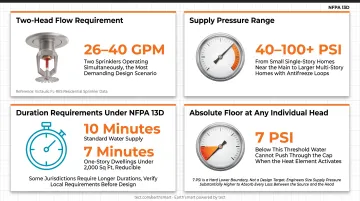
Pressure at the water source is a different number — it must account for all the losses between the supply and the head. Representative ranges run from roughly 40 PSI for small, single-story homes close to the main, up to 100 PSI or more for larger, multi-story homes or systems with antifreeze loops.
Duration requirements under NFPA 13D:
- Standard: 10 minutes of water supply
- One-story dwellings under 2,000 sq ft: reducible to 7 minutes
- Some jurisdictions require longer durations — verify local requirements before design
The absolute floor: 7 PSI at any individual sprinkler head. Below this threshold, water cannot push through the cap when the heat element activates. That said, 7 PSI is a hard lower boundary — not a design target. Engineers size supply pressure substantially higher to absorb every loss between the source and the head.
Commercial Requirements (NFPA 13)
Commercial systems are designed around design areas — the most hydraulically demanding zone of the system — rather than a fixed number of heads. Hazard classification drives both flow density and design area size:
| Hazard Class | Density | Design Area |
|---|---|---|
| Light Hazard | 0.10 GPM/ft² | 1,500 ft² |
| Ordinary Hazard Group 1 | 0.15 GPM/ft² | 1,500 ft² |
| Ordinary Hazard Group 2 | 0.20 GPM/ft² | 1,500 ft² |
| Extra Hazard Group 1 | 0.30 GPM/ft² | 2,500 ft² |
| Extra Hazard Group 2 | 0.40 GPM/ft² | 2,500 ft² |
An Extra Hazard Group 1 design area alone generates 750 GPM before hose allowances — and EH2 reaches 1,000 GPM. Required pressure at the riser must account for every loss between the supply and that design area.
The Factors That Determine Your System's Pressure Demand
The required pressure at the water source is not the pressure at the sprinkler head. It is that head pressure plus every form of loss water experiences in transit. All of it must be calculated and accounted for.
Elevation and Gravity
Gravity imposes a pressure loss of 0.433 PSI for every foot of vertical rise. A sprinkler on the second floor of a home with a 20-foot elevation gain requires approximately 8.7 PSI more at the source than one at ground level. For a three-story home with a 30-foot rise, that's 13 PSI of pressure consumed before the water even reaches the head — before any pipe friction is counted.
Pipe Friction and Fitting Losses
Water moving through pipes loses pressure to friction against pipe walls. This loss increases with:
- Higher flow rates
- Smaller pipe diameter
- Rougher pipe material (lower C-factor)
Pipe fittings — elbows, tees, valves — add turbulence that engineers calculate as the equivalent length of straight pipe they represent. The Hazen-Williams formula is the NFPA 13-approved method for calculating these losses. Copper and CPVC pipe carry a C-factor of 150 (smooth, minimal friction); steel pipe in wet systems typically runs C = 120, meaning notably higher friction loss over the same run.
One practical implication: as steel pipes age and scale internally, available pressure at the heads decreases over time — with no change to the supply pressure at the street. A system that passed its original hydraulic calculations can drift out of compliance years later through nothing more than corrosion.
That aging-pipe pressure loss is also why head selection matters as much as it does — it's one of the few variables a designer controls at the design stage to offset losses elsewhere in the system.
Sprinkler Head Selection (K-Factor)
K-factor describes how much water flows from a sprinkler head at a given pressure, through the formula Q = K√P (where Q is flow in GPM and P is pressure in PSI).
A higher K-factor head delivers more flow at lower pressure. The Victaulic data illustrates this directly:
| Head Type | Required Pressure | Flow Delivered |
|---|---|---|
| K4.9 | 16.7 PSI | 20 GPM |
| K6.9 | 10.2 PSI | 22 GPM |
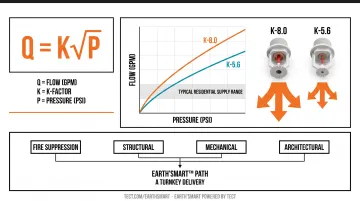
Selecting the right K-factor is a primary design lever for managing pressure demand — particularly relevant for homes where available supply sits at the lower end of the range.
For homeowners in wildfire-prone areas rebuilding from scratch, the decisions around sprinkler type, pipe sizing, and water supply must be made together and early. These parameters interact, and changing one affects the others. Getting them integrated at the concept stage prevents the costly deficiencies that force system redesigns mid-construction. This is the kind of coordination earth'smart powered by tect builds into every project through the Earth'smart™ Path A Turnkey Delivery process — fire suppression strategy engineered alongside structural, mechanical, and architectural decisions from day one.
When Available Pressure Falls Short
When hydraulic calculations reveal the municipal supply or well cannot meet the system's pressure demand, engineers have several design responses. The right choice depends on the gap between supply and demand, the water source type, and the building configuration.
The three primary solutions:
Fire pump or booster pump — adds pressure directly to the supply. Most common solution for tall buildings or long pipe runs. Governed by NFPA 20 (Standard for the Installation of Stationary Pumps for Fire Protection)
On-site water storage tank with dedicated pump — used when municipal supply is unavailable or insufficient in both volume and pressure. Governed by NFPA 22 (Standard for Water Tanks for Private Fire Protection). Per the Home Fire Sprinkler Coalition, a tank and pump combination is a well-established solution when public water is unavailable or insufficient
Design-side adjustments — higher K-factor sprinklers to reduce pressure demand, quick-response heads to reduce the required design area size, or larger diameter pipe to reduce friction losses
Qualified engineers typically combine several of these approaches. The mix depends on what the supply analysis reveals — a pressure deficit alone may only require a booster pump, while a home with no municipal connection at all requires a complete on-site solution.
For WUI homes in remote locations, that means a self-contained fire water supply: dedicated tanks, pumps, and distribution sized for fire-event response. Earth'smart powered by tect's Earth'smart™ projects integrate this infrastructure alongside FIREBOZZ® water cannons and vapor dome systems, operating independent of any municipal connection.
Common Misunderstandings About Fire Sprinkler Water Pressure
"My household water pressure is fine, so the sprinkler system should be fine."
Municipal pressure typically runs 45–80 PSI at the street. But by the time water passes through a meter, backflow preventer, pipe runs, elevation changes, and fittings, the residual pressure at the most remote head can fall well short of what the system requires. An NFSA example shows a 5/8-inch meter alone losing 18 PSI at 26 GPM — which means street pressure and system pressure at the furthest head are two very different figures.
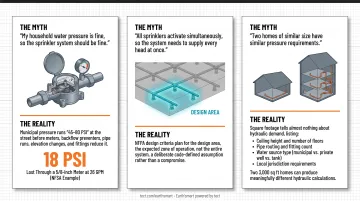
"All sprinklers activate simultaneously, so the system needs to supply every head at once."
NFPA design criteria plan for the most demanding subset of heads — the design area — to activate, not the entire system. NFPA's density/area methodology explicitly defines the design area as the expected zone of operation for demand calculations. This is a deliberate, code-defined assumption — not a compromise. Designing for whole-system activation would produce drastically oversized and overpriced water supplies.
"Two homes of similar size have similar pressure requirements."
Square footage tells almost nothing about hydraulic demand. Each of these factors affects pressure calculations independently:
- Ceiling height and number of floors
- Pipe routing and fitting count
- Water source type (municipal vs. private well vs. tank)
- Local jurisdiction requirements
Two 3,000 sq ft homes can produce meaningfully different hydraulic calculations. Pressure demand must always be determined for the specific installation.
Frequently Asked Questions
What PSI should a residential sprinkler system be?
Residential systems under NFPA 13D typically require pressure at the water source ranging from about 40 PSI for small, simple single-story homes to 100 PSI or more for larger or multi-story homes. The specific value must be calculated based on the home's configuration, pipe layout, elevation, and water source — it cannot be estimated from square footage alone.
How many GPM is a fire sprinkler system?
Most residential systems are designed for two simultaneously operating heads, typically requiring 26–40 GPM total depending on head selection. Flow demand scales with hazard classification, pipe layout, and the number of design heads — your fire protection engineer will calculate the required GPM based on your specific system.
What is the minimum water pressure for a fire sprinkler head to activate?
7 PSI is the absolute minimum at any sprinkler head — below this, water cannot push through when the heat element breaks. This is a hard lower boundary, not a design target; actual source pressure must be substantially higher to cover elevation, friction, and fitting losses between the supply and the head.
What happens if my home's water pressure is too low for a sprinkler system?
Engineers address low pressure through a fire pump or booster pump, an on-site storage tank with a dedicated pump, or design-side changes such as larger pipe diameter or higher K-factor sprinkler heads. A qualified fire protection engineer determines the right combination based on how large the gap is and what supply is available.
Does municipal water pressure always meet fire sprinkler requirements?
Not always. Municipal pressure frequently needs supplementing, particularly for multi-story homes, long pipe runs, antifreeze systems, or homes far from the main. A flow test at the point of connection — measuring both static and residual pressure under flow — is required before design can be finalized.
How is fire sprinkler system water pressure tested and verified?
Water supply capacity is determined through a flow test, typically conducted at a nearby fire hydrant using pitot gauges to measure both static and residual pressure under flow. NFPA 291 (2022 edition) provides the standard practice for conducting these tests and using the results to confirm whether the available supply meets system demand.