A fire-rated door assembly isn't a single product. It's a tested and certified system — door leaf, frame, hardware, and glazing — that must work together to contain smoke and flames for a defined duration. Getting any one component wrong can void the rated performance of the entire system.
This guide covers the components of a fire-rated door assembly, how ratings and testing work, glazing rules, how wall fire ratings drive door requirements, and what homeowners rebuilding in high-risk areas need to understand before making these decisions.
Key Takeaways
- A fire-rated door assembly has four components — door, frame, hardware, and glazing — each individually certified and functioning together as a rated system.
- Fire ratings run from 20 to 180 minutes; the wall's fire resistance rating determines the minimum door rating required.
- Swinging doors must pass positive pressure testing (UL 10C or NFPA 252) per IBC, in addition to fire endurance and hose stream tests.
- Fire protective glazing is capped at 100 sq. in. in 60–90 minute doors; fire resistive glazing (marked "W") is required to exceed that limit.
- Unlisted hardware swaps or field modifications can void the assembly's fire label — get assembly decisions right at the design phase.
What Makes Up a Fire-Rated Door Assembly?
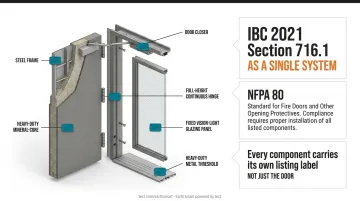
Four elements make up a fire-rated door assembly — and each must be individually listed, certified, and installed together per NFPA 80. A gap in any one of them voids the assembly's rating entirely.
The Door Leaf
The rated door panel itself can be constructed from steel, wood composite, or specialized materials. What confirms the rating isn't the material or appearance — it's the certification label from a nationally recognized testing laboratory (NRTL) such as UL or Intertek (which uses the Warnock Hersey mark). No label means no verified rating, regardless of what the manufacturer claims.
The Frame
Frames must be separately listed and certified for use in fire-rated assemblies. They also need to be compatible with both the door's rating and the wall construction type — masonry anchoring requirements differ from steel or wood stud framing. An unlisted or mismatched frame invalidates the entire assembly.
Rated Hardware
Every hardware component — hinges, locks, closers, latches, flush bolts, and fire exit devices — must be individually tested and listed. Two requirements apply without exception:
- Closes automatically under fire conditions, without manual intervention
- Latches positively to hold the door shut against fire pressure
Any unlisted hardware substitution in the field voids the fire label. This is one of the most common ways a compliant assembly becomes non-compliant after installation.
Glazing
Glazing is optional but heavily regulated. It must be separately certified, and its size, type, and placement are governed by code rules that vary by door rating. Selecting the wrong glazing type or exceeding permitted size limits creates a non-compliant assembly — even if every other component is correctly specified.
Why the Assembly Concept Matters
While most components are listed separately, they perform as a single system under fire conditions. IBC 2021 Section 716.1 requires opening protectives to comply with Section 716 and be installed in accordance with NFPA 80 — the standard governing fire door installation. In some cases, specific components are tested together and must be used as a unit. For homeowners rebuilding or specifying a new home, this means verifying that every component carries its own listing label — not just the door — before installation begins.
Fire Door Rating Levels: What 20, 45, 60, 90, and 180 Minutes Actually Mean
The rating number reflects how long the assembly can withstand standardized fire exposure in a controlled test. It doesn't guarantee that exact performance in a real fire. During testing, the door must remain in its frame with no through-openings and must limit flame penetration for the full rated duration.
Common Rating Tiers and Where They Apply
| Rating | Typical Application |
|---|---|
| 20 min | Corridor walls, smoke barriers, fire partitions |
| 45 min | 1-hour fire barriers (other than shaft/egress enclosures) |
| 60 min | 1-hour shaft enclosures, interior exit stairways/ramps |
| 90 min | 2-hour fire walls and fire barriers |
| 180 min | 3- and 4-hour fire walls — steel assemblies only |
According to SDI's fire ratings overview, only steel door assemblies qualify for the 3-hour (180-minute) rating.
Temperature Rise Ratings
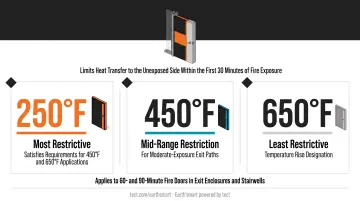
Beyond the hourly fire rating, some doors carry a temperature rise rating that limits heat transfer to the unexposed side within the first 30 minutes of fire exposure. Three tiers exist:
- 250°F — most restrictive; satisfies requirements for 450°F and 650°F applications
- 450°F — mid-range restriction for moderate-exposure exit paths
- 650°F — least restrictive temperature rise designation
These ratings apply to 60- and 90-minute doors in exit enclosures and stairwells, where occupants may still be evacuating through the space.
The "S" Smoke Designation
The "S" designation is a separate air leakage rating tested under UL 1784 — distinct from the hourly fire rating. It most commonly applies to 20-minute doors in rated corridors and smoke barriers. A door can carry an hourly fire rating without an "S" designation; specify it only where code or design explicitly requires smoke leakage control.
How Fire-Rated Door Assemblies Are Tested
Fire Endurance and Hose Stream
The door assembly is exposed to a furnace replicating fire conditions for the full rated duration. To pass, the door must stay in the frame with no through-openings and limit flame penetration throughout.
After the endurance test, the assembly faces a hose stream — which confirms it can withstand the mechanical force of firefighting operations and remain closed. 20-minute doors are typically exempt from the hose stream test under US building codes.
The IBC requires fire door assemblies to be tested to either NFPA 252 or UL 10C. The key difference:
- NFPA 252 — standard fire endurance test for door assemblies
- UL 10C — positive pressure fire test, replicating real fire conditions where pressure builds on the fire side of the door
Third-Party Certification and Labeling
Fire ratings are only valid when granted through a formal listing program by an NRTL. OSHA recognizes UL LLC and Intertek Testing Services NA, Inc. as NRTLs for this purpose. The certification label on each component — not the manufacturer's spec sheet or the door's appearance — is what building inspectors, fire marshals, and insurance carriers verify.
Label Integrity After Installation
A certified assembly's label can be voided by:
- Improper installation not following manufacturer instructions or NFPA 80
- Non-listed substitute components
- Field modifications not authorized by the manufacturer
If a door has been modified and its label status is uncertain, both UL and Intertek offer field evaluation and field labeling services to resolve the question — don't assume the original rating survives unauthorized changes.
Glazing in Fire-Rated Doors: Rules, Limits, and Design Implications
Fire Protective vs. Fire Resistive — A Critical Distinction
These two glazing categories are not interchangeable:
- Fire protective glazing (specialty tempered glass, filmed ceramics, wired glass) blocks smoke and flames but allows radiant heat to pass through.
- Fire resistive glazing (marked "W," tested to ASTM E-119) also limits radiant heat transmission — it's the only category that meets temperature rise criteria for large vision panels in higher-rated doors.
This distinction determines what's code-permissible, not just what performs better aesthetically.
Size Limits Under Current Code
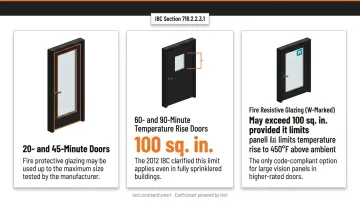
- 20- and 45-minute doors: fire protective glazing may be used up to the maximum size tested by the manufacturer
- 60- and 90-minute temperature rise doors: fire protective glazing is strictly limited to 100 sq. in. — the 2012 IBC clarified this limit applies even in fully sprinklered buildings
- Fire resistive glazing (W-marked, tested as part of the assembly): may exceed 100 sq. in. provided it limits temperature rise to 450°F above ambient — the only code-compliant option for large vision panels in higher-rated doors
Impact Safety Requirements
Fire performance isn't the only glazing standard that applies — impact safety runs in parallel and cannot be traded off against fire rating.
Under CPSC 16 CFR Part 1201, all glazing in hazardous locations (doors, sidelites) must meet one of two impact thresholds:
- Category I: 150 ft-lb impact resistance (smaller panels)
- Category II: 400 ft-lb impact resistance (larger panels)
Traditional wired glass lost its safety glazing exemption under the 2006 IBC across all new construction and occupancy types. For homeowners specifying fire-rated doors with vision panels, this means both ratings — fire performance and impact resistance — must be confirmed on the same piece of glass before the assembly qualifies.
How Wall Fire Ratings Determine Your Door Requirements
The fire resistance rating of the wall sets the minimum fire protection rating of the door installed in it. The door — as the weakest point in a rated assembly — must provide proportional protection to maintain compartmentation.
That proportional relationship holds in most cases, but the actual IBC 2021 Table 716.1(2) requirements are more specific than the common shorthand suggests:
| Wall Type | Wall Rating | Minimum Door Rating |
|---|---|---|
| Fire walls / fire barriers | 4 hr or 3 hr | 3 hr (180 min) |
| Fire walls / fire barriers | 2 hr | 1.5 hr (90 min) |
| Shaft, interior exit stairway/ramp fire barriers | 1 hr | 1 hr (60 min) |
| Other fire barriers | 1 hr | 45 min |
| Fire partitions, corridor walls, smoke barriers | 1 hr | 20 min |
The commonly cited "1-hour wall needs a 45-minute door" rule only applies to certain fire barriers. Shaft enclosures and exit stairways with 1-hour ratings require 60-minute door assemblies — a meaningful difference. When in doubt, pull the specific IBC table row for your wall type rather than relying on the shorthand.
The Assembly-Minimum Rule
The effective fire rating of a door assembly is limited by the lowest-rated component in it. If the door slab is rated 90 minutes but the hardware is only listed for 60 minutes, the assembly performs at 60 minutes.
Every component must be individually verified and listed for the intended application before the assembly is considered compliant:
- Door slab — rated and labeled for the required fire duration
- Frame — listed to match the door's fire rating
- Hardware — hinges, latches, and closers all carry individual listings
- Glazing — any glass or lite must be separately rated for the opening
One unlisted component pulls the entire assembly's rating down.
Fire-Rated Doors in High-Risk Home Design: What Homeowners Need to Know
Why This Matters in WUI and California Fire Zones
Homes in Fire Hazard Severity Zones and WUI communities face mandatory requirements under California Building Code Chapter 7A. CBC 2022 Section 701A.3 applies to new buildings in any FHSZ or WUI Fire Area designated by the enforcing agency. Under Section 708A, exterior doors must meet Chapter 7A wildfire exposure options — including a minimum 20-minute fire protection rating or other listed assembly pathways specified in the code.
NIST research on WUI structure losses identifies doors among 40 building vulnerabilities, with embers and direct fire exposure as the primary ignition mechanisms. A correctly specified, labeled, and installed fire-rated door assembly buys critical time for evacuation and limits interior fire spread. These vulnerabilities also explain why installation errors — not just product choices — are responsible for so many non-compliant assemblies in the field.
Common Specification and Installation Mistakes
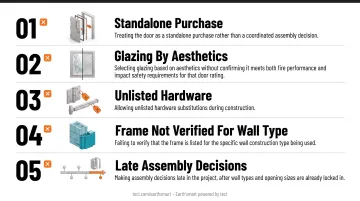
These errors consistently produce non-compliant assemblies:
- Treating the door as a standalone purchase rather than a coordinated assembly decision
- Selecting glazing based on aesthetics without confirming it meets both fire performance and impact safety requirements for that door rating
- Allowing unlisted hardware substitutions during construction
- Failing to verify that the frame is listed for the specific wall construction type being used
- Making assembly decisions late in the project, after wall types and opening sizes are already locked in
Getting Assembly Decisions Right from the Start
Fire-rated door assembly decisions shouldn't be made at the end of a project or delegated to whoever is ordering materials. By the time construction begins, the wall assembly, opening dimensions, and structural framing are already set. Changing them to accommodate a different door specification is costly — and sometimes impossible.
Earth'smart powered by tect's approach to fire-resilient residential builds in Pacific Palisades and surrounding WUI communities integrates these decisions from the design phase. Through the earth'smart powered by tectApp community of 70+ building product manufacturers, homeowners and their design teams connect with the right product expertise early — while glazing specifications, hardware listings, frame compatibility, and fire rating requirements can still be coordinated before decisions are locked in.
For homeowners navigating a rebuild in a high-risk area, that kind of early coordination is the difference between an assembly that performs as rated and one that looks right but isn't.
Frequently Asked Questions
What is a fire door assembly?
A fire door assembly is the complete system of door leaf, frame, hardware, and glazing that has been tested and certified to contain smoke and flames for a specified duration. It's the assembly as a whole — not the door alone — that holds the fire rating. Replacing any component with an unlisted substitute can void the rating.
What are the different fire rating levels for fire-rated doors?
Standard rating durations are 20, 45, 60, 90, and 180 minutes. The required rating depends on the fire resistance rating and type of the wall in which the door is installed. Only steel door assemblies have achieved the maximum 3-hour (180-minute) rating.
Do fire-rated doors need to be self-closing?
Yes. Fire-rated doors are required by code to be both self-closing and positive latching. A fire door propped open or lacking a functioning closer provides no compartmentation and is a code violation under NFPA 80.
What is the difference between fire protective and fire resistive glazing?
Fire protective glazing blocks smoke and flames but passes radiant heat through. Fire resistive glazing, marked "W" and tested to ASTM E-119, also limits radiant heat transmission. Only fire resistive glazing is permitted for vision panels exceeding 100 sq. in. in 60–90 minute assemblies.
How does the wall fire rating determine the door fire rating?
The wall type and rating set the minimum door rating per IBC Table 716.1(2). A 2-hour fire wall requires a 90-minute door; a 1-hour corridor wall requires only a 20-minute door. There's no single formula — always verify against the IBC table for your specific wall type.
Are fire-rated door assemblies required for residential homes?
Requirements vary by jurisdiction. Homes in California Fire Hazard Severity Zones or WUI areas are subject to CBC Chapter 7A, which mandates fire-rated assemblies at specific exterior openings. Even where not explicitly required, fire-rated assemblies provide meaningful protection for homes in any high-risk area.