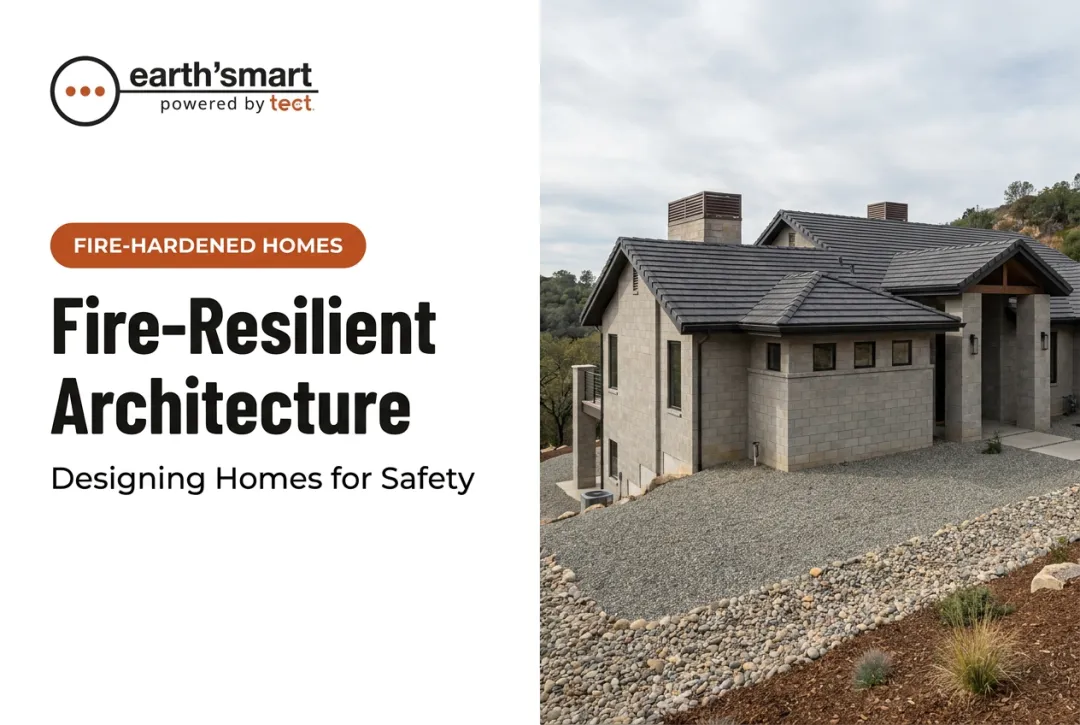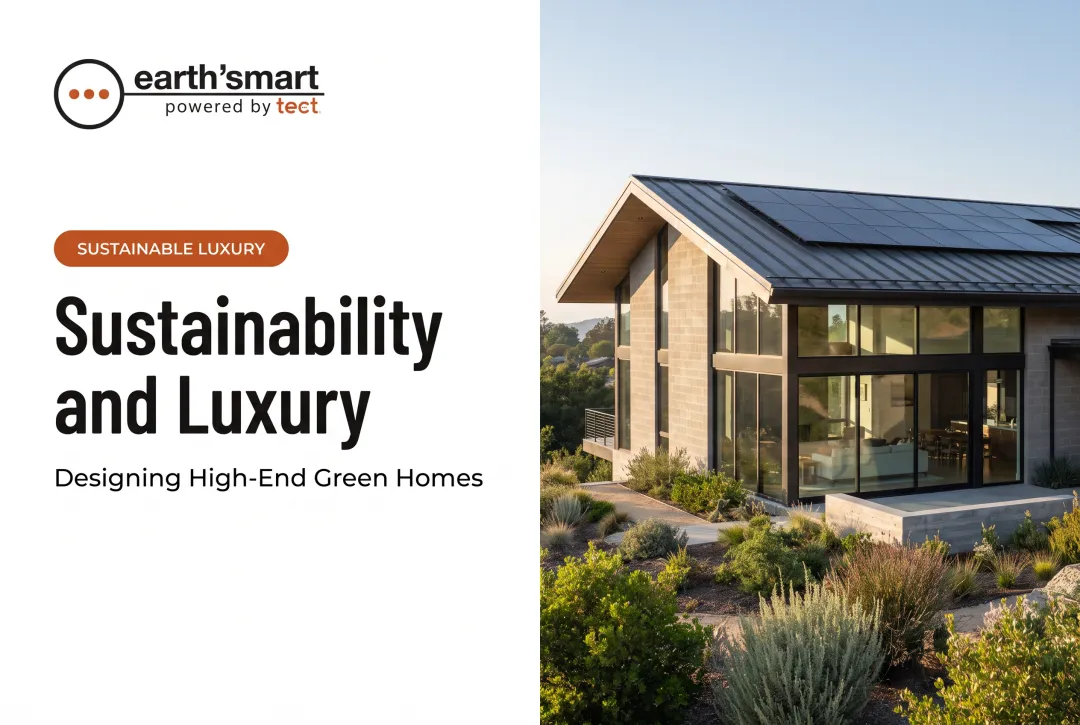
For homeowners in places like Pacific Palisades, this isn't an abstract design philosophy. When a home sits in a fire-prone, seismically active region, material choices carry real consequences. They shape whether the home survives a wildfire event, whether it remains insurable, and whether it holds its performance and value across generations — not just years.
That convergence of sustainability, resilience, and long-term value is what this article explores: the materials, systems, and design principles that make a luxury home genuinely high-performance, and why getting those decisions right early is the most important thing a homeowner can do.
Key Takeaways
- Buildings and construction account for 34% of global CO2 emissions — luxury homeowners in high-risk zones have real leverage to change that
- Sustainable materials like ICF, recycled steel, and CLT are also among the most fire- and weather-resistant options available
- 40%–60% energy reduction is achievable with Passive House-standard envelope design vs. code-built construction
- Wildfire-resistant upgrades typically add less than 1% of total construction cost when integrated at the design stage
- Envelope, orientation, structural system, and material choices determine most of a home's long-term performance — and all four are decided early
Why Sustainable Materials Matter More in High-Risk Luxury Builds
Conventional luxury construction tends to prioritize finishes over fundamentals. In wildfire-prone and Wildland-Urban Interface (WUI) regions, that approach carries real risk — because the materials that form the structure and envelope determine both environmental responsibility and survival under fire exposure. In high-risk builds, eco-friendly and high-performance have become the same category.
The Carbon Case for Getting This Right
The scale of the problem is significant. According to the UNEP/GlobalABC Global Status Report for Buildings and Construction 2024/25, buildings and construction accounted for approximately 34% of global energy demand and 34% of global CO2 emissions in 2023. High-end residential rebuilds — particularly in fire-affected communities like Pacific Palisades — represent an outsized opportunity to model better practice.
Lifecycle Costs vs. First Costs
The financial case for sustainable materials in luxury homes is strongest when evaluated over time, not at the point of purchase. RMI's analysis of zero-energy homes found that zero-energy-ready homes carried incremental cost premiums of just 0.9% to 2.5% over conventional construction — while delivering mortgage-life energy savings that more than offset that premium over 30 years.
A conventionally built luxury home accumulates costs in ways that aren't visible at closing:
- HVAC equipment working harder to condition a leaky envelope
- Finishes requiring replacement within 15–20 years
- Systems that were never coordinated and can't compensate for each other
Sustainable construction prices in durability and performance from the start — which is why the lifetime cost comparison consistently favors it.
Insurance Exposure in WUI Markets
Material choices affect insurability directly. In California, the numbers now make the case on their own:
- California's Department of Insurance requires insurers to offer mitigation discounts of 4% to 40% for homes meeting Safer from Wildfires criteria
- IBHS research published in 2025 found wildfire-resistant upgrades for a typical 2,000-square-foot home cost roughly $2,000 to $5,000 — generally under 1% of total construction cost
- Those upgrades may be partially offset by reduced premiums or increased property value
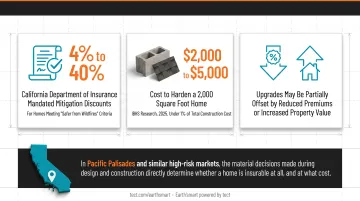
In Pacific Palisades and similar markets where coverage is increasingly difficult to obtain, the material decisions made during design and construction directly determine whether a home is insurable at all — and at what cost.
The Best Eco-Friendly Materials for Luxury Homes
Structural and Envelope Materials
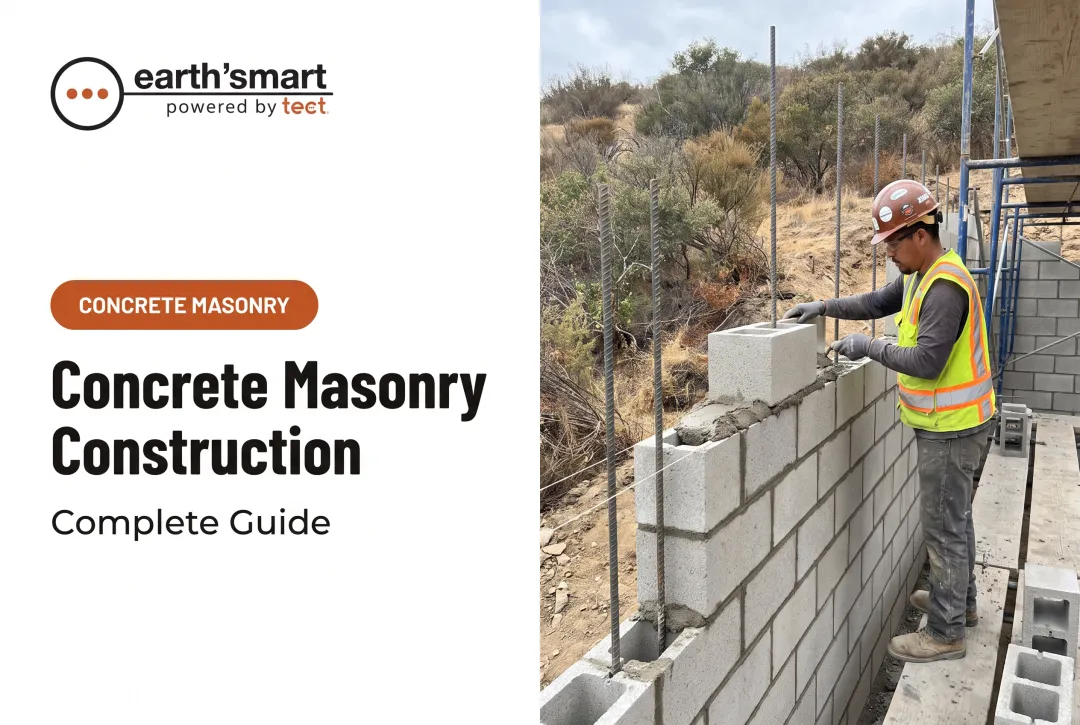
Insulated Concrete Forms (ICF) are one of the strongest sustainable structural choices for high-risk residential construction. ICFs consist of expanded polystyrene (EPS) foam forms filled with reinforced concrete, delivering whole-wall R-values of R-24 and above — with some assemblies reaching R-47 or higher.
That thermal performance translates directly to energy savings: ICF construction can reduce peak heating loads by up to 57% and cooling loads by 16%, according to manufacturer testing data from Nudura.
From a fire-resilience standpoint, a 6-inch core load-bearing ICF wall can achieve a 4-hour fire-resistance rating under ASTM E119. That's a structural choice that simultaneously lowers carbon footprint through reduced HVAC demand and raises fire survival odds substantially.
Cross-Laminated Timber (CLT) brings a different set of advantages. As an engineered wood panel system, CLT can replace steel and concrete in appropriate structural applications, with meaningfully lower embodied carbon than either material. Its aesthetic value in luxury design is significant — exposed CLT creates warmth and visual texture that concrete alone cannot.
One important caveat: CLT fire performance in WUI zones depends on member sizing, charring behavior, and exposure conditions. CLT is not appropriate for all structural applications in fire-prone luxury builds without project-specific fire engineering. It performs best when the structural role, member sizing, and assembly detailing are confirmed early — before design locks in.
Recycled steel framing completes the structural toolkit. According to the Steel Framing Industry Association, cold-formed steel framing contains a minimum of 25% recycled steel and is 100% recyclable at end of life. It's noncombustible, holds its shape under temperature swings, and ductile under seismic loading — a strong fit for multi-hazard environments where fire, earthquake, and wind exposure all need to be addressed.
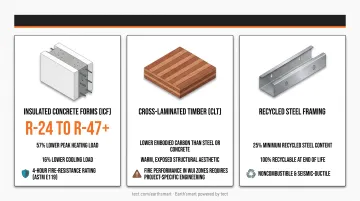
At a glance — structural material tradeoffs:
| Material | Key Strength | Primary Consideration |
|---|---|---|
| ICF | R-24+ thermal; 4-hr fire rating | Higher upfront cost than wood frame |
| CLT | Low embodied carbon; warm aesthetic | Requires fire engineering in WUI zones |
| Recycled Steel | Noncombustible; seismic ductility | Thermal bridging needs to be managed |
Interior and Finish Materials
Reclaimed wood — used for flooring, ceiling beams, and accent walls — delivers sustainability credentials that new lumber cannot match. It diverts material from the waste stream, eliminates the need for new logging, and brings a texture and provenance that manufactured finishes rarely replicate. Proper sourcing and treatment matter: reclaimed material needs to be vetted for prior chemical exposure, kiln-dried appropriately, and finished with products suited to a high-performance sealed interior.
Low-VOC paints, finishes, and adhesives become critical in high-performance luxury homes specifically because those homes are tightly sealed. According to the EPA, indoor VOC concentrations already average 2–5 times higher than outdoors — and can spike to 1,000 times outdoor levels during and immediately after applying conventional finishes.
In a home with excellent air-sealing and mechanical ventilation, specifying low-VOC products from the start is a health decision as much as an environmental one. Luxury-grade low-VOC finishes are now widely available without performance compromise.
Passive Design and High-Performance Building Systems
Starting with Passive Principles
The foundation of a sustainable luxury home is passive design — not solar panels, not geothermal, not any active system. Proper site orientation, south-facing glazing, strategic overhangs, and thermal mass work together to reduce the mechanical load on heating and cooling equipment. These are design decisions, not product decisions. They cost nothing to specify correctly and are nearly impossible to fix after construction.
In luxury residential design, the concern is often that passive principles conflict with large open volumes, extensive glazing, and spatial freedom. They don't — they shape those choices instead. A well-designed luxury home in Southern California can use glazing extensively if that glazing is high-performance, the overhangs are sized correctly for the latitude, and the thermal mass is positioned to absorb and release heat on the right schedule.
The Envelope as a System
Passive design principles only deliver their full benefit when paired with a coordinated building envelope:
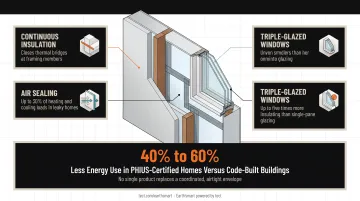
- Continuous insulation closes thermal bridges at framing members (the point where conventional insulation consistently fails)
- Air sealing prevents uncontrolled infiltration, which accounts for up to 30% of heating and cooling loads in leaky homes
- Triple-glazed windows outperform double-pane units by a wide margin; LBNL research has shown thin-glass triple-pane technology can be up to five times more insulating than single-pane glazing
No single product choice replaces the need for a coordinated, airtight envelope. That coordination is the core discipline — selecting and specifying every component as a system, not in isolation. PHIUS-certified projects built to Passive House standards use 40% to 60% less energy than code-built buildings as a direct result.
Water and Energy Systems
With the envelope performing at that level, water conservation and energy systems can do their jobs efficiently. Both depend on being designed in from the start, not added later:
- Greywater recycling and rainwater harvesting: EPA WaterSense-labeled homes must be at least 30% more water-efficient than typical new construction; in Southern California, water strategy should be treated as a primary design consideration
- Solar and geothermal: Most effective when the envelope load is minimized first — a tight, well-insulated envelope reduces the system size and upfront cost required to offset remaining demand
- Energy Recovery Ventilation (ERV): Essential in tightly sealed homes to maintain indoor air quality without sacrificing the energy performance gained through air-sealing
Where Sustainability and Resilience Converge
For homeowners in regions like Pacific Palisades, sustainability and resilience aren't competing goals. They're the same goal approached from different directions.
The design and material choices that minimize environmental impact (durability, reduced replacement cycles, high-performance envelopes) are often identical to the choices that protect a home against fire, seismic activity, and extreme weather. This is where the sustainable luxury home delivers its highest value.
The Material Overlap
Consider how specific material properties align across both objectives:
| Material | Sustainability Credential | Resilience Credential |
|---|---|---|
| ICF walls | Low operating energy demand, long lifespan | 4-hour ASTM E119 fire rating |
| Metal roofing | Long lifespan, recyclable at end of life | Noncombustible, ember-resistant |
| Recycled steel framing | High recycled content, 100% recyclable | Noncombustible, ductile under seismic load |
| Fiber cement cladding | Durable, low maintenance, no new logging | Noncombustible, weather-resistant |
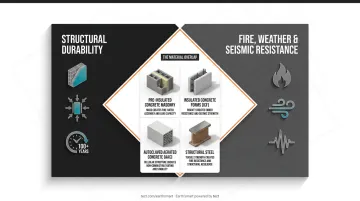
Each material above isn't pulling double duty by compromise — it performs both functions because the underlying properties that create durability also create resistance to fire, weather, and structural stress.
Building to Last Is a Sustainability Strategy
Building to last is a sustainability strategy in its own right. A home designed and specified to perform for 100+ years is inherently more sustainable than one that requires significant repair or replacement within 30–40 years because every replacement cycle carries its own embodied carbon cost. This is the difference between a permanent upgrade and a temporary solution.
Reaching this level of performance requires that materials, structure, systems, and envelope are designed to work together. Those decisions must be made correctly at the concept stage, not revisited during construction when changes are costly and options are limited.
That's where earth'smart powered by tect's coordination model makes a measurable difference. Powered by the earth'smart powered by tectApp community of 70+ building product manufacturers, earth'smart powered by tect connects homeowners and their design teams directly to manufacturer expertise from the earliest stages of a project. In conventional luxury residential construction, product decisions typically happen late, with limited manufacturer input and conflicts discovered during installation. The earth'smart powered by tectApp model reverses that sequence: the right expertise is present when design decisions are made, not after they've been locked in.
As earth'smart powered by tect's Bob Habian, AIA puts it, the goal is homes where systems are not guessed — they are understood, integrated, and delivered correctly from the start.
Green Certifications That Signal Real Performance
Certifications matter because they provide third-party verification of what a home actually performs — not just what it claims to.
LEED for Homes
LEED (Leadership in Energy and Environmental Design) is a widely recognized green building standard with certified performance across energy, water, materials, and indoor environment quality. USGBC data shows LEED-certified homes use 20% to 30% less energy than non-green homes on average, with some reaching 60% savings. For luxury homeowners and their insurers, LEED certification provides a structured, verifiable signal of performance that informal claims cannot.
Passive House (PHIUS)
For homeowners who want to go further, PHIUS certification sets the most demanding energy efficiency standard in residential construction. A certified Passive House combines extreme air-tightness, continuous insulation, and mechanical ventilation with heat recovery — each element coordinated to perform as a whole rather than added as separate upgrades. In climates with high cooling demand (like Southern California) or wide temperature swings, the results are measurable: 40% to 60% less energy than code-built buildings, as documented by PHIUS.
Net Zero Energy
Net Zero Energy certification — through pathways like the DOE Efficient New Homes Program or Living Future's Zero Energy Certification — aligns sustainability with energy independence. Living Future's standard requires that 100% of a building's energy needs on a net annual basis be supplied by on-site renewables.
In fire-prone areas where grid disruption is a recurring reality, that independence carries direct resilience value. For WUI homeowners in Southern California, a home that generates and stores its own power stays operational during outages — when the grid goes down, the house doesn't have to.
Key factors that make Net Zero meaningful in high-risk regions:
- On-site generation removes dependence on utility infrastructure during emergencies
- Battery storage extends usable power through multi-day outages
- Net metering can offset energy costs during normal grid operation
- Certification through Living Future or DOE provides documented, third-party verification
Frequently Asked Questions
What is the 80/20 rule in architecture?
In sustainable home design, roughly 80% of a home's long-term energy performance and environmental impact is determined by 20% of early design decisions — particularly envelope, orientation, structural system, and material selection. These foundational choices matter far more than any individual finish or appliance selected later.
What is the most eco-friendly material to build a house with?
There's no single answer. Materials like ICF, CLT, reclaimed wood, and recycled steel consistently rank highly for low embodied carbon, durability, and long-term performance. The most eco-friendly choice depends on the specific climate, structural requirements, and how the material is integrated into the building system as a whole.
Are sustainable luxury homes more expensive to build?
Upfront costs are often in line with conventional construction, or modestly higher. Total cost of ownership — accounting for reduced energy bills, lower maintenance, and longer material lifespans — typically favors the sustainable approach, and in high-risk regions, resilience-grade materials may also reduce insurance costs.
Can eco-friendly materials also withstand fire and extreme weather?
Many of the most sustainable materials — ICF, metal roofing, fiber cement, recycled steel framing — are also among the most fire- and weather-resistant available. In WUI and high-risk zones, choosing eco-friendly materials often means choosing the most resilient ones at the same time. Sustainability and resilience, in most material decisions, point in the same direction.
What should I prioritize first when designing a sustainable luxury home?
Start with site orientation, building form, and envelope performance — these decisions lock in most of a home's long-term energy performance and can't be corrected later. Early coordination between architect, structural engineer, and material specialists, ideally with direct manufacturer input, is what makes them stick.