The FAIR Plan was designed as a last resort: a safety net for homeowners who genuinely cannot find private coverage. Using it as a permanent solution often means overpaying for a policy that leaves significant gaps. Many homeowners don't realize that better alternatives exist — or that their own eligibility for private coverage may have changed.
This guide covers four concrete alternatives worth exploring before settling for the FAIR Plan, plus what you can do at the construction level to change your risk profile for good.
Key Takeaways
- FAIR Plan coverage is narrow: fire, lightning, smoke, and internal explosions only — no liability, theft, water damage, or additional living expenses
- Four alternatives exist: standard private market, high-risk specialty insurers, Excess & Surplus (E&S) lines, and a FAIR Plan + DIC policy combo
- Start with an independent broker — they reach markets most homeowners never find on their own
- Wildfire mitigation and fire-resistant construction directly affect insurer eligibility and can unlock private market coverage
- Treat the FAIR Plan as a bridge, not a destination — review your options every year
Why the California FAIR Plan Often Falls Short
The California FAIR Plan is a state-mandated insurer of last resort, funded by licensed California insurers. It exists for homeowners who cannot qualify for private market coverage — not as a substitute for comprehensive homeowners insurance.
What the FAIR Plan Covers (and Doesn't)
The FAIR Plan's Dwelling Fire Policy is a named-peril policy. According to the FAIR Plan's own policy documents, it covers only:
- Fire and lightning
- Internal explosions
- Smoke
- Optional add-ons: Extended Coverage (windstorm, hail, etc.) and Vandalism or Malicious Mischief
What it excludes — even when vandalism coverage is added:
- Theft, burglary, and larceny
- Personal liability
- Most water damage (surface water, sewer/drain backup)
- Additional living expenses (ALE) — limited Fair Rental Value at 10% of Coverage A, not the full ALE found in standard HO-3 policies
- Flood and earthquake
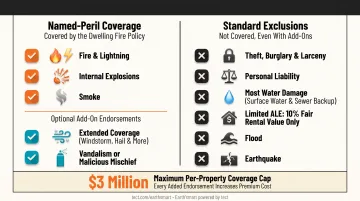
The residential coverage cap sits at $3 million per property. Optional endorsements can fill some gaps, but each one adds cost — and costs are already moving in one direction.
The Real Cost of Relying on the FAIR Plan Alone
FAIR Plan premiums are already elevated because it insures the highest-risk properties. A 2026 Assembly Insurance Committee presentation confirms the FAIR Plan submitted a September 2025 rate filing requesting a 35.8% increase, with an actuarial rate need of 80%.
The coverage gaps compound that cost problem. Without liability protection, a single slip-and-fall lawsuit on an uninsured property can exceed years of premium savings. For homeowners rebuilding after a wildfire, that exposure runs for the entire reconstruction period — sometimes 18 months or longer.
4 Better Alternatives to the California FAIR Plan
These four options are listed in order of preference — start with the best coverage at the most competitive cost, and work down based on your property's risk profile and eligibility.
Alternative 1: Standard Private Market Insurance
This is always the first step. Standard admitted carriers offer HO-3 or HO-5 policies covering dwelling, personal property, liability, and additional living expenses — everything in a single policy. Work with an independent broker who shops multiple carriers, not a captive agent tied to one company.
That broker search matters more than it did two years ago. Under California's Sustainable Insurance Strategy, carriers including Farmers, Mercury, CSAA, USAA, Pacific Specialty, and California Casualty have committed to expanding their California footprint. Farmers removed its cap on new homeowners policies entirely in late 2025. The FAIR Plan's clearinghouse program also allows private insurers to review anonymized FAIR Plan policies and identify homes they may want to offer coverage on.
| Category | Details |
|---|---|
| Best For | Homeowners in elevated but not extreme-risk areas who have made fire mitigation improvements |
| Coverage Scope | Comprehensive: dwelling, personal property, liability, ALE — all in one policy |
| How to Access | Licensed independent insurance broker shopping multiple admitted carriers |
Alternative 2: High-Risk / Specialty Private Insurers
Specialty carriers have built their underwriting models around properties in wildfire-prone areas, including the Wildland-Urban Interface (WUI). They accept elevated risk that standard admitted carriers decline — and offer full-coverage policies rather than named-peril plans.
Premiums run higher than standard policies, and eligibility criteria typically require fire mitigation measures. The CDI's Safer from Wildfires program identifies key features that affect eligibility and pricing:
- Class A fire-rated roofing
- 5-foot ember-resistant zone (including fencing)
- Ember- and fire-resistant vents
- Non-combustible material for the bottom 6 inches of exterior walls
- Combustible sheds moved at least 30 feet from structures
The coverage depth (liability, ALE, personal property) far exceeds what the FAIR Plan provides, even after add-ons.
| Category | Details |
|---|---|
| Best For | Homeowners in Very High Fire Hazard Severity Zones declined by standard carriers |
| Coverage Scope | Full homeowners policy (HO-3/HO-5 equivalent) tailored to fire-prone properties |
| How to Access | Independent brokers or agents specializing in high-risk California residential insurance |
Alternative 3: Excess & Surplus (E&S) Lines Insurance
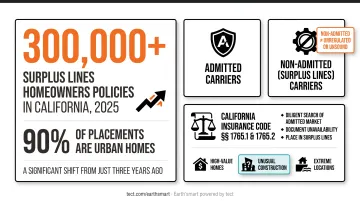
E&S carriers are not admitted (licensed) in California but are authorized to cover hard-to-place risks. They operate outside standard regulatory pricing constraints, which gives them more flexibility to underwrite unusual or high-risk properties: very high-value homes, unusual construction, or extreme locations that even specialty admitted carriers decline.
"Non-admitted" does not mean unregulated or financially unsound. California Insurance Code Sections 1765.1 and 1765.2 establish the vetting framework for surplus line carriers. E&S brokers are also required to conduct a diligent search among admitted carriers before placing business in the surplus lines market.
Surplus lines homeowners policies in California surpassed 300,000 in 2025, with urban homes accounting for roughly 90% of placements — a significant shift from where E&S stood just three years ago.
| Category | Details |
|---|---|
| Best For | Properties declined by both standard and specialty admitted carriers |
| Coverage Scope | Varies; can be comprehensive, but terms and exclusions differ from admitted market — review carefully |
| How to Access | Must be placed through a licensed surplus lines broker; not available directly to consumers |
Alternative 4: FAIR Plan + Difference in Conditions (DIC) Policy
When no private market option is available, this combination is the fallback. The FAIR Plan covers fire, lightning, smoke, and explosions. A separately purchased DIC (wrap-around) policy fills the gaps — adding liability, theft, water damage, and ALE — to create a combined package that approximates a standard HO-3 policy.
Before you buy, know how this combination actually works:
- The FAIR Plan does not sell DIC policies — you must purchase DIC separately from a private insurer
- The California Department of Insurance maintains a public list of carriers offering DIC policies
- CDI reports that for every two FAIR Plan policies issued, there is approximately one DIC wrap-around — meaning many FAIR Plan policyholders are going without
- Review policy language carefully to ensure the two policies align without gaps in limits, deductibles, or exclusions
| Category | Details |
|---|---|
| Best For | Homeowners who cannot qualify for any private market option but need more than basic fire protection |
| Coverage Scope | FAIR Plan (fire perils) + DIC (liability, theft, water damage, ALE) — together approximates a standard policy |
| How to Access | FAIR Plan through a licensed California broker; DIC purchased separately from a private insurer |
How to Compare These Options Properly
When weighing insurance alternatives, most homeowners stop at the premium — and that's where the comparison goes wrong. The right metric is total cost of coverage.
A bare FAIR Plan policy often looks inexpensive — until you add the DIC policy needed to fill the gaps. The combined cost frequently exceeds what a single specialty insurer policy would cost for equivalent protection. Always compare fully-loaded cost against full scope of coverage.
When evaluating any option, ask:
- Does it cover liability? (A single lawsuit can exceed years of premium savings)
- Does it cover additional living expenses? (Critical if you need to vacate during repairs)
- Does it cover theft and water damage?
- What is the claims process reputation of this carrier? A policy is only as good as the claims experience behind it — slow or disputed payouts leave you financially exposed when it matters most.
How Your Home's Construction Affects Your Insurance Options
Insurers don't just look at your ZIP code — they evaluate your property's specific risk profile. Homes built or rebuilt to fire-resistant standards are materially more attractive to private market carriers than standard construction at the same address. CDI confirms that wildfire mitigation discounts range from 4% to 40% for qualifying improvements, and carriers are required to offer them.
For homeowners currently rebuilding after a wildfire — particularly in Pacific Palisades — the rebuild isn't just a restoration. It's a once-in-a-generation opportunity to change a home's risk classification permanently.
What Fire-Resilient Construction Actually Looks Like
Standard code-minimum construction isn't designed to satisfy today's underwriting environment. Most rebuilds simply replicate what was there before. The result: the home re-enters the same risk tier it was in before the fire.
A different approach addresses risk at the system level:
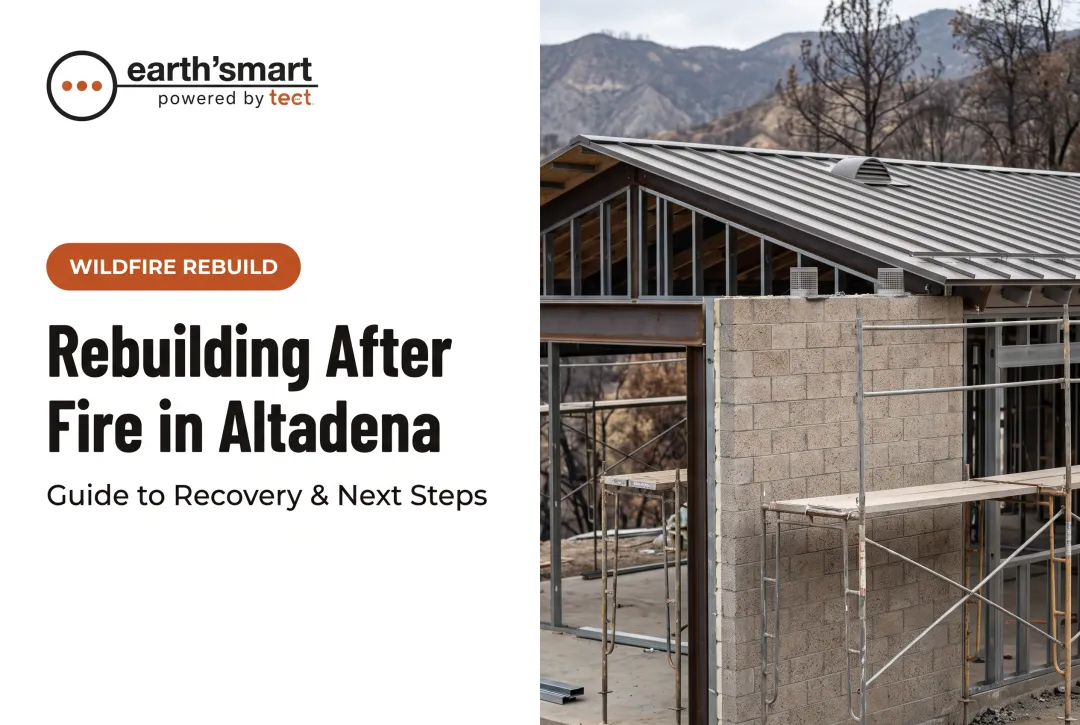
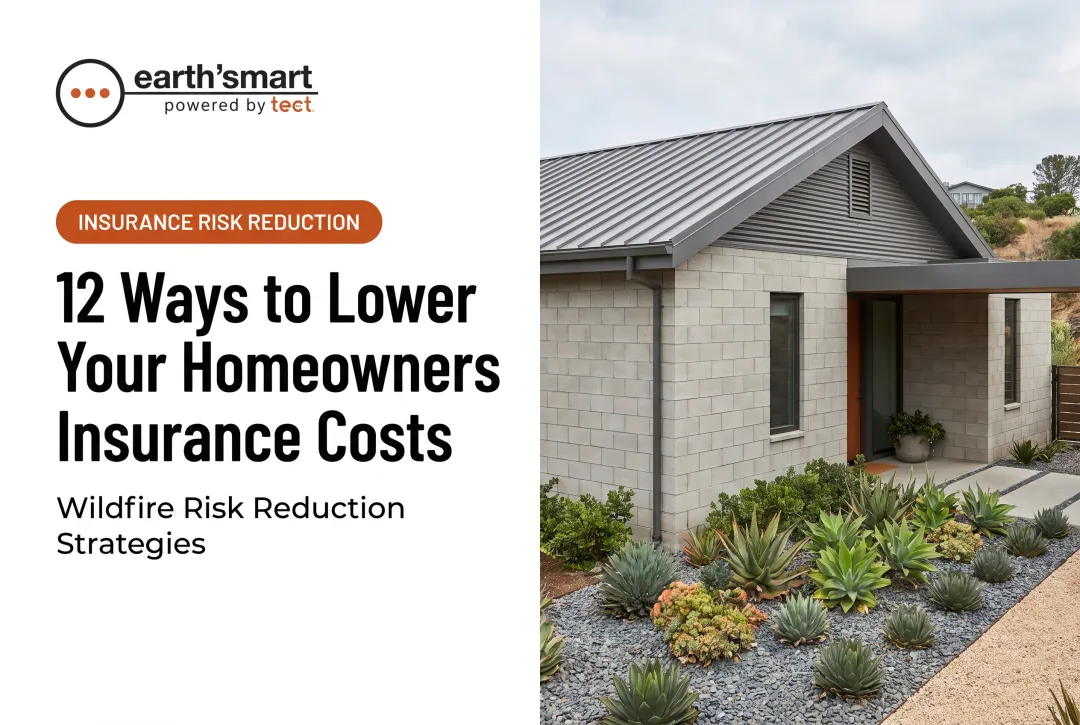
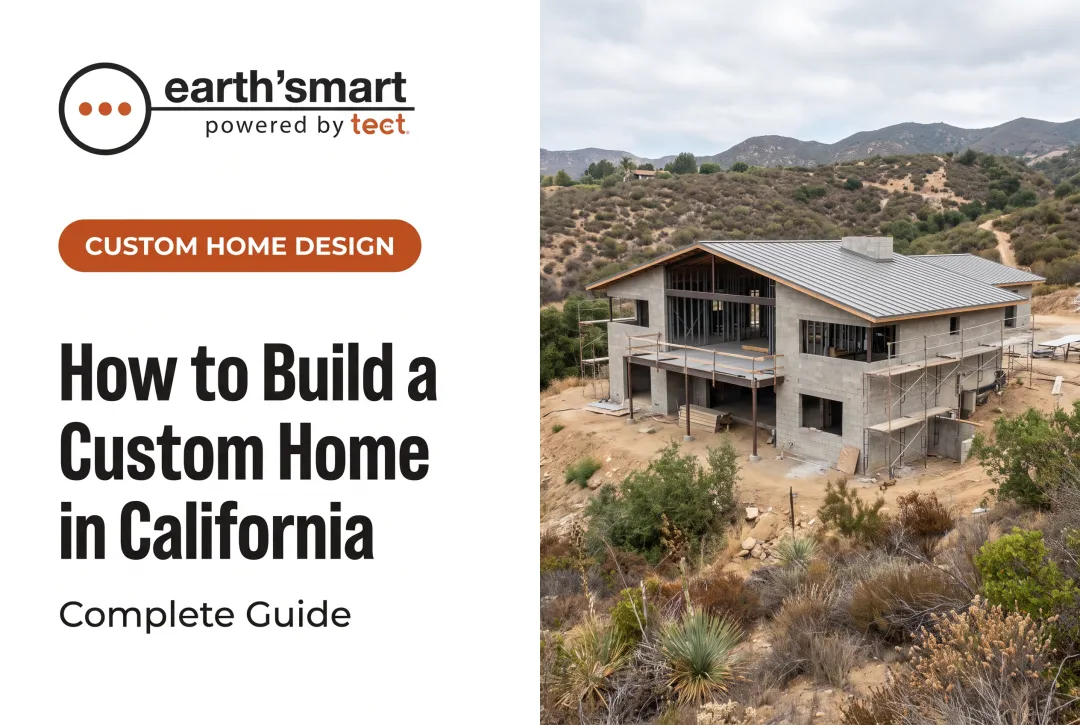
- Pre-insulated concrete masonry exterior walls that create a non-combustible barrier
- Non-combustible materials and assemblies throughout the structure, not just at the perimeter
- Long-life roofing and structural systems integrated from design through construction
- On-site water supply integrated with site-scale fire suppression
- Fire-resistant decisions made at concept stage, coordinated across all disciplines before framing begins
This is where earth'smart powered by tect's approach directly applies. Earth'smart powered by tect's Earth'smart™ program integrates fire-resistive assemblies, non-combustible materials, and suppression systems from concept through construction — coordinated through the earth'smart powered by tectApp™ community of 70+ building product manufacturers. That early coordination ensures fire-resilient decisions are made when they matter most, not after framing is complete.
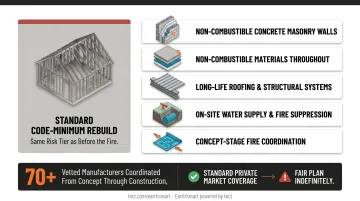
A home engineered to this standard presents a fundamentally different risk profile to an underwriter. That difference can determine whether you qualify for standard private market coverage or remain on the FAIR Plan indefinitely.
Conclusion
The California FAIR Plan was designed as a last resort, not a long-term solution. Homeowners in high-risk areas have real alternatives — and the right choice depends on your property's current risk profile, your budget, and how proactive you are about fire mitigation.
Start with a licensed independent broker. Review your coverage options every year. Carrier appetite is changing, and eligibility that didn't exist 18 months ago may exist today. If you're rebuilding, don't restore what was there before. The rebuild is your best chance to change your home's risk classification for good.
If you're rebuilding in Pacific Palisades or another high-risk area and want to understand how resilient design and construction can affect your insurance options, contact earth'smart powered by tect at (310) 913-5000 or reach Bob Habian, AIA directly at bob@tect.com. The conversation starts with understanding what your rebuild could be — built forward, not just restored.
Frequently Asked Questions
What are the alternatives to the California FAIR Plan?
Four main options exist: standard private market insurance (HO-3/HO-5), high-risk specialty insurers that underwrite WUI properties, Excess & Surplus lines carriers for hard-to-place risks, and a FAIR Plan policy paired with a DIC (wrap-around) policy. An independent broker is the best starting point to determine which fits your property.
Do I have to have the California FAIR Plan?
No. The FAIR Plan is a last resort for homeowners who cannot find coverage in the private market — not a requirement. Any homeowner who qualifies for a private policy should pursue that first and treat the FAIR Plan as a fallback only when all private options are exhausted.
What does the California FAIR Plan not cover?
The major exclusions include personal liability, theft, most water damage, additional living expenses, flood, and earthquake. Some gaps can be patched with optional endorsements or a DIC policy, but the combined cost often exceeds a single comprehensive private policy.
How much does California FAIR Plan insurance cost compared to a private policy?
FAIR Plan premiums are typically higher than comparable private policies because it covers the highest-risk properties, and a pending rate filing has requested a 35.8% increase. When a DIC policy is added to fill coverage gaps, the combined cost frequently exceeds what a single comprehensive private policy would cost.
Can building a fire-resilient home help me qualify for private insurance instead of the FAIR Plan?
Yes. A property's construction and fire-mitigation features directly affect insurer eligibility decisions. Homes with fire-rated materials, ember-resistant details, non-combustible assemblies, and defensible space are more likely to qualify for standard or specialty private market coverage — and California requires insurers to offer mitigation discounts ranging from 4% to 40% for qualifying improvements.