Key Takeaways
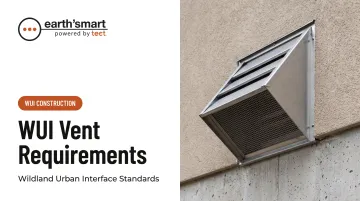
- Vents are the primary ember entry point in wildfires — standard 1/8" mesh fails under NIST-documented conditions
- California requires OSFM-listed, ASTM E2886-tested vents for all ventilation openings in Fire Hazard Severity Zones
- Governing codes: CBC Chapter 7A, CRC Section R337.6, and the 2025 California WUI Code — effective January 1, 2026
- WUI-listed vents have lower Net Free Ventilation Area than standard vents — your vent count calculations must be redone
- Non-compliant vents block permits, fail inspections, and jeopardize wildfire insurance eligibility
Why Vents Are the #1 Entry Point for Wildfire Embers
Most people picture a wildfire reaching a home through direct flame contact. According to IBHS research, wind-blown embers are the principal cause of building ignitions. Embers can travel miles ahead of a fire front, landing on and entering structures long before flames arrive. USFS research confirms that wind can carry firebrands significant distances, making ember exposure a threat across wide areas.
Attic and crawl space vents exist to manage moisture and cross-ventilation — intake at the eave or soffit, exhaust at the ridge. That same airflow path becomes an ember highway during a wildfire event.
Why 1/8" Mesh Isn't Enough
The common assumption is that any fine mesh will stop embers. NIST testing showed otherwise: firebrands continued burning until small enough to pass through a 3 mm (approximately 1/8") screen — and ignited fires inside test structures once through. The mesh doesn't stop small, still-burning embers. It just slows the larger ones.
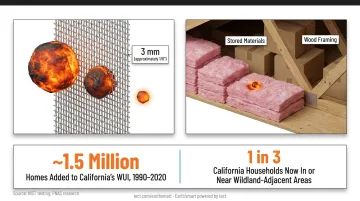
Once embers breach a vent and enter an attic or crawl space, they encounter the conditions they need: insulation, stored materials, wood framing.
Ignition happens inside the structure, often before anyone detects it. By the time firefighters respond, the interior is already burning.
That interior ignition risk now affects a far larger population than it once did. PNAS research found that California added nearly 1.5 million homes in the WUI between 1990 and 2020, with more than one in three California households now in or near wildland-adjacent areas. Conventional vents were never designed for this environment.
Who Must Comply: Understanding Fire Hazard Severity Zones
WUI vent requirements aren't universal across California — they apply to specific parcel designations. The California OSFM classifies Fire Hazard Severity Zones (FHSZ) under two frameworks:
- State Responsibility Areas (SRA): Any FHSZ designation — Moderate, High, or Very High — triggers WUI requirements
- Local Responsibility Areas (LRA): Only parcels designated Very High FHSZ are subject to the requirements
All new structures, additions, and exterior alterations in these zones must comply — regardless of occupancy type, project size, or building use.
Verifying Your Parcel
Don't assume your parcel's status. Confirm the designation using one of these official resources before specifying any products:
- CAL FIRE FHSZ & Local PIO Viewer — statewide parcel lookup
- City of Los Angeles GeoHub — separate Very High FHSZ dataset for LA parcels
Homeowners rebuilding after the January 2025 Palisades Fire should confirm their parcel status through these tools before making any product decisions.
When Exceptions Apply
California allows limited exceptions — typically covering single-vent replacements or very minor repairs. If you're doing a substantial rebuild, those exceptions don't apply. Full WUI compliance is required, and partial patchwork upgrades won't satisfy plan review. Verify any claimed exception directly with your jurisdiction's plan review authority.
What the Code Requires: CBC Chapter 7A and CRC R337.6
Two primary code sections govern WUI vents in California:
- California Building Code (CBC) Chapter 7A, Section 706A — applies to most new construction
- California Residential Code (CRC) Section R337.6 — applies to one- and two-family dwellings
- 2025 California Wildland-Urban Interface Code (Title 24, Part 7) — effective January 1, 2026
What Must Be Covered
The requirement isn't limited to attic vents. Every ventilation opening on the structure must use an OSFM-listed or ASTM E2886-compliant vent:
- Enclosed attic spaces
- Eave and soffit openings
- Gable ends
- Ridge and off-ridge vents
- Enclosed rafter spaces where ceilings attach directly to rafters
- Underfloor and crawl space openings
- Foundation vents
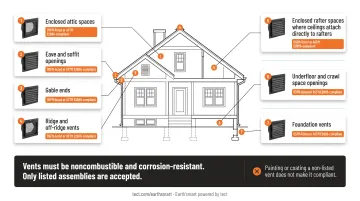
Material rule: Vents must be noncombustible and corrosion-resistant. Painting or coating a non-listed vent does not make it compliant. Only listed assemblies are accepted.
Ridge and Off-Ridge Vents
Ridge and off-ridge vents have one additional requirement beyond the listed assembly standard. Where these vents are used, they must be covered with noncombustible corrosion-resistant mesh. This mesh reduces the vent's Net Free Ventilation Area — and the recalculated NFVA must be submitted with permit documents.
Documentation Requirements
Construction documents must demonstrate compliance before a permit is issued. Plan reviewers and inspectors check for:
- Product specifications with OSFM listing numbers
- Manufacturer details confirming the listed assembly
- Installed products that match the approved submittal
The certificate of occupancy confirms WUI compliance. Non-compliant products discovered at final inspection delay the certificate of occupancy and may require demolition and replacement.
ASTM E2886: What "WUI-Listed" Actually Means
Not every ember-resistant vent qualifies as a WUI-listed vent — and that gap can stop a permit in its tracks.
ASTM E2886/E2886M — Standard Test Method for Evaluating the Ability of Exterior Vents to Resist the Entry of Embers and Direct Flame Impingement — is the testing standard that defines compliance. It runs two test sequences:
- Ember Intrusion Test: Embers are directed at the vent assembly. Cotton indicator material placed behind the vent must not ignite.
- Flame Intrusion Test: Direct flame is applied. Temperature on the unexposed side must stay within the specified threshold.
A vent that passes both sequences can be submitted to the California State Fire Marshal (OSFM) for listing under Category 8165. Products that complete this process appear in the OSFM Building Materials Listing (BML) database and the 2025 OSFM WUI Listed Products Handbook.
Before specifying any vent product: search the OSFM BML database to confirm the specific model is currently listed. Listings can be added, suspended, or removed, so a product listed last year may not be listed today. Confirm the listing at specification time, before permit submittal.
Types of WUI-Compliant Vents and Where Each Is Required
WUI compliance covers every ventilation opening, and different locations have different product configurations.
Attic, Eave, and Soffit Vents
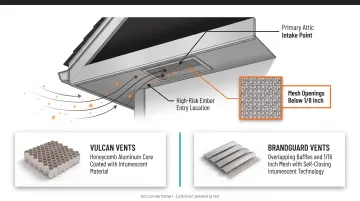
Soffit and eave vents are the primary attic intake points — and among the highest-risk ember entry locations given their orientation to wind-driven ember travel. WUI-listed soffit vents typically combine fine mesh (well below 1/8") with intumescent elements that expand and seal the vent opening when exposed to heat.
Two common approaches from listed manufacturers:
- Vulcan Vents: honeycomb aluminum core coated with intumescent material
- BrandGuard Vents: overlapping baffles and 1/16" mesh with self-closing intumescent technology
Gable End and Ridge Vents
Gable end vents and ridge vents serve as attic exhaust. In WUI applications, ridge vents require noncombustible corrosion-resistant mesh — which reduces the product's Net Free Ventilation Area (NFVA) compared to standard versions. Pull the product-specific NFVA from the manufacturer's data sheet before finalizing selection, then recalculate your ventilation ratios accordingly.
Foundation and Crawl Space Vents
Ember intrusion into crawl spaces often goes undetected until wood framing and subfloor materials have already ignited. WUI-listed foundation vents use the same ember-blocking and intumescent technology as attic vents and must carry OSFM listing. An unprotected crawl space vent is a direct ignition path — treat it with the same urgency as any attic opening.
Enclosed Rafter Spaces
Where ceilings attach directly to the underside of roof rafters — cathedral ceilings and similar assemblies — any ventilation openings in those enclosed rafter spaces also require WUI-listed vents. This is one of the most commonly overlooked application points during design. If your roof assembly includes this configuration, verify vent compliance is addressed in the construction documents before permit submittal.
Selecting and Installing WUI Vents: What Homeowners Get Wrong
Choosing Products Before Verifying Listings
The most common mistake: selecting a vent based on appearance, price, or a contractor's familiarity, only to find out at plan review that it lacks a current OSFM listing. Only products confirmed in the OSFM BML database at the time of permit submittal are acceptable. Verify listing status at the specification stage, not after products are purchased.
The NFVA Trap
WUI-listed vents restrict airflow more than standard vents. Their tighter mesh and internal baffles reduce Net Free Ventilation Area compared to conventional products. This matters because California requires minimum ventilation ratios — typically 1/150 of the attic floor area, with a 1/300 exception where specific conditions are met.
If you swap in WUI-listed vents without recalculating NFVA, you may end up with:
- An under-ventilated attic that fails code
- A need to add more vent openings than the original design planned
- Changes to framing or finish details late in the project
Use each listed product's published NFVA from the manufacturer's data sheet. Don't apply a universal multiplier: NFVA varies by product, and no code-endorsed ratio applies across all listed products.
That accuracy depends on knowing which products you're using before the permit package is assembled — which brings up how and when vent selection should happen.
Specifying at the Right Stage
The projects that run into trouble are the ones where vent selection gets treated as a contractor field decision rather than a design-phase specification. By the time a contractor is ordering vents, the soffit framing, ridge detailing, and ventilation ratio calculations should already account for the specific listed products being used.
This is where earth'smart powered by tect's Earth'smart™ approach differs from standard practice. Through the earth'smart powered by tectApp™ community of 70+ vetted building product manufacturers, ember-resistant vent specifications are built into the design phase — coordinated alongside roofing assemblies, eave details, and suppression system design rather than added afterward.
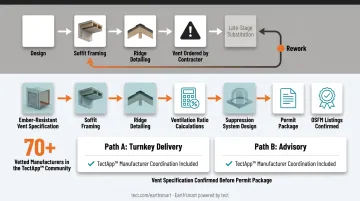
For homeowners rebuilding in Pacific Palisades or elsewhere in California's WUI, that upstream coordination is what prevents the rework that comes from late-stage product substitutions.
Both Earth'smart™ Path A (Turnkey Delivery) and Path B (Advisory) include this manufacturer coordination — Path A as part of a fully integrated team, Path B layered onto an existing architect and contractor relationship. In either case, the vent specification is confirmed against current OSFM listings before the permit package goes in.
Frequently Asked Questions
What is a WUI vent?
A WUI vent is a ventilation product tested and listed to resist ember intrusion and direct flame impingement through ventilation openings in homes located in Wildland-Urban Interface zones. California Building Code Chapter 7A and CRC Section R337.6 require these products on all ventilation openings in designated Fire Hazard Severity Zones.
What is the "7x rule" for WUI venting?
The "7x rule" is an informal reference to the fact that WUI-listed vents (due to their fine mesh and baffles) often have substantially lower Net Free Ventilation Area than standard vents. There is no universal code-endorsed multiplier; NFVA reduction varies by product. Use the specific NFVA published on each product's data sheet, and resubmit recalculated ventilation ratios with your permit documents.
What are the WUI vent standards in California?
The governing standards are CBC Chapter 7A (Section 706A) and CRC Section R337.6, reinforced by the 2025 California WUI Code (Title 24, Part 7), effective January 1, 2026. All listed WUI vents must pass ASTM E2886 testing and carry OSFM approval, verified through the OSFM Building Materials Listing database.
Do I need WUI vents in enclosed rafter spaces?
Yes. CRC R337.6 explicitly covers enclosed rafter spaces where ceilings are applied directly to the underside of rafters. Any ventilation openings in that assembly must use OSFM-listed WUI vents. The number of rafter bays vented is governed by your overall ventilation ratio requirements, not a specific WUI rule.
Can existing vents be retrofitted to meet WUI requirements?
California allows a narrow exception for replacing a single vent without triggering full compliance. Any broader replacement project requires OSFM-listed products. Some manufacturers offer listed retrofit products designed to cover or replace existing non-compliant vents ; confirm OSFM listing status before purchasing.
What happens if my WUI-zone home doesn't have compliant vents?
Non-compliant vents result in plan review rejection, failed inspections, and no certificate of occupancy until resolved. The California Department of Insurance's Safer from Wildfires framework also flags non-compliant vents, and insurers are increasingly using compliance status to determine both coverage eligibility and premium pricing.