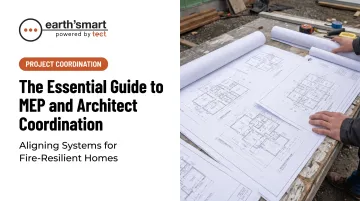
This sequential approach isn't just inconvenient. It's expensive. According to Dodge Construction Network's 2024 research, coordination issues were the primary cause of quality challenges for 33% of contractors, driving an average 9% increase in project budgets.
MEP coordination is the alternative: a deliberate process of aligning mechanical, electrical, and plumbing system design with architectural decisions from the earliest stages — not after the fact.
This guide covers what MEP coordination is, why it matters especially for performance and resilient homes, what breaks down without it, and what to look for in a building team that actually does it well.
Key Takeaways
- MEP coordination means architects and engineers review each other's decisions continuously throughout design, from schematic phase forward
- Poor coordination causes physical field conflicts, compressed living space, performance failures, and budget overruns
- In WUI and fire-resilient homes, uncoordinated MEP decisions carry direct life-safety implications
- MEP engineers should be engaged at schematic design — before floor plans are locked
- Ask your building team one direct question: when do MEP engineers first review architectural drawings?
What Is MEP Coordination and Why Does It Matter?
MEP stands for mechanical, electrical, and plumbing — the three systems that make a home livable:
- Mechanical covers HVAC equipment, ductwork, and ventilation
- Electrical covers power distribution, panels, and lighting systems
- Plumbing covers water supply, drainage, and waste lines
All three must physically share space inside walls, ceilings, floor assemblies, and chases — the same spaces that also contain structural framing. Coordination is what ensures none of these systems collide.
What Coordination Actually Means
Coordination isn't two disciplines exchanging emails after the design is done. It means MEP engineers and architects are actively reviewing each other's decisions throughout the design process — so that:
- Duct runs are planned around beams, not threaded through them after the fact
- Electrical panels land in accessible, code-compliant locations the architect anticipated
- Mechanical rooms are sized and positioned in the floor plan from day one
The North America MEP services market was valued at USD 31.35 billion in 2023 and is projected to grow at a 7.4% CAGR through 2030. That trajectory reflects a construction industry increasingly treating system coordination as a baseline professional standard, not an optional service.
The Residential Gap
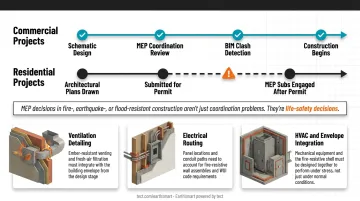
Commercial projects have addressed this for decades. A hospital or office tower engages MEP engineers at schematic design (the earliest design phase, runs full coordination reviews, and often uses Building Information Modeling to catch conflicts before construction begins.
Residential projects rarely do this. MEP subs are typically brought in after architectural plans are drawn and submitted for permit. The plans were never reviewed by the people who have to execute the systems inside them. That gap, rooted in sequence rather than incompetence, is the root cause of most residential system conflicts.
For high-performance and resilient homes, that sequencing gap carries real consequences. MEP decisions in fire-, earthquake-, or flood-resistant construction aren't just coordination problems — they're life-safety decisions. Three areas where this matters most:
- Ventilation detailing: Ember-resistant venting and fresh-air filtration must integrate with the building envelope from the design stage
- Electrical routing: Panel locations and conduit paths need to account for fire-resistive wall assemblies and WUI code requirements
- HVAC and envelope integration: Mechanical equipment and the fire-resistive shell must be designed together to perform under stress, not just under normal conditions
The Roles: Architect vs. MEP Engineer
These two disciplines are often confused or conflated. They're distinct, but each directly constrains the other.
| Role | Owns | Determines |
|---|---|---|
| Architect | Design vision: space planning, building envelope, aesthetics, life safety code compliance | How a building looks and how space functions |
| MEP Engineer | System design: HVAC sizing and routing, electrical load distribution, plumbing infrastructure | How a building's essential systems work |
Neither role overlaps the other. An architect designing a roofline without knowing where the mechanical unit lands can create an installation that's impossible or code-deficient. Ductwork routed without regard for architectural intent compromises ceiling heights, wall finishes, or the thermal envelope.
Why Both Disciplines Must Understand Each Other's Constraints
On well-coordinated projects, these decisions are made together, not handed off in sequence. A few examples of where constraint awareness matters:
- A floor plan that doesn't account for a mechanical room forces the HVAC system into undersized or awkward locations
- A structural wall placed where the electrical panel was planned means the panel moves — or the wall changes
- A tightly insulated assembly compromised by unplanned duct penetrations loses a significant portion of its thermal performance
The ASCE's Architectural Engineering Institute describes architectural engineering as the application of engineering principles to building design — distinct from structural engineering, which focuses on load distribution, and distinct from architecture, which focuses on form and function. These are complementary roles, but each carries responsibilities the others cannot absorb.
The Coordination Process: When MEP and Architect Work Together
Coordination isn't a single meeting. It's a phase-by-phase discipline that begins at schematic design and continues through field execution.
Schematic Design
This is when MEP engineers should first be engaged — before floor plans are finalized. Early involvement means:
- Mechanical room locations are designed in, not retrofitted
- Electrical panel placement is part of the floor plan conversation
- Plumbing chases are integrated with wall and floor assemblies
Retrofitting always costs more than designing correctly the first time. The AIA's Integrated Project Delivery guide describes this directly: the combined knowledge of key participants is most powerful early in a project, when informed decisions have the greatest effect and the cost of changes is lowest.
Design Development
This is the most intensive coordination phase. Structural framing, wall assemblies, and roof design are all being finalized simultaneously. MEP routing must be resolved against these decisions before construction documents are produced — once drawings go to contractors, changes get expensive fast.
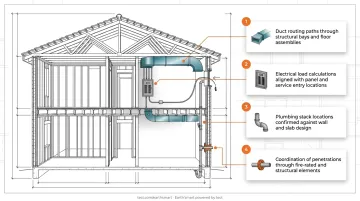
Key items that must be resolved at this phase:
- Duct routing paths through structural bays and floor assemblies
- Electrical load calculations aligned with panel and service entry locations
- Plumbing stack locations confirmed against wall and slab design
- Coordination of penetrations through fire-rated and structural elements
Construction Documents
Coordinated construction documents mean all disciplines — architectural, structural, and MEP — have been reviewed for conflicts before anything is issued for bid or permit. Uncoordinated documents passed directly to contractors are one of the leading causes of field change orders.
Autodesk and FMI's Construction Disconnected research found that poor project data and miscommunication were responsible for 48% of all U.S. construction rework, equal to $31.3 billion in rework costs. That's a general construction figure — but the mechanism applies directly to residential projects where drawings from different disciplines are never reconciled.
Field Coordination
Good documents reduce field friction — they don't eliminate it. Site conditions change. Products get substituted. Sequencing creates conflicts nobody anticipated on paper. Ongoing communication between the architect, MEP contractors, and the general contractor is where coordinated drawings become a coordinated building.
Earth'smart powered by tect builds this coordination structure into residential projects from the start. The Earth'smart™ Path A Turnkey Delivery model engages one aligned team — architecture, engineering, construction, and manufacturer input — from concept through construction.
System decisions get made early, with the right people in the room, before the cost of changing them compounds.
What Happens When MEP and Architecture Don't Align
Four categories of failure emerge consistently from uncoordinated projects.
The Clash Problem
When MEP systems are routed without reference to structural and architectural drawings, physical conflicts occur in the field: a duct running through a beam, a pipe where a window was planned, a panel in an inaccessible location.
Field resolution of these clashes is consistently more expensive than catching them in design. It means stopping work, coordinating trades, and potentially re-ordering materials.
The Space Problem
MEP systems take up real space. When this isn't accounted for architecturally:
- Ceiling heights get compressed to accommodate ductwork nobody planned for
- Mechanical rooms get carved out of living space
- Exposed conduit and ductwork compromise finished interiors
The Performance Problem
In resilient or high-performance homes, uncoordinated MEP directly undermines the building's intended performance. The DOE's air sealing research identifies duct and mechanical penetrations as primary sources of energy loss — leaky ducts in unconditioned spaces can account for 20% or more of a home's heating and cooling energy losses. Penetrations through insulated assemblies that aren't properly coordinated and sealed create thermal bypasses that erode the performance of the entire envelope.
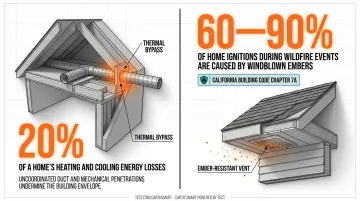
In wildfire-resilient homes, the stakes are higher. California Building Code Chapter 7A governs vents and openings in WUI zones because embers are estimated to cause 60–90% of home ignitions during wildfire events.
An ember-resistant vent designed into a coordinated assembly performs as intended. Selected and installed late — without integration into the envelope and structural design — it may not meet code or hold up under fire conditions.
The Accountability Problem
Uncoordinated teams create accountability gaps. When the architect hands off to MEP subs, who hand off to the contractor, no one owns the integrated outcome. Homeowners absorb the consequences: cost overruns, schedule delays, and systems that fall short of what was promised.
Tools That Enable Effective Coordination
Building Information Modeling (BIM)
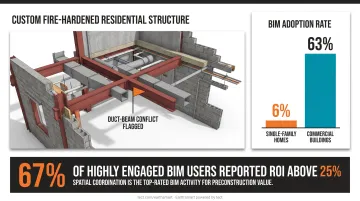
BIM is a shared 3D digital model of the building where all disciplines — architectural, structural, and MEP — work in the same environment. Clash detection within BIM can flag a duct-beam conflict in the model before a single piece of material is ordered.
BIM is standard practice on commercial projects. In residential construction, adoption has lagged significantly. Older Dodge/McGraw-Hill research estimated BIM use in single-family homes at roughly 6%, compared to 63% for commercial buildings — a technology gap that directly explains why residential coordination lags commercial by decades.
For contractors engaged with BIM, the returns are clear: 67% of highly engaged BIM users reported ROI above 25%, and spatial coordination is the top-rated BIM activity for value in preconstruction, according to Dodge's North America BIM research.
Other Coordination Tools
BIM handles the 3D model, but coordination depends on process too. Effective teams pair the technology with:
- Multi-discipline meetings that bring all trades to the table, not siloed discipline-by-discipline reviews
- Drawing cross-checks where MEP and structural sets are reviewed against architectural documents before issue
- Cloud-based platforms so every team member pulls from the same current, reconciled files
That last point — working from shared, current information — is where manufacturer input changes the equation. Earth'smart powered by tect's earth'smart powered by tectApp™ platform connects projects directly with 70+ vetted building product manufacturers across structure, envelope, mechanical, electrical, plumbing, and fire suppression systems. System specifications get set during design, when routing decisions are still open, not after they've already been locked in.
What Homeowners Should Look for in a Coordinated Design Team
Most homeowners assume their architect manages coordination. In fragmented delivery models, the architect often hands off to MEP engineers late — and may never reconcile conflicts before documents go to contractors.
Questions Worth Asking Before You Sign
Before committing to a design team, ask directly:
- When will MEP engineers be engaged? If the answer is "after we finish the architectural drawings," that's the sequential model — the source of most field conflicts.
- How are system decisions reviewed against architectural drawings? Look for a structured process, not "we communicate well" as the only answer.
- Who owns conflict resolution when MEP requirements and architectural design don't align? The answer should name a person or process, not defer to the contractor.
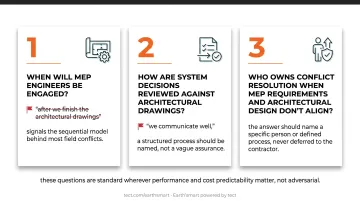
These questions aren't adversarial — they're standard for any project where performance and cost predictability matter.
What a Coordinated Team Looks Like
An integrated team engages MEP engineers at schematic design and reviews architectural and system drawings continuously as the design evolves. Engineers participate in the same decision-making process rather than working from a completed plan set handed to them late.
Product and material decisions are made with manufacturer input during design. Selections aren't pulled from a catalog after framing is complete — they're resolved before the first permit drawing is issued.
That's the standard earth'smart powered by tect holds for homeowners in Pacific Palisades and across California's WUI zones. Under Earth'smart™ Path A Turnkey Delivery, one aligned team covers architecture, engineering, construction, and manufacturer coordination from concept through construction. Under Path B Advisory, earth'smart powered by tect serves as an owner-side strategic advisor working alongside an existing team — providing early system guidance and direct manufacturer coordination through the earth'smart powered by tectApp™ community of 70+ vetted manufacturers. Both paths bring a depth of coordination that most residential projects never access.
Frequently Asked Questions
What is the difference between MEP engineer and architect?
Architects design the form, function, and envelope of a building — how it looks and how space functions. MEP engineers design the mechanical, electrical, and plumbing systems that make the building livable. In a well-coordinated project, these decisions are made together from the start rather than handed off sequentially between disciplines.
Do architectural engineers and structural engineers do the same job?
No. Architectural engineers focus on integrating building systems — including MEP — with the overall architectural design. Structural engineers focus specifically on how a building carries and distributes loads. They're complementary disciplines with distinct scopes, and both are needed on complex residential projects.
When should MEP engineers be involved in a home building project?
MEP engineers should be engaged at schematic design — before floor plans are finalized. Early involvement allows mechanical rooms, electrical panel locations, and plumbing chases to be designed into the building from the start. Retrofitting these systems after design decisions are locked in costs significantly more.
What happens when MEP systems and architecture aren't coordinated?
Three main consequences follow from poor coordination:
- Physical conflicts in the field that require costly rework
- Compromised interior space or finishes when systems don't fit as planned
- Performance failures where uncoordinated penetrations undermine energy efficiency, code compliance, or resilience in high-risk zones
How does MEP coordination affect construction costs?
Resolving a conflict during design costs a fraction of resolving it in the field. Poor coordination leads to change orders, construction delays, and rework expenses — all of which homeowners ultimately absorb through budget increases and schedule extensions.
What does good MEP-architect coordination look like in residential construction?
It looks like an integrated team: MEP engineers engaged at schematic design, reviewing drawings continuously, and working alongside the architect from the start. The goal is parallel collaboration, not a completed set of plans handed off after design decisions are already locked in. Earth'smart powered by tect's fully aligned delivery model is built specifically around this standard.