Introduction
Picture this: a homeowner in Pacific Palisades completes their custom rebuild. The home looks exactly as rendered. Then the first inspection reveals that a specified cladding system isn't available in California, the HVAC layout conflicts with the structural framing, and the final cost ran $400,000 over the original estimate. None of these were surprise problems — they were predictable ones that no one caught because the architect finished the drawings before the builder ever saw them.
This is what happens when architects and builders work in sequence rather than in sync.
Architect-builder collaboration determines far more than whether a home looks good. In custom homes — especially those in high-risk wildfire zones — it determines whether structural systems perform under stress, whether mechanical systems integrate without compromise, and whether the budget survives contact with reality.
This article breaks down how that collaboration works, what makes it succeed, and where most projects go wrong.
Key Takeaways
- Architect-builder collaboration works best when both parties are engaged before design begins, not after drawings are complete
- Early involvement prevents budget shocks, constructability failures, and late-stage redesigns
- Architects lead design vision; builders contribute cost reality, material feasibility, and construction sequencing
- In WUI and high-risk builds, collaboration must address structural systems, building envelope, and fire-resilient assemblies alongside floor plans
- Skipping or shortening construction administration is one of the most costly decisions a homeowner can make
What Is Architect-Builder Collaboration on a Custom Home?
Architect-builder collaboration means both parties work together from the start, rather than one finishing before the other begins. Each role stays distinct:
- Architect: design vision, spatial planning, and structural intent
- Builder: construction execution, cost management, and system integration
When those roles run in parallel, the result is a home that's both well-designed and actually buildable.
The Three Delivery Models
Understanding the difference between delivery models matters because it shapes who has authority over what — and when.
| Model | How It Works | Key Risk |
|---|---|---|
| Design-Bid-Build | Architect completes drawings; owner bids construction separately | Builder sees the design too late to prevent costly issues |
| Design-Build | Single entity handles both design and construction | Less owner control; design and cost decisions may conflict internally |
| Integrated Collaborative | Architect and builder are engaged separately but work together from the start | Requires deliberate structure; roles must be clearly defined |
According to AIA, design-bid-build remains the traditional model — the owner holds separate contracts with the architect and contractor, and the two typically interact only after design is complete. The integrated collaborative model challenges that sequence without eliminating the value of distinct roles.
That last model is where meaningful collaboration actually lives. Earth'smart powered by tect's Earth'smart™ delivery model follows this integrated approach directly — aligning architecture, engineering, construction, and manufacturer input from concept through completion. Decisions get made in the design phase, when revisions cost time on paper rather than money in the field.
Why Early Collaboration Determines Project Outcomes
The core principle is simple: the earlier a decision is made with input from all parties, the cheaper it is to adjust. The later a change happens, the more it costs — in money, time, and rework.
Research from the Construction Industry Institute found that quality deviations requiring rework — including redesign, repair, or replacement — account for an average of 12.4% of total installed project cost. On a $2 million custom home, that's $248,000 in avoidable costs.
What Happens When the Builder Arrives Late
When a builder is brought in only after full architectural drawings are complete, the sequence typically looks like this:
- Builder reviews drawings and flags constructability issues
- Architect revises drawings to address conflicts
- Budget estimate comes in over target
- Value engineering strips features the homeowner valued
- Timeline extends to accommodate redesign cycles
- Homeowner absorbs the cost and frustration of all of the above
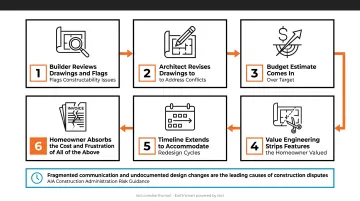
AIA's construction administration risk guidance identifies fragmented communication and undocumented design changes as leading causes of disputes — patterns that start forming the moment the two parties are kept apart during design.
What a Constructability Gap Looks Like
A constructability gap is the distance between what a drawing specifies and what can actually be built — within budget, on schedule, and to code. CMAA defines constructability review as a structured check for conflicts, errors, omissions, and ambiguities that could affect cost, schedule, or quality.
In practice, a constructability gap might look like:
- A specified exterior cladding material that's not available in the required fire-resistance rating for a WUI site
- A structural detail requiring a custom engineering solution that adds four weeks and $30,000
- A mechanical system layout that conflicts with beam placement established early in design
- A site access condition that wasn't factored into foundation or framing assumptions
For homeowners rebuilding in areas like Pacific Palisades, these gaps carry additional weight. California Building Code Chapter 7A regulates exterior wildfire-exposure construction methods across roofs, walls, vents, eaves, decks, and appendages. A system that doesn't meet 7A requirements can't be permitted. Discovering that after design is complete means starting over.
That's why earth'smart powered by tect connects project teams with its earth'smart powered by tectApp™ community of 70+ building product manufacturers at the pre-design stage — before any decisions are locked in. When manufacturer-level expertise on compliant systems and assemblies is available from day one, the team isn't discovering 7A conflicts after drawings are complete. They're building with that knowledge from the start.
How the Collaboration Process Works
The collaboration between architect and builder moves through three recognizable phases. The quality of communication at each phase directly affects the home's final performance, cost alignment, and timeline.
Phase 1: Pre-Design and Site Feasibility
Before a line is drawn, the team needs to understand the site. An effective architect-builder team conducts a joint assessment covering:
- Lot constraints and zoning setbacks
- Topography, slope stability, and drainage
- Solar orientation and prevailing wind
- Fire exposure classification and defensible space requirements
- Seismic zone and soil conditions
- Site access and construction logistics
Builders contribute knowledge of site preparation costs and ground conditions. Architects bring spatial strategy and code interpretation. Together, they produce the most important output of this phase: a realistic budget anchor.
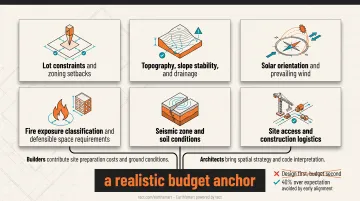
That anchor only works if it's set early. The mistake most projects make is designing first and budgeting second. A feasibility check at pre-design — before drawings exist — aligns design ambition with actual construction cost, and avoids the more painful conversation when a completed design prices out 40% over expectation.
Phase 2: Design Development and Constructability Review
As the architect produces floor plans, elevations, and sections, the builder provides concurrent input on:
- Structural feasibility of proposed systems
- Material costs and current lead times
- Local code compliance for specific assemblies
- Construction sequencing and access requirements
The constructability review in a well-run collaborative model isn't a single checkpoint — it's an ongoing dialogue. As design evolves, the builder flags issues so the architect can adjust before documentation is finalized. This prevents the common failure mode where an architect delivers completed permit drawings and a builder returns a list of dozens of conflicts.
For fire-resilient builds, this phase is where decisions about non-combustible exterior assemblies, integrated suppression systems, and long-life structural systems must be confirmed before framing begins — not deferred to it.
Phase 3: Construction and Field Coordination
The architect's role doesn't end at permit submission. AIA identifies construction administration as one of the standard phases of architectural service — and for good reason.
During construction, the architect:
- Conducts regular site visits to verify design intent is being met
- Reviews builder submittals and product substitution requests
- Responds formally to Requests for Information (RFIs) from the builder
- Issues clarifications when field conditions differ from drawings
Teams that skip this phase rely on field improvisation to resolve the inevitable gap between drawings and actual conditions. In practice, it introduces cost overruns, coordination conflicts, and design compromises that would have been avoidable with active oversight.
Key Factors That Shape How Well Architect-Builder Teams Work Together
Three factors separate functional collaboration from the kind that breaks down once construction is underway.
Role Clarity
Both parties need to understand where architectural authority ends and construction authority begins. A clean division looks like this:
- Design intent questions go to the architect
- Construction method questions go to the builder
- Budget or scope changes require homeowner approval
Disputes almost always start in the gaps between these categories — when a builder makes a material substitution that the architect considers a design decision, or when an architect specifies a construction sequence that conflicts with the builder's site management. Defining these boundaries upfront, in writing, is not optional.
Communication Structure
Good collaboration isn't just frequent communication — it's structured communication. That means:
- Documented meeting cadences (weekly during construction, biweekly during design)
- Shared project management tools with a single source of truth
- Formal channels for change orders and design clarifications
- The homeowner in the loop, not just informed after decisions are made
Verbal approvals and undocumented changes are the primary source of disputes and cost overruns. AIA's risk guidance identifies this pattern directly as a leading cause of legal exposure for architects — and financial exposure for homeowners.
Alignment on Performance Targets
In a high-risk or resilient build, aligning on aesthetics and budget isn't enough. The team must also document and own specific performance targets:
- Fire-resistance ratings for specific assemblies
- Structural redundancy requirements for seismic exposure
- Building envelope airtightness targets
- Energy and mechanical system integration
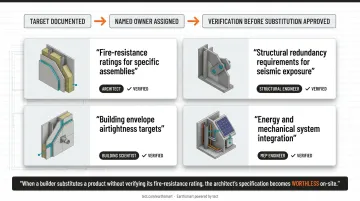
These targets need to be documented and owned by the team — not left to each trade to interpret independently. When a builder substitutes a product without verifying its fire-resistance rating, the architect's specification becomes worthless on-site. The fix is simple: every performance target gets a named owner and a verification step before substitutions are approved.
Common Misconceptions That Derail Architect-Builder Collaboration
Misconception 1: The architect's job ends at permit submission
Construction administration (the phase where the architect actively supports the builder in the field) is standard scope, not an add-on. Homeowners who cut this scope to reduce fees often find their built home drifts noticeably from the design intent. Substitutions get approved without review. Details get simplified in the field. With no architect present, those field decisions go unreviewed.
Misconception 2: Any good architect and any good builder can work together
Productive collaboration depends on more than individual credentials. It requires:
- Compatible communication styles between architect and builder
- Shared commitment to transparency on costs, changes, and constraints
- Prior working experience together, or at minimum a structured introduction process
A builder focused on minimizing cost conflict and an architect committed to formal design intent will create friction — and the homeowner ends up in the middle. When selecting a team, ask whether the architect and builder have worked together before, and how they handle disagreements in the field.
Misconception 3: Collaboration is primarily a design-phase activity
The decisions made during construction — material substitutions, system sequencing, inspection coordination — are just as significant as the decisions made at the drawing board. Homes that need to perform across structure, systems, and building envelope require alignment that runs from concept through completion — not just through permit approval.
Frequently Asked Questions
Who comes first — the architect or the builder on a custom home?
Both should be identified and introduced before design work begins — ideally at the same time. Completing architectural drawings without any builder input is the most common and costly mistake, producing budget shocks and buildability problems that force expensive redesign cycles.
What is the architect's role during construction?
The architect's role during construction (called construction administration) includes regular site visits, responding to builder RFIs, reviewing material submittals, and verifying that what's being built matches the design intent. Most homeowners undervalue this scope, but it's the primary quality control mechanism for a custom home.
How do architects and builders typically handle disagreements?
Effective teams establish a decision hierarchy upfront and document it before construction begins:
- Design intent questions go to the architect
- Construction method questions go to the builder
- Budget or scope changes require homeowner approval
Most disputes originate in the ambiguity between these categories, which is exactly why the hierarchy needs to be written down.
How much does an architect charge to design a house?
According to Angi's 2026 cost guide, architect fees typically range from $2,189 to $11,550, with a national average around $6,630. For complex custom homes, fees may be structured as a percentage of total construction cost. Whether construction administration is included or billed separately significantly affects the total. Always confirm scope before comparing quotes.
How does early builder involvement affect the final home?
Early builder involvement prevents budget surprises, improves the constructability of the design, and allows material and system decisions to be made with accurate cost and availability data. The result is fewer redesigns, fewer change orders during construction, and a more predictable delivery timeline.
What should homeowners look for when choosing a team for a high-risk or resilient build?
Beyond portfolio and references, look for demonstrated experience with performance-driven construction across structural systems, building envelope, and fire or seismic resilience. Teams that integrate manufacturer expertise early in the specification process — through communities like earth'smart powered by tect's earth'smart powered by tectApp™ network of 70+ building product manufacturers — give homeowners access to coordinated technical input that most residential projects never receive.