Introduction
The Palisades Fire burned 23,448 acres and destroyed 6,845 structures. The Eaton Fire burned 14,021 acres and destroyed 9,419 more. Together, they represent one of the most destructive wildfire events in California history, leaving thousands of LA homeowners facing a rebuild in one of the highest-risk fire environments in the country.
If your home was among them, you're now navigating code compliance, insurance requirements, material decisions, and contractor availability — all at once, in a post-disaster construction market where demand far outpaces capacity.
This guide covers what LA's Wildland-Urban Interface homeowners need to know before breaking ground: how WUI designation works, what California Chapter 7A actually requires, and how to plan a fire-resistive rebuild that holds up — to the next fire, the next inspection, and the next insurance renewal.
Key Takeaways
- Homes in LA's WUI must meet California Chapter 7A fire-resistance requirements covering roofing, siding, vents, windows, and decking
- Factory-controlled construction achieves tighter tolerances and more consistent fire-rated assemblies than field-built methods
- WUI compliance requires integrated design decisions made early — structure, envelope, and defensible space together
- The 2026 California WUI Code creates a standalone regulatory framework — designing above current minimums now reduces future risk
- An architect-led team coordinating materials and systems from concept through construction is the most reliable path to a compliant rebuild
What Is the WUI and Why It Matters for LA Homeowners
The Wildland-Urban Interface is defined as the zone where residential development meets or intermingles with wildland vegetation. In California, that designation functions as a regulatory trigger.
CAL FIRE and OSFM designate Fire Hazard Severity Zones using a science-based model that evaluates hazard — not risk — across three tiers: Moderate, High, and Very High. The tier assigned to your parcel determines which provisions of California Building Code Chapter 7A apply to any new construction or major remodel on that property.
Verifying your parcel's FHSZ classification is a required first step. Lookup sources differ by jurisdiction:
- LA City properties: LAFD Fire Zone Map
- LA County properties: County FHSZ feature layer
Confirm the tier at the parcel level before engaging any design team. Neighborhood assumptions are routinely wrong.
Why WUI Homes Burn
IBHS identifies three primary ignition pathways that explain how WUI homes fail during wildfires:
- Ember intrusion — wind-driven embers enter through vents, gaps, and eave openings and ignite interior materials
- Radiant heat — heat from burning vegetation or adjacent structures causes window failure and exterior material ignition before direct flame contact
- Direct flame contact — combustible exterior materials ignite from direct exposure to advancing fire
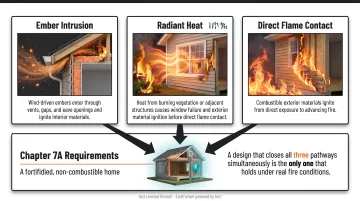
Chapter 7A requirements are designed to address all three. A design that closes all three pathways simultaneously is the only one that holds under real fire conditions.
California WUI Code Requirements for New Construction
The governing framework for WUI construction in California is Chapter 7A of the California Building Code — formally titled "Materials and Construction Methods for Exterior Wildfire Exposure." It applies to new buildings and substantial remodels in designated FHSZ and WUI areas, with Section 701A.3.1 applying to permits submitted on or after July 1, 2008.
One critical date: the 2025 California Wildland-Urban Interface Code becomes Title 24, Part 7, effective January 1, 2026. Projects permitted under the new code will face expanded and more detailed requirements. Designing above current minimums now positions your project ahead of requirements that will likely apply to any amendments or corrections filed after that date.
Roofing
Section 705A.1 requires roof assemblies in FHSZs to be Class A when tested to ASTM E108 or UL 790. The key word is assembly: not just the surface material. The underlayment and deck must be part of a listed assembly, not independently selected components.
In LA County specifically, wood shingles and wood shakes are prohibited in any FHSZ regardless of classification. Metal roofing (standing seam, stone-coated steel), concrete tile, clay tile, and fiber-cement shingles are the practical options for most LA hillside rebuilds.
Exterior Walls and Siding
Exterior wall assemblies must use non-combustible or ignition-resistant materials. In high and very high severity zones, this typically means a non-combustible sheathing layer beneath the cladding (gypsum sheathing, cement board, or mineral wool) before applying the finish material.
Code-compliant cladding options include:
- Fiber cement siding
- Stucco
- Concrete panels
- Non-combustible composite claddings
Standard wood siding and untreated wood composites face increasing restriction in LA's highest-risk zones. LA County's local Chapter 7A amendments are stricter than the state baseline on several points, and local amendments continue to evolve.
Ember-Resistant Vents and Openings
Section 706A.2 requires vents to be California State Fire Marshal-listed or tested to ASTM E2886. Certain roof vents must use mesh between 1/16 inch and 1/8 inch. Open or under-specified vents are one of the most common ignition entry points in WUI fires.
Closed-eave or boxed-eave construction eliminates another common accumulation point. HVAC penetrations, dryer vents, and utility entries require the same ember-resistant treatment — yet standard residential design frequently overlooks them.
Windows, Doors, and Decking
Section 708A.2.1 requires exterior windows and skylights to meet one of four compliance paths, including multipane glazing with at least one tempered pane. Single-pane windows can fail from radiant heat before the exterior cladding is even affected, creating a flame entry point at the envelope's most vulnerable location.
Research indexed by NIST found that vinyl-frame windows did not perform well under imposed heat fluxes, with frames losing strength and distorting. Aluminum frames with thermally broken construction are the more durable choice in radiant heat exposure.
Exterior door assemblies (Section 710A) must also meet ignition-resistant standards — solid-core or steel-clad construction with tested frames is the typical compliant path. Key compliance checkpoints for this zone include:
- Windows: Multipane with at least one tempered pane; aluminum or steel frames preferred
- Doors: Ignition-resistant assembly per Section 710A; solid-core or steel-clad with tested frames
- Decking (Zone 0, 0–5 ft): Ignition-resistant materials required; combustible decking here is one of the most common compliance gaps in WUI residential projects
Why Modular Homes Are Ideal for WUI Compliance
For WUI projects, modular construction's core advantage is assembly quality and documentation — not aesthetics or cost.
Factory Conditions vs. Field Conditions
In conventional site-built construction, fire-rated assemblies are assembled in sequence by multiple subcontractors, often in variable weather, with inspections that may occur after the window for verifying critical details has passed. Tolerances vary. Sealing gets missed. Documentation is inconsistent.
Modular homes are built in a factory-controlled environment where:
- Material specifications are verified before assembly begins
- Layup sequences for fire-rated wall and roof panels are controlled and inspectable
- Joint sealing and penetration detailing happen in a stable environment
- Third-party inspections occur during production, not after components are enclosed
This matters for Chapter 7A compliance because a tested fire-rated assembly only performs as tested when it's built as tested. Factory construction makes it more practical to achieve that consistency.
Speed in a Post-Disaster Market
According to NAHB, a typical modular house can be move-in ready in approximately three months. The Modular Building Institute reports that modular construction can reduce schedules by 30% to 50% compared to conventional builds.
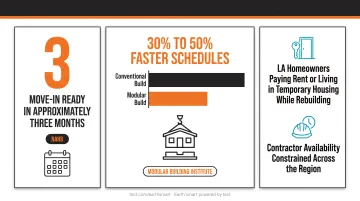
For LA homeowners paying rent or living in temporary housing while rebuilding, that faster timeline matters, particularly in a post-disaster construction market where contractor availability is constrained across the region.
Design Flexibility Is Not a Limitation
A common misconception is that modular construction can't accommodate the architectural forms typical of LA hillside homes. Modern modular systems support:
- Cantilevers and sloped site conditions
- Flat and low-slope roof profiles
- Open-plan interiors
- WUI-compliant cladding including fiber cement, stucco, and concrete panels
For hillside lots in Pacific Palisades or Malibu, that range of structural and cladding options covers most of what Chapter 7A requires — provided the design and engineering decisions are made early.
Documentation for Insurers
California's Department of Insurance requires insurers to offer discounts for Safer from Wildfires mitigation actions. Insurers may also require proof or a post-completion inspection before applying those discounts.
Modular construction's third-party factory inspection records create a documented compliance trail that supports insurer review. In a market where homeowners' coverage is increasingly difficult to obtain, that paper trail can be the difference between qualifying for a policy and not. Firms like tect coordinate this documentation from the start, so the compliance record is built alongside the home rather than assembled after the fact.
Key Fire-Resistant Design Elements for WUI Modular Homes
Roof Assembly
Class A compliance requires the full roof system — surface, underlayment, and deck — to be a listed assembly. Each component must be specified as part of a tested, listed system. For LA WUI hillside homes, the most common compliant options are:
- Standing seam metal — durable, long-life, compatible with low-slope and flat roof profiles
- Stone-coated steel — achieves Class A with a lower-profile aesthetic than standard metal
- Concrete or clay tile — traditional in Southern California, Class A compliant, heavy (structural implications)
- Fiber-cement shingles — lower profile, Class A capable, suited to steeper pitches
Exposed rafter tails and eave overhangs require specific detailing to close potential ember entry points. Boxed or closed eave construction is the more defensible approach in high and very high severity zones.
Exterior Wall Systems
The standard approach for high severity zones: a non-combustible sheathing layer beneath the exterior cladding, followed by a code-compliant finish material.
Non-combustible sheathing options include:
- Gypsum sheathing — widely available, fire-rated, compatible with most cladding systems
- Cement board — high durability, moisture-resistant, suited to direct-applied finishes
- Mineral wool — continuous insulation with fire resistance built in
Each creates a continuous barrier that limits fire penetration even if the cladding fails. Earth'smart powered by tect's Earth'smart™ approach uses pre-insulated concrete masonry for exterior wall systems, integrating fire resistance, thermal performance, and structural durability into one assembly.
Vents, Eaves, and Penetrations
Every vent opening requires California SFM-listed or ASTM E2886-tested ember-resistant covers — foundation vents, attic vents, crawl space vents, and soffits. The mesh specification (1/16 to 1/8 inch for certain roof vents) is not optional.
HVAC penetrations and dryer vents are frequently the detail that gets deferred and then missed. In WUI modular construction, these penetrations should be specified and detailed in the factory drawings, not resolved in the field.
Windows and Glazing
Dual-pane glazing with at least one tempered pane meets the Section 708A.2.1 baseline. For high and very high severity zones, thermally broken aluminum frames are the more resilient choice over vinyl — vinyl frames distort and lose structural integrity under the heat fluxes present in WUI fire events.
Defensible Space and the Zone 0 Perimeter
California's defensible space model establishes three zones:
| Zone | Distance | Requirement |
|---|---|---|
| Zone 0 | 0–5 feet | Ember-resistant zone — no combustible mulch, no wood fencing attached to structure, ignition-resistant decking only |
| Zone 1 | 5–30 feet | Reduced fuel zone — reduced vegetation density, no ladder fuels |
| Zone 2 | 30–100 feet | Lean and clean zone — maintained spacing, horizontal separation |
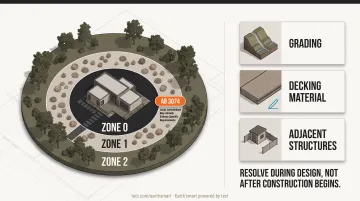
Zone 0 is being codified under AB 3074, though local jurisdictions may already enforce specific requirements. How the perimeter is handled — grading, decking material, adjacent structures — shapes siting and finish decisions. This needs to be resolved during design, not after construction begins.
Planning Your WUI Modular Home Rebuild in Los Angeles
Start With Sequencing, Not Speed
The most expensive mistake in WUI modular construction is the wrong sequence: architect designs first, manufacturer comes in later, and conflicts between design intent and available systems surface only after the design is locked. In modular construction, factory production sequences can't be revised mid-run — late changes carry more cost and schedule impact than in any conventional build.
The right sequence: engage an architect and manufacturer input simultaneously, confirm site classification with the local AHJ early, and lock in exterior assembly specifications before advancing the design.
For LA homeowners, LA County has established One-Stop Permit Centers for Eaton and Palisades rebuilds, with a Permitting Progress Dashboard tracking current review times. Use these resources to calibrate your timeline expectations before committing to a production schedule.
Key Early Decisions
These decisions determine compliance and cost — and they interact with each other:
- Site classification — confirm FHSZ tier with the local AHJ before design begins
- Structural system — informs which wall assembly configurations are available
- Exterior assembly specification — roofing, sheathing, and cladding must be selected as a system, not individually
- Vent and opening strategy — ember-resistant specification must be integrated into factory drawings
- Zone 0 landscape plan — grade-level finish, deck detailing, and perimeter surfaces must coordinate with the structure
Earth'smart powered by tect addresses this coordination problem directly. The team aligns architecture, engineering, and manufacturer input through the earth'smart powered by tectApp™ community of 70+ building product manufacturers before design is locked in. Critical decisions get made when they're still inexpensive to get right — not after conflicts have already been built into the drawings.
Insurance and Permitting
Contact your insurer before finalizing a design — not after. A WUI-compliant build with complete assembly documentation directly supports insurance discount applications and compliance conversations.
Key pre-design steps on the permitting and insurance side:
- Insurer contact: California's Department of Insurance requires insurers to offer discounts for Safer from Wildfires mitigation actions; documentation may be required at application
- Local amendments: LA County's Chapter 7A amendments exceed state minimums in several areas — confirm the current version with your AHJ
- LADBS checklist: The 2025 California WUI Code Fire Hazard Severity Zone Supplemental Checklist takes effect January 1, 2026; pull it into your pre-design code review
- AHJ confirmation: Verify all local amendments with the city or county AHJ before locking any design
Frequently Asked Questions
What is the WUI in California?
The Wildland-Urban Interface is the zone where residential development meets wildland vegetation. California designates these areas through Fire Hazard Severity Zones (Moderate, High, and Very High), which trigger specific Chapter 7A building code requirements for any new construction or major remodel within those boundaries.
What is the 5-foot rule in California?
California's Zone 0 regulation requires an ember-resistant zone within 5 feet of all structures. This means no combustible mulch, no wood fencing directly attached to the home, and no non-ignition-resistant decking materials within that immediate perimeter. Zone 0 regulations are currently being formalized under AB 3074.
What is the WUI code for manufactured homes?
Manufactured and modular homes in designated WUI zones must meet the same Chapter 7A requirements as site-built homes: Class A roofing, ignition-resistant exterior walls, ember-resistant vents, and compliant glazing. Factory-built homes often have a documentation advantage, since controlled-environment assembly and third-party inspection records make compliance easier to demonstrate.
Are modular homes fire resistant enough for LA's high-risk fire zones?
Modular homes can be engineered to fully meet California Chapter 7A requirements, and factory-controlled construction often produces more consistently compliant fire-rated assemblies than field-built work. Compliance depends on design specification and material selection, not on whether the home is modular or site-built.
Can I build a modular home in a Very High Fire Hazard Severity Zone in California?
Yes. Modular homes are permitted in Very High FHSZs provided they meet all applicable Chapter 7A requirements. LA City and County may have additional local amendments beyond state minimums, so confirm current requirements with your local building department before you start design.
What materials are prohibited for exterior walls in LA's WUI zones?
Standard wood siding, untreated wood shakes, and certain wood composites are restricted or prohibited on exterior walls in high and very high severity zones in LA. Compliant alternatives include fiber cement, stucco, concrete panel, and non-combustible composite claddings.