Here's what actually happens: embers land under the overhang, heat concentrates against the soffit, and the underside of your roof edge ignites. From there, fire travels into the rafter cavity or attic, and the structure begins burning from the inside before flames ever reach the exterior walls. CAL FIRE reports that embers cause up to 90% of home ignitions during wildfires — and eaves, soffits, and attic vents are well-documented pathways for those embers.
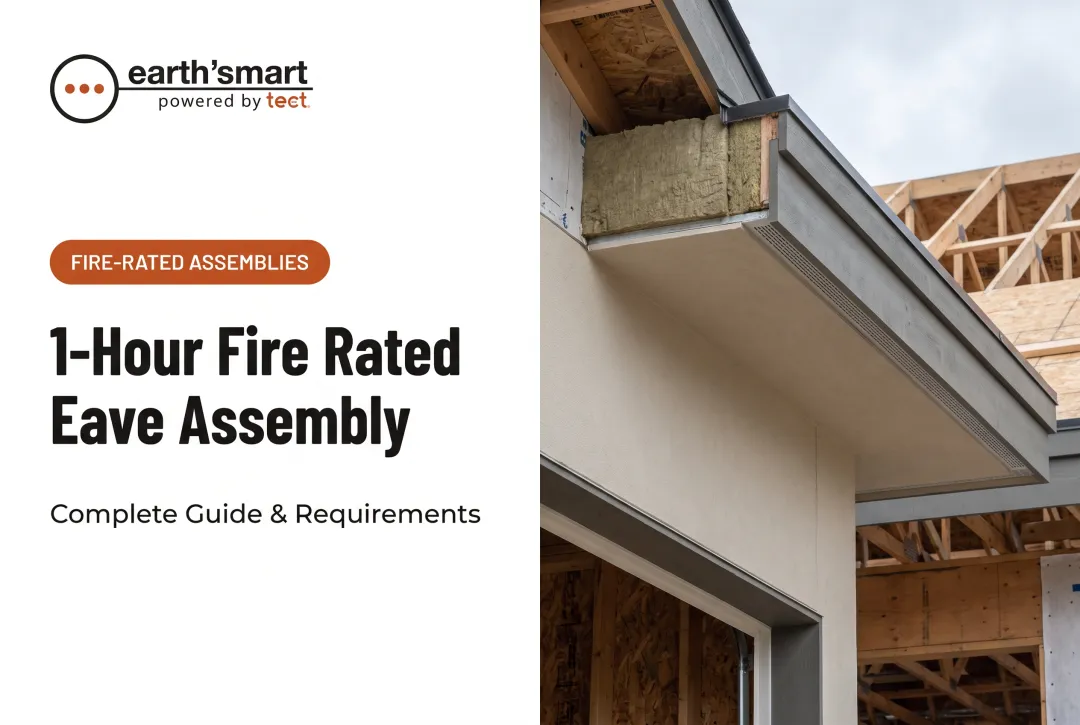
A fire-resistant eave assembly isn't a single product. It's a system — soffit panel, fascia, vent openings, blocking, and backing materials — that must work together to resist ignition. If any one component fails, the assembly fails.
This guide covers why eaves fail, what a compliant assembly looks like, how to approach both new construction and retrofits, and what California code requires.
Key Takeaways
- Eaves and soffits are high-risk ignition points — embers accumulate under overhangs and hot gases concentrate against combustible materials
- A fire-resistant eave assembly is a system: soffit, fascia, vents, and backing all work together
- Minimum benchmark is a 1-hour fire-resistance rating for enclosed soffits; Very High Fire Hazard Severity Zones require enhanced protection
- Fiber-cement board, stucco, and 5/8-inch Type X gypsum are the right materials — plywood, OSB, and vinyl are not
- Replacing the soffit without upgrading the vents is the most common retrofit mistake — it leaves the whole assembly compromised
Why Eave Assemblies Are a Critical Wildfire Vulnerability
How Ignition Actually Starts
Wildfire doesn't need to reach your house to ignite it. NIST research shows firebrands can travel miles ahead of a wildfire front, landing on and around structures long before flames arrive. When those embers reach an overhang, the geometry works against you: the soffit face creates a trap where embers collect and radiant heat concentrates. The pocket gets hotter, faster, than an exposed surface would.
The ignition sequence goes like this:
- Embers lodge against or beneath the soffit
- Heat concentrates in the eave pocket
- Soffit material ignites or fails structurally
- Fire enters the rafter bay or attic space
- The structure burns from the inside
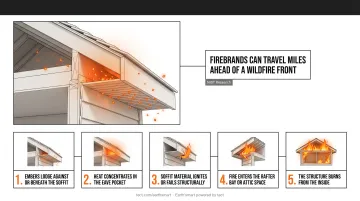
Each step enables the next. Once fire enters the attic, the structure burns from within — faster and with less chance of suppression.
Why Standard Materials Fail
Most residential construction is not designed for wildfire exposure. FEMA's Technical Fact Sheet No. 6 on Eaves, Overhangs, and Soffits identifies the specific failure modes:
- Untreated wood ignites under direct flame or prolonged radiant heat
- Vinyl panels melt and fall away, fully exposing the rafter cavity to the fire environment
- Metal panels conduct heat, warp under thermal stress, and can allow ember passage through distorted joints
Standard residential construction assumes fire department intervention. In Southern California's WUI zones, wildfire moves faster than response capacity allows — these materials simply weren't specified with that scenario in mind.
Open Eaves: The Worst Configuration
An open eave — exposed rafter tails with no soffit panel — provides zero barrier between the fire environment and the attic. Embers enter directly into the roof structure. Hot gases flow unimpeded into the space where roof decking, insulation, and framing are waiting to ignite.
The 2025 Palisades and Eaton fires put numbers to this risk. IBHS found that only 10.3% of assessed Palisades structures and 6.4% of assessed Eaton structures had vent screens of 1/8 inch or smaller — well below the code requirement. Oversized vent screens and open eaves were identified as vulnerabilities across both fire zones.
The Components of a Fire-Resistant Eave Assembly
Every part of the assembly must perform. A rated soffit combined with an unprotected vent negates the rating. Three components drive the outcome: the soffit, the fascia, and the vents.
Soffit Materials
The soffit panel — the horizontal face on the underside of the overhang — is the primary heat and ember intercept surface. Acceptable materials for WUI construction:
- Fiber-cement board (such as HardieSoffit panels): ASTM E136 noncombustible, ASTM E84 Class A with a Flame Spread Index of 0 and Smoke Developed Index of 5
- Stucco: noncombustible, performs well as a finish surface over a compliant substrate
- 5/8-inch Type X fire-resistant gypsum board: typically achieves a 1-hour fire-resistance rating and is used as a backing layer in Very High Fire Hazard Severity Zones
Standard plywood and OSB are not acceptable in WUI zones without a compliant cladding layer over them. Vinyl is not acceptable under any WUI condition.
Geometry also affects performance. Flat, horizontal soffits outperform soffits attached directly to sloped rafters because they reduce the depth of the pocket where embers and hot gases collect. This is a framing-stage decision — it becomes expensive to change later.
Fascia and Trim
The fascia board runs vertically at the eave edge — and even when the soffit is upgraded, a standard dimensional lumber fascia remains combustible. Compliant options:
- Fiber-cement board fascia
- Fire-retardant-treated lumber (FRTL) — exterior-rated only, per AWPA Standard U1 UCFB category
Vents
The fascia may be overlooked, but vents are the most actively dangerous gap in the assembly. Standard perforated soffits and conventional attic vents allow direct ember entry into the attic. Compliant vent specifications:
- Specify vents meeting ASTM E2886/E2886M-20, which tests exterior vents for resistance to ember entry and direct flame impingement
- California Chapter 7A requires noncombustible mesh with openings between 1/16 inch and 1/8 inch as a baseline
- Where possible, relocate ventilation away from the eave zone entirely — ridge venting combined with an enclosed soffit removes the under-eave vulnerability
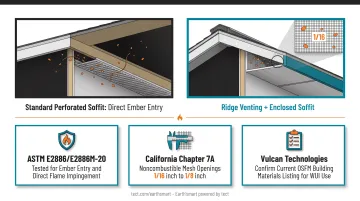
Vulcan Technologies eave vents appear on California's OSFM Building Materials Listing for WUI use — confirm the specific model is currently listed before specifying.
Design and Construction Guidance: New Builds and Retrofits
New Construction Best Practices
The most fire-resilient eave configuration for WUI zones is no overhang at all. A flush or near-flush eave profile eliminates the ember-trapping geometry entirely and reduces the quantity of fire-resistant materials required. There's a real trade-off with rain protection and aesthetics, but in Very High Fire Hazard Severity Zones, the performance argument is strong.
For designs requiring overhangs, the complete assembly specification should include:
- Enclosed flat soffit achieving a minimum 1-hour fire-resistance rating
- Fiber-cement or stucco soffit cladding
- FRTL or fiber-cement fascia
- Ember-resistant vents meeting ASTM E2886 — or ventilation relocated away from the eave zone
- In Very High Fire Hazard Severity Zones: 5/8-inch exterior-grade fire-resistant gypsum board as a backing layer behind the soffit cladding
Getting these decisions right during design is substantially cheaper than correcting them during or after construction. Earth'smart powered by tect connects homeowners with compliant soffit, fascia, and vent manufacturers through earth'smart powered by tectApp before framing begins. Assembly specifications get locked in when they're easiest to implement — not patched after a failed inspection.
Retrofitting Existing Eaves
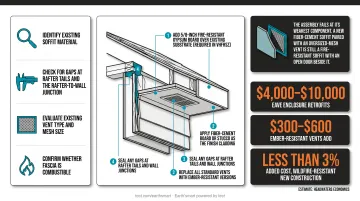
Most existing eaves can be brought into compliance, but the scope depends on what's there. Start with an assessment:
- Identify existing soffit material (plywood, vinyl, wood tongue-and-groove)
- Check for gaps at rafter tails and the rafter-to-wall junction
- Evaluate existing vent type and mesh size
- Confirm whether fascia is combustible
For existing plywood or wood soffits, full removal isn't always required. A layering approach works:
- Add 5/8-inch fire-resistant gypsum board over existing substrate (required in VHFHSZ)
- Apply fiber-cement board or stucco as the finish cladding
- Replace all standard vents with ember-resistant versions
- Seal any gaps at rafter tails and wall junctions
The most common retrofit mistake: upgrading the soffit material while leaving standard vents in place. The assembly rating only holds if every component meets the standard. A new fiber-cement soffit paired with an oversized-mesh vent is still a fire-resistant soffit with an open door beside it. The assembly fails at its weakest component.
Those component choices also affect cost. Headwaters Economics estimates eave enclosure retrofits run $4,000–$10,000, with ember-resistant vents adding $300–$600. Wildfire-resistant new construction, by contrast, adds less than 3% to overall construction costs when integrated from the start. The cost argument for doing it right in a rebuild is clear.
Code Requirements and Testing Standards
California SFM Standard 12-7A-3
SFM Standard 12-7A-3 is the under-eave test standard referenced in California Title 24, Part 12. It evaluates fire resistance of horizontal projection undersides using a 300 kW direct flame impingement exposure from below — simulating the actual wildfire exposure condition. Products used in fire-rated eave assemblies in California must be tested to this standard to qualify.
California Chapter 7A of the Building Code sets the statewide WUI baseline, including:
- Noncombustible vent mesh with openings 1/16 to 1/8 inch
- Noncombustible or fire-resistant soffit and fascia materials
- Requirements for enclosed overhangs in designated High and Very High Fire Hazard Severity Zones
Federal Guidance
California sets the floor for WUI construction, but federal guidance adds a parallel layer worth knowing. FEMA Technical Fact Sheet No. 6 — part of the Home Builder's Guide to Construction in Wildfire Zones — is the key federal reference for eave, overhang, and soffit design. It applies to high-risk zones in any state. Core recommendations include:
- Minimize or eliminate overhangs where feasible
- Use flat horizontal soffits to reduce ember accumulation
- Target a 1-hour fire-resistance rating for any enclosed overhang
Local Jurisdiction Amendments
Chapter 7A is the floor, not the ceiling. Local jurisdictions within Very High Fire Hazard Severity Zones often adopt requirements more restrictive than the state baseline. Confirm current requirements with your Authority Having Jurisdiction (AHJ) before finalizing assembly specifications — local amendments can shift material requirements, vent specifications, and overhang limits beyond what Chapter 7A mandates.
Eave Assembly as Part of a Whole-Home Wildfire Defense
A fire-resistant eave assembly performs only as well as the weakest system adjacent to it. A rated soffit next to an unrated roof covering, combustible siding, or single-pane windows creates inconsistent defense that fire will find and exploit.
Zone 0 and the Immediate Perimeter
Zone 0 — the 0 to 5 feet immediately surrounding the structure — directly affects eave performance. CAL FIRE's Ready for Wildfire guidance is specific: remove vegetation and combustible materials directly below eaves. If combustible mulch, stored wood, or dead vegetation is present beneath the overhang, a radiant heat exposure from that material can ignite the soffit from a distance, independent of the main fire front.
The gutter matters too. Debris-filled gutters at the roof edge expose the fascia and soffit junction to localized flame. Noncombustible gutters with covered gutter systems — estimated at $1,500–$3,500 by Headwaters Economics — close that exposure point.
Whole-System Coordination
For homeowners rebuilding in Pacific Palisades and surrounding areas, the eave assembly is one part of an interconnected set of fire-resilient systems. Each must be coordinated together — roof covering, wall cladding, attic ventilation, window ratings, and the immediate site perimeter:
- Roof covering: Rated Class A material compatible with the eave assembly
- Wall cladding: Noncombustible or ignition-resistant siding at the eave-wall junction
- Attic ventilation: Ember-resistant vent placement and screening
- Window ratings: Dual-pane or fire-rated glazing near the eave line
- Site perimeter (Zone 0): Combustible materials cleared within 5 feet
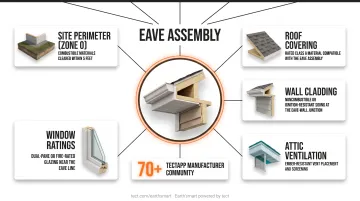
Making these decisions separately, with different contractors at different stages, is where performance gaps open up.
Earth'smart powered by tect's approach for rebuilding clients in Pacific Palisades integrates fire-resistive exterior wall systems, non-combustible assemblies, long-life roofing, and early coordination across all disciplines into a single aligned project delivery. Through the earth'smart powered by tectApp community of 70+ building product manufacturers, earth'smart powered by tect brings in the right product expertise while decisions can still be made correctly — before framing is complete and options narrow.
Frequently Asked Questions
What is a fire-rated eave assembly?
A fire-rated eave assembly is a tested combination of soffit panel, fascia, and vent components designed to resist ignition from radiant heat, direct flame, and ember exposure for a defined period — typically 1 hour minimum. The rating applies to the system as installed, not to individual materials in isolation.
Do eaves and soffits need to be fire-rated?
In California's High and Very High Fire Hazard Severity Zones, and in WUI zones across many other states, fire-rated or noncombustible eave assemblies are required by code for new construction and major retrofits. Check your local jurisdiction — requirements vary, and many zones have been updated after recent fire events.
What materials are best for fire-resistant soffit construction?
Fiber-cement board, stucco, and 5/8-inch Type X fire-resistant gypsum board (as a backing layer) are the leading options. All are noncombustible or fire-rated and substantially outperform wood, OSB, plywood, or vinyl under direct flame, radiant heat, and ember exposure.
Can I retrofit my existing eaves to be fire-resistant?
Yes, but the full assembly must be addressed together — partial upgrades provide incomplete protection. Most existing eaves can be upgraded by replacing the soffit cladding with a compliant material, swapping standard vents for ember-resistant versions, and upgrading any combustible fascia.
What is the minimum fire-resistance rating for eave assemblies in wildfire zones?
A 1-hour fire-resistance rating is the standard benchmark for enclosed soffits per FEMA guidance and California fire code. Very High Fire Hazard Severity Zones require enhanced assemblies, typically including 5/8-inch gypsum board backing behind the finish soffit cladding.
How do open eaves compare to enclosed eaves in a wildfire?
Open eaves — with exposed rafter tails and no soffit panel — offer no barrier to embers or hot gases. They are the highest-risk configuration. Enclosed eaves with fire-rated soffits deflect heat, block ember intrusion, and substantially reduce the risk of attic ignition from below.