Most homeowners rebuilding after a fire ask the wrong question: What do I need to meet code? The right question is: What does it actually take to keep fire out? Code sets a floor. Survivability requires more.
This post answers that question system by system — roof, eaves, walls, windows, vents, doors, and the five feet of ground immediately surrounding the structure.
Key Takeaways
- Homes in WUI areas most commonly ignite from windborne embers, not direct flame contact — the exterior envelope must be designed around that fact.
- Class A roofing, enclosed noncombustible eaves, and ember-resistant vents are the three most critical roof-level decisions — and each one depends on the others to hold.
- Exterior walls, windows, and doors must be specified as one coordinated fire-resistant system.
- Zone 0 — the five feet immediately surrounding the home — is as critical as the structure itself; noncombustible surfaces here stop embers from gaining a foothold at the base of the walls.
- Building to IBHS Wildfire Prepared Home Plus adds approximately 3% to wildfire-relevant construction costs — and directly affects insurability.
How Homes Actually Ignite: The Ember Problem Most Builders Overlook
The fire front rarely reaches the home first. Windborne embers do.
Post-fire analysis of the 2018 Camp Fire found embers implicated in 33% of damaged homes — either through direct ignition or by enabling later flame impingement. NIST and IBHS research consistently identifies firebrands as the dominant ignition pathway in WUI events. The 2025 Palisades and Eaton fires reinforced this: IBHS post-fire findings confirmed that homes with reduced ember exposure and hardened immediate zones were far more likely to avoid damage.
Three Ignition Pathways Embers Exploit
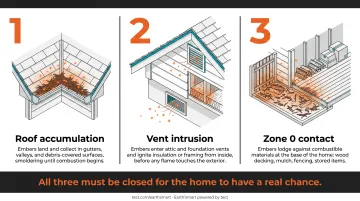
All three must be closed for the home to have a real chance:
- Roof accumulation — Embers land and collect in gutters, valleys, and debris-covered surfaces, smoldering until combustion begins
- Vent intrusion — Embers enter attic and foundation vents and ignite insulation or framing from inside — before any flame touches the exterior
- Zone 0 contact — Embers lodge against combustible materials at the base of the home: wood decking, mulch, fencing, stored items
Ignition-Resistant, Not Fireproof
No home is fireproof. The goal is to resist ignition long enough for the fire front to pass. A home built this way buys time — but a single unprotected pathway, an open eave or an unscreened vent, can let the home ignite from within while the exterior looks intact.
The data on construction era is decisive. According to SGH's WUI construction analysis, homes built after 2008 under California's Chapter 7A were more than three times more likely to survive the Camp Fire than pre-1997 construction (43% survival vs. approximately 11.5%).
Even so, 56% of post-2008 homes did not survive. That gap is why earth'smart powered by tect's benchmark isn't minimum code compliance — it's the IBHS Wildfire Prepared Home Plus standard, which exceeds Chapter 7A at the details that matter most.
What We Specified for the Roof and Eaves — and Why
The roof is the largest ember-collection surface on the home. It's also the first point of failure in most WUI fire losses.
Class A Roofing: What It Actually Means
Class A under ASTM E108/UL 790 means the roof assembly can withstand severe fire exposure — not just the surface material in isolation. A Class A rated tile over a combustible substrate that isn't part of the tested assembly can still fail. The rating applies to the complete system.
Metal roofing and Class A tile are the materials most consistently specified in Pacific Palisades rebuilds for good reason: noncombustible substrate, low ember-accumulation profiles, and resistance to radiant heat. Wood shake and standard asphalt shingles have no place in a WUI context.
Tested performance also degrades over time. ASTM D2898 weathering protocols exist because fire-retardant-treated materials must maintain their classification through the home's lifecycle — not just at installation. The spec decision locks in a rating; the material choice determines whether that rating holds.
The Eave Detail
Open eaves are among the most common failure points in WUI fires. Embers accumulate under the soffit, reach structural framing, and ignite — while the roof above remains intact.
The requirement: enclosed, noncombustible eave assemblies. That means:
- Noncombustible or ignition-resistant soffits, fascia, and overhangs
- 1-hour fire-rated assembly per ASTM E119/UL 263
- No exposed framing accessible to ember accumulation
Gutters and Debris
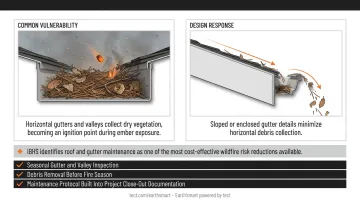
Even a correctly rated roof fails when gutters and valleys collect dry vegetation. IBHS guidance identifies roof and gutter maintenance as one of the most cost-effective wildfire risk reductions available. The design response includes sloped or enclosed gutter details that minimize horizontal debris collection — paired with a maintenance protocol built into the project close-out documentation.
Walls, Windows, Vents: Closing Every Path Fire Takes In
Exterior Walls
The exterior wall is the last major barrier before fire reaches the interior. The minimum requirement is a 1-hour fire-rated assembly per ASTM E119/UL 263.
Materials that achieve this in practice:
- Fiber cement siding (noncombustible, does not sustain combustion under direct flame)
- Stucco over noncombustible sheathing
- Masonry and concrete masonry systems
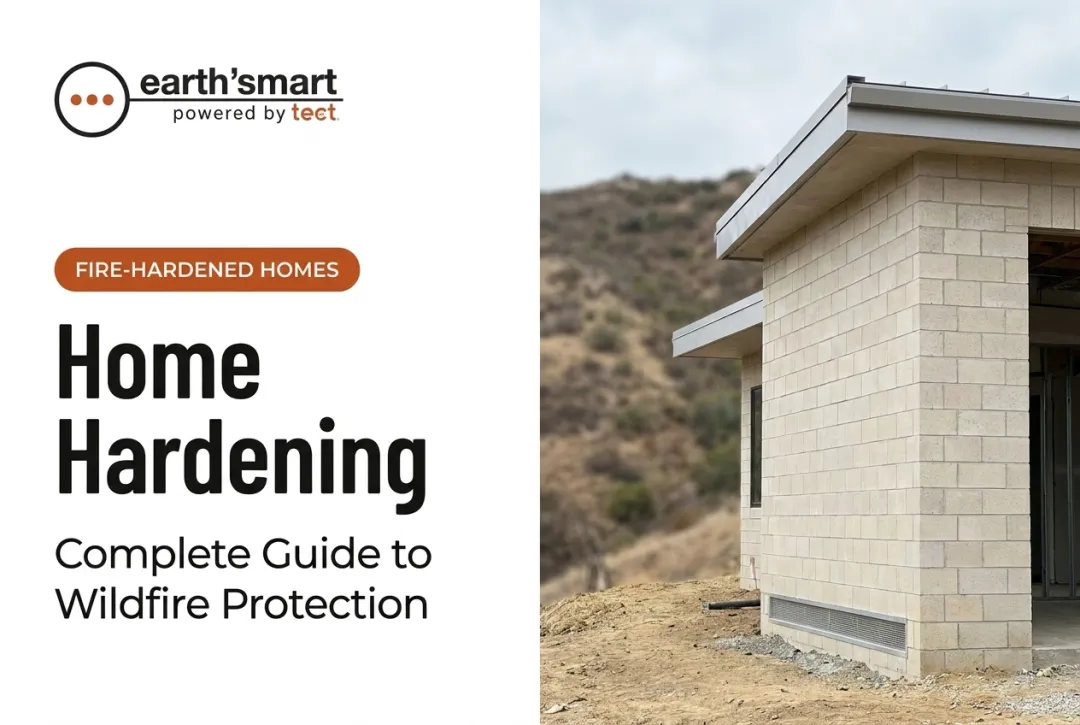
Standard wood siding fails the test — not because it can't be rated in theory, but because it contributes fuel and degrades rapidly under heat flux. Earth'smart powered by tect's preferred approach specifies pre-insulated concrete masonry for exterior walls: structurally robust, genuinely noncombustible, and thermally efficient without combustible insulation layers exposed at the wall edge.
Windows
Windows are among the most underspecified elements in standard residential construction and among the most critical in WUI exposure. The failure mode is specific: radiant heat causes single-pane glass to shatter, opening an immediate pathway for embers and flame.
Research from FSRI/UL Research Institutes found single-pane glass failed within 30–90 seconds at heat flux of 11 kW/m² or greater. Tempered fire-side panes in dual-pane assemblies held until heat flux exceeded 45 kW/m² — a meaningful difference in time.
California Chapter 7A requires multi-pane glazing with at least one tempered pane, tested under NFPA 257 or SFM Standard 12-7A-2. This is the floor, not the ceiling.
Doors and Garage Doors
Hollow-core doors fail rapidly. The specification is solid-core or steel exterior doors at minimum 1¾" thickness, tested under NFPA 252. Noncombustible framing at all exterior openings is required.
The same logic extends to garage doors — one of the most consistently overlooked vulnerabilities in WUI construction. Chapter 7A regulates garage doors as exterior components for WUI exposure. Gaps and poor sealing create ember entry paths — CAL FIRE identifies poorly sealed exterior openings as direct ignition pathways.
Ember-Resistant Vents
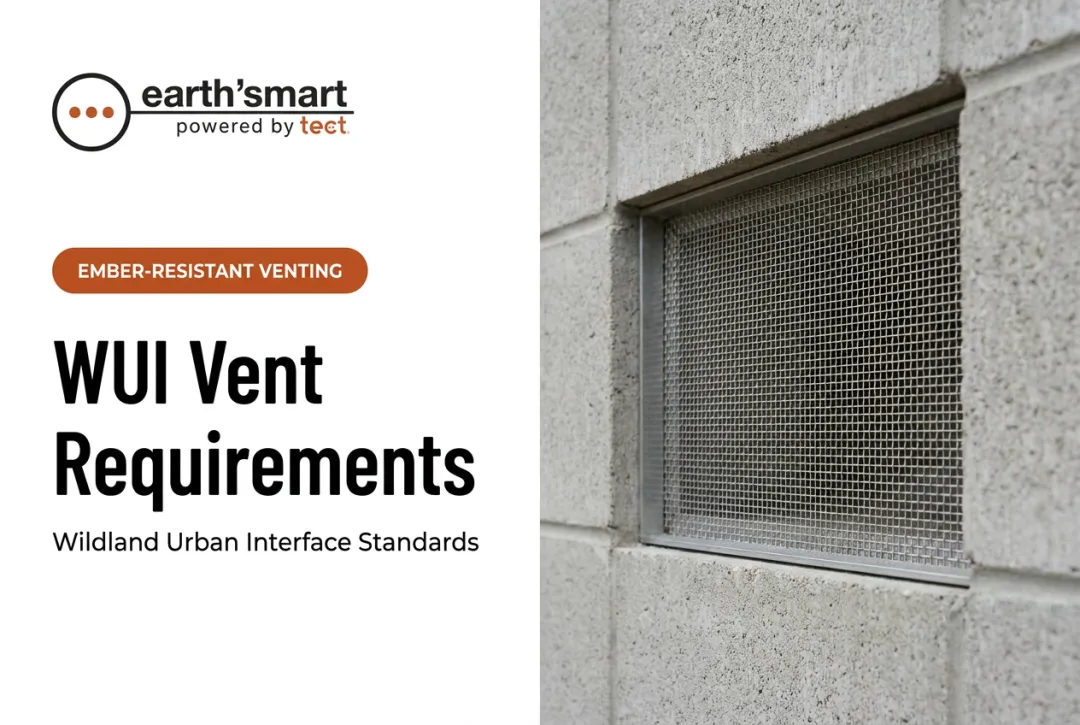
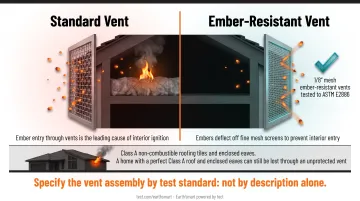
Ember entry through vents is the leading cause of interior ignition — fires that begin inside the structure before any flame reaches the exterior wall. Standard attic and foundation vents are open invitations to embers. Once inside, embers ignite insulation or framing before any flame contacts the exterior.
The requirement: 1/8" mesh ember-resistant vents tested to ASTM E2886. A home with a perfect Class A roof and enclosed eaves can still be lost through an unprotected vent. Specify the vent assembly by test standard — not by description alone.
The First Five Feet: Zone 0 and Why the Ground Around the Home Is Part of the Home
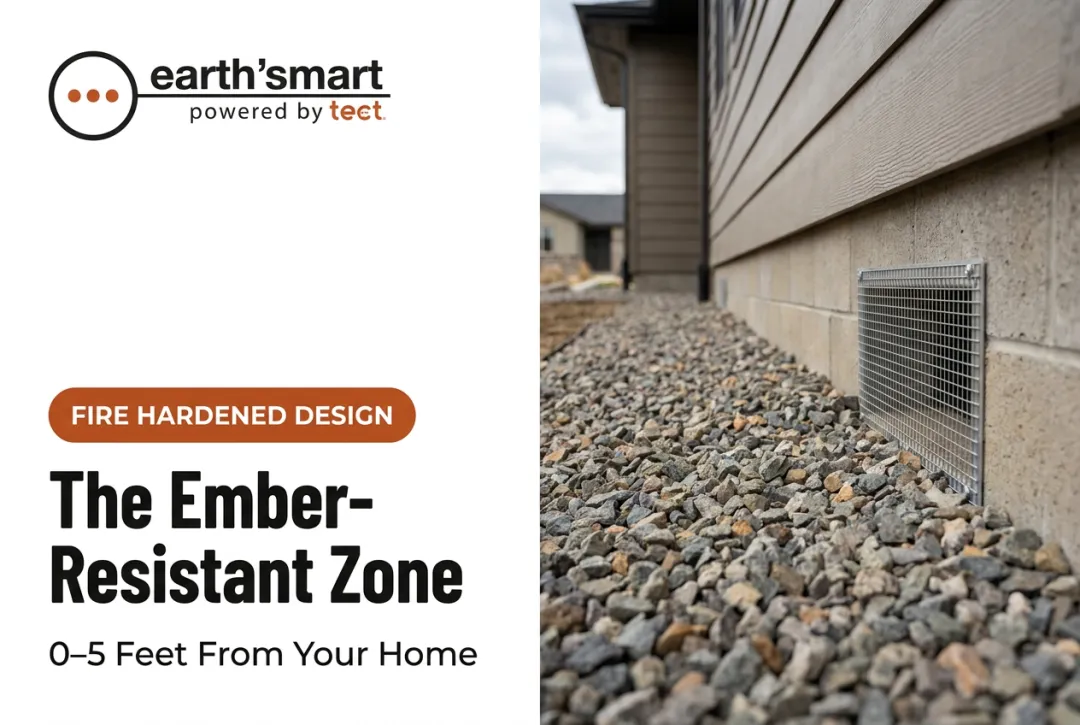
Zone 0 — the 0 to 5-foot area immediately surrounding the structure — is where ember accumulation becomes a direct ignition pathway. Embers landing against combustible materials at the foundation bypass every investment made in the walls and roof above.
What Compliant Zone 0 Design Looks Like
California's Board of Forestry is finalizing formal Zone 0 regulations under AB 3074 (with rulemaking directed by Executive Order N-18-25). The design standard in practice:
- Noncombustible surface materials within 5 feet of the structure: concrete, pavers, decomposed granite, or gravel
- No combustible mulch immediately adjacent to the foundation
- No dense plantings in direct contact with exterior walls
- Combustible items — furniture, stored materials — moved outside Zone 0
Decks, Fences, and Attached Structures
A combustible deck physically connected to the home creates a direct fire pathway regardless of how well the walls are built. IBHS research on deck vulnerability documents ember accumulation in deck-board gaps as a primary ignition point, with exposed joists sustaining combustion until structural failure.
Two attached-structure requirements follow from this:
- Decking: Noncombustible or ignition-resistant materials only — combustible boards create a direct burn path into the structure
- Fencing: Combustible fencing attached to or approaching the home within Zone 0 has caused direct home ignitions in documented fires. The 2025 Palisades event included confirmed structure-to-structure spread via this pathway.
Zone 0 vs. Defensible Space
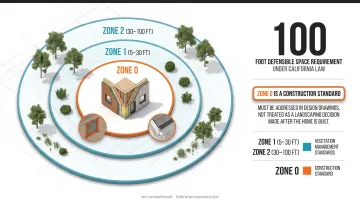
Zone 0 is distinct from the 100-foot defensible space requirement under California law. Zones 1 (5–30 ft) and 2 (30–100 ft) are vegetation management standards. Zone 0 is a construction standard. It must be addressed in design drawings — not treated as a landscaping decision made after the home is built.
Why These Decisions Have to Be Made Early, Together, and Correctly
Most homes that fail in WUI fires weren't built without fire-resistant materials. They were built with the wrong materials in the wrong assemblies — or with good materials undermined by a single missing detail. An unprotected vent. An open eave. A combustible deck.
The underlying problem is fragmentation: the architect, contractor, material suppliers, and homeowner making decisions in sequence rather than together.
System Integration, Not Component Selection
Fire-resilient design decisions compound each other. A Class A roof is most effective paired with:
- Enclosed noncombustible eaves
- Ember-resistant vents
- Noncombustible Zone 0 perimeter
- Dual-pane tempered windows
- Noncombustible exterior wall assembly
Getting one right while leaving another unaddressed creates a false sense of protection and a real vulnerability. The survivability data supports this: it's the completeness of the fire-resistant envelope that determines outcomes, not the presence of any single material.
How earth'smart powered by tect Addresses the Coordination Problem
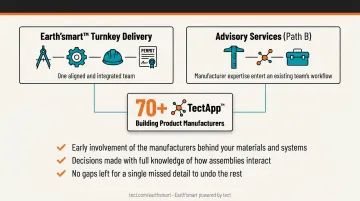
Earth'smart powered by tect's Earth'smart™ Turnkey Delivery model provides one coordinated team from concept through construction — architecture, engineering, construction, permit strategy, and direct input from the manufacturers behind the home's materials and systems. Critical decisions get made early, when they're still inexpensive to get right.
That's the role of the earth'smart powered by tectApp™ community of 70+ building product manufacturers. Rather than product decisions happening late with limited input, a pattern that produces compliant-but-vulnerable homes, systems are understood and specified as a coordinated whole. The result is a home where no single component is working against the others.
For homeowners who already have an architect or contractor in place, earth'smart powered by tect's Advisory Services (Path B) brings that same manufacturer coordination and fire-resilient system expertise into the existing team's workflow. Both paths deliver what most residential projects never access:
- Early involvement of the manufacturers behind your materials and systems
- Decisions made with full knowledge of how assemblies interact
- No gaps left for a single missed detail to undo the rest
Frequently Asked Questions
Frequently Asked Questions
What is the most common way homes ignite in wildfire — and what does it mean for how we build?
Windborne embers, not direct flame contact, are the dominant ignition pathway in WUI fires. This means the exterior envelope — roof, vents, eaves, walls, and Zone 0 — must function as an integrated ember-resistant system. Protecting any one component while leaving others exposed gives embers a path in.
Does building a fire-resistant home to WUI standards cost significantly more than standard construction?
According to Headwaters Economics and IBHS research, building to the IBHS Wildfire Prepared Home Plus standard adds approximately 3% to the cost of wildfire-relevant building components on a modeled Southern California home. That's far less than a post-construction retrofit. It also directly affects insurability in California's current market.
Is meeting California's Chapter 7A code enough to truly protect a home from wildfire?
Chapter 7A sets a minimum floor, and it meaningfully improves survival odds over pre-code construction. But the IBHS Wildfire Prepared Home Plus standard, which exceeds 7A, shows better survivability and insurability outcomes. The differences come down primarily to enclosed eaves, dual-pane tempered windows, and a maintained noncombustible Zone 0.
What is Zone 0, and why does it matter for new construction in Pacific Palisades?
Zone 0 is the 0 to 5-foot area immediately surrounding the structure where embers accumulate and can ignite combustible surfaces. In new construction, it must be addressed as a design decision: specifying noncombustible ground materials, decking, and perimeter details — not left as a landscaping afterthought after the home is complete.
How does fire-resistant construction affect home insurance in high-risk fire areas?
The California Department of Insurance has found that rebuilding to IBHS standards could reduce projected wildfire losses by 31–35%. The CDI also states that insurers must give discounts for Safer from Wildfires mitigation actions, with documented discounts ranging from 4–40%.
What's the difference between a home that survives a wildfire and one that doesn't — when both had fire-resistant materials?
Survivability depends on system completeness. A home with a Class A roof but open eaves, unprotected vents, or combustible Zone 0 materials will still ignite; embers find the unaddressed pathway. What determines survivability is whether the entire fire-resistant envelope holds, not whether any single material was specified correctly.