Wood framing remains dominant: NAHB reports that 93% of 2023 single-family completions were wood-framed, with steel framing accounting for less than 0.5%. That gap reflects builder familiarity, not superior performance.
This guide is for homeowners planning a high-performance custom build, those rebuilding in fire- or earthquake-prone areas, and anyone comparing structural options for a luxury project. We'll cover what steel frame construction actually means, why it matters, what it costs, and how the building process works.
Key Takeaways
- Steel frame luxury homes use structural steel, cold-formed steel (CFS), or a hybrid — outperforming wood on fire resistance, longevity, and span flexibility
- Key benefits: noncombustibility, 100+ year design lifespan, seismic resilience, and long-span design freedom
- Upfront costs run higher than wood; maintenance, insurance, and energy savings close the gap over time
- Less than 0.5% of homes are steel-framed — finding the right builder and integrated team early is critical
- System integration decisions made at design phase directly determine whether the project stays on budget
What Is a Steel Frame Luxury Home?
Steel frame luxury homes use steel as the primary structural system instead of wood. The "luxury" designation reflects high-end finishes, large footprints, and architectural ambition — the steel is what makes those ambitions structurally achievable.
Structural Steel vs. Cold-Formed Steel
According to BuildSteel, there are two distinct steel types used in residential construction:
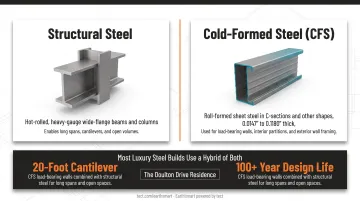
- Structural steel — hot-rolled, heavy-gauge wide-flange beams and columns; enables long spans, cantilevers, and open volumes
- Cold-formed steel (CFS) — roll-formed sheet steel in C-sections and other shapes, ranging from 0.0147 to 0.1180 inches thick; used for load-bearing walls, interior partitions, and exterior wall framing
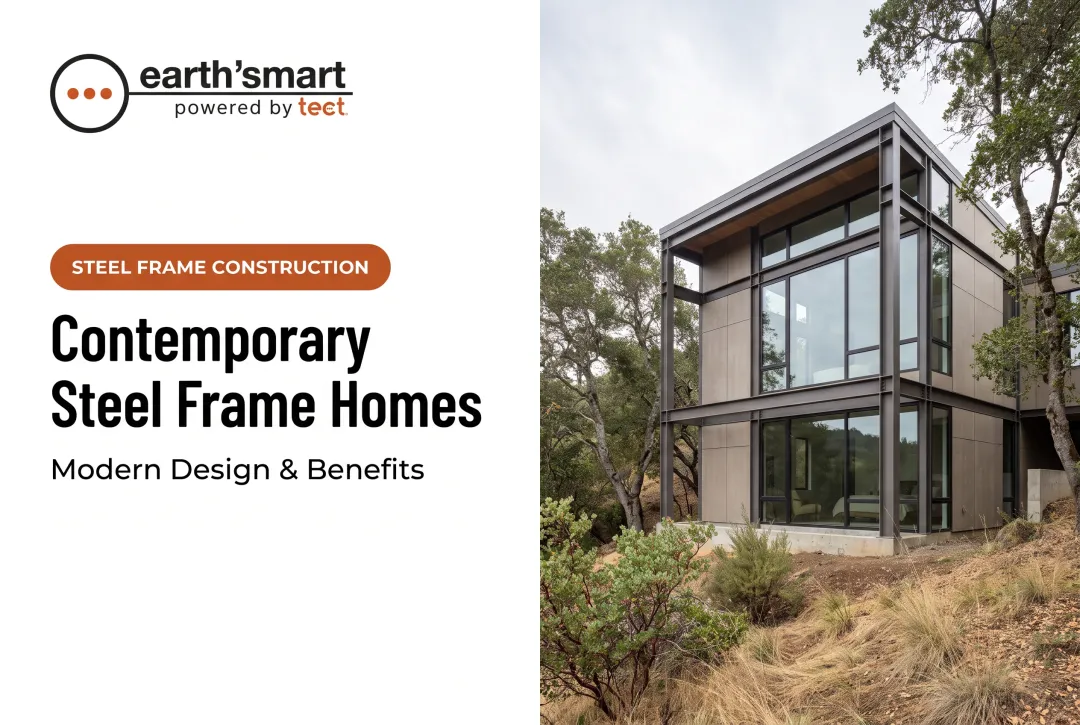
Most luxury steel builds use a hybrid of both. The Doulton Drive residence — a well-documented luxury home with a 20-foot cantilever and a design life exceeding 100 years — used CFS load-bearing walls combined with structural steel for long spans and open spaces. That combination is what makes ambitious open-plan designs buildable without the cost of all-structural-steel framing throughout.
The choice of system isn't purely technical — it's driven by what the client needs the building to survive and do.
Who Is Building This Way?
Three client profiles drive most luxury steel frame decisions:
- Homeowners rebuilding after wildfire who want noncombustible construction
- Those building in seismic or high-wind zones requiring engineered lateral performance
- Architects and clients pursuing bold, open designs that wood physically cannot support at the required scale
Why Choose Steel for a Luxury Home?
Fire Resistance
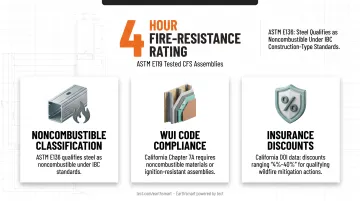
Steel is noncombustible. Under ASTM E136 — the standard referenced by the IBC for construction-type combustibility classification — steel qualifies as a noncombustible material. CFS-framed assemblies tested under ASTM E119 have achieved fire-resistance ratings of up to four hours.
For homeowners in Wildland-Urban Interface (WUI) areas, this matters beyond code compliance:
- Noncombustible classification: ASTM E136 qualifies steel as noncombustible under IBC construction-type standards
- WUI code compliance: California's Chapter 7A requires exterior wall coverings in WUI zones to use noncombustible materials, ignition-resistant assemblies, or fire-retardant-treated wood — steel framing supports compliant assembly design from the structural layer outward
- Insurance discounts: California DOI data from 2026 indicates discounts ranging 4%–40% for qualifying wildfire mitigation actions, though steel-frame-specific premium reductions should be confirmed directly with your insurer
Structural Longevity
CFS does not shrink, warp, crack, rot, or swell. It resists termites because it is inorganic. A galvanized CFS study from Missouri S&T found average life expectancies measured in centuries for tested framing components in residential cavities — the fastest corrosion rate recorded was just 0.1306 microns per year in crawlspace conditions.
The Doulton Drive project is the clearest residential illustration: the architect explicitly designed the home for a life expectancy exceeding 100 years, citing steel framing as the structural basis for that intent. That is an engineering position, not a marketing claim.
Seismic Performance
Structural steel can be engineered to flex and absorb lateral seismic loads. For CFS systems, AISI S400-20 covers seismic force-resisting system design; AISI S230-19 governs CFS framing for one- and two-family dwellings up to three stories.
Full-scale shaking-table tests of two-story CFS archetype buildings have calibrated seismic response models, giving engineers validated performance data for residential steel framing in high-seismic regions.
California's Residential Code (CRC R603) recognizes CFS wall framing as a code-compliant system, not a workaround or a variance.
Sustainability
AISC reports that domestically produced fabricated structural steel carries 93% average recycled content, is 100% recyclable without metallurgical degradation, and achieves a 98% end-of-life recovery rate. Steel mills recycle more than 70 million tons of scrap annually.
CFS panelization also reduces jobsite waste compared to field-cut wood framing — factory precision means less off-cut material ends up in the dumpster.
Getting the Integration Right
Choosing steel is one decision. Getting the structural, envelope, and systems integration right from the start determines whether a home actually performs for 100+ years. Earth'smart powered by tect's Earth'smart™ delivery model brings structural, envelope, and product experts into the project at concept stage — drawing on the earth'smart powered by tectApp™ community of 70+ vetted building product manufacturers — so the decisions that define long-term performance are made with the right people at the table, not revisited after framing is complete.
Steel Frame Luxury Home Design: What's Possible
Steel's structural efficiency doesn't just improve a home's performance — it expands what's architecturally achievable.
Long Spans and Open Plans
Wide-flange structural steel beams can span distances that wood cannot without intermediate columns. Open-concept living areas measured in tens of feet, double-height volumes, and uninterrupted sightlines follow directly from the material's structural capacity. In steel, these aren't expensive workarounds — they're the default.
Floor-to-Ceiling Glass
Because steel handles lateral and gravity loads at the building perimeter, interior and exterior walls carry less structural load. That frees large wall surfaces for glazing. The Doulton Drive home's glass-dominant exterior is a direct consequence of this — the structural system enables the aesthetic, rather than fighting it.
The Bridge House by architect Dan Brunn demonstrates the same principle at an extreme: a 4,500-square-foot residence, 20 feet wide and 210 feet long, with a 65-foot section bridging a stream using a modular steel frame.
Cantilevers and Bold Geometry
Outdoor decks that float without visible supports, dramatic roof overhangs, asymmetric volumes — these are steel moves. The Doulton Drive home's 20-foot cantilever is structurally straightforward in steel. In wood, the same gesture becomes an expensive engineering problem with diminishing returns. Pierre Koenig's 1959 Stahl House — still one of the most photographed residential buildings in the world — demonstrated that steel-framed residential architecture can be both technically precise and visually arresting.
Interior Finishes That Work With Steel
Steel framing's dimensional stability makes it compatible with finishes that wood framing compromises over time:
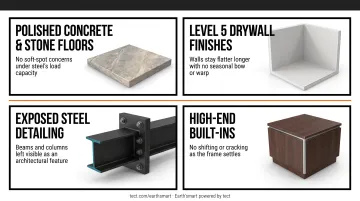
- Polished concrete and stone floors — compatible with steel's structural load capacity; no soft-spot concerns
- Level 5 drywall finishes — stay flatter longer because steel walls don't bow or warp seasonally
- Exposed steel detailing — beams and columns can be left visible as an architectural element
- High-end built-ins — don't shift or crack as a steel frame settles (because it largely doesn't)
Smart Home and Systems Integration
Steel-framed walls are well-suited to high-performance systems integration when planned from the start. Custom luxury builds routinely use this advantage to deliver:
- Structured wiring runs — clean conduit paths built into the wall cavity before enclosure
- Embedded technology panels — AV, security, and smart-home controls with dedicated backing
- HVAC zoning infrastructure — ductwork and control wiring routed without retrofitting
- MEP coordination — mechanical, electrical, and plumbing systems located and sized in design, not in the field
Prefab steel panel systems like Veev's have pushed this further, integrating MEP hook-ups directly into factory-built wall panels. Custom projects aren't using production panel systems, but the design discipline behind that approach applies directly.
Steel Frame Home Cost: What to Budget For
Honest answer upfront: authoritative cost-per-square-foot ranges for luxury steel frame homes aren't publicly disclosed in current contractor databases or NAHB studies. What we can tell you is the cost structure and the directional delta.
The Cost Baseline
NAHB's 2024 data puts average U.S. single-family construction at roughly $162/sf for a typical home (2,647 sf average). A historical CFS comparison study found steel-framed homes cost approximately 4.2% more than equivalent wood-framed homes — but that data is from 2007 and doesn't reflect current luxury custom construction dynamics or lumber price volatility.
For luxury custom homes in high-cost California markets, total project costs commonly run $500–$1,000+/sf depending on finish level, site complexity, and system specifications. Steel framing adds to the baseline; the gap versus wood varies significantly by project.
Primary Cost Drivers
Steel frame luxury builds carry several premiums over wood equivalents:
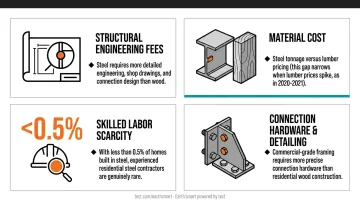
- Structural engineering fees — steel requires more detailed engineering, shop drawings, and connection design than wood
- Material cost — steel tonnage versus lumber pricing (this gap narrows when lumber prices spike, as in 2020–2021)
- Skilled labor scarcity — with less than 0.5% of homes built in steel, experienced residential steel contractors are genuinely rare
- Connection hardware and detailing — commercial-grade framing requires more precise connection hardware than residential wood construction
Long-Term ROI Factors
Higher upfront costs are partially offset by:
- No rot, no warping, no termite remediation — maintenance costs drop substantially over decades
- Potential insurance premium reductions in fire-risk zones for noncombustible construction (confirm specifics with your insurer)
- Improved energy performance when steel is paired with a well-designed thermal envelope
Two Hidden Costs to Address Early
1. Foundation upgrades. Steel-framed homes may carry more dead load than wood equivalents, affecting footing and slab design. Don't assume a standard residential foundation transfers to a steel project without engineering review.
2. Thermal bridging. Steel conducts heat. Without continuous insulation detailing at wall assemblies, energy performance degrades. This isn't a minor detail — it needs to be addressed in the design phase, not corrected during construction.
Both issues require upfront engineering attention. Decisions about structural frame type, envelope strategy, MEP routing, and finish sequencing made early determine whether a project stays on budget — or generates costly field changes later.
That sequencing is where aligned delivery matters most. Earth'smart powered by tect's Earth'smart™ Path A Turnkey Delivery coordinates the structural engineer, envelope consultant, and manufacturer inputs before steel is ordered — so these interdependencies are resolved on paper, not on-site.
The Building Process: From Design to Completion
Steel frame construction differs from wood framing in one critical way: mistakes made in the field are harder and more expensive to correct. Getting the process right from the start isn't optional — it's how steel projects stay on schedule and on budget.
Key Phases
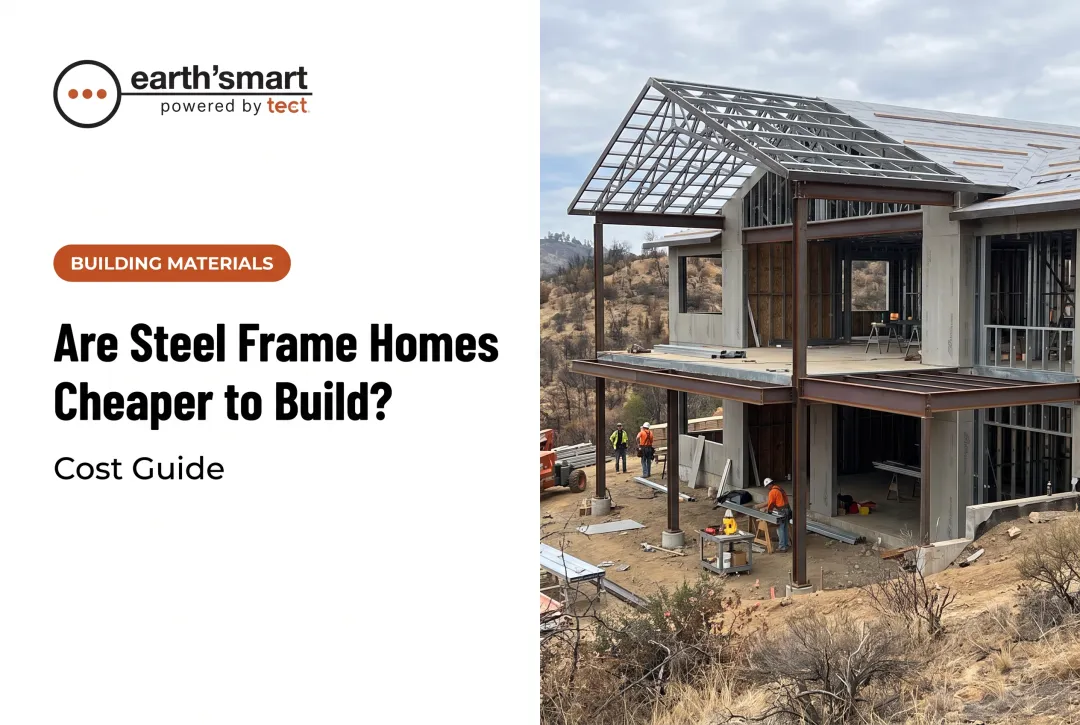
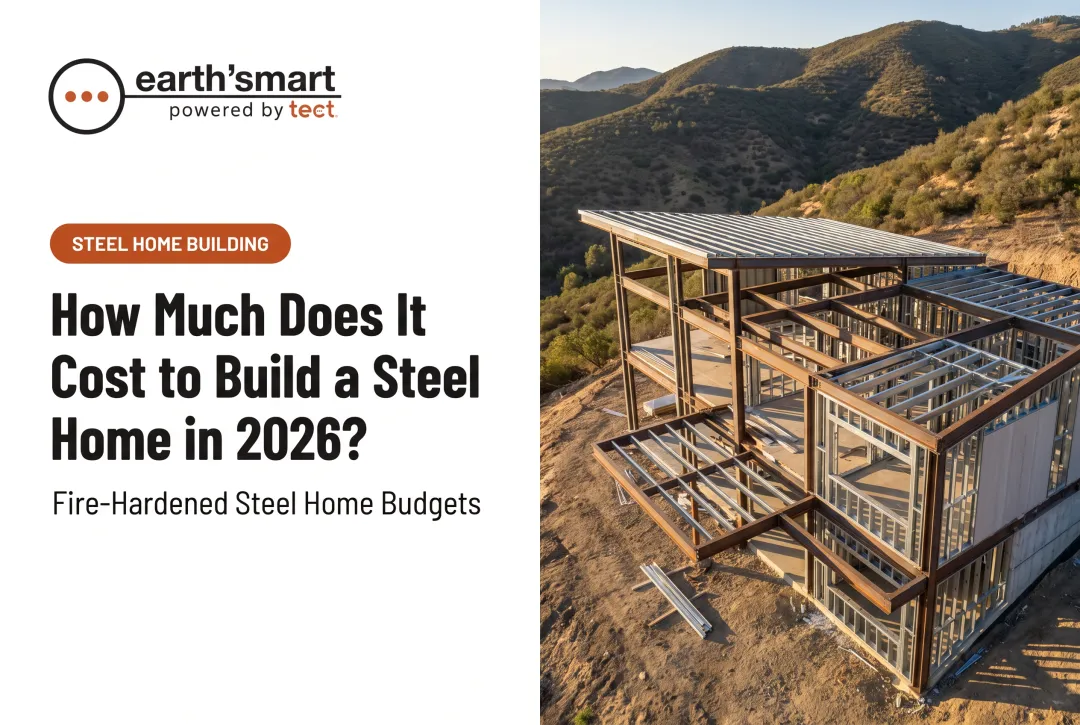
- Structural design and engineering — includes shop drawings for fabrication; this phase takes longer than wood design
- Steel fabrication — off-site or factory; once fabricated, changes are costly
- Foundation and site work — must account for steel dead loads
- Steel erection — typically fast once components arrive on site
- Envelope installation — thermal strategy, waterproofing, and cladding; must be coordinated with the steel assembly
- MEP and finish work — mechanical, electrical, plumbing, and interior finishes
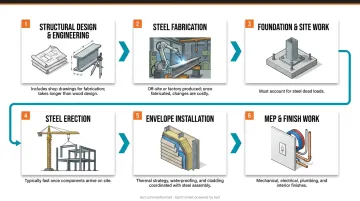
Why All Specialists Must Be Aligned Before Steel Is Ordered
The structural engineer, architect, steel fabricator, envelope consultant, and MEP designers all need to be aligned before steel is ordered. In wood construction, field adjustments are routine. In steel, a beam that's the wrong length or a connection that doesn't coordinate with the envelope system can add weeks and significant cost.
This is the core difference between steel and wood project management. Earth'smart powered by tect's Path A Turnkey model is built around this reality: coordination across all disciplines happens at the concept phase, not during construction documents or fabrication — because by then, correcting misalignments is expensive.
Timeline Expectations
A realistic range for a luxury steel frame home from design through certificate of occupancy:
- Prefabricated CFS panel systems — can compress the construction schedule meaningfully; Veev's productized system claimed 30-day builds, though that reflects a factory-production model, not custom luxury construction
- Fully custom structural steel builds — extend the timeline due to engineering, shop drawing review, and fabrication lead times
- Permitting in WUI zones — California's AB 2234 sets review time limits (30 business days for smaller projects), but fire-permit reviews and Chapter 7A compliance documentation add additional lead time
For custom steel builds in California's WUI zones, add permitting and compliance review time to your baseline schedule — it's rarely accounted for in early planning conversations.
Steel Frame vs. Wood Frame: Which Is Right for Your Luxury Home?
| Decision Dimension | Steel Frame | Wood Frame |
|---|---|---|
| Upfront cost | Higher (historically ~4%+ over wood) | Lower baseline |
| Fire resistance | Noncombustible (ASTM E136) | Combustible |
| Structural longevity | 100+ year design life; no rot, warp, or pests | Vulnerable to moisture, rot, termites |
| Long-span design | Structurally practical | Expensive workarounds |
| Floor-to-ceiling glass | Structurally enables it | Limits scale |
| Cantilevers | 20-foot cantilevers achievable | Cost-prohibitive at same scale |
| Builder availability | <0.5% of homes; limited skilled contractors | 93% of homes; widely available |
| Seismic performance | Engineered per AISI S400-20 | Standard wood framing has no equivalent seismic standard |
When Steel Is the Clear Choice
- Building in a WUI or fire-prone zone
- Located in a seismic zone
- Design requires significant open spans, cantilevers, or double-height volumes
- 50–100+ year ownership horizon with minimal maintenance is the goal
The Hybrid Approach
Full structural steel throughout is overkill for most projects. A hybrid approach uses structural steel for primary framing and load-bearing moments, with cold-formed steel (CFS) handling interior partitions and non-load-bearing walls. This captures most of steel's performance benefits while keeping costs in check — and it's the structure behind most luxury steel frame builds, including the Doulton Drive case study referenced later in this guide.
Frequently Asked Questions
Are steel frame homes more expensive?
Yes, steel frame homes typically cost more upfront than wood equivalents due to material, engineering, and labor premiums. Long-term savings in maintenance, reduced termite and rot remediation, and potential insurance reductions in fire-risk zones often narrow or eliminate the gap over the home's lifespan.
What is the lifespan of a steel frame house?
A properly engineered steel frame home can last well over 100 years. Steel does not rot, warp, or degrade from moisture or pests — making it a natural choice when a 100+ year design lifespan is the goal.
Is steel framing fire resistant?
Steel is noncombustible — it does not ignite or fuel a fire, and CFS assemblies have tested fire-resistance ratings of up to four hours under ASTM E119. At extreme temperatures, structural steel can lose strength and may require fireproofing coatings per local code requirements.
What design styles work best with steel frame luxury homes?
Steel framing is most aligned with contemporary minimalist, industrial-modern, and open-plan luxury designs featuring large spans, floor-to-ceiling glass, cantilevers, or double-height volumes. Its structural advantages are most visible in designs that push beyond what wood framing can support, though it can accommodate nearly any style.
Can a steel frame home improve my insurance rates?
In fire-risk and WUI zones, noncombustible construction may qualify for wildfire mitigation discounts — California DOI data shows discounts ranging 4%–40% for qualifying mitigation actions. Request your insurer's specific structural and envelope requirements before finalizing your design so qualifying specifications are built in from the start.
How long does it take to build a steel frame luxury home?
Luxury steel frame builds require more upfront design and engineering time than wood-frame equivalents. Prefabricated CFS panel systems can compress the construction phase; custom structural steel projects extend it. Permitting in WUI zones adds further lead time — factor this into your project schedule from the outset.