The problem is that system failures are rarely dramatic. They happen quietly: a control valve someone closed during a plumbing repair and never reopened, a sprinkler head painted over during a remodel, a pump that's been sitting idle for years. According to NFPA research, sprinklers operated in 95% of home fires large enough to activate them — but when they didn't, maintenance lapses were almost always the reason.
This guide covers why maintenance matters, the three types of maintenance involved, warning signs every homeowner should know, and a practical schedule based on NFPA 13D guidelines for one- and two-family dwellings.
Key Takeaways
- Residential sprinklers are highly reliable — but require active maintenance to perform in an emergency
- The #1 cause of system failure is a closed control valve; monthly valve checks are non-negotiable
- Maintenance has three layers: routine preventive, reactive corrective, and scheduled professional servicing
- Core tasks: monthly valve and tank checks, semi-annual waterflow tests, annual professional inspection
- For WUI homeowners, treat every NFPA 13D interval as a minimum, not a target
Why Residential Fire Suppression System Maintenance Matters
The NFPA's 2024 report on U.S. sprinkler experience is clear: when home sprinklers operate, they are effective 98% of the time, and fire is confined to the room of origin in 96% of cases. Homes with sprinklers also see an 89% lower civilian death rate and 55% lower average property loss per fire compared to homes with no automatic suppression.
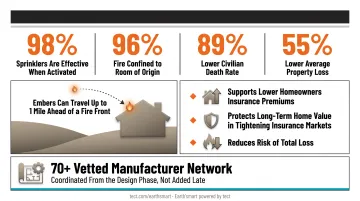
Those numbers assume the system works when it's needed. For homeowners in WUI areas — where burning embers can travel up to a mile ahead of a fire front and structure-to-structure spread can accelerate losses rapidly — a suppression system that fails silently is worse than no system at all. It creates false confidence.
Beyond life safety, the financial case is real:
- A functioning, maintained system supports lower homeowners insurance premiums (more on this in the FAQ)
- It protects long-term home value, particularly in markets where insurers are tightening coverage in high-risk zones
- It reduces the risk of total loss in the event of a fire
Protecting that investment starts at the design phase. For homeowners building or rebuilding in California's fire-risk zones, integrating suppression systems early — alongside structural and mechanical systems, not added late — produces documentation that is component-specific rather than generic.
Earth'smart powered by tect's Earth'smart™ approach does exactly this: through the earth'smart powered by tectApp™ community of 70+ vetted manufacturers, fire suppression components are specified and coordinated at the design phase, so homeowners have the right ITM protocols for their exact installed system from day one.
Types of Residential Fire Suppression System Maintenance
Residential fire suppression maintenance works in layers: homeowner habits, periodic DIY checks, and professional servicing. Each layer handles what the others can't.
Routine Preventive Maintenance
This is the foundation. Most homeowners can handle it in a few minutes per month, and it costs nothing beyond their time.
Monthly routine tasks include:
- Visually confirm all control valves are fully open
- Check water storage tanks (if present) to confirm they're at full capacity
- Test pumps (if present) to confirm they start without tripping circuit breakers
- Walk the home and visually inspect sprinkler heads, hangers, and visible piping for obstruction, corrosion, paint, or physical damage
For homeowners on municipal water supply with no pump and a well-integrated system, routine preventive maintenance covers most of what the system needs to stay reliable. There's no direct cost — just consistent attention.
Corrective Reactive Maintenance
Corrective maintenance is triggered by a problem: a failed flow test, a discovered closed valve, a painted or damaged sprinkler head, a pump that won't start, or visible piping corrosion.
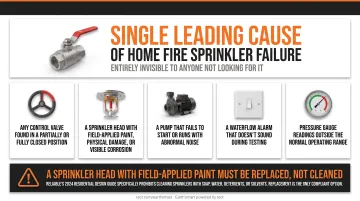
The risk with a purely reactive approach is that residential systems can go years without revealing a hidden failure. A partially closed valve doesn't announce itself. Corrosion builds gradually. The NFSA identifies a closed control valve as the single leading cause of home fire sprinkler failure — and it's entirely invisible to anyone not looking for it.
What triggers corrective action:
- Any control valve found in a partially or fully closed position
- A sprinkler head with field-applied paint, physical damage, or visible corrosion
- A pump that fails to start or runs with abnormal noise
- A waterflow alarm that doesn't sound during testing
- Pressure gauge readings outside the normal operating range
One important rule on painted heads: per NFPA 25 guidance, a sprinkler head with field-applied paint must be replaced, not cleaned. Paint cannot be safely removed without risking damage to the heat-sensitive element, and Reliable's 2024 Residential Design Guide specifically prohibits cleaning sprinklers with soap, water, detergents, or solvents. Replacement is the only compliant option.
Professional and Overhaul Maintenance
Some tasks require a licensed fire sprinkler contractor. Annual professional inspections go beyond what any DIY visual check can achieve — covering internal piping assessment, pressure readings, waterflow device testing, and full system functionality review.
Deeper overhaul servicing is specifically warranted when:
- The home changes ownership (NFPA 13D calls for inspection by a qualified individual at transfer)
- A fire event has occurred, even if the system didn't activate
- Renovations may have affected piping, valves, or water supply
- The system hasn't had professional review in several years
- Internal piping shows signs of scale, mineral buildup, or corrosion (NFPA 25 recommends a full obstruction investigation every five years)
Systems with pumps, tanks, or dedicated on-site water supply carry additional servicing requirements beyond a standard municipal-supply setup. This applies to configurations like the integrated vapor dome and FIREBOZZ® water cannon systems that earth'smart powered by tect engineers for WUI residences.
These configurations involve pump testing protocols, tank maintenance, and coordination across multiple suppression components. A licensed contractor familiar with the full installed system should always lead that review.
Warning Signs Your System Needs Maintenance
Catch small problems before they become system-level failures. Here's what to look for.
Visible Physical Signs
Sprinkler head issues:
- Heads with paint applied after installation (any color, any amount)
- Visible corrosion, pitting, or rust on the deflector or frame
- Dust, debris, or spider webs loading the head
- Physical bending, impact damage, or a misaligned deflector
- Decorations, wires, or objects attached to or hanging from heads
- Concealed cover plates that have been painted over or are misaligned
Piping and fitting issues:
- Water stains or mineral deposits near pipe joints or fittings
- Visible rust or corrosion along exposed pipe
- Missing or improperly seated escutcheon plates and trim rings
A painted sprinkler head is a code violation under NFPA 25. Regardless of how minor the paint application appears, the head must be replaced by a licensed contractor.
Operational and Performance Warning Signs
Most of these surface during monthly or semi-annual testing:
- A pump that fails to start, trips the circuit breaker, or runs with unusual noise
- A waterflow alarm that doesn't activate during semi-annual testing
- Pressure gauge readings consistently above or below the system's normal operating range
- A control valve that is stiff, partially closed, or shows corrosion when exercised through its full range of motion
System-Specific Indicators
Beyond general performance signs, certain system types have their own failure indicators:
- A storage tank consistently below full capacity — this points to a leak or supply feed problem, not normal evaporation
- A backflow preventer showing signs of leakage or pressure loss
- Any post-renovation situation where you can't visually confirm a valve's open position
Plumbers and contractors inadvertently close valves during work and don't always reopen them. After any renovation near your system, verify valve positions before assuming the system is ready.
Residential Fire Suppression System Maintenance Schedule
Maintenance frequency for NFPA 13D systems — governing one- and two-family dwellings — varies by system type. Municipal-supply-only homes have fewer moving parts to check. Systems with pumps and storage tanks carry additional monthly tasks. For homeowners in high-fire-risk zones, these are minimum intervals.
| Frequency | Task |
|---|---|
| Monthly | Inspect all control valves — confirm fully open |
| Monthly | Check water storage tanks (if present) — confirm at full capacity |
| Monthly | Test pumps (if present) — confirm proper start without tripping circuit breakers |
| Monthly | Visual inspection of sprinkler heads, hangers, and visible piping for damage or obstruction |
| Every 6 months | Test all waterflow devices — notify monitoring service before testing |
| Every 6 months | Conduct a flow test |
| Every 6 months | Extended visual inspection of all sprinkler heads, hangers, and accessible piping — including areas not reachable during monthly checks |
| Annually | Operate control valves through full range of motion; return to open position |
| Annually | Test connection downstream of any pressure-reducing or pressure-regulating valve |
| Annually | Schedule professional inspection with a licensed fire sprinkler contractor |
| Every 5 years | Internal piping assessment for obstructions (scale, mineral buildup, foreign material) — requires a licensed contractor |
| At change of ownership | Inspection by a qualified individual, regardless of prior inspection history |
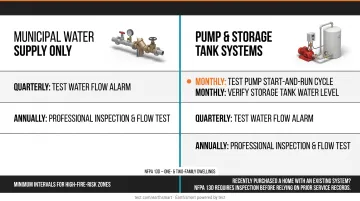
If you've recently purchased a home with an existing sprinkler system, NFPA 13D requires an inspection before you rely on any prior service records. The maintenance history may be incomplete or entirely unknown — don't assume otherwise.
Conclusion
A residential fire suppression system that isn't maintained is a system you can't trust. For homeowners in California's WUI communities — where the distance between a controlled situation and a total loss can be measured in minutes — that gap in reliability is unacceptable.
A structured plan aligned with NFPA 13D guidance doesn't require much: monthly valve and tank checks that take a few minutes, semi-annual flow testing, and a professional inspection once a year. These aren't burdensome tasks. Consistent maintenance is what keeps a properly specified system working the way it was designed to — not just at installation, but years down the road.
That discipline matters most when a home is built to last well beyond the typical replacement cycle. For Earth'smart™ projects — where earth'smart powered by tect integrates fire-resistive structure, non-combustible materials, and on-site suppression into a single coordinated system — the maintenance foundation is part of what makes the long-term performance promise real.
A well-coordinated system, specified correctly from the design phase with direct manufacturer input, gives homeowners both the right equipment and the right protocols to keep it working for generations.
Frequently Asked Questions
How often should a residential fire suppression system be serviced?
NFPA 13D calls for monthly homeowner inspections of valves, tanks, and pumps; semi-annual waterflow device testing; and an annual professional inspection by a licensed fire sprinkler contractor. Internal piping assessments for obstruction and corrosion are recommended every five years under NFPA 25 general guidance for water-based systems.
How do you maintain a residential fire suppression system?
Monthly, confirm control valves are fully open, check storage tank levels, test pumps, and visually inspect sprinkler heads for damage or obstruction. Semi-annually, test waterflow devices. Each year, schedule a licensed contractor to cover pressure testing, valve operation, and full system functionality.
What is the 3 times rule for sprinklers?
Verified NFPA guidance requires selecting sprinkler heads based on maximum ambient ceiling temperature — not a "3 times" formula, which has no formal NFPA basis. Ordinary-rated heads (135°F–170°F) suit locations where ceiling temps stay below 100°F; intermediate-rated heads (175°F–225°F) apply where temps reach up to 150°F. Heads near skylights, attics, or cooking areas should be evaluated against these limits.
What happens if you don't maintain your fire sprinkler system?
The most common failure is a closed or partially closed control valve going undetected — rendering the system useless during a fire. Painted, corroded, or obstructed sprinkler heads and internal pipe blockages carry the same risk, and none of these problems are visible without regular inspection.
Can homeowners inspect their own fire sprinkler system?
Most monthly tasks — valve checks, visual inspections, tank level checks, and pump testing — are designed for homeowners to perform. However, waterflow device testing, internal piping assessments, pressure readings, and full system functionality reviews require a licensed fire sprinkler contractor.
Does maintaining a fire sprinkler system affect homeowners insurance?
USFA data indicates that home fire sprinklers can reduce homeowners insurance premiums by 5% to 15%, with some insurers offering discounts up to 20% for combined alarm and sprinkler systems. In high-risk California WUI markets where coverage is increasingly difficult to secure, a maintained suppression system paired with thorough documentation can strengthen your case for continued coverage.